Compressing a large language model feels like winning the lottery. You slash memory usage by half, cut inference costs, and suddenly your app runs on a laptop instead of a data center. But then you run the benchmarks. The perplexity spikes. The model starts hallucinating facts it knew yesterday. It forgets how to write code or summarize text correctly. This is the brutal trade-off of model compression: without careful repair, you don’t just lose efficiency; you lose intelligence.
The old advice was simple but expensive: if you prune or quantize a model, you must fully retrain it from scratch to fix the damage. That approach works, but it eats up compute budgets that most teams simply do not have. Fortunately, recent research from 2024 and 2025 has shifted the narrative. We now know that "retraining" doesn't always mean a full, costly backpropagation pass through every parameter. Instead, we have a toolbox of targeted, efficient methods to restore lost accuracy-sometimes even exceeding the original model’s performance-without breaking the bank.
Why Compression Breaks Your Model
To fix the problem, you first need to understand why it happens. When you compress an LLM, you are fundamentally altering the mathematical function the network learned during its initial training. There are two main ways this goes wrong.
First, consider weight pruning. This involves removing connections (weights) deemed less important to reduce the model's size. If you delete these weights naively, you disrupt the delicate balance of signals flowing through the attention and MLP (Multi-Layer Perceptron) blocks. The remaining weights are no longer calibrated for the new sparse structure, leading to a sharp drop in zero-shot accuracy.
Second, there is low-bit quantization. This reduces the precision of numbers used in calculations, for example, moving from 16-bit floating point (FP16) to 4-bit integers (INT4). While this shrinks the model significantly, it introduces "quantization noise." Small errors in each layer accumulate as data passes through the network. A 2025 study by Apple Machine Learning Research highlighted that this noise disproportionately affects knowledge-intensive tasks. The model might still speak fluent English, but it loses access to specific factual details, effectively "forgetting" information it previously held.
The "Free Lunch": Local Reconstruction After Pruning
If you are using pruning, you might be tempted to skip the recovery step because full retraining is too slow. However, a pivotal 2025 paper titled "A Free Lunch in LLM Compression" offers a compelling alternative: local reconstruction.
Traditional approaches often treated the entire model as a single unit for retraining. The new research shows that you can achieve better results by treating each transformer block independently. By reconstructing the remaining weights within specific components-such as the attention heads and MLP layers separately-you can restore performance more efficiently than global fine-tuning.
Here is why this matters:
- Efficiency: Local reconstruction requires far less memory and compute than end-to-end retraining.
- Performance: In many cases, this method matches or exceeds the accuracy of the uncompressed baseline.
- Simplicity: It works well even with simpler pruning criteria like Wanda (Weight and Activation Aware pruning), meaning you don't need complex sparsification algorithms to get good results.
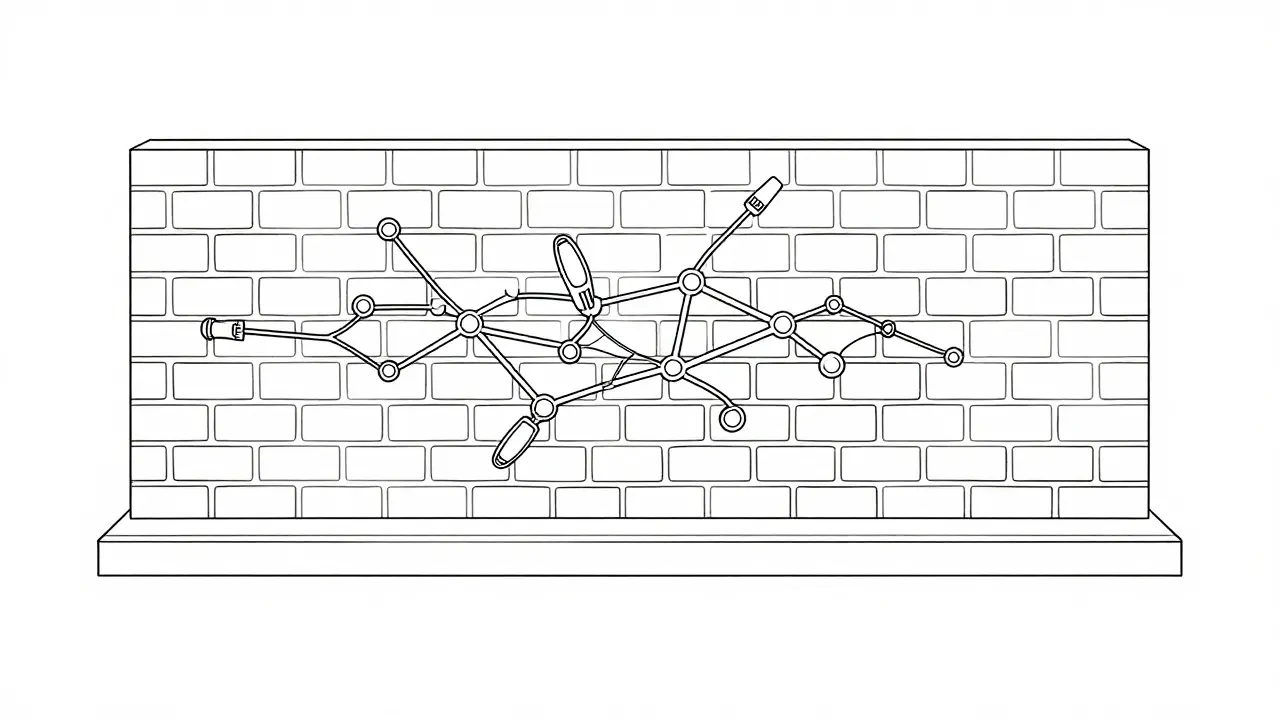
Think of it like repairing a wall. Instead of rebuilding the entire house (full retraining), you patch the specific holes where bricks were removed (local reconstruction). The result is structurally sound and looks just as good, but it takes a fraction of the time.
Fixing Quantization Errors Without Full Retraining
Quantization is trickier because the error isn't just about missing weights; it's about numerical precision. The APXML course module on "Accuracy Recovery for Low-Bit Quantized LLMs" outlines a hierarchy of fixes, ranging from free adjustments to more intensive training.
1. Better Calibration Data The most common mistake is using poor calibration data. Methods like GPTQ or AWQ rely on a small dataset to estimate how activations behave. If your calibration set doesn't match your target workload (e.g., using general web text to calibrate a medical model), the quantization will fail. Use larger, representative datasets. Adaptive calibration strategies that iteratively adjust scaling factors can close significant accuracy gaps without any training at all.
2. Post-Quantization Fine-Tuning If calibration isn't enough, try short fine-tuning. Unlike full Quantization-Aware Training (QAT), which inserts quantization operators during the entire training process, post-quantization fine-tuning takes an already quantized model and trains it for a few hundred or thousand steps. This allows the parameters to adapt to the quantization noise. It is significantly cheaper than QAT and recovers substantial accuracy for 4-bit models.
3. Mixed-Precision Strategies Not all parts of a model are equally sensitive to low precision. Some layers, like certain attention projections or normalization layers, degrade quickly when compressed to INT4. A mixed-precision approach keeps these sensitive layers at higher precision (like INT8 or FP16) while aggressively compressing the bulk of the linear layers. This balances speed gains with accuracy retention.
EoRA: Compensation Without Gradients
What if you want to avoid gradient-based training entirely? NVIDIA Research introduced Eigenspace Low-Rank Approximation (EoRA) in 2024 as a breakthrough solution. EoRA reframes compression not as a loss to be fixed by retraining, but as an error to be compensated.
EoRA adds residual low-rank paths to the compressed model. These paths approximate the compression error ($\Delta W$) in eigenspace. Essentially, it learns a lightweight correction matrix that sits on top of the compressed weights. Because it uses low-rank approximation, it requires minimal computation. According to NVIDIA, EoRA can recover performance within minutes using very little calibration data, outperforming older SVD-based methods.
This is particularly powerful for production environments where you cannot afford the latency or complexity of fine-tuning pipelines. You compress the model, apply EoRA, and deploy. The model retains its small footprint but regains its accuracy.
Prompt-Based Recovery: Is Knowledge Really Lost?
Perhaps the most intriguing finding comes from Apple’s 2025 study, "Do Compressed LLMs Forget Knowledge?" The researchers asked whether compression erases knowledge permanently or merely displaces it internally. Their experiments suggest the latter.
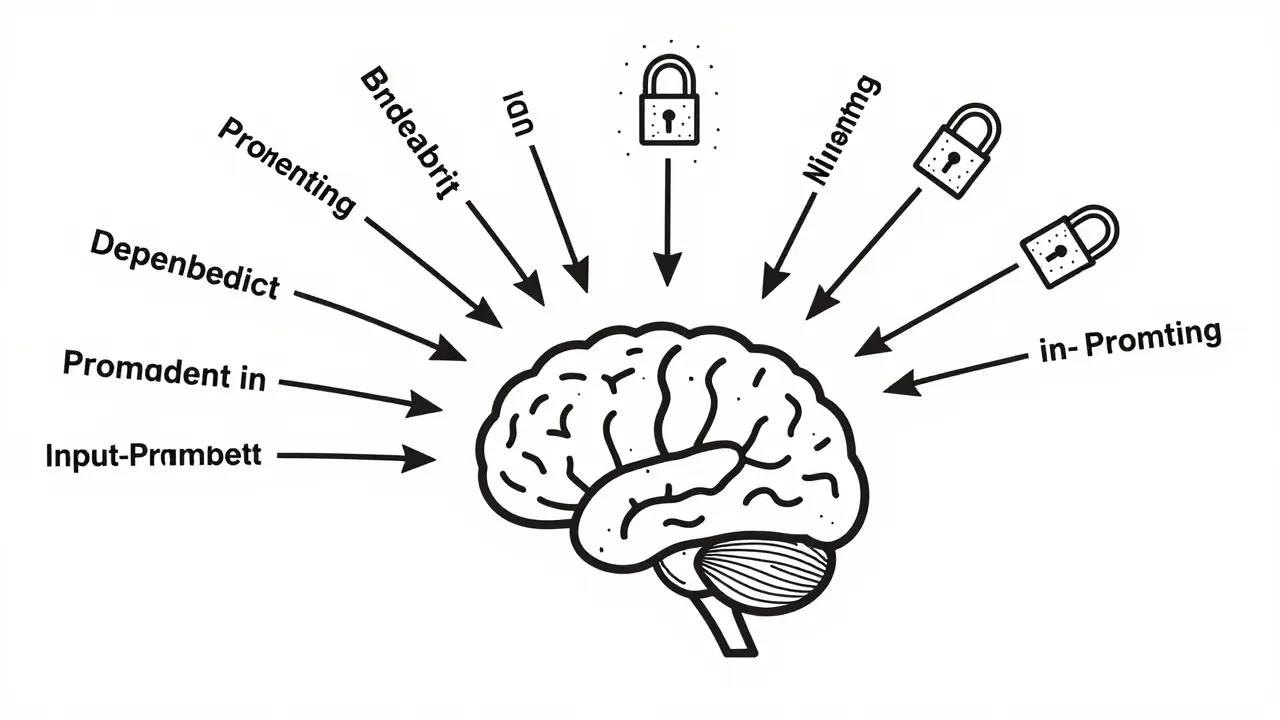
They developed a technique called Input-Dependent Prompting (IDP). Instead of retraining the model’s parameters (like LoRA does), IDP modifies the input prompts to redirect the model’s attention to displaced knowledge. In their tests, IDP matched or surpassed LoRA-based retraining on knowledge-intensive tasks while saving 21x in extra parameter size and reducing inference latency by 60%.
This implies that for many applications, you might not need to touch the model weights at all. By engineering smarter prompts or integrating retrieval-augmented generation (RAG) techniques, you can reactivate the knowledge that compression buried. This shifts the burden from heavy computational retraining to clever prompt design.
| Technique | Best For | Compute Cost | Accuracy Recovery |
|---|---|---|---|
| Local Reconstruction | Pruned Models | Low-Medium | High (Matches Baseline) |
| Post-QT Fine-Tuning | 4-Bit Quantized Models | Medium | High |
| EoRA Compensation | Aggressive Pruning/Quantization | Very Low | Medium-High |
| IDP Prompting | Knowledge-Intensive Tasks | Negligible | Medium (Task Specific) |
| Full QAT | Sub-4-Bit (INT3/INT2) | Very High | Highest |
Choosing the Right Strategy
There is no one-size-fits-all solution. Your choice depends on your constraints and goals.
If you are deploying a heavily pruned model and have limited compute, start with local reconstruction. It offers the best trade-off between cost and accuracy restoration. If you are working with 4-bit quantized models, ensure your calibration data is robust before attempting any fine-tuning. Only move to post-quantization fine-tuning if calibration fails to meet your accuracy thresholds.
For teams looking to minimize operational complexity, explore EoRA. Its ability to compensate for errors without gradients makes it ideal for rapid iteration. Meanwhile, if your primary concern is factual recall on specific domains, test IDP prompting first. It might save you weeks of training time by leveraging existing knowledge rather than trying to force the model to relearn it.
Remember, compression is no longer a dead end. With these modern recovery techniques, you can maintain high performance while enjoying the efficiency benefits of smaller, faster models. The key is to treat recovery as an integral part of the compression pipeline, not an afterthought.
Does pruning always require retraining?
Not necessarily. While naive pruning causes accuracy drops, techniques like local reconstruction or using advanced pruning criteria like Wanda can minimize the need for extensive retraining. However, some form of weight adjustment or compensation is usually required to restore optimal performance.
What is the difference between PTQ and QAT?
Post-Training Quantization (PTQ) converts a trained model to lower precision without further training, relying on calibration data. Quantization-Aware Training (QAT) simulates quantization errors during the training process itself, allowing the model to learn to tolerate them. QAT generally yields higher accuracy but is much more computationally expensive.
Can I use EoRA with both pruning and quantization?
Yes. EoRA is designed to be compatible with various compression techniques, including combined pruning and quantization. It adds residual low-rank paths to compensate for errors regardless of the specific compression format used.
Is Input-Dependent Prompting (IDP) effective for all tasks?
IDP is particularly effective for knowledge-intensive tasks where the model needs to retrieve specific facts. It may be less effective for creative generation or reasoning tasks that rely heavily on the model's internal structural coherence rather than stored knowledge.
How much accuracy can I expect to recover with local reconstruction?
Recent studies indicate that local reconstruction can fully restore, and sometimes even exceed, the original model's perplexity and zero-shot accuracy. It is often more resource-efficient than full end-to-end retraining while achieving comparable or better results.
 Artificial Intelligence