You’ve probably been there. You ask a chatbot a specific question about recent legal changes or niche medical data, and it answers with the confidence of a tenured professor. The problem? It’s completely wrong. This is hallucination, the bane of modern generative AI. But what if the model just admitted it didn’t know? That’s where abstention policies come in.
An abstention policy is a set of rules or mechanisms that allow a generative AI model to decline answering a query when its confidence level falls below a certain threshold. Instead of forcing an answer, the system says "I don't know" or asks for clarification. This isn't just a nice-to-have feature; it's a critical safety layer. Without it, you’re gambling with accuracy every time you hit send.
Why Silence Is Better Than Wrong Answers
We tend to think of AI as an oracle. If it speaks, we assume it knows. But large language models (LLMs) are probabilistic engines, not truth machines. They predict the next most likely word based on training data. When the probability distribution is flat-meaning several words are equally likely-the model is essentially guessing. Forcing a guess leads to errors that can be costly in fields like healthcare, law, or finance.
Think of it like asking a friend who studied for a test versus one who didn’t. The prepared friend gives you the right answer. The unprepared friend might give you a confident but wrong answer just to avoid silence. Abstention policies teach the AI to recognize when it’s the unprepared friend. By allowing the model to stay silent, we reduce the risk of spreading misinformation. In high-stakes environments, a "no answer" is infinitely better than a misleading fact.
The Mechanics of Uncertainty
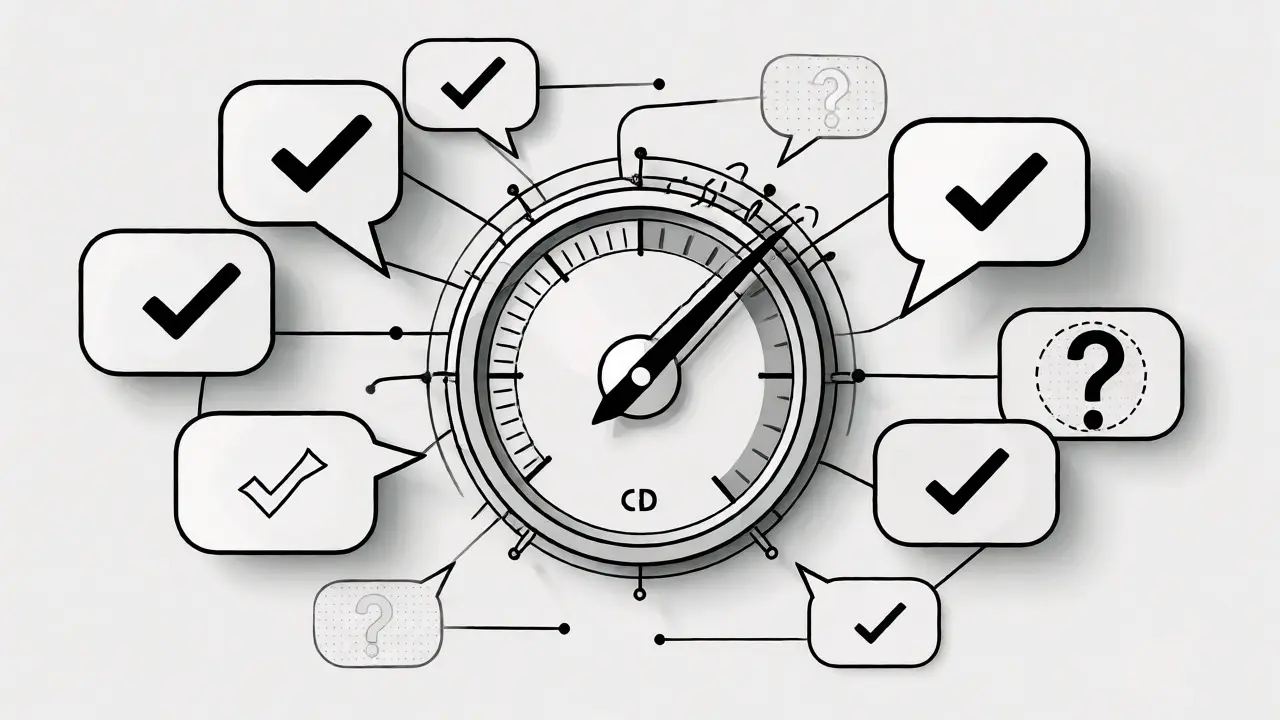
How does a model actually know it doesn’t know? It comes down to confidence calibration. This is the process of ensuring that when a model says it is 90% sure, it is correct 90% of the time. Many standard LLMs are poorly calibrated; they often claim 99% certainty while being wrong half the time.
To fix this, developers use several techniques:
- Token Probability Analysis: The model looks at the likelihood of each generated token. If the top choice isn't significantly more probable than the second choice, the system flags low confidence.
- Self-Consistency Checks: The model generates multiple answers to the same prompt using different sampling methods. If these answers contradict each other, the model abstains.
- Retrieval-Augmented Generation (RAG) Signals: In systems that pull data from external databases, if the retrieved documents don't contain relevant information, the model is instructed to state that no evidence was found rather than inventing facts.
These methods turn vague intuition into measurable metrics. Instead of relying on a gut feeling, the system uses mathematical thresholds to decide whether to speak up or shut up.
Designing Effective Abstention Strategies
Not all abstentions are created equal. A blunt approach might make the AI too shy, refusing to answer even simple questions. A nuanced strategy balances coverage (how many questions it answers) with precision (how accurate those answers are). Here is how leading tech companies approach this challenge:
| Approach | Mechanism | Pros | Cons |
|---|---|---|---|
| Threshold-Based | Sets a fixed confidence score limit (e.g., < 0.8). | Simple to implement and understand. | Hard to tune for diverse topics; may over-abstain on complex queries. |
| Ensemble Voting | Runs multiple model instances; abstains if votes split. | Robust against single-model quirks. | Computationally expensive and slower response times. |
| Uncertainty Estimation | Uses Bayesian networks or dropout during inference to measure variance. | Provides a probabilistic view of knowledge gaps. | Technically complex to integrate into production pipelines. |
| Human-in-the-Loop | Flags low-confidence responses for human review. | Highest accuracy for critical tasks. | Doesn't scale well; requires human resources. |
Most modern systems combine these. For instance, a customer service bot might use threshold-based checks for general FAQs but switch to ensemble voting for technical troubleshooting steps. This hybrid approach ensures efficiency without sacrificing reliability.
Real-World Implications and Risks
Ignoring abstention policies creates real-world liabilities. Imagine a medical assistant AI suggesting a drug interaction that doesn't exist because it hallucinated a connection between two unrelated chemical structures. Or a legal bot citing a case law precedent that was overturned years ago. These aren't just annoying glitches; they're potential lawsuits.
Conversely, overly aggressive abstention can frustrate users. If your AI assistant refuses to answer basic trivia or common sense questions because its confidence threshold is set too high, users will perceive it as broken or unintelligent. The goal is to find the sweet spot where the model admits ignorance only when it truly matters.
Consider the difference between a general chatbot and a specialized domain expert. A general chatbot might need looser abstention rules because users expect creativity and broad knowledge. A financial advisor bot needs strict rules because accuracy is non-negotiable. Your abstention policy must align with your specific use case and risk tolerance.

Implementing Your Own Policy
If you’re building or deploying an AI solution, you can’t just rely on the default behavior of the underlying model. You need to define your own policy. Start by categorizing your queries. Which ones are high-risk? Which ones are low-stakes?
- Audit Your Data: Run your model against a benchmark dataset where you know the ground truth. Measure how often it hallucinates when confidence is low.
- Set Thresholds: Determine the minimum confidence score required for an answer to be published. Start conservative and relax it as you gather more data.
- Define Fallback Behavior: What happens when the model abstains? Does it say "I'm not sure," does it search the web, or does it escalate to a human agent? Make sure the fallback is helpful, not dead-end.
- Monitor Drift: Model performance changes over time. Regularly re-evaluate your abstention rates to ensure they remain effective as new data enters the system.
This isn't a one-time setup. It’s an ongoing tuning process. As your user base grows and their questions become more diverse, your policy needs to adapt. Keep logs of every abstention event. Analyze why the model stayed silent. Was it truly uncertain, or was it confused by ambiguous phrasing? This feedback loop is crucial for improvement.
The Future of Honest AI
The industry is moving toward more transparent AI. Researchers are increasingly focusing on explainability and the ability of AI systems to articulate the basis for their decisions and uncertainties. We are seeing the rise of models specifically trained to detect their own limitations, such as those developed by Anthropic with their Constitutional AI framework, which explicitly trains models to reject false premises.
As AI becomes embedded in critical infrastructure-from autonomous vehicles to diagnostic tools-the expectation shifts from "give me an answer" to "give me a reliable answer." Abstention policies are the bridge between raw computational power and trustworthy intelligence. They transform AI from a flashy demo into a dependable tool.
What is the main benefit of an abstention policy?
The primary benefit is reducing hallucinations. By allowing the model to decline answering when uncertain, you prevent the spread of incorrect information, which is crucial for maintaining user trust and avoiding liability in sensitive sectors.
How do I determine the right confidence threshold?
There is no universal number. You should start by testing your model on a validation set with known correct answers. Plot the relationship between confidence scores and actual accuracy. Choose a threshold where the trade-off between coverage (number of answered questions) and precision (accuracy of those answers) meets your business requirements.
Does abstention slow down the AI?
It depends on the method. Simple threshold checks add negligible latency. However, methods like ensemble voting or running multiple self-consistency checks require additional computational steps, which can increase response time. Optimizing for speed vs. accuracy is a key part of implementation.
Can users tell when the AI is abstaining?
Yes, and they should. Good UX design makes abstention clear. Instead of a generic error message, the AI should say something like, "I don't have enough information to answer that confidently," or "I'm not sure about that specific detail." This transparency builds trust.
Are abstention policies applicable to all types of AI?
They are most critical for generative models like LLMs that produce text or code. For predictive models that output probabilities (like spam filters), the concept exists but is handled differently, usually through decision boundaries rather than explicit verbal abstention.
 Artificial Intelligence