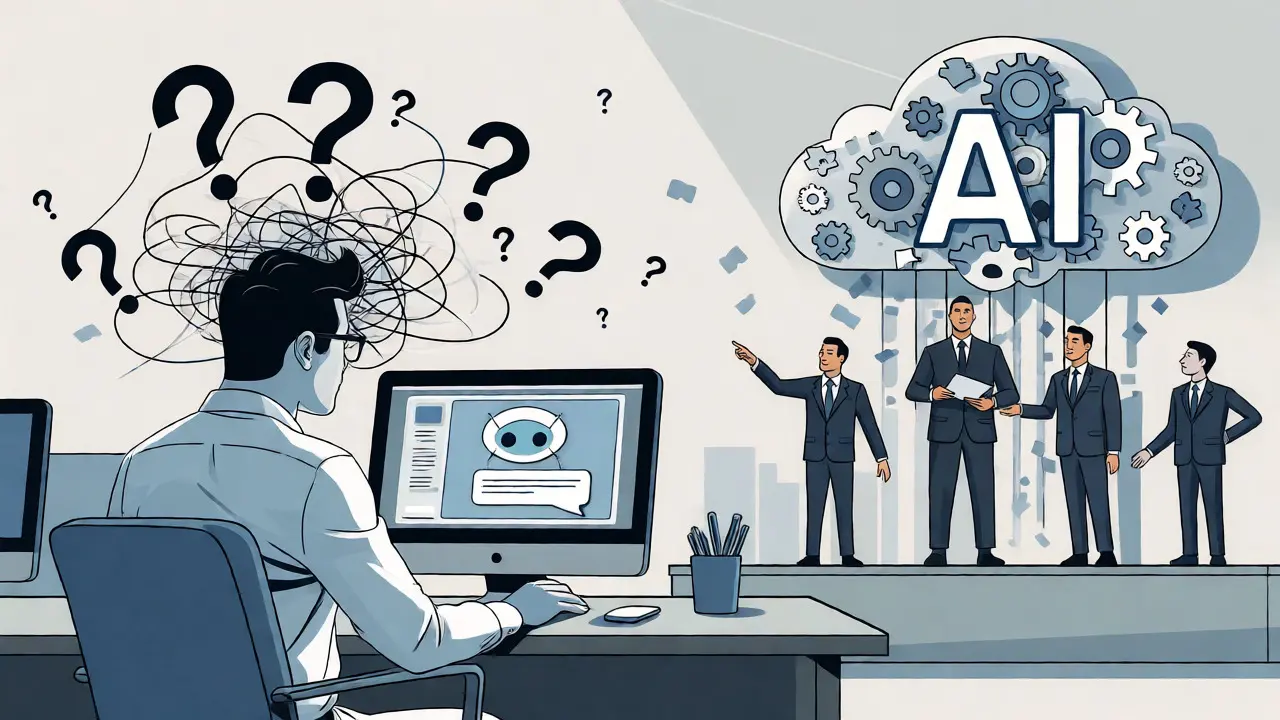
You just bought the enterprise license. The C-suite is buzzing. But six months later, your marketing team is still pasting text into a free chatbot window, and legal is terrified of a data leak. Sound familiar? Here’s the hard truth: Generative AI doesn’t fail because the tech is bad. It fails because companies treat it like a software update instead of a cultural shift.
Traditional change management-think linear rollouts and rigid training manuals-breaks down when you’re dealing with tools that evolve weekly. You can’t script a rollout for something that changes its own rules. If you want to survive the GenAI wave, you need a new playbook. One that balances speed with safety, and experimentation with strict governance. Let’s look at how to actually make this stick.
Why Old Playbooks Don’t Work
Most organizations try to apply waterfall methodologies to AI. They define requirements, build a solution, deploy it, and hope for the best. This works for ERP systems. It fails miserably for Generative AI, which is a class of artificial intelligence models capable of generating novel content such as text, images, and code based on probabilistic patterns rather than deterministic rules. The technology moves too fast. By the time you finish your 12-month implementation plan, the model has been updated three times, and user expectations have shifted entirely.
The core challenge isn’t technical; it’s human. Employees don’t resist AI because they hate innovation. They resist it because they fear replacement or irrelevance. When leadership pushes AI without explaining the "why," teams perceive it as disruption, not progress. You need to shift from a mindset of "implementation" to one of "adaptation." This means embracing uncertainty and treating every deployment as a learning sprint, not a final destination.
Defining Vision and High-Visibility Wins
Before you touch a single line of prompt engineering, ask yourself: What specific problem are we solving? "Adopting AI" is not a strategy. It’s a buzzword. Successful adoption ties directly to measurable business outcomes. Are you trying to reduce customer service response times by 20%? Cut coding boilerplate in half? Improve proposal drafting speed?
Start small. Identify high-visibility wins. These are projects where the value is obvious, the risk is low, and the impact is felt quickly. For example, using AI to summarize meeting notes or draft initial email responses. These tasks are tedious but low-stakes. Success here builds confidence. It shows employees that AI is a tool to remove drudgery, not a threat to their jobs.
- Identify Pain Points: Look for repetitive, text-heavy tasks that drain employee energy.
- Set Clear Metrics: Define what success looks like before you start. Is it time saved? Quality improved? Cost reduced?
- Celebrate Early Wins: Publicly recognize teams who use AI effectively. This creates social proof and encourages others to jump in.
Don’t try to boil the ocean. Trying to transform every department simultaneously leads to chaos and wasted budget. Focus on a few pilot groups. Prove the value there. Then scale.
The Role of Change Champions
Top-down mandates rarely work well with creative tools. People ignore directives they didn’t help create. That’s why you need Change Champions. These are individuals who speak both business language and technical jargon. They aren’t necessarily IT staff or executives. They are curious early adopters within operational teams who have mastered the basics of prompting and workflow integration.
These champions act as bridges. They translate executive goals into practical workflows for their peers. More importantly, they provide peer-to-peer support. When a junior marketer struggles with a prompt, they’re more likely to ask a colleague than submit an IT ticket. Empower these champions. Give them time to experiment. Encourage them to lead informal practice groups. And crucially, have leaders visibly use AI themselves. If the CEO uses an AI assistant to prep for board meetings, it signals that this is part of the job, not an optional extra.

Training That Builds Confidence, Not Just Skills
Standard training sessions often miss the mark. Watching a webinar on "What is LLM?" doesn’t teach someone how to write a good prompt. Training needs to be hands-on, iterative, and safe. Employees need a sandbox environment where they can fail without consequence.
Focus on upskilling, not just tool usage. Teach critical thinking. How do you verify AI output? How do you spot hallucinations? How do you refine a prompt to get better results? This is about building a beginner’s mentality across the organization. Everyone, from interns to VPs, should feel comfortable experimenting. Provide clear documentation, but also foster community resources. Internal wikis, Slack channels, or regular lunch-and-learns where users share successful prompts and common pitfalls.
| Feature | Traditional Tech Training | GenAI Enablement |
|---|---|---|
| Content Stability | Static features, rarely change | Rapid evolution, frequent updates |
| Learning Style | Passive consumption (videos/manuals) | Active experimentation and iteration |
| Support Model | Tiered IT Helpdesk | Peer-to-peer communities and champions |
| Success Metric | Completion rate of course | Usage frequency and quality of output |
Governance Without Stifling Innovation
Governance gets a bad rap. People hear "compliance" and think "bureaucracy." But with GenAI, governance is your seatbelt. It protects you from data leaks, copyright issues, and reputational damage. The goal isn’t to stop people from using AI. It’s to keep them safe while they explore.
Establish an AI oversight committee. Include representatives from Legal, IT, Security, and key business units. Their job isn’t to approve every prompt. It’s to set guardrails. Define acceptable use policies clearly. What data can go into public models? What stays in private instances? Who owns the output?
Implement human-in-the-loop checkpoints. Never let AI make final decisions on critical outputs without review. Automate risk assessments where possible. Use tools that scan for sensitive data leakage before content leaves the company firewall. Remember, governance should be adaptive. As the technology matures and risks become clearer, adjust your policies. Rigid rules set in stone today will be obsolete next quarter.

Building Feedback Loops and Culture
You won’t know if your strategy is working unless you listen. Implement continuous feedback loops. Don’t wait for annual reviews. Use pulse surveys, focus groups, and direct observation. Ask simple questions: What’s frustrating you? Where does the AI fail? What’s one thing you’d love to automate?
Culture eats strategy for breakfast. Foster a culture of transparency. Admit when things go wrong. Share lessons learned openly. Celebrate curiosity, not just perfection. If an employee tries a new AI workflow and it fails, praise the attempt. This reduces fear and encourages further experimentation.
Finally, remember that adaptation is ongoing. The competitive advantage lies not in having the best AI model, but in how quickly your organization can learn and pivot. Build resilience by keeping communication open and multi-channel. Tailor messages to different roles. Executives care about ROI; developers care about API limits; marketers care about brand voice. Speak their language.
Frequently Asked Questions
How long does it take to see ROI from Generative AI adoption?
It varies, but most organizations see initial efficiency gains in high-volume, low-complexity tasks within 3-6 months. Significant strategic ROI, such as new product development or major cost restructuring, typically takes 12-18 months as workflows mature and employees become proficient.
Do we need a dedicated AI team for governance?
Not initially. Start with a cross-functional steering committee including IT, Legal, and Business Leads. As adoption scales, you may need a dedicated Center of Excellence (CoE) to manage vendor relationships, monitor model performance, and enforce compliance standards consistently across departments.
How do we handle employee resistance to AI?
Address fears directly by focusing on augmentation, not replacement. Show how AI removes mundane tasks. Involve resistant employees in pilot programs so they feel ownership. Provide ample training and emphasize that proficiency with AI will be a key career skill, making them more valuable, not less.
What is the biggest risk in GenAI adoption?
The biggest risk is unmanaged data leakage and hallucination. Employees pasting sensitive client data into public chatbots or accepting incorrect AI-generated facts without verification can lead to security breaches and reputational damage. Strict governance and human-in-the-loop reviews mitigate this.
Should we build custom AI solutions or buy off-the-shelf tools?
For most businesses, buying off-the-shelf tools integrated into existing workflows (like Microsoft Copilot or Google Workspace) is faster and lower risk. Build custom solutions only when you have unique data advantages or specific competitive needs that generic tools cannot address.
 Artificial Intelligence