

You type a prompt into an AI tool. You describe the feature you need. The code appears. It works. This is "vibe coding," and it is changing how we build software at breakneck speed. But here is the catch: when your application grows from a single script to a sprawling network of microservices, that initial magic can turn into chaos. Suddenly, you have dozens of services talking to each other, and you have no idea who is calling whom, or why one service is timing out.
This is where infrastructure stops being optional and starts being critical. You cannot vibe-code your way out of network complexity. You need guardrails. Specifically, you need to understand the two heavy hitters of modern cloud architecture: API Gateways are the front door, handling external traffic, while Service Meshes manage the internal hallway conversations between services.
If you are building with AI-assisted tools in 2026, understanding the difference between these two patterns isn't just for architects anymore. It is essential for anyone shipping production-grade code. Let's break down exactly what they do, why you probably need both, and how to avoid the common pitfalls that slow down development.
The Front Door: What API Gateways Actually Do
Think of an API Gateway as the receptionist for your entire application. Every request coming from a user’s browser, a mobile app, or a third-party partner hits this single entry point first. It does not care about the complex web of services inside; it cares about controlling who gets in and how they behave.
In a vibe-coded environment, developers often skip authentication and rate limiting because the AI generates the business logic quickly. An API Gateway enforces these rules centrally. According to a 2023 Postman analysis, 87% of implementations use OAuth 2.0 for authentication, and 92% implement rate limiting using token bucket algorithms. Without this layer, every single microservice would need its own security checks, which is a nightmare to maintain and a huge security risk.
Here is what an API Gateway handles:
- Request Routing: It directs traffic based on URL paths. A 2024 Kong survey found that 98% of gateways use path-based routing. If a user visits `/api/v1/users`, the gateway sends that request to the User Service.
- Protocol Translation: Clients might speak HTTP/1.1, but your backend services might prefer gRPC for speed. The gateway translates between them. About 68% of gateways support this translation.
- Aggregation: Instead of making your frontend hit five different services to load a dashboard, the gateway fetches all that data and returns it in one response. This reduces latency significantly for the end-user.
Popular choices include AWS API Gateway, which launched in 2015 and charges around $3.50 per million calls as of early 2026, and Kong, which offers robust enterprise features. If you are managing public APIs, this is non-negotiable.
The Internal Nervous System: Service Meshes Explained
Once the request passes through the API Gateway, it enters the cluster. Here, services talk to each other constantly. The Order Service needs to check inventory with the Inventory Service, which then pings the Warehouse Service. This is called east-west traffic. Managing this manually is impossible at scale. Enter the Service Mesh.
A Service Mesh is a dedicated infrastructure layer that handles service-to-service communication. It usually works by deploying a small proxy, called a sidecar, next to each service instance. These proxies intercept all traffic, adding capabilities without changing your application code. This is perfect for vibe coding because you don’t need to rewrite your AI-generated code to add observability or encryption; the mesh handles it transparently.
The concept gained traction with Linkerd, released in 2016, and Istio, announced in 2017 by Google, IBM, and Lyft. Today, Istio holds about 45% market share, while Linkerd has 30%, according to CNCF data.
Key capabilities of a Service Mesh include:
- mTLS Encryption: 92% of meshes implement automatic mutual TLS. This means every internal conversation is encrypted, even if your developers forgot to configure HTTPS. Security becomes default, not an afterthought.
- Traffic Management: Want to test a new version of a service? You can split traffic 10% to the new version and 90% to the old one (canary release). Istio supports precision splitting from 1-99%.
- Resilience: If the Inventory Service crashes, the mesh can automatically retry requests or failover to a backup. Circuit breaking prevents cascading failures, with 85% of meshes using failure rate thresholds of 5-10%.
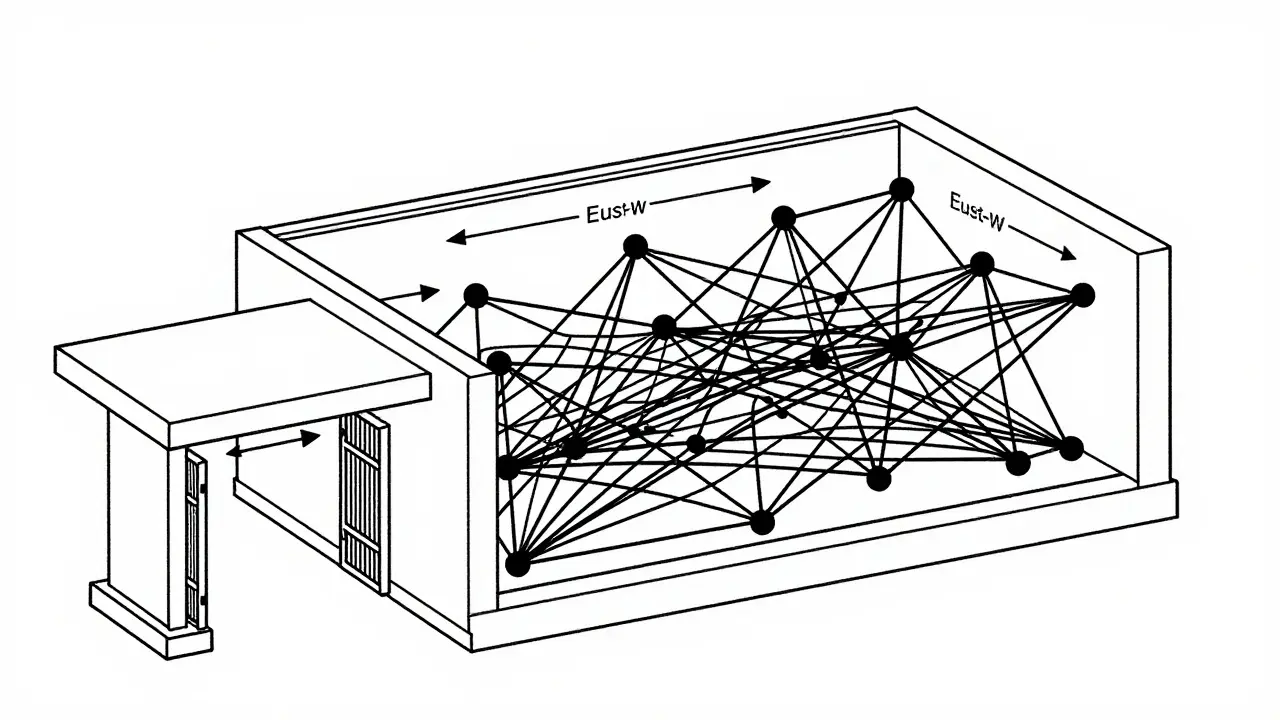
North-South vs. East-West Traffic
To keep things straight, remember this simple rule: API Gateways handle north-south traffic (external clients entering the system), while Service Meshes handle east-west traffic (internal services talking to each other).
| Feature | API Gateway | Service Mesh |
|---|---|---|
| Traffic Direction | North-South (External) | East-West (Internal) |
| Primary Role | Authentication, Rate Limiting, Routing | mTLS, Load Balancing, Observability |
| Deployment Location | Network Edge / Ingress | Inside Cluster (Sidecars) |
| Latency Impact | Minimal (Edge processing) | 1-2ms per hop (Sidecar overhead) |
| Complexity | Low to Medium | High (Requires K8s expertise) |
| Market Share Leaders | AWS, Kong, Apigee | Istio, Linkerd, Consul Connect |
Using an API Gateway for internal traffic is like having a bouncer check IDs for people moving between rooms in a house. It adds unnecessary friction. Conversely, using a Service Mesh for external traffic is overkill and exposes internal network details to the public internet. They are complementary, not interchangeable.
Why Vibe Coding Makes This Distinction Critical
Vibe coding accelerates feature creation but often obscures architectural dependencies. When an AI generates a microservice, it focuses on the function, not the integration. You might end up with 50 services that work individually but fail collectively due to network timeouts or authentication mismatches.
Without a Service Mesh, debugging these issues requires adding logging code to every service. With a mesh, you get immediate visibility. Tools like Prometheus integrate with 97% of meshes, giving you metrics on latency, error rates, and throughput without touching your code. This aligns perfectly with the vibe coding workflow: you generate code fast, and the infrastructure ensures it runs reliably.
However, there is a cost. Sidecars consume resources. A 2025 Red Hat benchmark shows sidecars use 15-20% additional CPU and memory. For resource-constrained environments, like IoT devices, this matters. That is why Linkerd is popular in such cases; its sidecar uses only 20MB of memory, compared to Istio’s 100MB footprint.
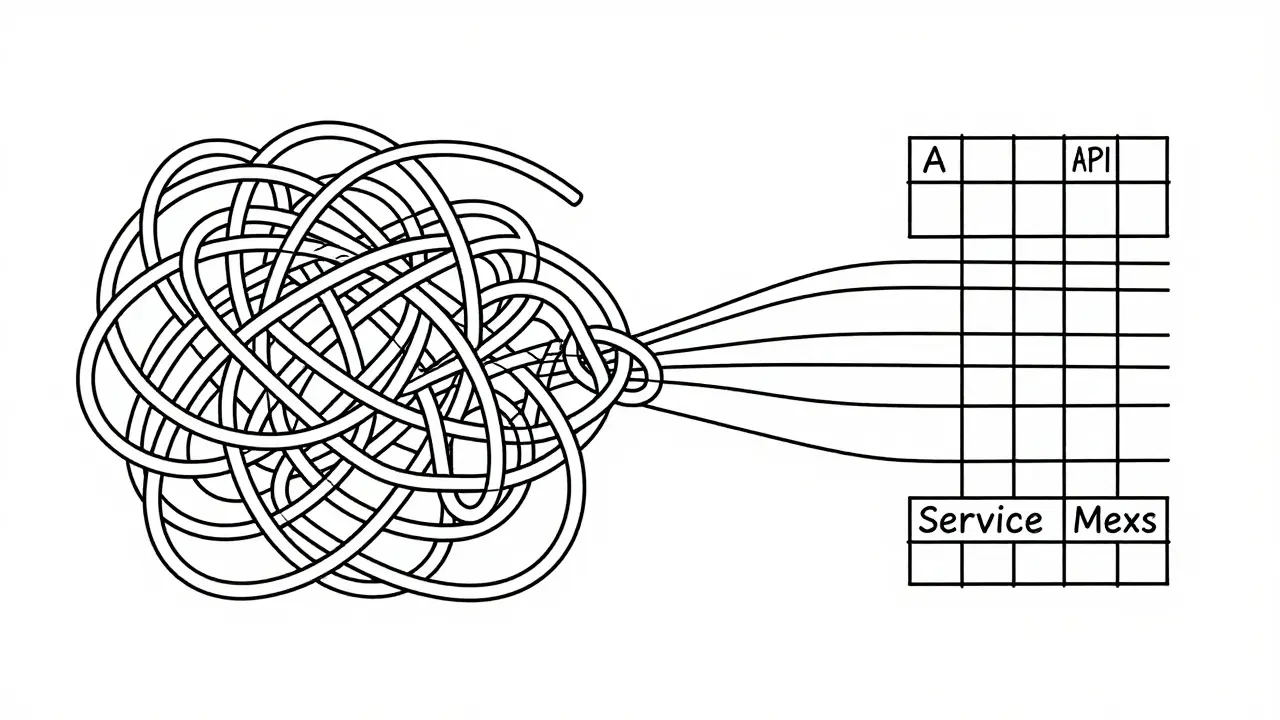
Implementation Challenges and Real-World Pitfalls
Even with powerful tools, implementation is tricky. A 2025 Forrester study found that full Service Mesh deployment takes 3-6 months. Why so long? Because it requires deep knowledge of Kubernetes networking and Envoy proxy configuration. Only 15% of organizations report having sufficient internal expertise.
Common pitfalls include:
- Over-engineering: Small teams with fewer than 10 services often don’t need a Service Mesh. The complexity outweighs the benefits. Start with an API Gateway and basic health checks.
- Pricing Surprises: AWS API Gateway’s pricing model can be complex. One DevOps lead reported an unexpected $12,000 bill due to an unoptimized endpoint hitting high call volumes. Always set up budget alerts.
- Certificate Management: 65% of users struggle with SSL/TLS certificate management in API Gateways. Automate this with tools like Let’s Encrypt or ACM.
On the flip side, API Gateways are easier to deploy. Initial setup typically takes 2-4 weeks. But they struggle with internal contract management. 78% of organizations report difficulties managing internal API contracts without a mesh.
The Future: Convergence or Separation?
Some experts argue the line is blurring. Adrian Cockcroft, former AWS VP, suggested the distinction will collapse as Envoy-based control planes become universal. Projects like Ambassador’s unified control plane aim to bridge the gap.
However, Gartner’s 2026 Magic Quadrant maintains that separation of concerns is best practice. They predict that through 2028, organizations using both patterns with clear roles will achieve 40% better operational outcomes. New features like Istio’s “ambient mode” (reducing sidecar usage by 40%) and Kong’s AI-powered anomaly detection show both technologies evolving independently but compatibly.
For vibe coders, this means you should plan for both. Use the API Gateway to protect your public face and the Service Mesh to ensure your internal operations are resilient. Don’t try to force one tool to do the job of the other. It creates technical debt that slows down your rapid development cycle.
Do I need both an API Gateway and a Service Mesh?
If you have more than 10-15 microservices and handle external traffic, yes. The API Gateway manages external access, security, and rate limiting, while the Service Mesh handles internal communication, encryption, and resilience. Using only one leaves gaps in either security or reliability.
Which Service Mesh is best for beginners?
Linkerd is often recommended for beginners due to its simplicity and lightweight footprint. It installs in under 15 minutes and has a smaller learning curve compared to Istio, though Istio offers more advanced traffic management features.
How much latency does a Service Mesh add?
Typically 1-2 milliseconds per hop. While this seems small, it can add up in complex chains of service calls. However, the benefit of automatic retries, load balancing, and encryption usually outweighs this minor performance cost.
Can an API Gateway replace a Service Mesh?
No. API Gateways are designed for external traffic. They lack the granular control over internal service-to-service communication, such as automatic mTLS, circuit breaking, and detailed internal observability, which are core functions of a Service Mesh.
What is the cost of running AWS API Gateway?
As of early 2026, AWS API Gateway costs approximately $3.50 per million API calls. However, costs can escalate quickly with high-volume endpoints, so monitoring and setting budget alerts is crucial to avoid surprise bills.
 Artificial Intelligence




Patrick Dorion
July 2, 2026 AT 07:41It is fascinating how the industry keeps reinventing the wheel but calling it a revolution. We used to call this separation of concerns in the nineties, now it is vibe coding and microservices. The real issue is not the tools, it is the lack of discipline. People think AI writes good code because it runs, but it does not mean it scales. You need structure or you get chaos.
Marissa Haque
July 2, 2026 AT 07:53Oh my goodness! This is exactly what I have been trying to tell my team for months!!! They keep ignoring the internal traffic management and wonder why everything breaks during peak hours!!! It is so frustrating when people skip the basics just because they want to move fast!!! Please read this again!!!
Lisa Puster
July 4, 2026 AT 02:03most of these devs are too stupid to understand basic networking let alone kubernetes. stop using ai to write your code if you cannot even debug a simple timeout. it is embarrassing watching americans try to build complex systems with zero foundation knowledge. just hire someone who actually knows what they are doing instead of relying on magic prompts.
Bineesh Mathew
July 4, 2026 AT 13:59The tragedy of modern software engineering lies in its hubris. We believe that by automating the creation of code we are liberating ourselves from the drudgery of labor. Yet we have merely replaced the drudgery of typing with the existential dread of maintenance. When the AI generates the service it creates a ghost in the machine. A phantom limb that twitches in the dark. We are building cathedrals of complexity on foundations of sand. And when the tide comes in we will all be drowning in our own technical debt. It is a moral failing to ship such fragile systems into the world. We owe it to society to build things that last not things that merely function until they break.
Keith Barker
July 6, 2026 AT 10:35simple truth is people overcomplicate things. start small add mesh later if needed. most startups do not need istio. just use a gateway and be done with it.