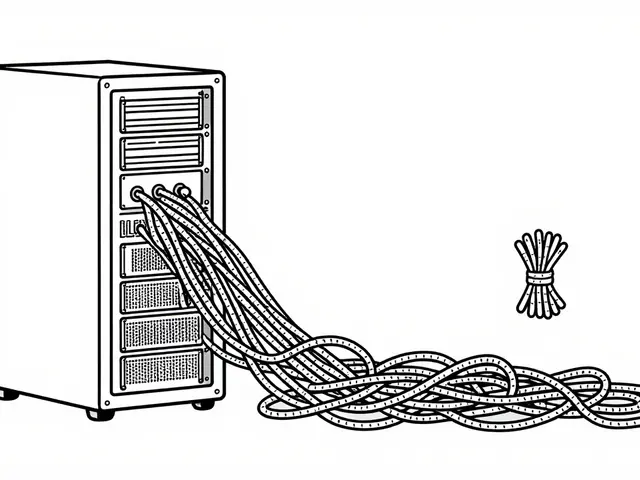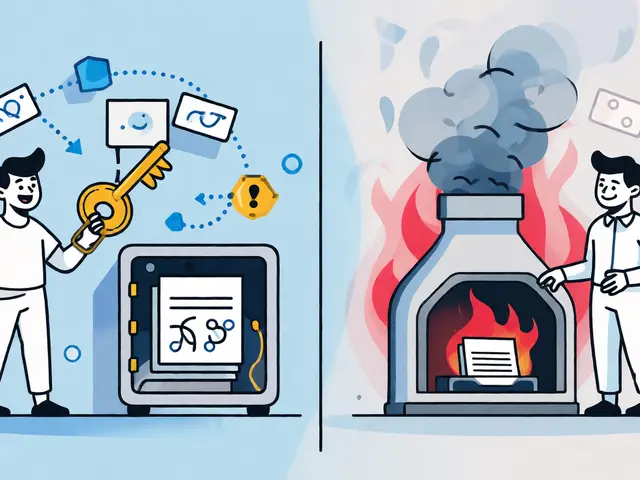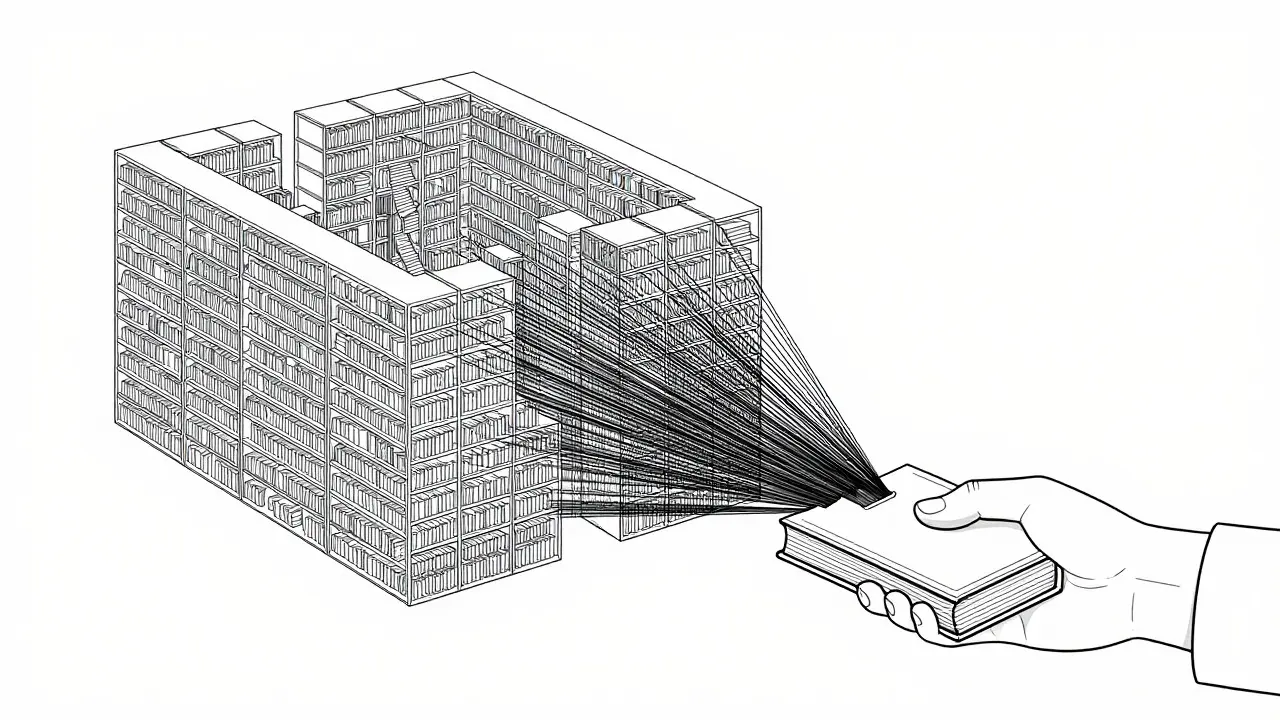
Imagine shrinking a massive library into a pocket-sized book. You save space, but do you lose the nuance of the stories? That is exactly what happens when we compress Large Language Models (LLMs) for real-world use. The industry has moved past the era where only tech giants could afford to run these models. Today, developers are squeezing billion-parameter systems onto consumer-grade hardware like the NVIDIA RTX 3090. But there is a catch. When we shrink these models using techniques like quantization or pruning, we don't just remove weight; we often strip away linguistic subtleties and specialized knowledge.
This isn't just about saving GPU memory. It is about whether your compressed model still understands Swahili as well as it does English, or if it can still diagnose a medical condition accurately after being shrunk by half. Recent data from 2024 and 2025 reveals a troubling trend: while general performance metrics look fine, specific capabilities-especially in low-resource languages and high-stakes domains like law or medicine-are crumbling under pressure.
The Mechanics of Shrinking Giants
To understand the impact, you first need to know how the shrinking happens. The goal is simple: reduce computational requirements without killing performance. Most teams aim for a 4x compression ratio, moving from 16-bit or 32-bit precision down to 4-bit or even 2-bit precision. This can cut GPU memory usage by up to 75%, turning a task that requires a cluster into one that runs on a single laptop.
There are three main tools in this toolbox:
- Quantization: This reduces the bit-width of the model's weights. Instead of storing precise floating-point numbers, the model uses simpler integers. Techniques like QuIP (Chee et al., 2023) use complex math, including LDL decomposition of the Hessian matrix, to keep the model smart despite the lower resolution. A 7B-parameter model might drop from needing 14GB of VRAM to just 6GB.
- Pruning: Think of this as trimming dead branches. Methods like SparseGPT and Wanda identify and remove redundant connections (weights) in the neural network. Studies show they can achieve 50-60% sparsity-meaning half the connections are gone-while keeping perplexity scores nearly identical to the original.
- Knowledge Distillation: Here, a smaller "student" model learns to mimic a larger "teacher" model. This preserves task performance well but requires thousands of domain-specific examples to train effectively.
On paper, these methods look perfect. Apple’s Machine Learning Research team noted in 2024 that training-free compression methods can achieve negligible perplexity degradation. But perplexity is a tricky metric. It measures how surprised the model is by the next word in a sentence. A model can be perfectly predictable (low perplexity) yet completely wrong in its reasoning. This disconnect is at the heart of the current crisis in LLM compression.
The Multilingual Penalty: Why Low-Resource Languages Suffer
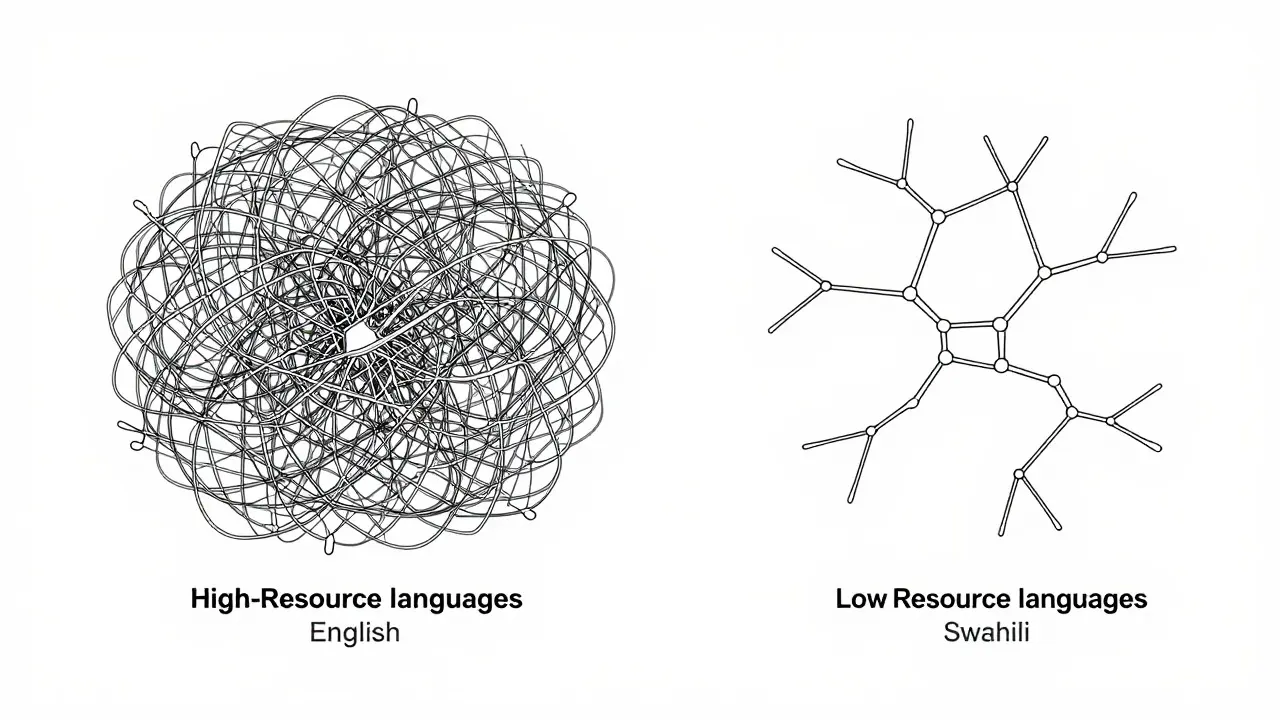
If you are deploying an LLM globally, compression is not a neutral act. It disproportionately hurts languages that have less data in their training sets. High-resource languages like English, Spanish, or Mandarin are robust because the model has seen billions of examples. Low-resource languages, however, rely on fragile patterns that compression easily breaks.
Liu et al. (2024) documented a stark reality: in 4-bit quantized models, performance for Swahili dropped by 14.3%, while English only dipped by 3.2%. The gap widens as you go deeper into compression. For languages with fewer than 1 million Wikipedia articles, you can expect an 8-12% performance hit compared to a mere 2-4% for major languages.
Why does this happen? Compression removes the "long tail" of knowledge. Rare words, unique grammatical structures, and cultural nuances in low-resource languages are stored in the less critical weights-the very ones pruning algorithms target first. When you prune 50% of the model, you aren't just removing redundancy; you are erasing the specific pathways that allow the model to handle non-dominant languages correctly.
| Language Category | Example Languages | Avg. Accuracy Drop | Risk Factor |
|---|---|---|---|
| High-Resource | English, Chinese, Spanish | 2-4% | Low |
| Mixed-Resource | French, German, Japanese | 5-7% | Medium |
| Low-Resource | Swahili, Vietnamese, Icelandic | 8-14% | High |
User reports back this data. On Reddit’s r/LocalLLaMA, developers noted that pruning made their medical LLM hallucinate 3.2 times more frequently in Spanish than in English. Inconsistency in tokenization across languages after quantization remains the most common complaint in GitHub issue trackers for libraries like llama.cpp, with nearly 80 reported cases of this specific bug alone.
Domain-Specific Collapse: Medicine, Law, and Code
The problem gets worse when you move from general chat to specialized tasks. General-purpose models are trained on everything, so they have broad, shallow knowledge. Domain-specific models, however, rely on deep, precise associations. Compression attacks this depth.
Research from Kim et al. (2025) shows that domain-specific models experience 30% greater knowledge degradation than general-purpose models when compressed to 4-bit precision. The stakes are highest in regulated industries:
- Medical AI: Accuracy drops by 27% post-compression. A model might confidently give a plausible-sounding but incorrect diagnosis because the subtle distinctions between similar symptoms were pruned away.
- Legal AI: Accuracy falls by 22%. Legal reasoning requires strict adherence to precedent and nuanced language. Compressed models often simplify this logic, leading to flawed interpretations.
- General Knowledge: Only a 12% drop. Trivia and basic facts are easier to retain because they are highly correlated in the training data.
This phenomenon is known as the "perplexity-performance paradox." Khanal and Capone (2024) demonstrated that LLaMA-2-7B with 50% sparsity showed only a 0.8% increase in perplexity (looking healthy) but suffered a 22.4% accuracy drop on the TyDi QA multilingual benchmark. The model sounded confident, but it was wrong. Relying solely on perplexity to validate a compressed model is like judging a surgeon by how steady their hands look, rather than checking if the patient survived.
Bias Amplification: The Hidden Cost
Perhaps the most alarming side effect of compression is bias amplification. We often assume that making a model smaller makes it simpler and perhaps more neutral. The opposite is true. Compression acts as a filter that reinforces dominant patterns and erases minority perspectives.
Kim et al. (2025) found that DECODER models like Llama3.1-8B exhibit 18.7% greater bias amplification post-compression compared to ENCODER-DECODER models like T5. Specifically, Llama3.1-8B showed 37% greater bias amplification than Mistral after 8-bit quantization. This means stereotypes towards subpopulation groups become more pronounced in the compressed version.
Professor Sarah Strubell of Carnegie Mellon University put it bluntly during a NeurIPS 2023 panel: "Compression without domain-specific calibration is like performing surgery without anesthesia-the patient might look fine but suffers internally." The model retains the majority opinion strongly while losing the nuanced counter-arguments that usually balance it out. For multilingual applications in diverse cultural contexts, this risks exporting amplified biases to regions that were already underrepresented in the original training data.

How to Compress Without Breaking Things
So, should you avoid compression? No. The market demand is too strong, with enterprise adoption jumping from 12% in 2023 to 47% in 2025. But you need to change your workflow. Generic compression scripts are no longer enough.
First, stop using perplexity as your only metric. Adopt Jensen-Shannon (JS) Divergence. Khanal and Capone (2024) proved that JS Divergence correlates with downstream task performance at r=0.87, whereas perplexity only correlates at r=0.32. If your JS Divergence spikes, your model is losing semantic integrity, even if perplexity looks good.
Second, use domain-specific calibration data. Using generic text to calibrate a medical or legal model leads to poor results. Khanal and Capone showed that using relevant calibration data improves downstream task performance by 18.7%. If you are targeting multiple languages, ensure your calibration set includes representative samples from those low-resource languages.
Third, consider hybrid approaches. Pure magnitude pruning is risky. Combining mild pruning with aggressive quantization (e.g., 4-bit) often yields better stability than extreme sparsity. Also, look at newer frameworks. Google’s 2025 release of 'CompressLLM' introduces language-aware quantization groups, which help mitigate the multilingual penalty. Meta’s 'Llama-3-8B-Compressed' offers domain-adaptive compression strategies that are worth testing for specialized use cases.
Finally, budget for time. Effective compression is not a one-click process. Stanford CRFM estimates it takes 80-120 hours of specialized training to master these techniques. Expect failures. Layer collapse occurs in 32% of attempted compressions according to MLPerf data. Plan for iterative testing.
The Future of Compact AI
The landscape is shifting rapidly. The global LLM compression market is projected to grow at a 38.7% CAGR through 2028. By 2027, Gartner predicts compression will be standard for 95% of enterprise deployments. However, regulatory pressures are mounting. The EU AI Act draft (November 2024) now requires bias impact assessments for compressed models in high-risk applications. This means you cannot just ship a shrunken model; you must prove it hasn't become more biased or less accurate in critical areas.
We are moving toward "task-aware compression," where the model knows which parts of its brain are essential for its specific job and protects them from pruning. Until then, developers must remain vigilant. Compression is a powerful tool, but it is not magic. It is a trade-off. You gain speed and efficiency, but you risk losing the soul of the model-its ability to understand nuance, diversity, and complexity.
What is the biggest risk of compressing multilingual LLMs?
The biggest risk is disproportionate performance degradation in low-resource languages. While English may only see a 2-4% drop in accuracy, languages like Swahili or Vietnamese can suffer 8-14% drops. This happens because compression removes the rare patterns and nuanced grammar that define these languages, leaving the model fluent only in dominant tongues.
Does model compression increase AI bias?
Yes, significantly. Studies show that quantization can amplify demographic bias by up to 28-37% in certain decoder-only models. Compression tends to reinforce dominant stereotypes while erasing minority perspectives, making the model less inclusive than its uncompressed counterpart.
Why is perplexity a bad metric for evaluating compressed models?
Perplexity measures prediction confidence, not factual accuracy or logical reasoning. A compressed model can have near-perfect perplexity (sounding very confident) while suffering a 20%+ drop in actual task accuracy. This is called the "perplexity-performance paradox." Experts recommend using Jensen-Shannon Divergence instead, which correlates much better with real-world performance.
Which compression method is best for domain-specific tasks like medicine?
For high-stakes domains, pure pruning is dangerous due to high knowledge degradation (up to 27% in medicine). A hybrid approach using mild pruning combined with 4-bit quantization, calibrated with domain-specific data, is recommended. Always validate with task-specific benchmarks rather than general language tests.
Can I run a compressed LLM on my personal computer?
Yes. A 7B-parameter model quantized to 4-bit typically requires only about 6GB of GPU memory, allowing it to run on consumer cards like the NVIDIA RTX 3080 or 3090. This enables inference speeds of 7ms per token, compared to 28ms for full-precision versions, making local deployment feasible for many users.
 Artificial Intelligence