You send a prompt to an AI model. It processes your data. You get an answer. Simple, right? But where did that data actually live while the AI was thinking? For most businesses handling sensitive info-like patient records or financial strategies-that "thinking" phase is a massive blind spot. Your data sits in RAM, decrypted and exposed, waiting for a hacker or even a curious cloud admin to peek. This is the AI privacy paradox: you need powerful models to process your secrets, but traditional security can't protect data while it's actively being used.
This is where confidential computing changes the game. By using hardware-based Trusted Execution Environments (TEEs), we can now encrypt data not just when it's sitting still (at rest) or moving between servers (in transit), but also while it’s crunching numbers (in use). As of late 2026, this isn't just theoretical; major players like NVIDIA, AWS, and Microsoft have rolled out robust solutions that let enterprises deploy large language models (LLMs) without exposing their crown jewels. If you're worried about GDPR fines, HIPAA violations, or leaking proprietary model weights, understanding how TEEs work is no longer optional-it's essential infrastructure.
The Core Problem: Why Standard Encryption Isn't Enough
Think about how we usually secure data. We lock it up in a database (encryption at rest). We wrap it in SSL/TLS when sending it over the internet (encryption in transit). But the moment that data hits the CPU or GPU memory to be processed, it has to be decrypted. Why? Because processors don't understand encrypted math-at least, not efficiently enough for real-time AI tasks.
This creates a vulnerable window. In a standard cloud deployment, your prompts and the model's intermediate calculations sit in plain text within the server's memory. A compromised hypervisor, a malicious insider, or a side-channel attack could theoretically siphon this data off. For consumer chatbots, maybe that's acceptable. But for a hospital analyzing genomic data or a bank processing loan applications, it's a dealbreaker. You can't hand your unencrypted secrets to a third-party cloud provider and hope they behave. You need a guarantee that even the cloud provider can't see what's happening inside the black box.
How Trusted Execution Environments (TEEs) Solve This
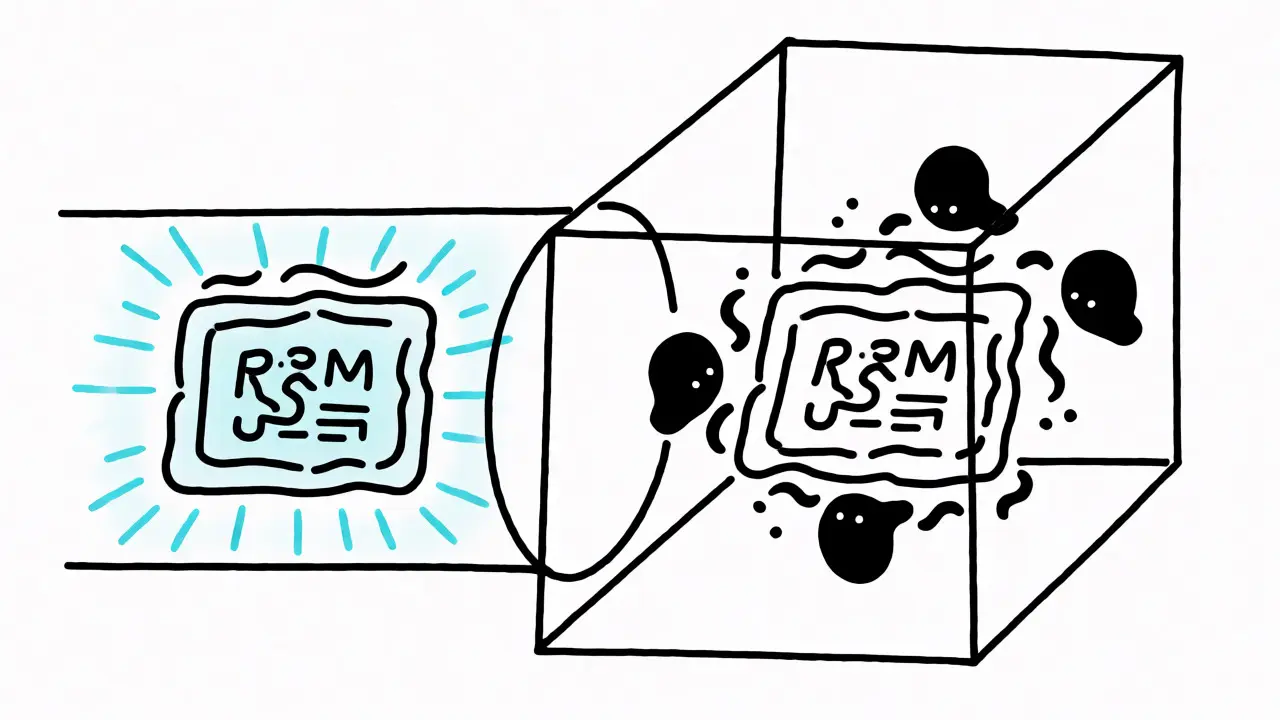
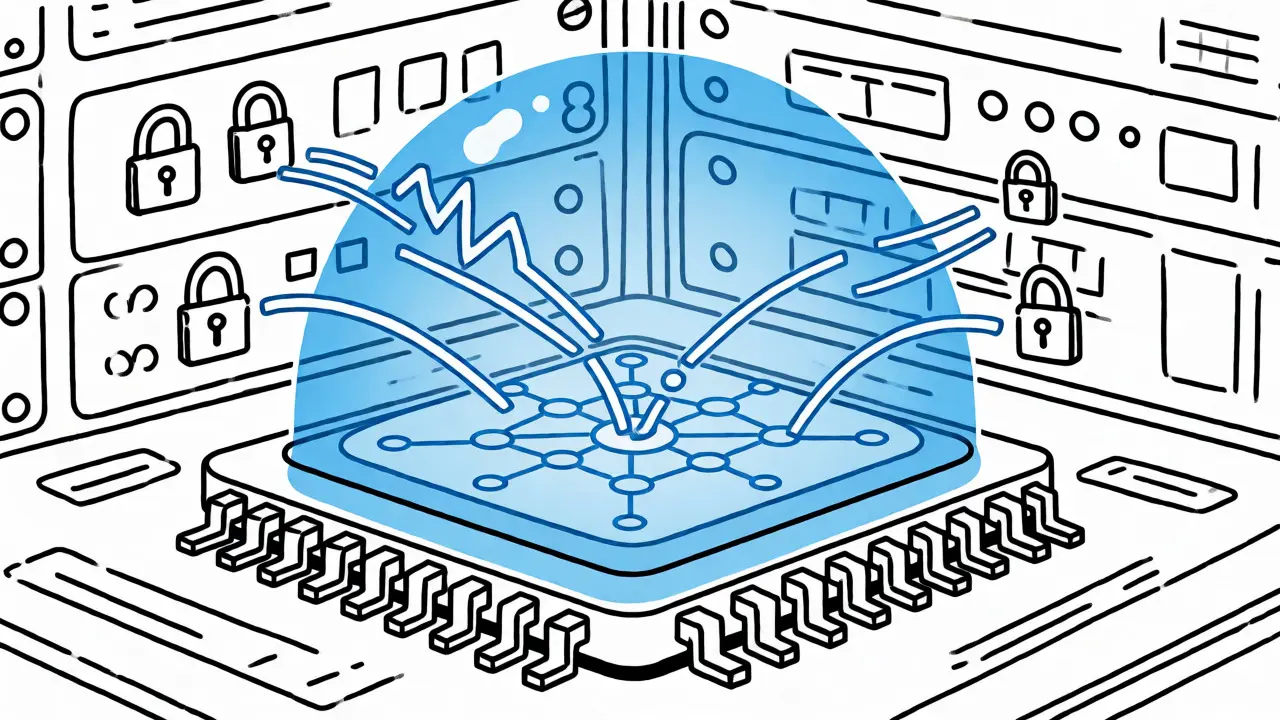
A Trusted Execution Environment is essentially a secure vault built into the processor itself. Whether it's Intel SGX, AMD SEV-SNP, or Intel TDX, these technologies create an isolated region of memory that is encrypted by the hardware. The key insight here is that the decryption keys never leave the physical chip. Even if someone dumps the RAM contents from the outside, all they see is gibberish.
When you run an LLM inside a TEE, the entire inference pipeline happens within this protected boundary. Your prompt enters the enclave, gets decrypted only after verification, passes through the neural network layers in encrypted memory, and the final response is re-encrypted before leaving. No plaintext ever touches the host operating system or the cloud provider's management layer. This provides cryptographic proof-a process called remote attestation-that the code running inside the vault is exactly what you intended, untampered and authentic.
NVIDIA's Breakthrough: GPU Confidential Computing
For years, TEEs were mostly limited to CPUs. That was a problem for AI because LLMs rely heavily on GPUs for speed. Running complex matrix multiplications on a CPU is painfully slow. Enter NVIDIA's H100 and H200 GPUs, which introduced native Confidential Computing capabilities in late 2023. This was a watershed moment.
NVIDIA's approach extends the TEE concept directly to the GPU. The H100 features a dedicated hardware root of trust and memory encryption engines specifically designed for AI workloads. Early benchmarks showed performance overheads of 15-25% for older CPU-based solutions, which killed real-time applications. With NVIDIA's GPU TEEs, that overhead drops to a negligible 1-5%. This means you can run a 70-billion parameter model with near-native speed while keeping every bit of data encrypted in use. The Blackwell B200 GPUs, launching in December 2025, push this further, supporting models with over 200 billion parameters with less than 3% performance hit.
| Technology Provider | Hardware Basis | Performance Overhead | Best Use Case |
|---|---|---|---|
| NVIDIA Confidential Computing | H100/H200/Blackwell GPUs | 1-5% | High-performance real-time inference |
| AWS Nitro Enclaves | CPU Isolation (Nitro Hypervisor) | 15-25% (CPU only) | Cost-effective batch processing |
| Azure Confidential VMs | Intel TDX / AMD SEV-SNP | 5-10% | Enterprise hybrid cloud integration |
| Red Hat OpenShift | Kubernetes Native + CVMs | Variable (depends on underlying HW) | Cloud-native containerized apps |
The Challenge of Secure Model Loading
Securing the user's data is half the battle. The other half is protecting the model itself. Companies spend millions training proprietary LLMs. They don't want competitors stealing their weights or architecture details. In a standard setup, loading a model involves copying gigabytes of weights into memory. How do you do this securely?
If you load an encrypted model into a TEE, you need a way to decrypt it inside the enclave without exposing the decryption key to the outside world. This is where mutual attestation comes in. Solutions like those from Tinfoil Security or Phala Network require two proofs: first, the enclave proves it's genuine and running approved code; second, the model provider releases the decryption key only to that verified enclave. The model weights are then decrypted inside the secure memory boundary. This ensures that even the cloud provider hosting the server cannot extract your proprietary model weights during the loading process.
Real-World Performance and Trade-offs
Let's talk numbers, because nothing matters if your app becomes too slow. According to recent industry reports, including data from Phala Network and Red Hat, the performance penalty for confidential computing has dropped dramatically. While early Intel SGX implementations struggled with heavy I/O operations, modern GPU-accelerated TEEs handle the bulk of computational load efficiently.
However, there are caveats. Large models require massive VRAM. Loading a 70B+ parameter model requires over 140 GB of video memory. Moving this data into the TEE takes time. One case study from a financial services firm noted that loading a 30B parameter model into an Intel SGX enclave took 47 minutes versus 8 minutes normally. This latency is fine for batch jobs but problematic for real-time chat interfaces. NVIDIA's newer architectures mitigate this by optimizing the data transfer paths, but engineers must still design pipelines carefully to minimize data movement across the TEE boundary.
Regulatory Drivers and Market Adoption
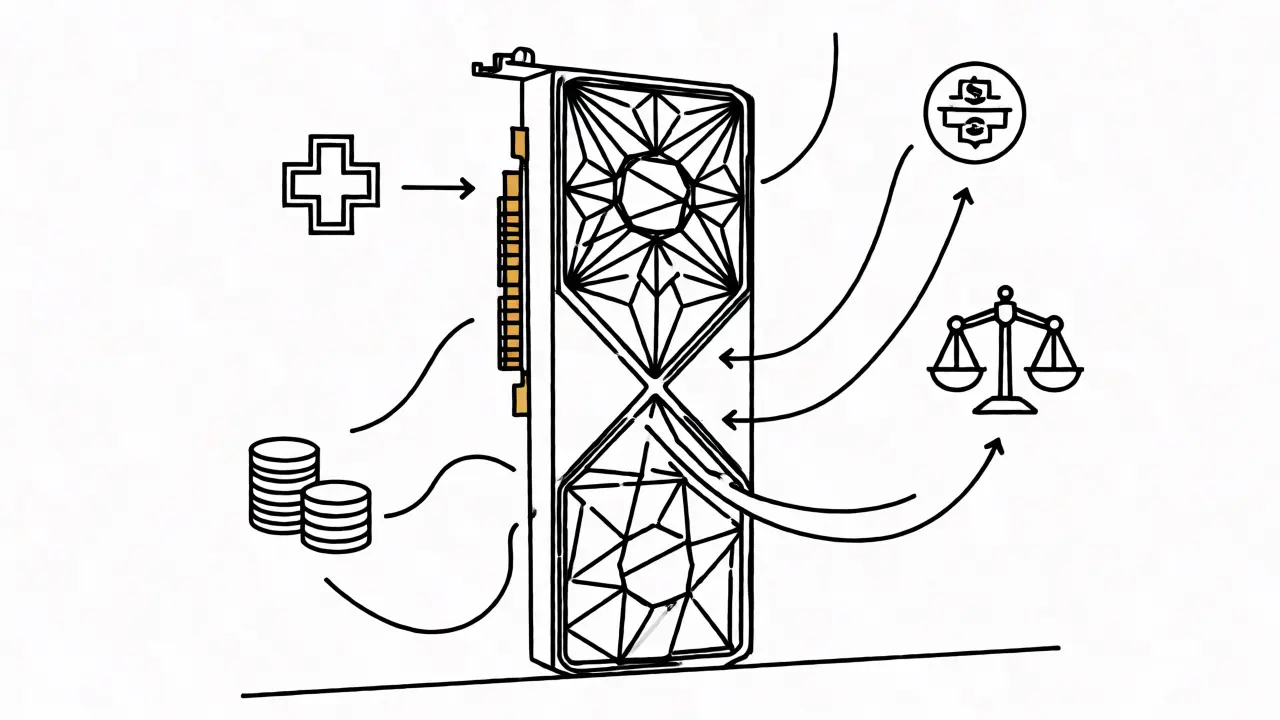
Why are companies adopting this now? Regulation. GDPR Article 32 demands "appropriate technical measures" for data protection. HIPAA mandates strict safeguards for electronic health information. Traditional encryption often fails to satisfy auditors who ask, "What protects the data while it's being processed?" Confidential computing provides a verifiable, hardware-backed answer.
Adoption is skyrocketing. Gartner predicts that by Q4 2026, 65% of enterprise LLM deployments handling sensitive data will use confidential computing, up from just 15% in mid-2025. Healthcare leads the charge with 42% of implementations, followed by financial services at 29%. The market value for secure AI infrastructure is projected to hit $8.3 billion by 2027. If you're building an AI product for regulated industries, ignoring this trend puts you at a competitive disadvantage.
Implementation Roadmap: Getting Started
Moving to confidential computing isn't a simple toggle switch. It requires architectural changes. Here is a practical checklist for teams looking to implement this:
- Select Hardware: Choose between CPU-based TEEs (Intel TDX, AMD SEV-SNP) for cost efficiency or GPU-based TEEs (NVIDIA H100+) for performance. Most production-grade LLMs need the GPU route.
- Design Attestation Flow: Implement a remote attestation service. Your client application must verify the TEE's quote before sending any sensitive data. Libraries like Intel DCAP or NVIDIA's attestation SDK help automate this.
- Secure Model Storage: Store your model weights in encrypted format (e.g., OCI images with encrypted layers). Ensure your inference engine supports decrypting these weights only inside the TEE.
- Minimize Data Movement: Keep all processing inside the enclave. Avoid passing intermediate results back to the host OS unless necessary. Batch requests to reduce the overhead of entering/exiting the secure environment.
- Monitor and Audit: Log attestation events and model loading times. Set alerts for anomalies, such as unexpected performance drops that might indicate contention or misconfiguration.
Pitfalls to Avoid
Don't fall into the trap of assuming TEEs make everything secure by default. Side-channel attacks remain a risk, though mitigations are improving. Also, consider the "trusted computing base" expansion. By adding more hardware components to the trust chain, you introduce new potential failure points. Ensure your supply chain-from the silicon manufacturer to the cloud provider-is vetted.
Another common mistake is underestimating the complexity of key management. Who holds the master keys? How are they rotated? Using a Hardware Security Module (HSM) integrated with your TEE workflow is highly recommended. Finally, remember that confidential computing doesn't replace input validation or output filtering. Garbage in, garbage out still applies-even if the garbage is encrypted.
Does confidential computing significantly slow down LLM inference?
Not anymore. While early CPU-based implementations had 15-25% overhead, modern GPU-accelerated solutions like NVIDIA H100 Confidential Computing incur only 1-5% performance loss. This makes them viable for real-time applications.
Can cloud providers see my data in a TEE?
No. The core promise of confidential computing is that data remains encrypted in memory. The cloud provider manages the hardware but cannot access the plaintext data or model weights inside the Trusted Execution Environment without the specific decryption keys held by the client.
What is remote attestation?
Remote attestation is a cryptographic process where the TEE generates a signed report proving its identity and integrity. The client verifies this signature against a trusted certificate authority before sending sensitive data, ensuring the environment hasn't been tampered with.
Is confidential computing required for all AI projects?
No. It is primarily needed for regulated industries (healthcare, finance, government) or cases involving highly proprietary models. For public-facing chatbots with low-sensitivity queries, standard encryption in transit may suffice and is less complex to manage.
Which hardware vendors support confidential computing for AI?
NVIDIA leads with GPU-based TEEs (H100, H200, Blackwell). Intel offers TDX and SGX for CPUs. AMD provides SEV-SNP. Cloud providers like AWS (Nitro Enclaves), Azure (Confidential VMs), and Google Cloud offer managed services wrapping these hardware capabilities.
 Artificial Intelligence