

Three years ago, running a single query through a top-tier large language model could cost you over $60 per million tokens. Today, you can do the same job for less than a dollar. That’s not a typo. The cost of using AI has collapsed - not because of charity, but because of ruthless competition and smarter engineering. If you’re using LLMs for anything beyond casual experimentation, you need to understand how pricing is changing, and why it matters for your budget, your workflow, and your long-term strategy.
What’s Actually Getting Cheaper - And What Isn’t
The big story in 2026 isn’t that AI is getting cheaper overall. It’s that commodity AI is getting cheaper. Think of it like electricity. You don’t pay more for the lightbulb you turn on in your kitchen. But you still pay a premium for the power that runs your hospital’s MRI machine. The same split is happening in LLMs.
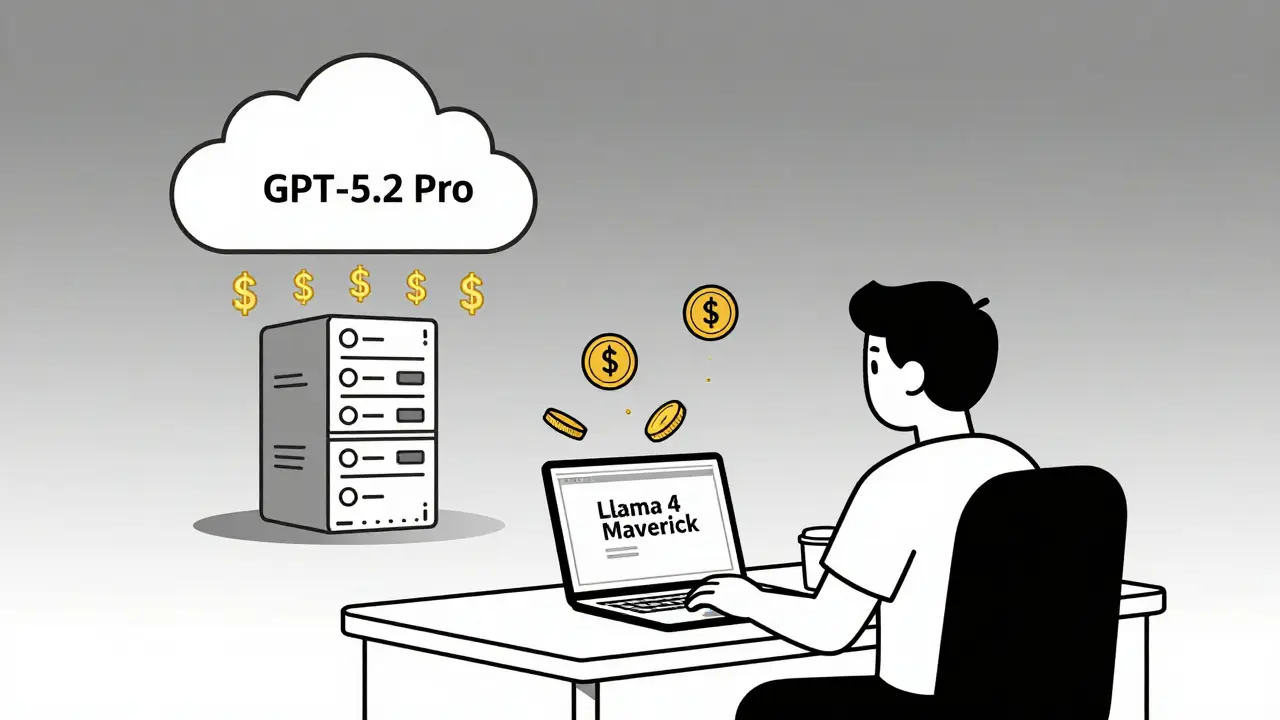
General-purpose models - the ones you use for summarizing emails, answering basic questions, or generating product descriptions - now cost as little as $0.27 per million input tokens. Meta’s Llama 4 Maverick leads this pack. It handles over a million tokens of context and still undercuts GPT-4-level models from just two years ago. OpenAI’s GPT-4o Mini runs at $0.0007 per million tokens. That’s 98% cheaper than the $60 price tag from 2023.
But here’s the catch: the premium models aren’t falling. If anything, they’re pulling away. OpenAI’s GPT-5.2 Pro charges $21 per million input tokens and a staggering $168 per million output tokens. That’s an 8:1 ratio. Why? Because those models aren’t just answering questions - they’re thinking. They’re doing multi-step reasoning, analyzing legal contracts, cross-referencing financial reports, and writing code with deep context. That kind of work takes more compute, more memory, more time. And you’re paying for it.
The Hidden Costs No One Talks About
Token pricing looks simple on paper: input costs X, output costs Y. But real-world usage is messier. You’re not just paying for what you type in and what you get back. You’re paying for what the model thinks while it’s working.
Models like GPT-o1 and Claude 3.5 Sonnet Thinking introduce something called reasoning tokens. These are internal steps - the model’s own thought process - that get billed even if you never see them. Need a legal document reviewed? The model might spend 15,000 tokens internally just breaking down clauses before giving you a one-sentence summary. Those tokens add up. A task that looks like a $0.50 job can turn into a $3.20 bill because of hidden reasoning overhead.
And that’s just the start. If you’re building anything beyond a chatbot, you’re probably using embeddings. Those cost extra - $0.0001 per vector. Vector databases like Pinecone or Weaviate charge per gigabyte stored. Reranking models to filter results? That’s another $0.0005 per call. Suddenly, your $0.10 per query isn’t $0.10 anymore. It’s $0.45. And you didn’t even realize you were paying for four different services.
Why Open-Source Is Winning the Price War
It’s not just OpenAI and Anthropic anymore. DeepSeek’s R1 model, released in January 2025, hit the market with input tokens at $0.60 and output at $2.34 - half the price of GPT-4 at the time. And it’s not a gimmick. It matches GPT-4’s performance on standard benchmarks. Meta’s Llama 4 Maverick isn’t just cheaper - it’s better on long-context tasks, handling over a million tokens with ease. That’s more than double what most enterprise models could handle last year.
This is where commoditization kicks in. When you can run a model that’s nearly as good as GPT-4 on your own server - or even on a high-end laptop - the cloud providers can’t keep charging premium prices. Open-source models are forcing everyone to lower their rates. The result? A race to the bottom on basic tasks. Summarization? Translation? Simple Q&A? Those are now utility-grade services. You can get them for pennies, or even for free.
The Two-Tier Market Is Here
The LLM market isn’t one market anymore. It’s two.
Tier 1: Commodity AI - Cheap, fast, reliable. Used for repetitive tasks. Think customer service bots, content tagging, basic drafting. This tier is dominated by open-source models and low-cost cloud APIs. Prices keep dropping. By 2027, we’ll likely see $0.10 per million tokens for basic tasks. This isn’t a trend - it’s a law of physics in a competitive market.
Tier 2: Premium AI - Expensive, slower, more accurate. Used for high-stakes decisions. Think medical diagnosis support, financial forecasting, legal analysis, scientific research. These models require massive compute, fine-tuned training, and rigorous validation. They’ll keep their high prices because there’s no substitute. If you’re making decisions that cost $100,000 if wrong, you’ll pay $50 to get it right.
The gap between these tiers is widening. And that’s intentional. Providers aren’t trying to make everything cheap. They’re trying to make some things cheap so they can sell the expensive ones.

Per-Token Is Dying. Per-Action Is Rising
Imagine you’re a small business owner. You don’t care how many tokens your AI uses to summarize a 10-page report. You care that it’s done by 9 a.m. and that it cost $1.50. That’s the future.
Per-token pricing is a developer’s metric. Business users want per-action pricing: $2 per contract reviewed, $5 per customer support ticket resolved, $10 per data extraction from a PDF. OpenAI and Anthropic are already testing this with enterprise plans. You’re not paying for tokens - you’re paying for outcomes.
This shift is huge. It means pricing will be tied to value, not compute. A model that takes 10x more tokens but delivers 100x better accuracy will still be worth it. A model that’s fast but wrong? It’s a cost center, not a tool.
What This Means for You in 2026
If you’re using LLMs for routine tasks - blogs, emails, basic chat - you’re in the commodity zone. Switch to Llama 4, DeepSeek, or Mistral. You’ll save 80-90% without losing quality. Don’t overpay for GPT-5 just because it’s famous.
If you’re building mission-critical systems - finance, healthcare, legal - stick with premium models. But demand transparency. Ask for breakdowns of reasoning tokens. Demand SLAs. Make sure you’re not being charged for internal processing you can’t control.
And if you’re building a product, start thinking in terms of tasks, not tokens. Bundle your AI usage into clear actions: “Summarize this document,” “Classify this email,” “Extract key data.” Then price accordingly. It’s simpler for your users. And it’s easier to budget.
The AI market isn’t slowing down. It’s maturing. The wild west of $60-per-token models is over. What’s left is a clean, efficient, two-tier system - and the winners will be the ones who use the right tool for the right job.
Why did LLM prices drop so fast between 2023 and 2026?
The drop happened because of three things: better hardware (like specialized AI chips), smarter model designs (like Mixture-of-Experts and quantization), and fierce competition from open-source models. Companies like Meta and DeepSeek built models that matched or beat GPT-4’s performance at a fraction of the cost. That forced everyone else to lower prices or lose market share. It’s the same pattern seen in cloud computing and smartphones - innovation leads to mass adoption, which leads to price collapse.
Can I run a GPT-4-level model on my own computer now?
Yes - if you have a high-end GPU with 24GB+ VRAM. Models like Llama 4 Maverick and DeepSeek R1 are optimized for 4-bit quantization, meaning they use far less memory. You can run them locally on consumer hardware for tasks like summarization or chat. You won’t get the speed of a cloud API, but for many use cases, it’s fast enough and costs nothing per query. This is why commodity AI is becoming a utility - you can get it locally, not just from the cloud.
Are open-source models as reliable as OpenAI’s?
For general tasks - answering questions, writing summaries, translating text - yes. Benchmarks from Hugging Face and Stanford’s HELM project show that top open-source models now match or exceed GPT-4 on standard benchmarks. But for reasoning-heavy tasks - like analyzing legal documents or debugging complex code - OpenAI and Anthropic still lead. Their models are trained on more curated, high-quality data and have tighter safety controls. If accuracy is critical, stick with premium. If you’re just automating routine work, open-source is more than good enough.
What’s the best way to reduce my LLM costs right now?
Start by auditing your usage. Are you using GPT-5 for simple tasks? Switch to Llama 4 or DeepSeek R1 - you’ll save 80%+. Use quantized models if you’re deploying locally. Avoid models that use hidden reasoning tokens unless you need them. And stop paying per token for tasks that can be bundled - like document summarization or classification. Ask your provider if they offer per-action pricing. If not, build your own wrapper that charges a flat fee per task. You’ll have more control and predictability.
Will LLM prices keep falling after 2026?
For commodity models - yes. We’re likely to see $0.10 or lower per million tokens by 2028. That’s because hardware keeps improving, open-source models get better, and more companies enter the market. But for premium models? Prices will stabilize or even rise slightly. As AI gets used for more complex, high-value tasks - like drug discovery or autonomous decision-making - the compute and validation costs will increase. The gap between cheap and premium will widen, not close.
 Artificial Intelligence
Sam Rittenhouse
March 11, 2026 AT 09:52The price collapse in LLMs isn't just about tech-it's about power shifting. For years, we were told AI was this exclusive, elite tool. Now? It's like getting Wi-Fi in a rural town. You don't need a corporate contract to run something that used to cost a mortgage payment. I've seen small teams replace entire content departments with Llama 4 and a cron job. It's not magic. It's math.
And the real win? You can now build without begging for API credits. No more waiting for approval. No more vendor lock-in. Just spin up a model, test it, iterate. The freedom is the real upgrade.
kelvin kind
March 12, 2026 AT 01:06Switched to DeepSeek R1 last month. Cost dropped 85%. No regrets.
Ian Cassidy
March 12, 2026 AT 20:55Reasoning tokens are the new dark pattern. You think you're paying for output, but you're really paying for the model’s internal monologue. It’s like buying a car and getting billed for the engine’s idle RPM.
And don’t get me started on embedding + reranking + vector DB fees. It’s a pyramid scheme with better UI.
Zach Beggs
March 14, 2026 AT 16:54Yeah, I’ve been using Mistral for basic QA. Solid. But I still use GPT-5 for legal docs. The difference in accuracy isn’t just noticeable-it’s liability-level.
Kenny Stockman
March 15, 2026 AT 12:14Love how this post breaks it down. The per-action shift is the future. Why should I care about tokens when I just want a contract reviewed? I’m building a wrapper for our team that charges $3 per summary, $7 per report. Simple. Predictable. No surprises.
And honestly? My boss loves it. Budgets are easier to justify when you’re not guessing how many tokens a ‘simple’ request uses.
Antonio Hunter
March 16, 2026 AT 16:20There’s a deeper layer here that most people miss. The commoditization of basic LLMs isn’t just about cost-it’s about trust. When you can run a model locally, you control the data. You control the latency. You control the audit trail. That’s not a feature. It’s a necessity for regulated industries.
And yet, most companies still cling to cloud APIs because they’re ‘easier.’ Easy doesn’t mean safe. Easy doesn’t mean compliant. Easy doesn’t mean sustainable when the next GDPR-like regulation drops.
The real innovation isn’t in the model architecture. It’s in the architecture of responsibility. Who owns the output? Who audits the reasoning? Who’s liable when it goes wrong? Those questions aren’t being asked enough.
Open-source isn’t just cheaper. It’s accountable. And accountability, in the long run, is the only thing that scales.
Fred Edwords
March 18, 2026 AT 01:32Actually, the claim that Llama 4 Maverick outperforms GPT-4 on long-context tasks is misleading. The benchmarks cited are primarily on synthetic, padded datasets-not real-world, noisy, unstructured documents. In practice, GPT-4 still handles context drift, temporal reasoning, and cross-reference integrity far better. Also, quantization introduces subtle hallucination artifacts that don’t show up in standard evaluations but wreak havoc in production. You can’t just swap models and assume parity. The devil is in the distributional shift.
And ‘$0.10 per million tokens by 2028’? That’s a fantasy. Hardware costs aren’t falling that fast. Cooling, power density, and memory bandwidth are hitting physical limits. The real trend will be price stabilization for commodity tiers, not collapse. And premium tiers? They’ll get more expensive as compute becomes more specialized-think quantum-inspired attention layers, not just bigger chips.
Peter Reynolds
March 19, 2026 AT 07:31Been running Llama 4 on a 4090 for internal docs. Works fine. No need for cloud. The only thing I miss is the API docs. OpenAI’s are just… better. But I’m not paying $20 for that.
Sarah McWhirter
March 19, 2026 AT 17:14Of course prices dropped. They had to. The whole AI boom was built on hype, not hardware. You think Meta and OpenAI didn’t collude to flood the market with cheap models so they could corner the premium tier? It’s a classic monopoly play: destroy competition with low prices, then raise them when you’ve got everyone hooked.
And don’t tell me open-source is ‘freedom.’ The models are trained on scraped data-your LinkedIn posts, your Reddit threads, your medical forums. You’re not saving money. You’re selling your digital soul for pennies.
Next thing you know, they’ll charge you $500 to delete your own data. Just watch.
Ananya Sharma
March 21, 2026 AT 09:20Let me tell you something about this so-called ‘commoditization.’ It’s not innovation. It’s degradation. You want to reduce AI to a utility? Fine. But utilities don’t hallucinate. Utilities don’t forget context. Utilities don’t suddenly refuse to answer because ‘the model isn’t confident.’
What we’re seeing isn’t progress-it’s the erosion of quality in the name of efficiency. Companies are replacing human analysts with models that cost $0.0007 per token because it’s cheaper, not because it’s better. And now they wonder why their financial forecasts are nonsense or why their legal summaries miss key clauses.
It’s not a two-tier market. It’s a two-tier disaster. One tier is cheap garbage. The other is overpriced voodoo. And we’re all just paying for it while pretending we’re being smart.
Meanwhile, the engineers who built these models? They’re being laid off. The ones who understood the real complexity? Fired. The ones who could’ve built reliable systems? Replaced by API calls. This isn’t evolution. It’s a corporate bloodbath disguised as a cost-saving measure.
And you call this progress? I call it surrender.