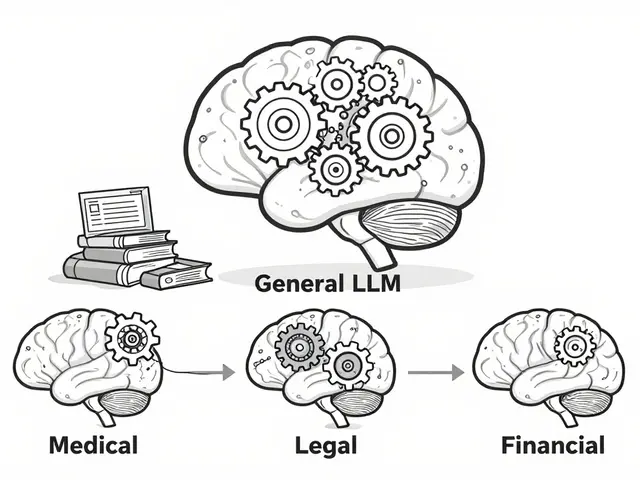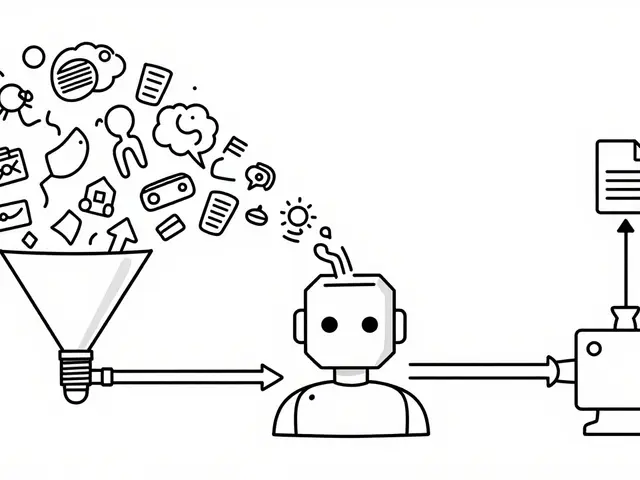
You built a powerful Large Language Model. It crushes English benchmarks. But ask it to write a poem in Swahili or debug code in Japanese, and it stumbles. Why? Because most LLMs are trained on data that is heavily skewed toward English. This imbalance creates a gap between what the model knows in its "native" tongue and how it performs elsewhere. You don't need to retrain from scratch to fix this. You need cross-lingual fine-tuning. This process adapts an existing model to new languages by leveraging parallel data and smart training strategies. It’s not just about translation; it’s about teaching the model to think across linguistic boundaries.
If you’re working with global users or handling diverse datasets, ignoring this technique leaves performance on the table. Let’s break down how it works, why simple translation isn’t enough, and which methods actually deliver results in 2026.
The Core Problem: English Bias in LLMs
Most foundational models learn from the internet. The internet speaks mostly English. Consequently, these models develop deep semantic understanding for English but shallow grasp for other languages. When you try to use them directly for non-English tasks, they often hallucinate or miss nuance. Standard supervised fine-tuning (SFT) helps, but if you only feed it translated instructions, the model might memorize patterns without truly understanding the underlying concepts. It’s like memorizing a phrasebook versus learning grammar.
X-CIT (Cross-Lingual Continued Instruction Tuning) addresses this by mimicking how humans learn a second language. Instead of dumping all data at once, it starts with strong English foundations and gradually introduces target language nuances. This approach, presented at ACL 2025, shows that structured progression beats brute-force translation.
How X-CIT Works: Learning Like a Human
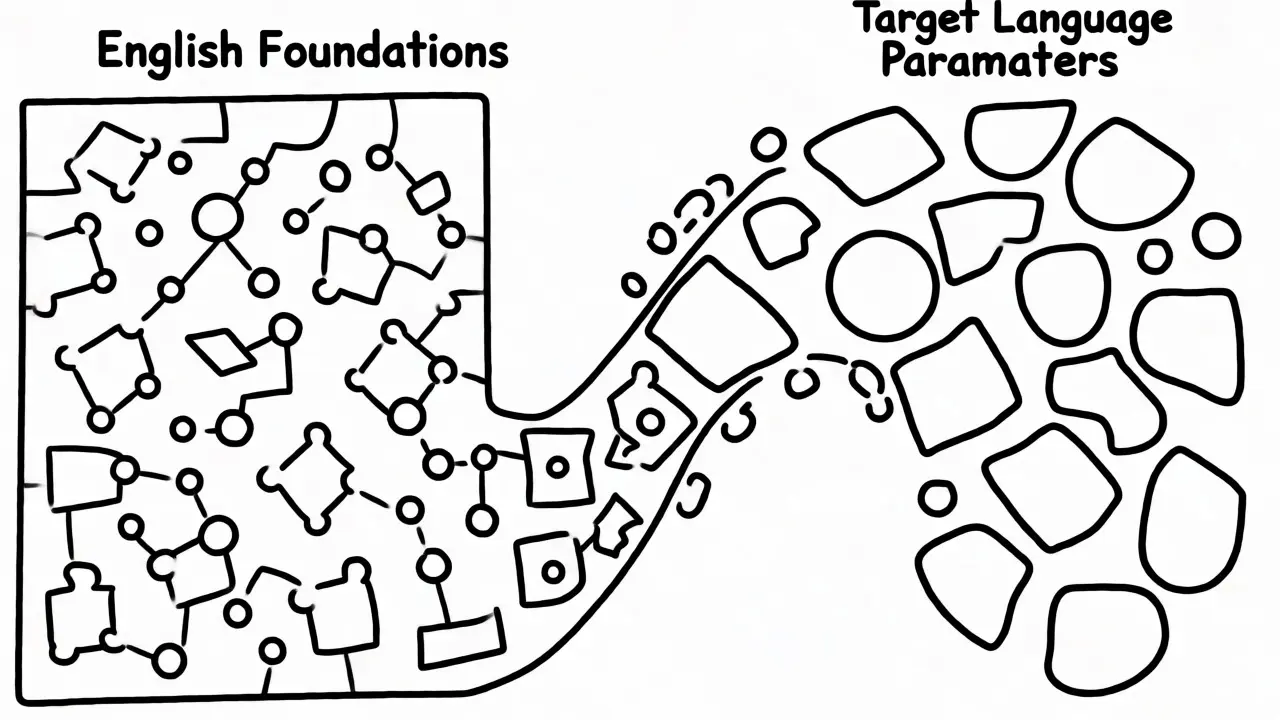
X-CIT operates on a two-phase strategy inspired by Chomsky’s Principles and Parameters Theory. Think of "principles" as universal logic and "parameters" as language-specific rules.
- Phase 1: Establish Foundations. Fine-tune the model on high-quality English instruction data. This locks in general reasoning capabilities.
- Phase 2: Adapt Parameters. Continue training using translated parallel data and custom chat instructions in the target language. Crucially, the model first processes information in English internally before generating output in the target language. This "thinking step" ensures semantic alignment.
This method uses Self-Paced Learning (SPL). The model starts with simple tasks and moves to complex ones. On Llama-2-7B, X-CIT improved objective benchmark scores by 1.97% and human-judged quality by 8.2% compared to standard baselines. That’s a significant jump for a few hours of compute.
Beyond Translation: Semantic Alignment with CrossAlpaca
Not all approaches rely on phased learning. CrossAlpaca focuses on semantic alignment through translation-following demonstrations. Standard instruction tuning often fails because the model doesn’t link concepts across languages deeply enough. CrossAlpaca solves this by including examples where the model must translate and then answer, reinforcing the connection between English concepts and their foreign equivalents.
Validated on benchmarks like XQUAD and MLQA, CrossAlpaca outperformed models tuned on monolingual data alone. If your priority is question-answering accuracy across six or more languages, this architecture offers a robust alternative to X-CIT.
Modular Approaches for Low-Resource Languages
What if you have zero task-specific data in the target language? Enter modular frameworks. Recent research reveals that mathematical reasoning and multilingual capabilities reside in distinct, non-overlapping parts of the model’s parameters. You can freeze one part while updating another.
| Method | Best Use Case | Data Requirement | Key Advantage |
|---|---|---|---|
| X-CIT | High-performance general tasks | Parallel instruction data | Mimics human acquisition; high accuracy gains |
| CrossAlpaca | Q&A and semantic alignment | Translation-following demos | Strong cross-language concept linking |
| Layer-Swapping | Low-resource / No task data | None (uses pre-trained experts) | No catastrophic forgetting; modular efficiency |
The most successful modular technique identified so far involves fine-tuning separate "experts" for language and math, then merging them via Layer-Swapping. Interestingly, reverting less useful updates after training often works better than freezing parameters beforehand. This is critical when adapting to languages with scarce digital resources.

Handling Code-Switching and Real-World Chaos
Real conversations aren’t clean. Bilingual speakers mix languages mid-sentence. This is called code-switching. Standard POS tagging or NER models fail here. Research from RESOURCEFUL-2025 introduced the S-index (Switching-Index) to measure this phenomenon. Fine-tuning models specifically on code-switched Indian languages and English showed that specialized adaptation improves tagging accuracy even for combinations not seen during training. If your app serves bilingual communities, generic fine-tuning won’t cut it. You need data that reflects actual speech patterns.
Practical Steps to Implement Cross-Lingual Fine-Tuning
Ready to adapt your model? Follow this checklist:
- Audit Your Data: Do you have parallel instruction pairs? If not, start with machine translation plus human verification for a small subset.
- Choose Your Strategy: Use X-CIT for general capability boost. Use CrossAlpaca for Q&A. Use Layer-Swapping if you lack target-language task data.
- Monitor Parameter Overlap: Check if your fine-tuning affects mathematical reasoning. If it does, consider modular freezing.
- Evaluate with Dual Metrics: Don’t just look at BLEU scores. Use LLM-as-a-judge benchmarks to assess naturalness and coherence.
Cross-lingual fine-tuning isn’t magic. It’s engineering. By respecting how models learn and structuring your data accordingly, you can turn an English-centric model into a true polyglot without breaking the bank.
Is cross-lingual fine-tuning cheaper than training a new model?
Yes, significantly. Training a new LLM from scratch requires massive computational resources and vast datasets. Cross-lingual fine-tuning leverages existing weights, requiring only a fraction of the compute power-often just a few GPUs for a short duration-to adapt the model to new languages.
Can I use any base model for cross-lingual fine-tuning?
Most transformer-based models work, but those with strong initial multilingual exposure (like Llama-2 or Mistral) yield better results. Models with poor baseline multilingual coverage may require more extensive fine-tuning to achieve comparable performance.
What is the biggest risk in cross-lingual fine-tuning?
Catastrophic forgetting. Aggressive fine-tuning on a new language can degrade the model's original English capabilities. Techniques like X-CIT and modular layer-swapping help mitigate this by preserving core reasoning parameters while adjusting language-specific ones.
Do I need human-translated data?
For high-stakes applications, yes. Machine translation introduces noise. However, recent methods like CrossAlpaca show that synthetic data augmented with translation-following demonstrations can be surprisingly effective, reducing the need for expensive human annotation.
How do I evaluate success?
Use a combination of objective benchmarks (like XNLI or XQUAD) and subjective evaluations (LLM-as-a-judge). Objective metrics catch factual errors, while judge models assess fluency and cultural appropriateness, which are critical for user experience.
 Artificial Intelligence