Remember when training a Transformer cost about $900? That was 2017. Fast forward to today, and you are looking at price tags that make venture capitalists sweat. We are talking hundreds of millions of dollars just to get the weights initialized. If you are building an Large Language Model (LLM) program now, your biggest hurdle isn't just the code-it's the cash flow. Compute budgets have become the defining constraint of modern AI development.
You might think bigger is always better, but the math doesn't support that anymore. The era of throwing unlimited GPUs at a problem without checking the meter is over. Organizations are realizing that unchecked scaling leads to unsustainable burn rates. According to IBM’s Institute for Business Value, computing costs are projected to jump nearly 90% between 2023 and 2025. Most executives say generative AI is the main culprit. So, how do you scale without bankrupting your startup or blowing up your enterprise budget? It comes down to understanding scaling laws and planning your roadmap with surgical precision.
The New Reality of Training Costs
Let’s look at the numbers. They are staggering. Epoch AI reported in mid-2024 that the compute required for the largest models doubles every eight months. That is not a linear increase; it is an explosion. When OpenAI trained GPT-4, estimates suggest it consumed around 2.1 × 10^25 FLOPs. Google’s Gemini Ultra reportedly needed even more, hitting roughly 5.0 × 10^25 FLOPs. At current hardware prices, those numbers translate to real money. CUDO Compute estimated GPT-4’s training cost between $78 million and $100 million. Gemini Ultra? Closer to $191 million.
Why does this matter to you? Because if you are trying to compete, you need to know where your money goes. Energy consumption alone accounts for about half of total training costs. The rest covers hardware amortization and infrastructure. You aren't just paying for chips; you are paying for the electricity to keep them from melting. If your roadmap ignores energy efficiency, you are leaving money on the table. And let's be honest, no one likes burning cash on heat sinks.
Hardware Choices: Cloud vs. On-Premise
Do you rent or buy? This is the classic IT dilemma, but with higher stakes. Data center-grade GPUs like the NVIDIA A100-80GB cost about $15,000 each. For a large-scale deployment, you might need thousands of them. That is a capital expenditure nightmare for many companies. But here is the twist: you don't always need the biggest hammer for the nail.
A recent analysis from September 2025 showed that medium-scale models can run efficiently on just two A100s. That is a $30,000 hardware investment. Models like GLM-4.5-Air or Llama-3.3-70B lose less than 10% accuracy compared to their massive counterparts. For many business applications, that trade-off is worth it. You save hundreds of thousands in infrastructure while maintaining strong performance in reasoning and coding tasks.
| Model Type | Example Models | GPU Requirement | Est. Hardware Cost | Best Use Case |
|---|---|---|---|---|
| Small/Medium | Llama-3.3-70B, GLM-4.5-Air | 2x A100-80GB | $30,000 | Specialized tasks, internal tools |
| Large | Qwen3-235B | 4x A100-80GB | $60,000 | General purpose, high volume |
| Enterprise Scale | GPT-4 Class, Gemini Ultra | Thousands of GPUs | Millions | State-of-the-art research, global APIs |
If you are a small team or doing research, prosumer gear like the RTX 5090 might work. It is cheaper, sure, but scalability hits a wall fast. For multi-user deployments, stick to data center grade. The reliability and bandwidth matter more than the upfront sticker shock.

Inference: The Hidden Killer
Training is a one-time event. Inference is forever. And it gets expensive. McKinsey noted in June 2025 that OpenAI’s o1 model costs six times more for inference than GPT-4o. Why? Reasoning capabilities require more compute per token. If your application handles millions of queries, that multiplier hurts.
Tom Tunguz put it plainly: a typical AI query costing a few cents might seem trivial until you multiply it by user growth. If you have a viral app, your cloud bill will follow your user count straight into the red zone. This is why quantization and batching are not just buzzwords-they are survival tactics. Reducing memory requirements through quantization allows you to serve more users on the same hardware. Speculative decoding speeds things up by guessing tokens before verifying them. These techniques lower your cost-per-token significantly.
Consider model cascades. Instead of sending every request to your most expensive model, route simple queries to smaller, cheaper ones. IBM’s experts recommend intelligent routing based on complexity. Do you really need a 175-billion-parameter model to answer "What is the weather?" Probably not. Save the big guns for complex reasoning tasks.
Scaling Laws and Predictive Budgeting
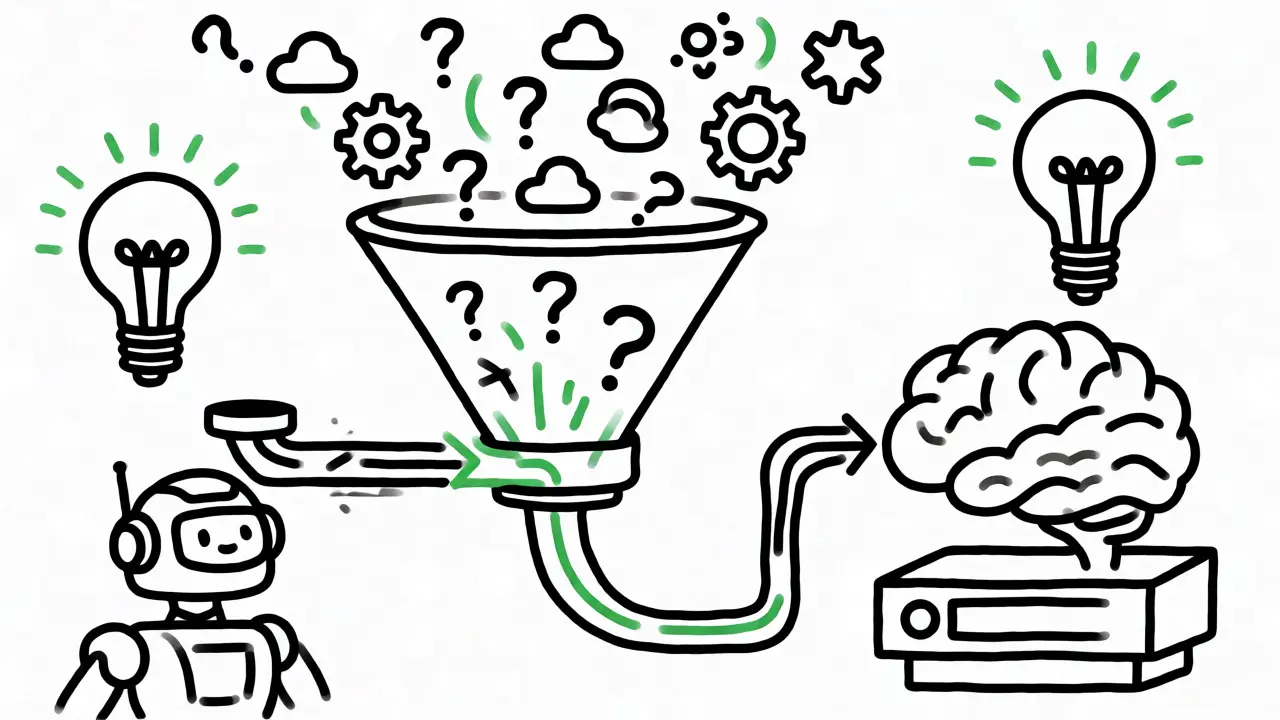
You cannot budget what you cannot predict. This is where scaling laws come in handy. Researchers at MIT and IBM Watson AI Lab developed a universal guide in September 2025 for estimating performance using smaller models. The key insight? You don't need to fully train a target model to guess its final performance. Training a model to about 30% of its dataset can give you accurate predictions.
This changes everything for your roadmap. Instead of spending $50 million to find out your architecture sucks, you spend $5 million to test the hypothesis. If the scaling law predicts poor performance, you pivot early. This approach saves massive amounts of compute. However, be careful: this method works best within similar model families. Borrowing parameters from a different architecture might lead to bad predictions.
There is also the parameter efficiency angle. DeepSeek claimed in February 2025 that their V3 model reduced training costs by 18 times compared to GPT-4o. How? Architectural innovations. They proved that you don't need brute force to get results. If your roadmap focuses solely on adding parameters, you are ignoring efficiency gains. Look for models that offer high performance per parameter. As inference load grows, these efficient models provide better economic value.
Strategic Roadmap Planning
So, what does a smart roadmap look like in late 2026? First, define your constraints. Are you limited by capital expenditure (buying GPUs) or operational expenditure (cloud bills)? Second, choose your deployment strategy. On-premise offers control and potentially lower long-term costs for stable workloads. Cloud offers flexibility and access to cutting-edge hardware without the maintenance headache.
Third, plan for obsolescence. Hardware improves rapidly. What is state-of-the-art today will be mediocre in eighteen months. Your budget should account for refreshing infrastructure regularly. Don't lock yourself into a five-year depreciation schedule if the technology moves faster. Fourth, prioritize energy efficiency. With data centers requiring trillions in investment by 2030, power availability is becoming a bottleneck. Efficient models are not just cheaper; they are more sustainable.
Finally, stay flexible. The landscape shifts quickly. What worked for GPT-3 might not work for the next generation. Build a culture that values experimentation over perfection. Run small tests, measure costs rigorously, and iterate. Remember, the goal is not the biggest model. It is the most useful model for the lowest possible cost.
Frequently Asked Questions
How much does it actually cost to train a competitive LLM?
It varies wildly based on size. Medium-scale models can be fine-tuned for tens of thousands of dollars. State-of-the-art frontier models like GPT-4 or Gemini Ultra cost between $78 million and $191 million in compute alone. For startups, leveraging existing open-source models and fine-tuning them is the most viable path to competitiveness without needing hundreds of millions in funding.
Is it cheaper to run LLMs on-premise or in the cloud?
For stable, high-volume workloads, on-premise often wins due to lower long-term ownership costs. For variable workloads or rapid experimentation, cloud services are cheaper because you avoid large upfront hardware investments. A hybrid approach is common: use cloud for training and testing, then move steady-state inference to dedicated hardware.
What are scaling laws and why do they matter for budgeting?
Scaling laws are mathematical relationships that predict model performance based on size, data, and compute. They allow developers to estimate the final performance of a large model by training smaller versions first. This saves significant budget by preventing expensive failures during full-scale training runs.
How can I reduce inference costs for my LLM application?
Use quantization to reduce memory usage, implement batching to process multiple requests simultaneously, and employ model cascades to route simple queries to cheaper, smaller models. Additionally, speculative decoding can speed up generation times, reducing the total compute time per query.
Will AI compute costs continue to rise indefinitely?
While absolute demand for compute is growing exponentially, efficiency improvements are offsetting some of these costs. Innovations in architecture, such as those seen with DeepSeek, show that we can achieve similar performance with significantly less compute. The trend is toward higher performance per dollar, even if the total market spend increases.
 Artificial Intelligence