By mid-2026, nearly half of the code written in major software projects is generated by AI assistants. GitHub reports that Copilot generates 46% of code in files where it is enabled. This isn't just a statistic; it's a fundamental shift in how we build software. The problem isn't that AI writes worse code than humans. It's that we trust it too much. We review it less. And when you combine blind trust with systems that have no concept of your project's threat model, you create a massive security gap.
The core issue is simple: AI coding assistants like GitHub Copilot, Cursor, Cody, and Amazon CodeWhisperer do not understand security contexts. They predict the next token based on patterns in their training data. If that data contains insecure practices, the AI will replicate them. Worse, if your team has historically cut corners on security, the AI will learn those bad habits and suggest them back to you as "best practice."
The Reality of AI-Generated Vulnerabilities
You might think AI code is inherently risky. The data tells a more nuanced story. A 2023 study by NYU evaluated code generated by GitHub Copilot across 89 security-relevant scenarios. They found that approximately 40% of the generated programs contained vulnerabilities. That sounds alarming. But here’s the twist: GitHub’s internal research in 2024, conducted with Microsoft, concluded that the vulnerability rate in AI suggestions was comparable to human-written code in the same repositories.
So, why is this a crisis? Because volume changes everything. Humans write code slowly. AI writes it instantly. When you scale up the output, you also scale up the surface area for attack. A 2024 study by Snyk and Backslash analyzed code from multiple AI assistants and found that 36% of generated snippets contained at least one security vulnerability when tested against common CWE (Common Weakness Enumeration) patterns. Authentication code had significantly higher vulnerability rates than data processing code. This means the most critical parts of your application-where users log in and permissions are checked-are the most likely to be flawed.
| Source | Year | Finding | Key Insight |
|---|---|---|---|
| NYU Study | 2023 | 40% of AI-generated programs had vulnerabilities | High baseline risk in security-relevant scenarios |
| Snyk & Backslash | 2024 | 36% of snippets contained at least one CVE/CWE match | Authentication code is disproportionately vulnerable |
| GitHub/Microsoft | 2024 | AI vulnerability rate mirrors human code in same repo | AI reflects the quality of its training data/context |
Common Vulnerability Patterns in AI Output
When AI gets security wrong, it doesn't usually invent new types of attacks. Instead, it repeats old mistakes at scale. Here are the most common categories you need to watch for:
- CWE-79 (Cross-Site Scripting/XSS): AI often inserts user input into HTML without proper encoding. While modern frameworks like React and Vue auto-escape content, AI frequently suggests using
innerHTMLor server-side templates that lack this protection. If you see an AI suggesting raw string concatenation for HTML output, flag it immediately. - CWE-89 (SQL Injection): This remains a top offender. AI models tend to generate SQL queries by concatenating strings rather than using parameterized statements. Even when prompted for security, they may overlook edge cases in dynamic query building.
- CWE-798 (Hardcoded Credentials): This is perhaps the most dangerous. AI assistants often generate example code with placeholder API keys or tokens. Developers, rushing to get things working, sometimes leave these in production or replace them with real credentials in a way that exposes secrets in version control.
- CWE-22 (Path Traversal): File upload handlers generated by AI rarely include strict file type or size checks. They assume the "happy path" where the user uploads a valid image, ignoring the possibility of a malicious script disguised as a PDF.
- Poor Error Handling: AI often creates broad exception handlers that either suppress errors entirely or expose internal stack traces. Exposing stack traces gives attackers valuable information about your infrastructure, while suppressing errors hides bugs until they cause outages.
The underlying issue is that AI defaults to the "happy path." It writes code that works for expected input but fails to add boundary checks or handle malicious input. Numeric inputs accept negative values. URL parameters pass through without validation. This lack of defensive programming is systematic.
The Threat Landscape: AI vs. AI
It’s not just that AI introduces vulnerabilities. It’s that attackers are using AI to exploit them faster than ever. Trend Micro’s 2026 security predictions highlight a critical trend: attackers will use AI to discover and weaponize vulnerabilities at scale. The same automation that powers innovation amplifies exploitation.
Threat actors can now use coding-capable LLMs to write polymorphic malware. Imagine prompting a model: "Write a Python script that searches a directory for .docx files, encrypts them using AES-256, and then deletes the original files." In the past, writing such a script required specialized knowledge. Now, it requires only a clear prompt. This lowers the barrier to entry for cybercrime dramatically.
Furthermore, unsecure AI-generated code created through "vibe coding"-a term for rapid, low-fidelity development driven by AI-will silently introduce bugs and backdoors into production environments. These aren't always obvious. They compound systemic risk across the supply chain. If your vendor uses AI to write their API integrations, and those integrations contain hardcoded credentials, your organization is exposed even if your own code is secure.

Mitigation Strategies: Building a Defense-in-Depth
You can’t stop AI adoption. That ship has sailed. But you can manage the risk. The key is to treat AI-generated code with the same skepticism and rigor as any third-party library. Here’s how to build a robust defense:
- Deploy Static Application Security Testing (SAST): SAST tools scan source code for vulnerabilities regardless of who wrote them. An AI-generated SQL injection is detected identically to a human-written one. Integrate SAST into your CI/CD pipeline so that no code reaches production without being scanned. Tools like Semgrep and SonarQube are essential here.
- Enable Secret Detection: Hardcoded credentials are a silent killer. Use dedicated secret scanners like GitGuardian alongside built-in features in SonarQube or Semgrep (which offers
p/secretsrules). Configure these tools to block commits that contain potential secrets. - Prioritize High-Risk CWEs: Focus your SAST rules on the vulnerabilities AI generates most frequently: CWE-89 (SQL injection), CWE-79 (XSS), CWE-798 (hardcoded credentials), CWE-22 (path traversal), CWE-502 (deserialization), and CWE-20 (input validation). Customizing your ruleset to target these areas yields the highest return on investment.
- Review Dependencies: AI tools sometimes suggest obscure or deprecated libraries to solve a problem. Always verify that new dependencies are well-maintained and free of known vulnerabilities. Use Software Composition Analysis (SCA) tools to monitor your dependency tree.
- Enforce Environment Variables: Never allow credentials to be hardcoded. Enforce the use of environment variables or secret managers like AWS Secrets Manager or HashiCorp Vault. Make this a non-negotiable part of your coding standards.
Regulatory Compliance: The EU AI Act Impact
Security isn't just about preventing breaches; it's about legal compliance. The EU AI Act, fully applicable by August 2026, imposes strict requirements on AI providers and users. One key requirement is that AI-generated content must be machine-readable and detectable. Failing to maintain robust watermarking can result in fines of up to 7% of global turnover.
This regulation affects how you manage AI-generated code. If your company uses AI to generate customer-facing content or automated decisions, you must ensure that synthetic media is labeled appropriately. Harmful content that evades moderation through unlabeled synthetic media constitutes a compliance violation. This means your security team needs to work closely with legal and product teams to implement detection mechanisms.
Cross-model inconsistency adds another layer of complexity. Users may receive different answers to the same query depending on which model is active. This can lead to brand confusion and potential compliance gaps if variations in data handling or safety responses lead to accidental policy violations. You need governance frameworks that account for these inconsistencies.
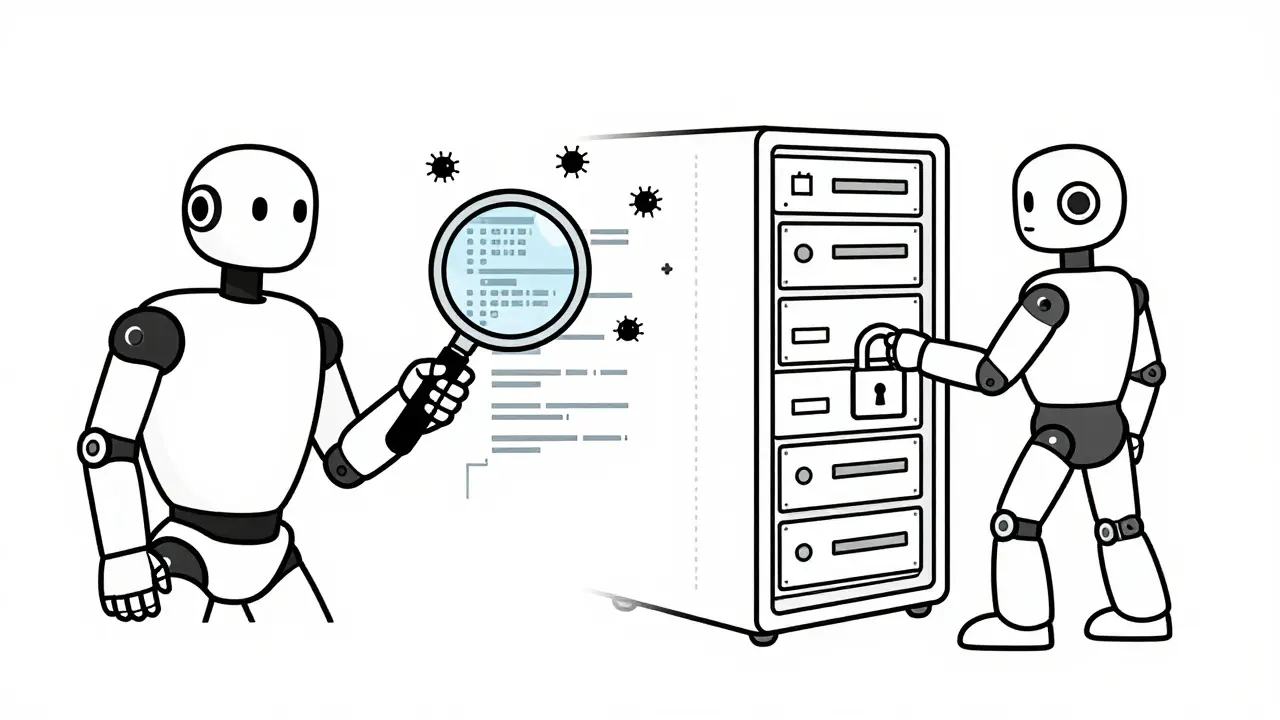
The Dual Nature of AI: Defender and Attacker
While AI poses significant risks, it also offers powerful defensive capabilities. Recent developments in 2025-2026 show that AI systems can discover vulnerabilities just as effectively as they create them. For example, an AI system called AISLE discovered 15 CVEs across late 2025 and early 2026, including 12 of 12 OpenSSL zero-days. This demonstrates that AI can be leveraged defensively to identify critical security vulnerabilities before attackers find them.
This dual capability defines the current landscape. AI is both the sword and the shield. Organizations that only focus on the risks miss out on the opportunities. By integrating AI-driven security analysis into your workflow, you can stay ahead of threats. However, this requires careful implementation. You must validate AI findings manually to avoid false positives and ensure that the AI is trained on accurate, up-to-date security data.
Next Steps for Your Organization
Managing security in an AI-driven world requires a cultural shift. It’s not enough to buy tools. You need to change how your team thinks about code. Here’s a checklist to get started:
- Establish Clear Policies: Define what types of code can be generated by AI and what must be written manually. Critical security modules, such as authentication and authorization logic, should ideally be reviewed line-by-line by senior engineers.
- Train Your Team: Educate developers on the specific vulnerabilities AI tends to generate. Show them examples of bad AI code and explain why it’s dangerous. Awareness is the first line of defense.
- Automate Where Possible: Use SAST, SCA, and secret scanning tools to automate the detection of common vulnerabilities. Integrate these tools into your pull request process so that feedback is immediate.
- Conduct Regular Audits: Periodically audit your codebase for AI-generated segments. Check for hardcoded credentials, missing input validation, and outdated dependencies. Treat AI code as third-party code that requires extra scrutiny.
- Stay Updated on Regulations: Keep track of evolving regulations like the EU AI Act. Ensure your compliance processes adapt to new requirements regarding synthetic media and data privacy.
The future of software development is collaborative between humans and AI. But collaboration requires trust, and trust requires verification. By implementing rigorous testing, automated scanning, and clear policies, you can harness the power of AI without compromising your security posture. Remember: the goal isn't to prevent AI adoption, but to manage its implications responsibly.
Is AI-generated code less secure than human-written code?
Not necessarily. Studies show that the vulnerability rate in AI-generated code is comparable to human-written code in the same repository. However, because AI generates code much faster, the total volume of vulnerabilities increases. Additionally, AI tends to repeat common mistakes like hardcoded credentials and missing input validation, making these issues more prevalent.
What are the most common vulnerabilities in AI-generated code?
The most common vulnerabilities include Cross-Site Scripting (CWE-79), SQL Injection (CWE-89), hardcoded credentials (CWE-798), path traversal (CWE-22), and poor error handling. AI often defaults to the "happy path" and neglects defensive programming practices like input validation and proper error suppression.
How can I detect hardcoded credentials in AI-generated code?
Use dedicated secret scanning tools like GitGuardian or built-in features in SAST tools like SonarQube and Semgrep. Configure these tools to run automatically in your CI/CD pipeline to block commits that contain potential secrets. Also, enforce the use of environment variables or secret managers in your coding standards.
What is the impact of the EU AI Act on code security?
The EU AI Act, fully applicable by August 2026, requires AI-generated content to be machine-readable and detectable. Fines for non-compliance can reach up to 7% of global turnover. This affects how organizations manage AI-generated code, particularly in terms of labeling synthetic media and ensuring transparency in AI decision-making processes.
Can AI help improve security instead of just creating risks?
Yes. AI systems can be used defensively to discover vulnerabilities. For example, the AI system AISLE discovered 15 CVEs, including 12 OpenSSL zero-days, in late 2025 and early 2026. By integrating AI-driven security analysis into your workflow, you can identify critical vulnerabilities before attackers exploit them.
Should I disable AI coding assistants in my organization?
Disabling AI assistants is not practical in 2026, as they are widely adopted. Instead, focus on managing the risks through rigorous testing, automated vulnerability scanning, and clear policies for safe AI coding practices. Emphasize code review and security validation regardless of whether the code was written by a human or an AI.
 Artificial Intelligence