
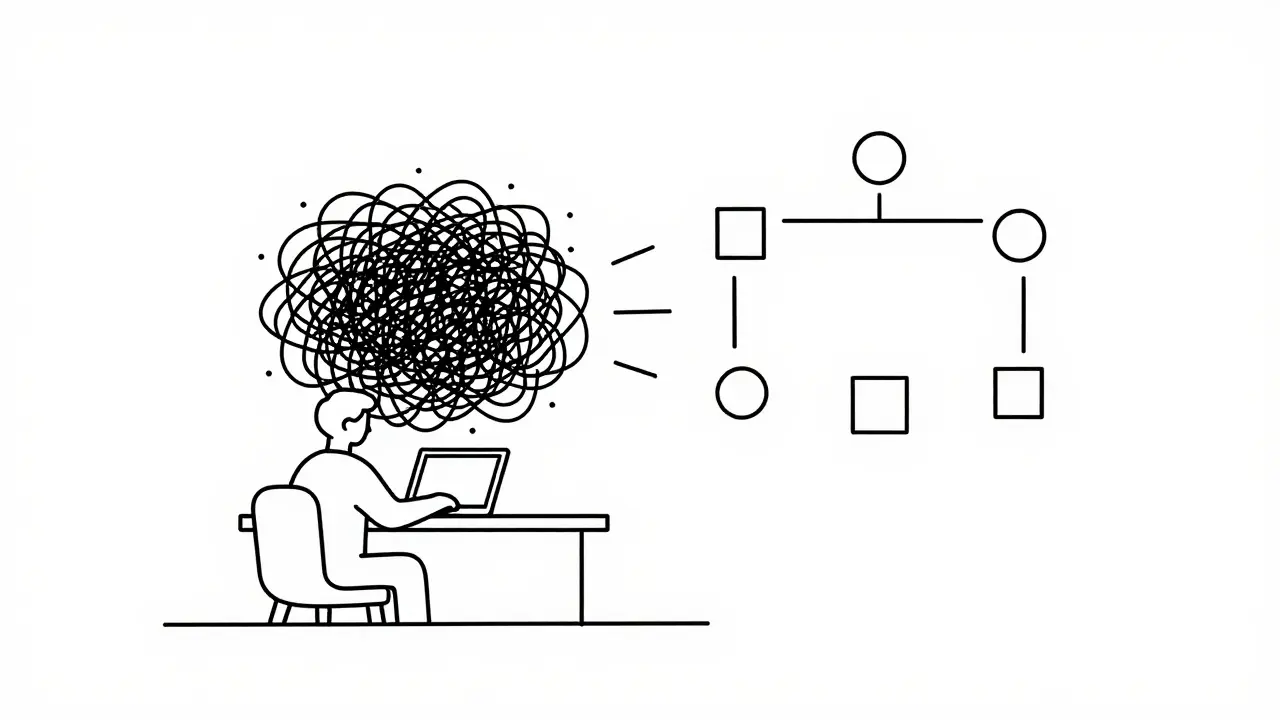
You ask an AI to summarize a report. It gives you a paragraph that misses the key financial figures. You try again with slightly different wording. Still off. This is the frustration of zero-shot prompting, where you give the model no examples and hope it guesses your intent correctly. But what if you could show the model exactly what you want before asking it to work? That is the power of few-shot prompting is a technique that provides specific input-output examples to guide large language models toward higher accuracy and consistency. By providing just two to eight carefully crafted examples, you can boost performance by 15% to 40% without spending weeks training a new model.
This isn't magic; it's pattern recognition. Large language models (LLMs) like GPT-4o, Claude, and LLaMA are built on vast amounts of text data. They don't just memorize facts; they learn structures. When you provide examples within the context window, you trigger in-context learning. The model temporarily adapts its behavior based on the patterns it sees in your examples rather than relying solely on its general training. This makes few-shot prompting a cost-effective bridge between simple zero-shot requests and expensive fine-tuning processes.
The Core Mechanism: Why Examples Work
To understand why few-shot prompting works, you need to look at how LLMs process information. Unlike traditional machine learning models that require updating internal parameters (weights) through backpropagation, LLMs use attention mechanisms to weigh the importance of different parts of the input sequence. When you include examples, the model identifies the relationship between the input query and the output response in those examples. It then applies that same logical mapping to your actual task.
Consider a customer support scenario. If you ask a model to "classify this ticket," it might return a generic label like "Issue." But if you provide three examples showing inputs labeled as "Billing Error," "Technical Glitch," and "Feature Request" with their corresponding outputs, the model learns the specific taxonomy you prefer. This reduces ambiguity. The model stops guessing your categorization system and starts following your defined structure. This shift from general knowledge application to specific pattern replication is what drives the accuracy gains.
Furthermore, this approach democratizes access to advanced NLP capabilities. You don't need a team of data scientists or GPUs costing thousands of dollars per hour to fine-tune a model. You just need good examples. For many businesses, this means deploying specialized AI workflows in days instead of months.
Selecting and Ordering Your Examples
Not all examples are created equal. Throwing random sentences into a prompt often leads to mediocre results. The quality of your few-shot strategy depends heavily on selection and ordering. Here is how to choose them effectively:
- Representativeness: Choose examples that mirror the complexity and style of your actual data. If your real inputs are messy, informal emails, don't use polished, academic texts as examples. The gap between example and reality confuses the model.
- Diversity: Avoid repetitive patterns. If you are building a sentiment analyzer, include examples of sarcasm, neutral statements, and strong emotions. This helps the model generalize rather than overfitting to one tone.
- Progressive Complexity: Order your examples from simple to complex. Start with a clear, straightforward case to establish the basic rule. Follow it with edge cases or ambiguous scenarios. This guides the model's reasoning process step-by-step, much like teaching a human student.
- Avoid Bias: Ensure your examples don't inadvertently teach the model unwanted biases. If you want balanced responses, make sure your examples reflect diverse perspectives and outcomes.
For instance, if you are prompting a model to extract dates from legal documents, start with a standard date format (e.g., "January 1, 2023"). Then add a complex example (e.g., "The contract was signed on the first day of the second month of twenty-two"). This progression teaches the model both the ideal format and how to handle variations.
The Few-Shot Dilemma: Less Can Be More
Here is a counterintuitive truth: adding more examples doesn't always help. In fact, it can hurt. Recent research has identified a phenomenon called the few-shot dilemma or over-prompting. When you flood the context window with too many examples, performance can actually decline.
Why does this happen? First, there is the issue of context window saturation. Every token used for examples is a token not available for the model's internal reasoning or for processing your actual query. Second, excessive examples can introduce noise. If even one example contains a slight inconsistency or outlier pattern, the model might latch onto it, degrading overall consistency. Third, some models exhibit diminishing returns after a certain number of shots-often between 3 and 5 examples.
Studies evaluating models like GPT-4o, DeepSeek-V3, and LLaMA-3.1 have shown that performance peaks at an optimal number of examples and then gradually drops. This challenges the old wisdom that "more data is always better." Instead, precision matters more than volume. A small set of highly relevant, high-quality examples will outperform a large set of mediocre ones every time.

Advanced Selection Techniques: TF-IDF and Stratification
If you are dealing with large datasets and need to automate example selection, manual curation isn't scalable. This is where algorithmic selection methods come into play. Research indicates that using TF-IDF (Term Frequency-Inverse Document Frequency) vectors to select examples often outperforms random sampling or simple semantic embedding similarity.
TF-IDF helps identify examples that share unique, important keywords with your target query, ensuring topical relevance. However, keyword matching alone isn't enough. You also need stratification. This means ensuring your selected examples cover all necessary classes or categories, especially rare ones. If you are classifying medical symptoms, and "rare disease" is only 1% of your data, random sampling might miss it entirely. Stratified selection guarantees that the model sees at least one example of each critical category, improving its ability to handle minority classes.
| Method | Pros | Cons | Best Use Case |
|---|---|---|---|
| Random Sampling | Simple to implement | High variance, may miss key patterns | Quick prototyping |
| Semantic Embedding | Captures meaning beyond keywords | Can be computationally heavy | Nuanced language tasks |
| TF-IDF + Stratification | High relevance, ensures class balance | Requires preprocessing setup | Production-grade classification |
Combining Few-Shot with Chain-of-Thought
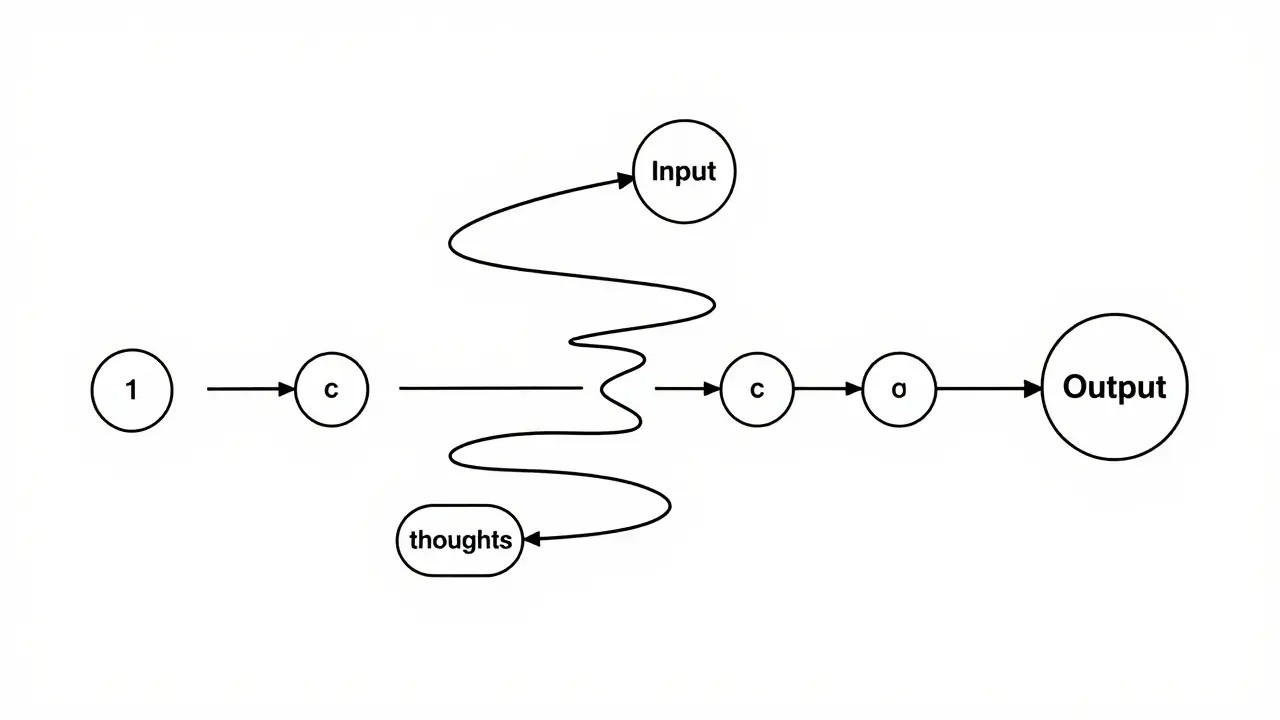
For complex reasoning tasks-like math problems, logical deductions, or multi-step analysis-standard few-shot prompting might still fall short. This is where you combine it with Chain-of-Thought (CoT) prompting. Instead of just showing the input and the final answer, you show the intermediate reasoning steps.
Imagine a prompt for calculating discounts. A standard few-shot example might look like: Input: Price $100, Discount 10% Output: $90 A CoT few-shot example looks like: Input: Price $100, Discount 10% Thought: Calculate 10% of 100, which is 10. Subtract 10 from 100. Output: $90 By explicitly modeling the thinking process, you teach the model *how* to arrive at the answer, not just what the answer is. This significantly improves accuracy on tasks requiring logic, arithmetic, or structured decision-making. The model mimics the reasoning path, reducing hallucinations and calculation errors.
When to Choose Few-Shot vs. Fine-Tuning vs. RAG
Few-shot prompting is powerful, but it isn't the solution for every problem. Knowing when to use it versus other techniques is crucial for efficient AI development.
Use Few-Shot Prompting when: - You have limited labeled data (just a handful of examples). - The task requires specific formatting or style adaptation. - You need rapid iteration and testing. - Computational resources for training are unavailable. - The task complexity is moderate and relies on pattern recognition.
Choose Fine-Tuning when: - You have large volumes of high-quality training data (thousands of examples). - Maximum accuracy and speed are critical (fine-tuned models are faster at inference). - The domain is highly specialized and distinct from general web text. - You need to embed proprietary knowledge directly into the model weights.
Opt for Retrieval-Augmented Generation (RAG) when: - The information needed is dynamic or changes frequently (e.g., current news, live inventory). - You need to ground responses in a specific, large external knowledge base. - Hallucination reduction via source citation is a priority.
In many production environments, these methods are combined. You might use RAG to retrieve relevant documents, few-shot prompting to structure the output, and chain-of-thought to ensure logical consistency. Understanding the strengths of each allows you to build robust, reliable AI systems.
Practical Checklist for Implementation
To get started with few-shot prompting today, follow this practical checklist:
- Define the Task Clearly: Write a concise instruction before your examples. Ambiguity here undermines everything else.
- Curate 3-5 High-Quality Examples: Don't guess. Test different sets. Ensure they cover common cases and edge cases.
- Order Strategically: Place the most similar example to your target query last. Recency bias in LLMs means the model pays close attention to the end of the context window.
- Add Reasoning Steps (If Needed): For complex tasks, insert "Thought:" or "Reasoning:" lines in your examples.
- Test Rigorously: Evaluate your prompt on a held-out test set. Measure accuracy, consistency, and latency.
- Iterate: If performance drops, reduce the number of examples. Check for conflicting patterns. Refine your selection method.
Remember, few-shot prompting is an iterative craft. There is no single perfect prompt. Continuous testing and refinement are key to unlocking the full potential of your language model.
How many examples should I use in few-shot prompting?
Start with 3 to 5 examples. Research shows that performance often peaks around this number. Adding more can lead to the "few-shot dilemma" where performance declines due to context window saturation or noise. Always test incrementally to find the optimal number for your specific task and model.
What is the difference between few-shot prompting and fine-tuning?
Few-shot prompting uses examples provided in the prompt context to guide the model temporarily without changing its underlying parameters. Fine-tuning involves retraining the model on a dataset, permanently altering its weights. Few-shot is faster and cheaper for small-scale tasks, while fine-tuning offers higher performance and efficiency for large-scale, specialized applications.
Does the order of examples matter?
Yes, significantly. LLMs exhibit recency bias, paying more attention to information near the end of the context window. Placing the most relevant or complex example last can improve accuracy. Additionally, ordering from simple to complex helps the model build understanding progressively.
What is the "few-shot dilemma"?
The few-shot dilemma refers to the phenomenon where adding too many examples to a prompt causes model performance to degrade. This over-prompting can occur due to context window limits, introduction of noisy or conflicting patterns, or the model becoming confused by excessive variation. It highlights that quality and relevance outweigh quantity.
How can I combine few-shot prompting with Chain-of-Thought?
Include explicit reasoning steps in your examples. Instead of just Input -> Output, use Input -> Thought Process -> Output. This teaches the model the logical steps required to solve the problem, significantly boosting accuracy on complex reasoning, math, or analytical tasks.
 Artificial Intelligence



Michael Richards
July 5, 2026 AT 15:06Stop wasting tokens on fluff. If you can't curate five perfect examples, you don't deserve to use the API. Most people here are just throwing spaghetti at the wall and wondering why it sticks. Precision is king, volume is trash. Read the section on TF-IDF again if you have to.
Andrea Alonzo
July 6, 2026 AT 13:42I really appreciate how this article breaks down the concept of in-context learning because it helps us understand that these models aren't just memorizing facts but are actually learning structures through pattern recognition which is incredibly fascinating when you think about how we can guide them with just a few carefully selected examples rather than needing expensive fine-tuning processes that require massive computational resources and specialized teams of data scientists who might not even be available to smaller organizations trying to implement AI solutions effectively in their daily workflows while maintaining high standards for accuracy and consistency across various tasks.
Saranya M.L.
July 6, 2026 AT 19:31The application of TF-IDF vectors for example selection is fundamentally superior to naive semantic embedding approaches due to its ability to isolate term frequency significance within specific document contexts thereby ensuring topical relevance without the computational overhead associated with high-dimensional vector space operations which often suffer from dimensionality curse issues in large-scale production environments where latency constraints are paramount and resource optimization is critical for maintaining service level agreements.
om gman
July 7, 2026 AT 11:35oh look another guru telling us how to prompt like we're babies lol i've been using chain of thought since before it was cool and let me tell you the real secret isn't the prompt its the model weights which you clearly dont understand because you're still stuck in the zero-shot era crying about hallucinations while ignoring the fact that most of your 'edge cases' are just bad data inputs masquerading as complex reasoning problems
Jeanne Abrahams
July 7, 2026 AT 19:02In South Africa we tend to say that too much spice ruins the stew. You add so many examples that the model forgets what the main ingredient is. It is quite amusing how Western tech circles obsess over adding more data when less is often more elegant.
Bineesh Mathew
July 8, 2026 AT 23:04The ethical implications of bias propagation through few-shot examples are profound and deeply troubling for the moral fabric of our digital society because when we select examples we are essentially curating reality itself and if we fail to include diverse perspectives we are complicit in the systemic erasure of marginalized voices which creates a feedback loop of discrimination that reinforces existing power structures and perpetuates inequality under the guise of algorithmic neutrality which is nothing short of a dystopian nightmare waiting to happen.
Oskar Falkenberg
July 10, 2026 AT 15:44i totally agree with the point about ordering examples from simple to complex because it really helps the model build up its understanding step by step kind of like how we teach kids new concepts starting with the basics and then moving on to harder stuff which makes sense intuitively and also aligns with how human cognition works so its a pretty solid strategy that anyone can implement without needing any special tools or advanced degrees in machine learning just some common sense and careful planning.
Caitlin Donehue
July 11, 2026 AT 21:24Interesting read.