

Imagine you are an expert chef who knows how to cook Italian food perfectly. Now, someone asks you to cook a traditional Thai dish. You have never cooked Thai food before, and you don't speak Thai. But because you understand the general principles of heat, flavor balance, and ingredient preparation, you can probably make something edible, even if it isn't perfect. This is exactly what Cross-Lingual Transfer is the ability of a large language model (LLM) trained primarily on one language, usually English, to perform tasks in other languages it has seen little or no labeled data for.
In the world of natural language processing (NLP), this capability is revolutionary. It means we don't need to collect millions of labeled examples in every single language on Earth to build useful AI tools. Instead, we train a massive model on high-resource languages and let it "transfer" that knowledge to low-resource ones. As of 2026, this technology powers everything from customer service bots in Swahili to medical diagnosis assistants in Urdu. But like our hypothetical chef, these models aren't perfect. They hit hard limits when the linguistic gap gets too wide.
How Cross-Lingual Transfer Actually Works
To understand why this works, you have to look under the hood of modern Large Language Models (LLMs). These models do not just memorize words; they learn representations-mathematical vectors-that capture meaning. The breakthrough came with architectures like XLM-R (Cross-lingual Language Model by Rohan et al.), which was designed to share a common latent space across 100 languages.
Here is the technical magic: XLM-R uses a shared vocabulary of 250,002 subword tokens. Whether the input is English, Japanese, or Arabic, the model breaks the text down into these tokens and maps them into the same multi-dimensional space. If the concept of "love" or "error" sits in a similar coordinate region regardless of the language, the model can apply logic learned in English to sentences in French without ever being explicitly taught French grammar rules.
- Shared Parameters: The model weights are updated during pretraining to align semantically similar concepts across different scripts.
- Zero-Shot Setting: The model is trained on labeled data in a source language (e.g., English sentiment analysis) and tested directly on a target language (e.g., Spanish sentiment analysis) with zero training examples in Spanish.
- Subword Tokenization: Using Byte-Pair Encoding (BPE) allows the model to handle rare words and diverse scripts by breaking them into familiar pieces.
This approach transformed NLP from a monolingual siloed process into a global capability. Before this, building a classifier for a low-resource language meant starting from scratch. Now, it’s a matter of leveraging existing strength.
The Strengths: Massive Gains in Low-Resource Settings
The evidence for the power of cross-lingual transfer is overwhelming and quantifiable. Let's look at the numbers from the XTREME benchmark, which evaluates models across 40 languages and 9 tasks, including question answering and named entity recognition.
When researchers compared older models like mBERT (Multilingual BERT) against the larger XLM-R Large, the results were stark. XLM-R Large outperformed mBERT by 14.6 percentage points on the XNLI natural language inference task. On MLQA (Multilingual Question Answering), the F1 score jumped by 13 percentage points. These aren't marginal gains; they represent a fundamental shift in reliability.
| Model | XNLI Accuracy (%) | MLQA F1 Score (%) | NER F1 Score (%) | Average XTREME Score |
|---|---|---|---|---|
| mBERT | ~70.0 | ~55.0 | ~68.0 | 54.1 |
| XLM-R Base | ~80.0 | ~65.0 | ~75.0 | 78.5 |
| XLM-R Large | ~84.6 | ~68.0 | ~70.4 | 65.3 (Zero-Shot Strict) |
Note that while XLM-R Large shows a lower strict zero-shot average in some specific rigorous evaluations due to overfitting risks in smaller datasets, its overall capability on complex tasks remains superior. More importantly, the XTREME-R extension showed that average performance across all models rose from 55.8 to 81.4 points between early baselines and newer iterations. That is a 25.6-point improvement in just a few years of development.
Why does this matter? Because it democratizes AI. A startup in Nairobi doesn't need a Google-sized budget to build a Swahili chatbot. They can take a pre-trained English model, apply lightweight adaptation techniques, and get functional results immediately.

The Limits: Where Transfer Breaks Down
If cross-lingual transfer were perfect, we would have solved global communication by now. But it isn't. The limitations are real, measurable, and often tied to linguistic distance.
A seminal study published at EMNLP 2020 highlighted that massively multilingual transformers still suffer substantial drops in performance when transferring to typologically distant or extremely low-resource languages. What does "typologically distant" mean? It refers to differences in script, morphology, and syntax.
- Script Mismatch: Transferring from English (Latin script) to Arabic (Abjad) or Chinese (Logographic) is harder than transferring to Spanish or French. The visual and structural cues are completely different.
- Morphological Complexity: English is relatively analytic. Languages like Turkish or Finnish are agglutinative, meaning they attach many suffixes to a root word. An English-trained model might struggle to parse the internal structure of a long Turkish word because it hasn't seen enough examples of that specific morphological pattern.
- Data Scarcity: Even with 100 languages in pretraining, some languages have very little web presence. If the model barely saw the language during pretraining, the "shared latent space" alignment is weak.
Apple’s 2026 research on linguistic similarity confirmed that transfer performance is not uniform. Transfer from English to languages sharing the Latin script and analytic syntax tends to be strong. Transfer to languages with non-Latin scripts or highly inflected grammar lags significantly behind. In extreme cases, accuracy can drop below random chance if the model hallucinates structures that don't exist in the target language.
New Techniques: Making Transfer Efficient and Precise
By 2025 and 2026, the field moved beyond simple fine-tuning. Researchers realized that retraining entire billion-parameter models for each new language was wasteful and prone to catastrophic forgetting (where the model forgets English while learning Spanish). New methods emerged to solve this.
Prefix Tuning and AdaMergeX
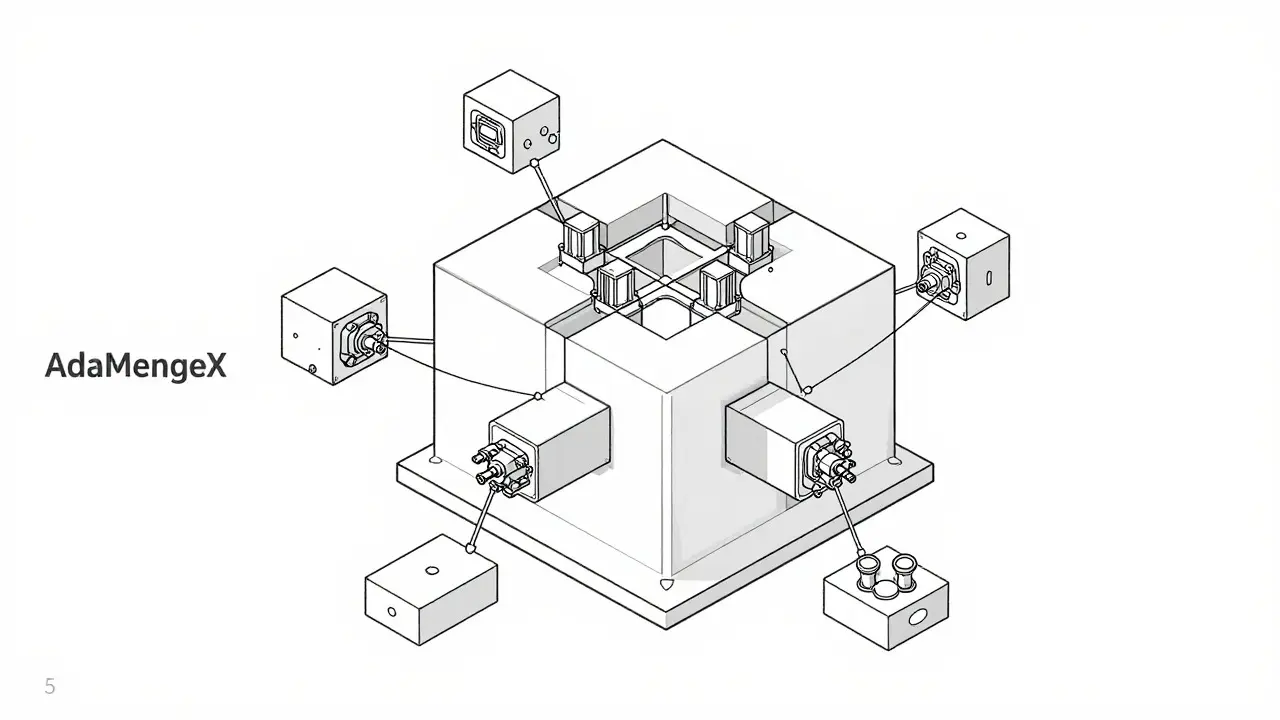
One promising approach is AdaMergeX, introduced at NAACL 2025. This framework conceptualizes transfer as merging "task ability" (learned in English) with "language ability" (learned in the target language). Instead of changing the core model, it trains small adapter modules for each language and merges them. This keeps the base model frozen and efficient.
Another technique involves prefix-based tuning. A 2025 study evaluated this method using Llama 3.1 8B and Mistral v0.3 7B. By adding only 1.23 million learned parameters (less than 0.02% of the total model size), they achieved up to a 6-percentage-point improvement on the Belebele reading comprehension benchmark across 35+ languages. This is huge. It means you can localize a massive LLM for a fraction of the cost.
Cross-Lingual Optimization (CLO)
CLO, presented at ACL 2025, offers a practical workflow for companies. It takes an English-centric LLM, uses publicly available English supervised fine-tuning (SFT) data, and a translation model to boost performance in target languages without degrading English capabilities. This preserves the "best" version of the model while extending its reach.
Practical Implications for Developers and Businesses
If you are building an NLP product today, here is how you should think about cross-lingual transfer:
- Start with Strong Encoders: For classification and extraction tasks, use encoder-based models like XLM-R Large. They offer the best zero-shot baseline.
- Use Adapters for Generative Tasks: For LLMs like Llama or Mistral, avoid full fine-tuning. Use LoRA or prefix tuning to adapt to new languages. Keep parameter updates under 1% of the total count.
- Expect Friction in Distant Languages: If your target audience speaks a language with a different script or complex morphology (e.g., Thai, Arabic, Georgian), plan for human-in-the-loop evaluation. Zero-shot will give you a start, but not production-ready quality.
- Leverage Domain Adaptation: Fine-tune on domain-specific data in English (e.g., legal contracts), then transfer to other languages. The domain knowledge transfers better than general language skills.
The market reality is clear. Companies like Apple and Meta are investing heavily in these capabilities because supporting 7,000 languages individually is impossible. Supporting 100 languages through transfer is viable. The goal is not perfection; it is utility.
Conclusion: The Future of Multilingual AI
Cross-lingual transfer has moved from a theoretical curiosity to a cornerstone of modern NLP. We have seen average benchmark scores climb from the mid-50s to the low-80s in just five years. Models like XLM-R and Llama 3.1 demonstrate that intelligence can be decoupled from language.
However, the gaps remain. Typologically distant languages still lag. Morphological complexity still trips up models. And true human-level parity across all tasks is still out of reach. The next frontier is not just scaling up parameters, but designing smarter adapters and better pretraining corpora that respect linguistic diversity. For developers, the message is simple: leverage transfer, but validate rigorously. The tool is powerful, but it is not magic.
What is cross-lingual transfer in simple terms?
Cross-lingual transfer is when an AI model trained on one language (like English) learns to perform tasks in another language (like Spanish) without being explicitly trained on labeled data in that second language. It relies on the model finding common patterns in meaning across different languages.
Which models are best for cross-lingual transfer?
For encoder-based tasks, XLM-R Large is currently considered state-of-the-art due to its training on 100 languages and CommonCrawl data. For generative tasks, Llama 3.1 8B and Mistral v0.3 7B are popular choices, especially when combined with efficient fine-tuning methods like LoRA or prefix tuning.
Does cross-lingual transfer work well for all languages?
No. It works best for languages that are typologically similar to the source language (usually English). Languages with different scripts (like Arabic or Chinese) or complex morphology (like Turkish) often see significant performance drops in zero-shot scenarios.
What is the difference between mBERT and XLM-R?
mBERT (Multilingual BERT) was trained on Wikipedia text in 104 languages. XLM-R (Cross-lingual Language Model by Rohan) was trained on a much larger dataset called CommonCrawl, covering 100 languages. XLM-R generally outperforms mBERT in cross-lingual tasks because of its larger and more diverse training data.
Can I use cross-lingual transfer for neural machine translation?
Yes. Research shows that universal encoders can enable zero-shot translation between language pairs never seen during training. However, quality is often lower than supervised translation, especially for distant language pairs. Domain adaptation can help improve results.
 Artificial Intelligence

Sabrina Newland
August 4, 2026 AT 03:09it is so wild to think about how we are basically teaching machines the concept of universal understanding without them needing to speak every single language perfectly first 🤯 it reminds me a lot of how humans learn concepts through analogy and shared experience rather than just rote memorization of facts. if an ai can understand the underlying structure of meaning across different linguistic boundaries, does that mean it is starting to grasp something closer to human consciousness or empathy? i guess we will have to wait and see but it feels like a huge step towards bridging the gap between cultures and people who dont share a common tongue. the chef analogy was perfect because cooking is also about feeling the heat and balance rather than just following a recipe exactly. hopefully this tech helps preserve endangered languages too instead of just pushing english everywhere 🌍✨
Amara Akbar
August 6, 2026 AT 01:09This is a remarkably insightful piece on the current state of NLP. The explanation of subword tokenization and shared latent spaces is particularly clear for those of us who may not have a deep background in machine learning architecture. It is encouraging to see that efficiency techniques like AdaMergeX are becoming more prevalent, as they allow smaller organizations to participate in this technological advancement without requiring massive computational resources. The democratization of AI tools through cross-lingual transfer is indeed a positive development for global communication.
Mark Harvey
August 7, 2026 AT 07:01great read man i love seeing progress like this its awesome that we can help out low resource languages now without spending millions on data collection. the part about prefix tuning saving costs is really cool too. keep up the good work with these posts they are super helpful for understanding what is going on in the industry right now. lets hope the models get even better at handling complex grammars soon
Art HND
August 7, 2026 AT 12:05Most of this is hype. The performance drops for distant languages are not minor issues they are fundamental flaws in the approach. You cannot simply map agglutinative structures onto analytic frameworks and expect parity. The benchmarks cited often ignore context-specific failures where the model hallucinates entirely wrong meanings. We are celebrating mediocrity disguised as innovation.
Brandon Olvera
August 8, 2026 AT 05:19Why do we need AI to handle other languages when English is clearly superior for technical communication anyway. This whole effort to support Swahili or Urdu seems like a waste of resources that could be better spent improving English-centric models. People should just learn English if they want to use modern technology. Stop trying to force equality where it does not belong.
Elizabeth Brooks
August 9, 2026 AT 18:41i totally agree with the point about morphological complexity being a real hurdle. working with turkish nlp tasks before showed me just how hard it is for models trained on english to parse those long suffix chains correctly. the adapter methods mentioned here like lora are definitely the way to go since full fine tuning is just too expensive and risky for catastrophic forgetting. its great to see practical advice for developers though sometimes the academic papers leave out the real world implementation details. thanks for sharing this info it really helped clarify some confusions i had about xlm-r vs mbert