
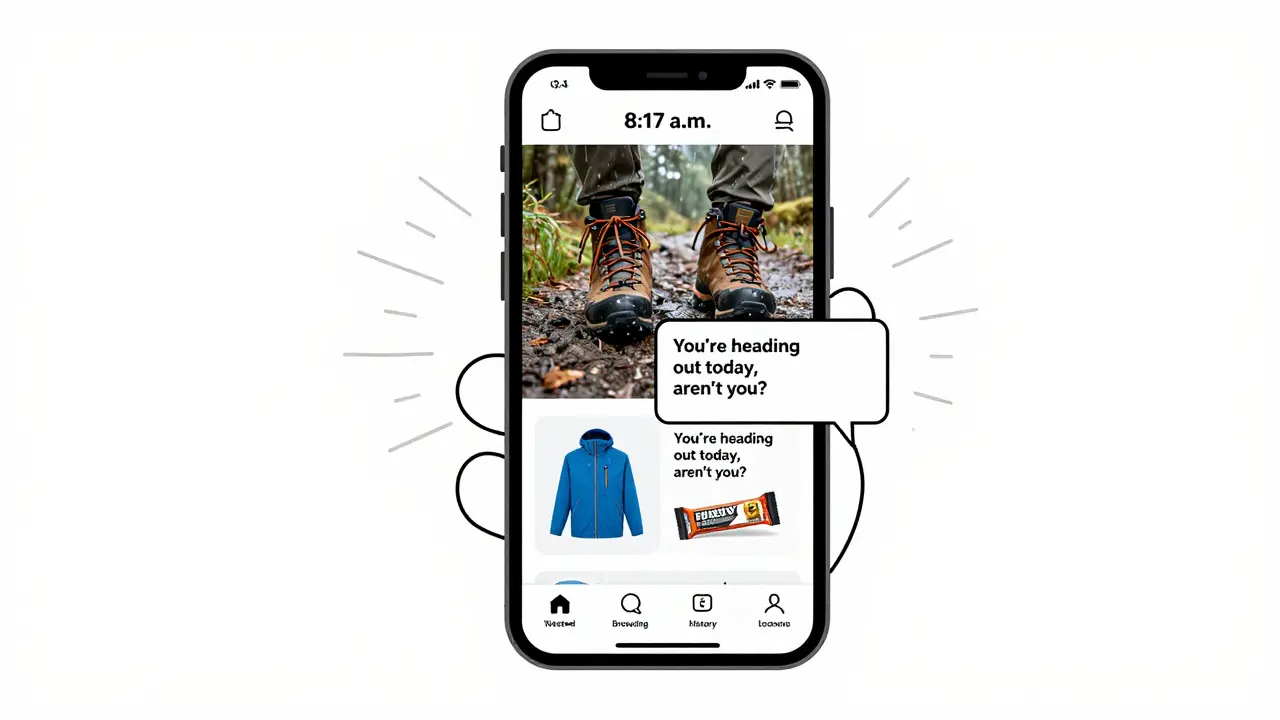
Imagine this: a customer opens your app at 8:17 a.m. on a Tuesday. They’ve browsed hiking boots last week, clicked on a rain jacket yesterday, and just searched for "best trail snacks." Before they even type anything, your system serves them a personalized feed: a video of someone wearing those boots on a rainy trail, a bundle deal with the jacket and three locally made energy bars, and a note: "You’re heading out today, aren’t you?" It’s not magic. It’s generative AI doing real-time segmentation and content creation-right now, in 2026.
Traditional personalization used to be about rules: "If they bought X, show Y." It was slow, rigid, and often wrong. Generative AI changes all that. Instead of static segments like "women aged 25-34," it builds a unique profile for every single person, in real time, using over 500 data points. Browsing behavior, time spent, device type, weather at their location, even how they reacted to past emails-all of it gets processed in under half a second. Then, it generates custom content on the fly: a product description, a discount offer, a video message, even a chatbot reply tailored to their tone.
How It Actually Works: Beyond Basic Segmentation
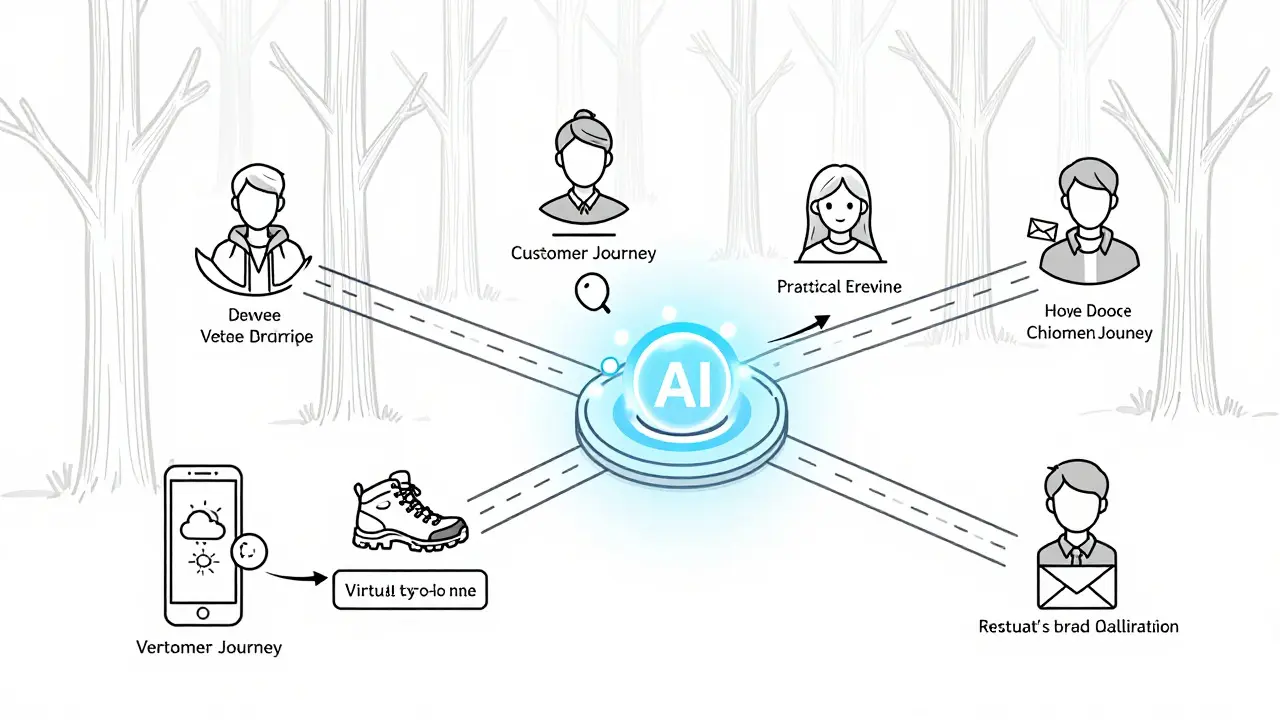
Think of customer journey personalization as a living map. Traditional systems draw lines between fixed points: homepage → cart → checkout. Generative AI turns that into a dynamic, branching forest. Each customer’s path is different, and it changes every time they interact.
Here’s how it happens:
- Customer data flows in from your website, app, email, CRM, and even in-store sensors.
- A transformer-based AI model-similar to the ones behind ChatGPT-analyzes all of it at once, spotting patterns no human could catch.
- It predicts what the customer will want next: a replacement product, a tutorial, a loyalty reward.
- Then, it writes the content: a headline, a product recommendation, a subject line, even a voice message.
- All of this happens in real time, with response times under 500ms.
That’s why companies like Sephora saw a 110% increase in conversions using AI-generated virtual try-ons. Or why a mid-sized retailer boosted email click-through rates by 27% by letting AI rewrite subject lines based on each recipient’s past behavior.
Real Numbers: What This Actually Delivers
Numbers don’t lie. Here’s what businesses are seeing in 2025 and early 2026:
- 15-20% higher customer satisfaction scores compared to rule-based systems (IrisAgent, 2025)
- 10-15% increase in revenue per customer (GrackerAI, Feb 2025)
- 37% higher conversion rates than traditional personalization (Bain & Company, 2024)
- 35% higher average order value in e-commerce from AI-driven product suggestions
- 40% more revenue from personalization activities than non-AI teams (Data Axle, 2025)
And it’s not just about sales. Customers stay longer. One SaaS company saw 22% longer session times because users felt understood-not targeted.
But here’s the catch: not every company sees these results. Success depends on how well you’ve built the foundation.
What You Need to Make This Work
You can’t just plug in an AI tool and expect miracles. This isn’t a software upgrade. It’s a system overhaul.
First, your data. Most failures happen because data is stuck in silos. Your CRM doesn’t talk to your website tracker. Your mobile app data is in a different cloud than your email platform. Generative AI needs a unified view. That means:
- A Customer Data Platform (CDP) that pulls from all channels
- Real-time streaming pipelines (Kafka, Apache Flink)
- Clear ownership: who cleans the data? Who monitors the model?
Second, your tech stack. The AI doesn’t work alone. It needs to connect with:
- Salesforce Marketing Cloud
- Adobe Experience Platform
- HubSpot
- Dynamic Yield or Insider’s Sirius AI™
Third, your team. You need more than marketers. You need:
- Data engineers who can write SQL and Python
- Marketing technologists who understand API integrations
- AI specialists who can interpret model outputs
Most companies spend 6-9 months getting this right. The average traditional personalization tool? 3-4 months. The extra time? Worth it-if you do it right.
Who’s Winning and Who’s Failing
Let’s look at two real cases.
Success: A national outdoor gear retailer
They used AI to generate personalized virtual try-on experiences for hiking boots. The system analyzed past purchases, weather data, and even local trail conditions. For someone in Seattle in February, it showed boots with extra grip and waterproofing. For someone in Arizona, it showed lightweight, breathable models. Conversion rates jumped 31%. They didn’t just sell more-they built trust.
Failure: A regional bank
They used AI to recommend financial products based on spending habits. One customer got a message: "You spent $2,147 on dining last month. Here’s a credit card with 5% cash back on restaurants." The customer felt watched. Not helped. Opt-out rates jumped 18%. They pulled the system.
That’s the line: helpful vs. creepy. Professor Michael Reynolds from MIT calls it "personalization creep." When AI gets too accurate, trust breaks. Customers don’t want to feel like they’re being watched. They want to feel understood.
Costs, Tools, and Market Reality
Enterprise platforms like Insider’s Sirius AI™ cost $50,000-$200,000 a year. Mid-market tools like Dynamic Yield start at $25,000. That’s not cheap. But here’s the thing: the ROI kicks in fast. One company recovered their $120,000 investment in 8 months through increased retention and higher average order values.
The market is exploding. It was worth $18.7 billion in 2025 and is projected to hit $42.3 billion by 2028. Retail leads adoption at 79%, followed by financial services at 72%. But even industries like manufacturing are starting to experiment, especially where purchase cycles involve multiple stakeholders.
And the players? Salesforce, Adobe, Oracle are all in. But so are specialists: Dynamic Yield (now owned by McDonald’s), Insider, Optimizely. The market is split: 45% enterprise suites, 30% vertical-specific tools, 25% point solutions. The fastest-growing? Point solutions-up 38% annually.
What’s Next? The Future Is Predictive
Right now, AI reacts. In 2026, it’s starting to anticipate.
Medallia’s new system detects emotional tone in customer messages and adjusts content accordingly. If someone sounds frustrated, the AI switches to a calming tone and offers help before they ask. Concord USA’s edge computing setup cuts latency to under 200ms-fast enough to personalize content during a live video call.
By Q3 2026, Insider says its AI will predict customer needs with 90% accuracy. No more "you might like this." Just: "Here’s what you need. You’re leaving tomorrow. We’ve got it ready."
And it’s not just text. Augmented reality is merging with personalization. Sephora’s virtual artist lets customers try on makeup using their own face. The AI adjusts lighting, skin tone, and even recommends products based on their unique features. That’s not personalization anymore. That’s presence.
Watch Out: The Risks You Can’t Ignore
There are three big traps:
- Privacy laws. GDPR and CCPA require transparency. You can’t just say "AI made this decision." You have to explain how. 43% of European implementations now add a simple explanation layer.
- Data quality. Garbage in, garbage out. If your customer data is messy, the AI will make bad calls. 78% of failed projects trace back to poor data hygiene.
- Human oversight. AI doesn’t understand nuance. A parent grieving a loss might be targeted with baby products. A sudden job loss might trigger luxury offers. You need humans in the loop to catch these moments.
Build a "personalization center of excellence"-a cross-functional team of marketers, data scientists, legal, and customer service. Let them review edge cases. Let them say no.
Where to Start: A Realistic Roadmap
If you’re new to this, don’t try to boil the ocean. Start small.
- Inventory your data. What do you have? Where is it? Who owns it? (2-4 weeks)
- Pick one channel. Email? Website? App? Pick the one with the most data and highest engagement.
- Start with demographics. Not behavior. Just age, location, device. Use AI to personalize subject lines or hero banners.
- Measure. Did open rates go up? Did bounce rates drop?
- Then add behavior. Clicks, time on page, cart abandonment.
- Finally, add real-time. Weather, location, current session activity.
That’s a 6-month journey. But by month 3, you’ll already see results.
Final Thought: It’s Not About Technology. It’s About Trust.
Generative AI personalization isn’t about being smarter than your competitors. It’s about being more human. Customers don’t want algorithms. They want someone who gets them. The best AI doesn’t just predict what you’ll buy. It knows when to stay quiet. When to apologize. When to offer help. When to say nothing at all.
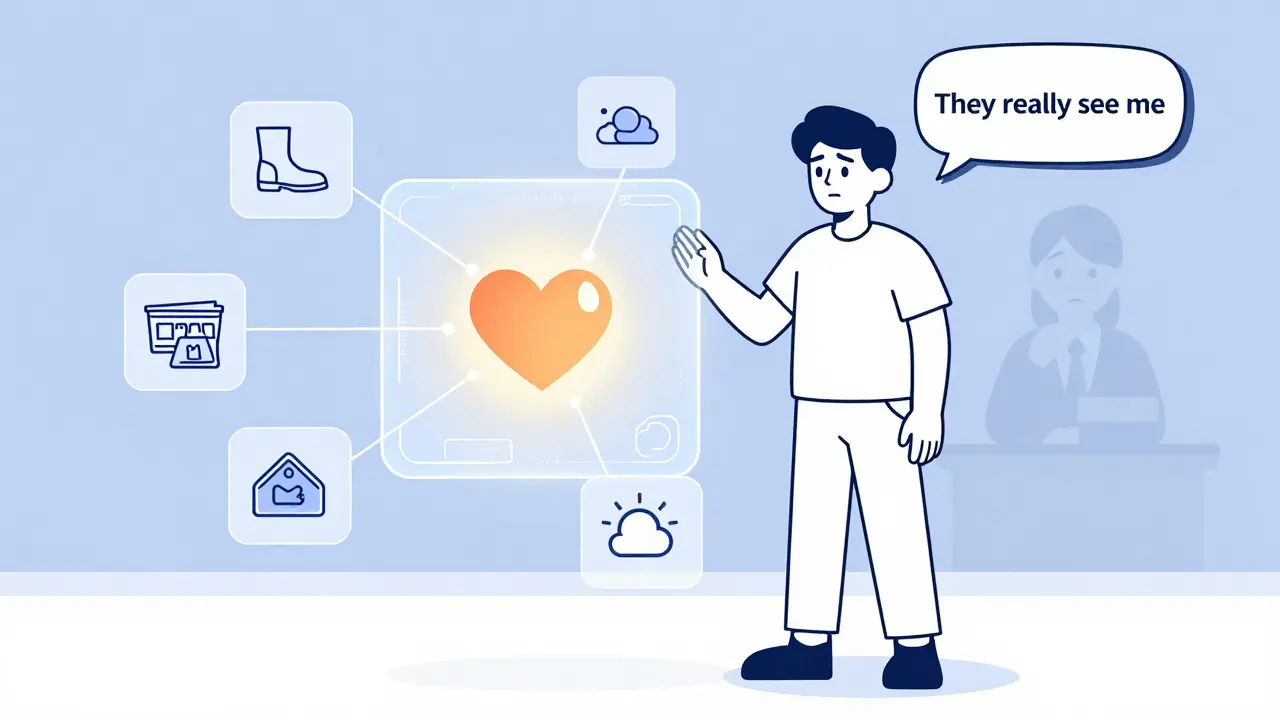
That’s the real advantage. Not the numbers. Not the speed. But the feeling: "They really see me."
Can generative AI personalize across all channels like email, web, and in-store?
Yes, but only if your systems are connected. Generative AI needs a unified customer data platform (CDP) that pulls data from email, web, mobile, CRM, and even point-of-sale systems. Without that, personalization breaks down. For example, if your website knows someone bought hiking boots but your in-store system doesn’t, they’ll get a discount on boots online but see ads for running shoes in-store. That confuses customers. Successful implementations use APIs to sync data across all channels in real time.
How long does it take to implement generative AI personalization?
Most full enterprise deployments take 6-9 months. That includes data cleanup, system integration, pilot testing, team training, and scaling. You can see small wins in 3-4 months-like improved email open rates-but full ROI requires patience. Companies that rush it often fail because they skip data quality or don’t train staff properly.
Is generative AI personalization only for big companies?
No. While enterprise tools like Salesforce Einstein or Adobe Sensei are expensive, mid-market platforms like Dynamic Yield, HubSpot’s AI tools, and Optimizely start at $20,000-$30,000 per year. Small businesses can start with basic AI features-like personalized email subject lines or product recommendations on their website. You don’t need 500 data points to begin. Start with 5. Measure. Improve.
What happens if the AI makes a mistake?
Mistakes happen. A customer might get a baby product after a miscarriage. Or someone unemployed gets luxury offers. That’s why you need human oversight. Build a review process where your team checks edge cases weekly. Use feedback loops: if customers report "this feels creepy," pause the campaign. The best systems don’t just auto-correct-they alert humans when something’s off.
Does GDPR or CCPA block generative AI personalization?
No, but they force changes. Under GDPR, customers have a "right to explanation." You can’t just say "AI did it." You need to explain how the decision was made. Many companies now include a simple note: "We used your recent browsing to suggest this." Also, some data-like location or browsing history-can’t be used without explicit consent. That’s why 43% of European implementations now add transparency layers. Compliance isn’t a barrier. It’s a design requirement.
Can generative AI replace human marketers?
Not even close. AI handles scale and speed. Humans handle nuance. AI can write 10,000 email subject lines in seconds. But only a human can decide if a message about grief, loss, or trauma is appropriate. The best teams use AI to do the repetitive work-so humans can focus on empathy, ethics, and strategy. Think of it as a co-pilot, not a replacement.
Generative AI personalization isn’t a trend. It’s becoming the baseline. By 2028, if you’re not doing it, you’ll be invisible. But if you do it right-with data, with care, with trust-you won’t just sell more. You’ll build loyalty that lasts.
 Artificial Intelligence

Mark Brantner
March 17, 2026 AT 12:07Kate Tran
March 17, 2026 AT 18:07amber hopman
March 17, 2026 AT 21:01Jim Sonntag
March 19, 2026 AT 10:16Deepak Sungra
March 21, 2026 AT 00:05Jack Gifford
March 21, 2026 AT 03:11Sarah Meadows
March 21, 2026 AT 04:47