
Why Your Model Is Failing (And It’s Not the Algorithm)
You’ve spent weeks tuning hyperparameters. You’ve upgraded to the latest GPU cluster. Yet your Generative AI is a type of artificial intelligence capable of creating new content like text, images, or code based on patterns learned from vast datasets still hallucinating facts or spitting out biased nonsense. The problem isn’t your model architecture. It’s your data.
We often treat data as a raw commodity-something we scrape, dump into a bucket, and hope for the best. But in 2026, that approach is obsolete. High-performing models don’t just need more data; they need curated data. Data curation is the unsung hero of reliable AI. It’s the difference between a model that passes a demo and one that powers a production system without legal or reputational risk.
This article breaks down how to build high-quality corpora that resist bias amplification. We’ll move beyond theory into actionable workflows, tools, and strategies that protect your models from inheriting the worst parts of the internet.
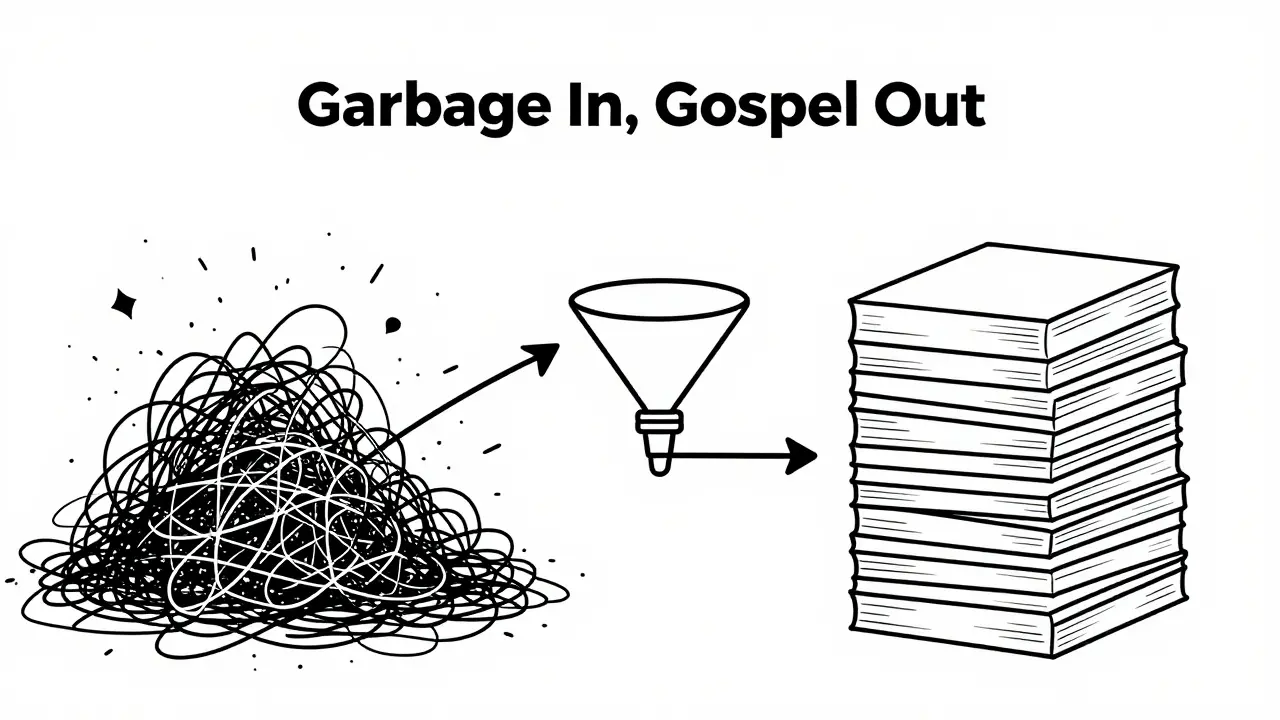
The Core Problem: Garbage In, Gospel Out
Large Language Models (LLMs) are statistical mirrors. They reflect the distribution, tone, and errors of their training data. If your dataset contains misinformation, toxic language, or skewed demographic representations, your model will amplify those traits. This is known as bias amplification.
Consider a customer service chatbot trained on public forum data. If that data contains aggressive language directed at specific demographics, the model learns to associate those demographics with conflict. When deployed, it doesn’t just replicate the bias; it generalizes it, applying stereotypes to new, unseen interactions. This isn’t a bug-it’s a feature of how transformer architectures learn probability distributions.
Data Curation is the active management and systematic preparation of data throughout its lifecycle, including cleaning, organizing, and filtering to ensure suitability for AI training. It transforms chaotic raw inputs into structured, high-signal assets. Without it, you’re not building an intelligent system; you’re building a sophisticated echo chamber.
The Three Pillars of Effective Data Curation
Building a robust corpus requires addressing three distinct challenges: quality, quantity, and fairness. Each pillar supports the others, and neglecting any one leads to model failure.
- Data Standardization: Raw web data is messy. HTML tags, broken line breaks, and inconsistent metadata create noise. Standardization involves stripping unnecessary elements, normalizing whitespace, and unifying formats. For example, converting all variations of "AI," "artificial intelligence," and "machine learning" into consistent tokens helps the model understand semantic equivalence rather than treating them as unrelated concepts.
- Data Filtering: Not all data is equal. Low-quality content, spam, and duplicate entries dilute signal. Filtering removes short, noisy snippets that provide no learning value. It also excludes PII (Personally Identifiable Information) to comply with privacy regulations like GDPR and CCPA.
- Bias Mitigation: This is where most teams struggle. Bias isn’t always obvious. It hides in underrepresented viewpoints, historical inaccuracies, and cultural blind spots. Mitigation requires active detection and rebalancing, not just passive collection.

Automated vs. Manual Curation: The Hybrid Reality
Early AI projects relied heavily on manual labeling. Teams hired annotators to review thousands of documents, tagging sentiment, entities, and toxicity. While accurate, this method didn’t scale. As datasets grew from millions to billions of tokens, manual curation became economically impossible.
Enter automated curation. Modern pipelines use machine learning algorithms to identify patterns, detect anomalies, and classify data at scale. Natural Language Processing (NLP) models can extract structure from unstructured text, flagging potential bias or low-quality segments automatically. Tools like NVIDIA NeMo Curator leverage these capabilities to clean and organize data with minimal human intervention.
However, full automation carries risks. Algorithms can miss nuanced context or reinforce existing biases if their own training data is flawed. The industry standard has shifted to a hybrid approach:
- Machine First: Automated systems handle initial screening, deduplication, and PII removal. They process high-volume data quickly, identifying obvious outliers and formatting issues.
- Human Second: Domain experts review edge cases, ambiguous samples, and flagged bias indicators. Humans provide the contextual understanding that machines lack, ensuring cultural sensitivity and factual accuracy.
This combination balances speed with precision. Machines do the heavy lifting; humans provide the guardrails.
| Feature | Manual Curation | Automated Curation | Hybrid Approach |
|---|---|---|---|
| Scalability | Low | High | High |
| Accuracy | High | Variable | High |
| Bias Detection | Strong (context-aware) | Weak (pattern-based) | Strong (combined) |
| Cost Efficiency | Low | High | Medium-High |
| Time to Deploy | Slow | Fast | Medium |
Synthetic Data: Solving Scarcity and Bias
What happens when real-world data is scarce, expensive, or ethically problematic? Synthetic data generation offers a powerful solution. By using existing models to create new, realistic data points, you can augment your training set without collecting additional sensitive information.
Synthetic Data is artificially generated data created by algorithms to mimic the statistical properties of real-world data, used to enhance training sets while preserving privacy and reducing bias. This technique is particularly useful for balancing datasets. If your medical records database lacks representation from certain demographic groups, synthetic data can fill those gaps, ensuring the model learns equitable diagnostic patterns.
Tools like NVIDIA NeMo Curator generate synthetic records using prompt templates and large language models. These records are then scored for quality using reward models. The iterative process ensures that only high-fidelity synthetic data enters the final corpus. This not only improves diversity but also enhances model robustness, helping it generalize better to unseen scenarios.
However, synthetic data isn’t a magic bullet. If the generating model is biased, the synthetic data will inherit those biases. Therefore, synthetic generation must be part of a broader curation strategy, not a replacement for careful oversight.
Technical Workflows for Bias-Resistant Corpora
Implementing effective data curation requires a structured pipeline. Here’s how leading organizations approach it:
- Data Identification: Define what data you need and where to source it. Ensure sources are diverse enough to minimize inherent bias. For computer vision, this means selecting images with varied lighting, angles, and subjects. For text, it means including multiple dialects, registers, and perspectives.
- Cleaning and Annotation: Correct errors, handle missing values, and annotate data if necessary. Use self-supervised learning techniques like SimCLR to extract embeddings from raw data. These embeddings help compute similarity matrices, detecting redundancy and prioritizing unique, informative samples.
- Transformation and Integration: Normalize and merge data from different sources. Add metadata and documentation to track lineage. Clear ownership and documentation prevent confusion about which data was used for training, crucial for auditability and compliance.
- Storage and Sharing: Store curated datasets in secure repositories or data warehouses. Platforms like LightlyOne allow teams to register datasets directly through web interfaces, ensuring version control and accessibility.
Active learning plays a key role here. Instead of labeling all data upfront, the model identifies uncertain predictions during inference. Curators then focus on labeling these ambiguous cases, improving efficiency and targeting areas where the model is weakest.

Emerging Trends: Edge Computing and Federated Learning
The future of data curation extends beyond central servers. Two emerging trends are reshaping how we handle data:
Edge Computing: Processing data closer to its source reduces latency and enables real-time decision-making. In IoT environments, devices can curate and filter data locally before sending only relevant insights to the cloud. This enhances speed and reliability, especially for high-velocity data streams.
Federated Learning: This technique allows multiple parties to collaborate on AI projects without sharing sensitive data directly. Each participant trains a local model on their own data, then shares only the model updates with a central server. This promotes privacy-preserving data curation, enabling collaboration across healthcare, finance, and other regulated industries without violating data sovereignty laws.
Both approaches emphasize decentralization and security, aligning with growing demands for ethical AI practices.
Practical Tips for Implementing Data Curation
Getting started with data curation doesn’t require a massive budget. Here are actionable steps to improve your current workflow:
- Audit Your Sources: Review where your data comes from. Are you over-relying on a single platform? Diversify your sources to capture broader perspectives.
- Use Embedding-Based Selection: Leverage self-supervised models to detect redundant data. Removing duplicates and near-duplicates reduces dataset size without sacrificing quality, lowering annotation costs and improving model generalization.
- Involve Domain Experts: Curators translate domain knowledge into structured form. Collaborate with subject matter experts to identify subtle biases and ensure technical terms are standardized correctly.
- Monitor Continuously: Data curation isn’t a one-time task. As models uncover gaps or uncertain cases, adapt your pipeline. Use active learning to prioritize new labeling efforts based on model performance.
- Document Everything: Maintain clear records of data lineage, transformations, and curation decisions. This supports auditability, compliance, and reproducibility.
Conclusion: Quality Over Quantity
In the race to build smarter AI, it’s easy to get distracted by model size and compute power. But the foundation of any successful generative AI system is high-quality, well-curated data. By implementing robust curation workflows, leveraging hybrid automation, and embracing synthetic data responsibly, you can build models that are not only accurate but also fair and reliable.
Remember, your model is only as good as the data you feed it. Invest in curation today, and you’ll reap the rewards of trustworthy AI tomorrow.
What is data curation in the context of Generative AI?
Data curation for Generative AI involves the systematic collection, cleaning, organization, and filtering of data to prepare it for training large language models. It includes removing duplicates, PII, and toxic content, as well as standardizing formats and mitigating bias to ensure model accuracy and fairness.
How does bias amplification occur in AI models?
Bias amplification occurs when AI models learn and exaggerate biases present in their training data. If the data contains skewed representations, stereotypes, or misinformation, the model generalizes these patterns, leading to unfair or inaccurate outputs in real-world applications.
What is the role of synthetic data in reducing bias?
Synthetic data helps reduce bias by filling gaps in underrepresented categories within training datasets. By generating realistic but artificial data points, developers can balance datasets, ensuring models learn equitable patterns without relying solely on potentially biased real-world data.
Why is a hybrid approach to data curation recommended?
A hybrid approach combines automated tools for scalability and speed with human oversight for accuracy and context. Automation handles large volumes of data efficiently, while humans detect nuanced biases and edge cases that algorithms might miss, resulting in higher quality and more reliable datasets.
How can federated learning improve data privacy?
Federated learning allows multiple parties to train AI models collaboratively without sharing raw data. Each participant keeps their data local, sharing only model updates. This preserves privacy and complies with data protection regulations while still enabling collective improvement of the AI model.
 Artificial Intelligence

Patrick Dorion
July 2, 2026 AT 10:28It is fascinating to consider that the 'intelligence' of a model is merely a reflection of its dietary intake, so to speak. We often forget that data is not just information but a cultural artifact carrying the weight of human history and bias. The article rightly points out that standardization is more than just cleaning up HTML tags; it is about creating semantic coherence in a chaotic world. I have found that when we treat data curation as an ethical practice rather than a technical chore, the results are significantly more robust. It forces us to ask difficult questions about what we value enough to include in our training sets. This philosophical approach to data hygiene is something we need more of in the industry.
Lisa Puster
July 2, 2026 AT 15:50typical woke nonsense trying to police algorithms with subjective moral frameworks
Michael Richards
July 3, 2026 AT 00:47You are completely missing the point here. Bias amplification is a measurable statistical phenomenon, not some political agenda. If your model outputs toxic content because your dataset was scraped from unmoderated forums, that is a failure of engineering, not philosophy. You need to implement rigorous filtering pipelines and stop hiding behind complaints about 'subjective frameworks'. Real professionals deal with the data they have and clean it effectively using automated tools combined with expert review. Ignoring this leads to legal liability and reputational damage for any serious organization.
Marissa Haque
July 3, 2026 AT 17:30Oh my goodness!!! This is such an incredibly important topic!!! I cannot stress enough how crucial the hybrid approach is!!! Automation alone is just so dangerous!!! We need humans in the loop to catch those subtle nuances!!! It makes me so anxious when I see companies relying solely on automated scraping!!! The potential for disaster is just huge!!! We must prioritize quality over quantity at all costs!!!
Joe Walters
July 4, 2026 AT 16:23look i worked on a project last year where we tried to do full automation and it was a total mess. the model kept hallucinating weird medical advice because it picked up on some obscure forum posts. we had to bring in domain experts to manually review the flagged samples. it was slow and expensive but honestly better than having a lawsuit on our hands. synthetic data helped fill some gaps but you cant just trust the generator blindly either. gotta be careful.
Keith Barker
July 6, 2026 AT 08:13the nature of truth in ai is constructed by the data we feed it. if the data is flawed the truth is flawed. it is a mirror reflecting our collective digital shadow.
Robert Barakat
July 7, 2026 AT 00:12The integration of federated learning presents a compelling paradigm shift for privacy-preserving curation. By decentralizing the training process, we mitigate the risks associated with centralized data lakes while maintaining model efficacy. This approach aligns with the broader trend towards ethical AI governance. However, the computational overhead remains a significant challenge that requires further optimization before widespread adoption can occur.