
You’ve spent months scraping the web, cleaning up HTML tags, and filtering out junk. You have billions of tokens ready to feed into your Large Language Model (LLM). But here’s the catch: a huge chunk of that data is just noise. Not random noise, but repeated content. The same news article syndicated across fifty sites. The same Stack Overflow answer copied into three different blogs. If you train on this without cleaning it up, your model wastes GPU cycles memorizing the same sentence over and over again. It learns nothing new, and worse, it might start hallucinating because it thinks a rare fact is common knowledge just because it appeared in ten duplicate documents.
This isn’t just about saving storage space. Deduplication is a core optimization lever for modern LLMs. Research shows that proper deduplication can improve training efficiency by around 20% and boost downstream accuracy by up to 2 percentage points. That’s massive when you’re talking about billion-parameter models. But how do you actually do it? You can’t just run a simple "find duplicates" command on trillions of records. You need a layered strategy. This guide breaks down the three main approaches-exact, fuzzy, and semantic deduplication-and shows you how to combine them into a pipeline that scales.
Why Your Model Needs Less Repetition
Before we dive into the algorithms, let’s talk about why this matters. When an LLM sees the same text multiple times, it assigns higher probability to those patterns. If a specific phrase appears in 100 duplicate documents, the model thinks it’s extremely common. This skews the distribution of your training data. You end up with a model that is biased toward whatever happened to be duplicated most often on the web, rather than what is actually representative of language or facts.
There are two main problems with skipping deduplication:
- Inefficient Training: You spend compute resources processing redundant information. Every epoch costs more time and money because you’re re-learning things the model already knows.
- Memorization and Overfitting: Duplicates increase the risk of the model memorizing specific strings instead of learning general patterns. This hurts generalization, meaning the model performs worse on tasks it hasn’t seen before.
NVIDIA’s technical guidance explicitly frames deduplication as a critical step in text data processing. They argue that without it, you’re effectively shrinking the diversity of your dataset while inflating its size. A corpus with high redundancy has less effective information density than a smaller, cleaner corpus. So, the goal isn’t just to remove copies; it’s to maximize the unique signal per token.
Exact Deduplication: The Low-Hanging Fruit
Start with the easiest problem to solve. Exact deduplication is the process of identifying and removing documents that are bit-for-bit identical or identical after basic normalization. Think of it as finding literal copy-paste errors. This is fast, cheap, and should always be your first pass.
The standard method here is hashing. You take the text of each document, normalize it (lowercase, strip whitespace, handle Unicode), and then run it through a cryptographic hash function like SHA-256 or MD5. If two documents produce the same hash, they are considered exact duplicates. You keep one and discard the rest.
Why does this work so well? Because it’s O(N) complexity. You don’t compare every document against every other document. You just store hashes in a set. If a hash exists, skip the document. If not, add it. This scales trivially to billions of documents. Tools like Apache Spark or even simple Python scripts with disk-backed databases can handle this efficiently.
However, exact dedup has a major blind spot. It misses near-duplicates. If someone changed a single word in a headline, or added a copyright footer at the bottom of a page, the hash changes completely. To the exact dedup algorithm, these are two completely different documents. In reality, they contain 99% of the same information. Relying only on exact dedup leaves a lot of redundancy on the table.
Fuzzy Deduplication: Catching Near-Duplicates
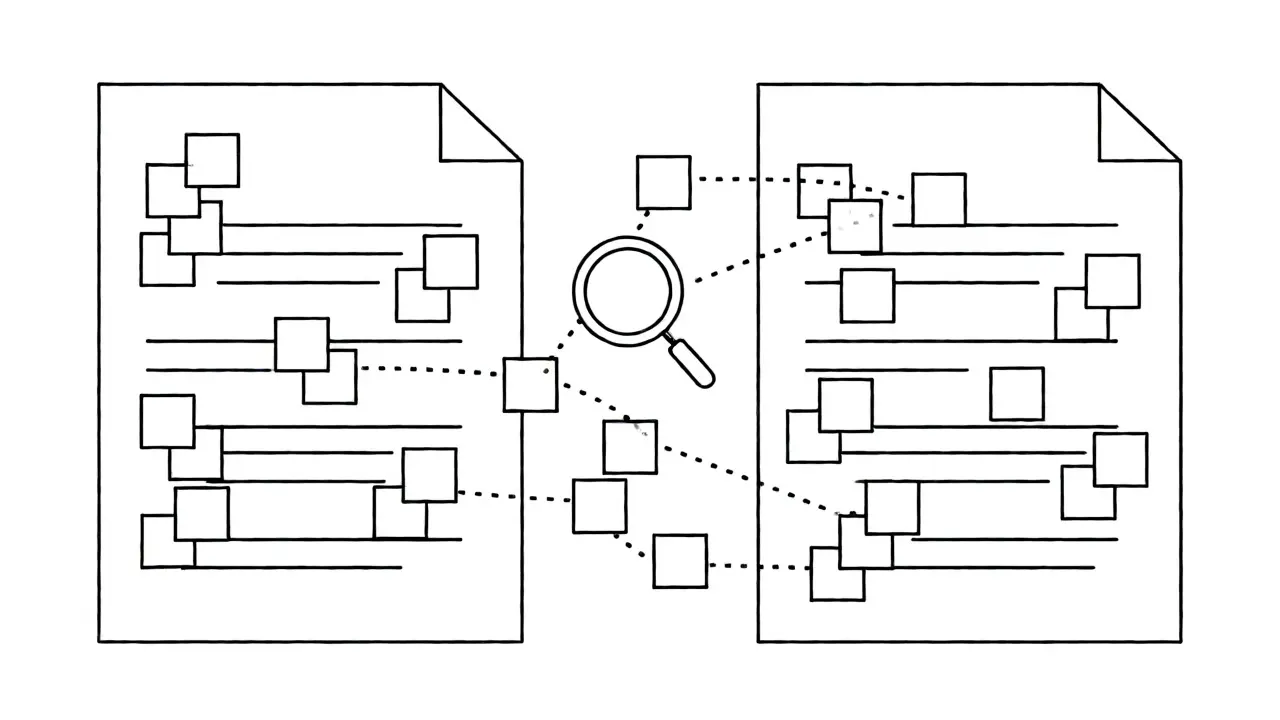
Once you’ve removed the obvious copies, you need to tackle the sneaky ones. Fuzzy deduplication is a technique that identifies near-duplicate documents based on surface-level similarity measures like shared n-grams. This approach assumes that if two documents share a large fraction of their local phrases, they are likely duplicates.
The industry standard for this involves two key concepts: shingling and Jaccard similarity.
Shingling means breaking a document into small, overlapping chunks called shingles. For example, if you use 5-token shingles, the sentence "The quick brown fox jumps" becomes a set of sets like {"The", "quick", "brown", "fox", "jumps"}, {"quick", "brown", "fox", "jumps", "over"}, and so on. Each document is now represented as a set of these shingles.
Jaccard Similarity measures how much two sets overlap. It’s calculated as the size of the intersection divided by the size of the union. If Document A and Document B share 80% of their shingles, their Jaccard similarity is 0.8. Practitioners often set a threshold, say 0.8 or 0.85. Any pair above that threshold is flagged as a duplicate.
But wait. Comparing every document against every other document using Jaccard similarity is computationally impossible for web-scale datasets. That’s where MinHash comes in. MinHash is a probabilistic algorithm that estimates Jaccard similarity by comparing compact signatures rather than full sets. Instead of storing all shingles, you generate a short signature for each document. If the signatures match closely, the original documents are likely similar.
To make this even faster, you combine MinHash with Locality Sensitive Hashing (LSH). LSH groups similar items into buckets so you only compare candidates within the same bucket. This reduces the number of comparisons from N² to something manageable. Zilliz, a leader in vector database technology, highlights MinHash LSH as a key method for handling trillion-scale corpora.
| Strategy | Mechanism | Computational Cost | Detection Capability |
|---|---|---|---|
| Exact | Hash matching (SHA/MD5) | Very Low | Identical strings only |
| Fuzzy | MinHash + LSH + Shingles | Moderate | Near-duplicates (typos, edits) |
| Semantic | Embedding Cosine Similarity | High | Paraphrases, translations |
Semantic Deduplication: Understanding Meaning
Exact and fuzzy methods look at the surface form of the text. They care about words and characters. But sometimes, two documents use completely different words to say the same thing. This is where Semantic deduplication shines. Semantic deduplication uses vector embeddings to measure the conceptual similarity between documents, regardless of their wording.
Here’s how it works: You pass each document through a pretrained embedding model (like Sentence-BERT or a specialized LLM encoder). This converts the text into a high-dimensional vector. Two documents that mean the same thing will have vectors that point in roughly the same direction. You measure this using cosine similarity. If the cosine similarity exceeds a certain threshold (e.g., 0.95), you flag them as duplicates.
This is powerful because it catches paraphrases. Consider these two sentences:
1. "Apple Inc. reported strong quarterly earnings today."
2. "Today, Apple announced impressive financial results for the quarter."
Exact and fuzzy dedup would miss this. Semantic dedup catches it immediately.
However, semantic dedup is expensive. Generating embeddings for billions of documents requires significant GPU power. Then, searching for similar vectors among billions of others requires efficient approximate nearest neighbor (ANN) search infrastructure, such as Milvus or Faiss. You can’t just brute-force this.
Recent research, like the D4 paper, suggests that semantic dedup shouldn’t necessarily delete data. Instead, it can guide data selection. By identifying clusters of semantically similar documents, you can choose the most diverse representatives or down-weight the redundant ones. This preserves the distribution of the data while reducing noise.
The Soft Approach: Reweighting Instead of Deleting
Hard deletion-removing documents entirely-is risky. What if your fuzzy threshold is too aggressive? You might delete legitimate examples that just happen to share boilerplate code or common phrases. This distorts your training distribution.
A newer trend, exemplified by methods like SoftDedup, proposes reducing the sampling weight of redundant data points rather than deleting them. Imagine you have 100 copies of a popular news article. Instead of keeping 1 and deleting 99, you keep all 100 but assign each a probability of being sampled during training that is 1/100th of a unique document.
This approach maintains the integrity of the dataset. The model still sees the common pattern, ensuring it doesn’t forget it, but it doesn’t over-optimize for it. It balances efficiency with coverage. For many teams, this is safer than hard deletion, especially when thresholds are hard to tune.
Building a Multi-Stage Pipeline
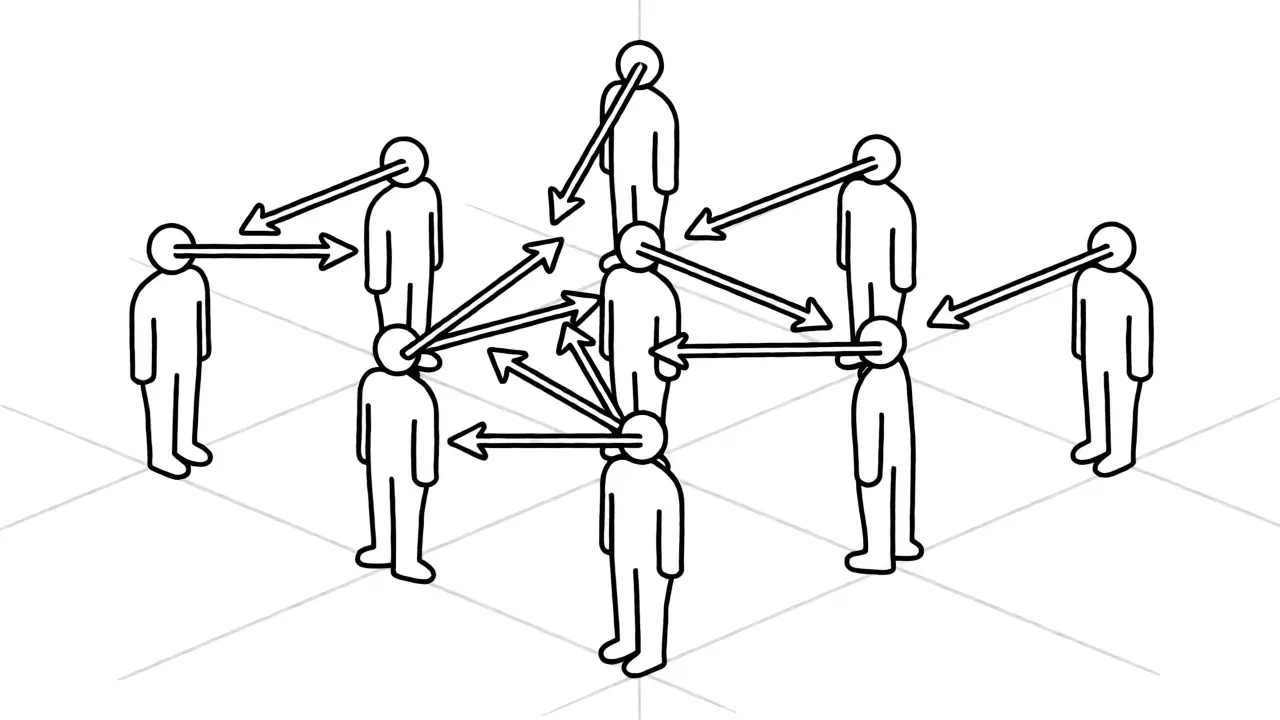
You rarely use just one of these methods. The best practice, recommended by NVIDIA and practitioners like Matti Lyra, is a multi-stage pipeline. Here is a proven workflow:
- Preprocessing: Normalize text (lowercase, unicode fix), detect language, and filter out very short or very long documents.
- Exact Dedup: Run hash-based deduplication. This is cheap and removes the bulk of literal copies. Do this first to reduce the load for subsequent steps.
- Fuzzy Dedup: Apply MinHash LSH with shingling. Tune your Jaccard threshold (start at 0.8). This catches near-duplicates like edited articles or scraped variations.
- Substring Dedup (Optional): Use suffix arrays to find and remove repeated substrings (like license headers or footers) that span across documents.
- Semantic Dedup/Reweighting: Generate embeddings for the remaining data. Use ANN search to find semantic clusters. Either remove outliers or apply soft weighting to reduce the influence of highly redundant clusters.
Lyra’s experiments showed that this "kitchen sink" configuration achieves performance comparable to much more expensive brute-force methods but at a fraction of the cost. The key insight is that exact dedup provides the biggest bang for the buck initially, while fuzzy and semantic steps provide incremental gains that justify their cost only if you’re aiming for state-of-the-art results.
Pitfalls and Practical Tips
Don’t treat deduplication as a black box. Here are some traps to avoid:
- Tuning Thresholds: There is no universal "correct" Jaccard threshold. 0.8 might work for news articles but fail for code repositories. Always validate on a small subset and check for false positives. Are you deleting distinct documents?
- Ignoring Boilerplate: Code snippets and legal disclaimers often cause false fuzzy matches. Consider masking common boilerplate before shingling.
- Compute Budget: Semantic dedup is heavy. If you have limited GPUs, stick to exact and fuzzy. Save semantic for fine-tuning datasets or high-value pretraining runs.
- Data Leakage: Ensure your deduplication logic doesn’t accidentally remove test set examples if you’re doing this in a unified pipeline. Keep validation/test splits separate until the end.
Deduplication isn’t glamorous. It’s plumbing. But bad plumbing ruins the house. By layering exact, fuzzy, and semantic strategies, you ensure your LLM learns from diverse, high-quality signals rather than echoing the internet’s loudest, most repetitive voices.
What is the difference between exact and fuzzy deduplication?
Exact deduplication identifies documents that are character-for-character identical, typically using hashing. Fuzzy deduplication identifies near-duplicates that may differ slightly due to edits, formatting changes, or minor content variations, usually employing techniques like MinHash and Jaccard similarity to measure overlap.
Is semantic deduplication worth the computational cost?
For large-scale pretraining, yes. While generating embeddings is expensive, studies like D4 show it can improve training efficiency by ~20% and downstream accuracy by up to 2%. It captures paraphrases and translations that exact and fuzzy methods miss, leading to better model generalization.
How do I choose a Jaccard similarity threshold for fuzzy dedup?
There is no one-size-fits-all value. Common starting points are 0.7 to 0.8. You should empirically tune this by analyzing samples of pairs above and below the threshold. Check if the "duplicates" are truly redundant or just topically similar. Adjust based on your specific domain (e.g., code vs. news).
Can I use soft deduplication instead of deleting data?
Yes. Methods like SoftDedup suggest down-weighting redundant samples rather than deleting them. This preserves the dataset's statistical distribution while reducing the impact of over-represented content, which can be safer than hard deletion if your thresholds are uncertain.
What tools are commonly used for LLM data deduplication?
Common tools include Apache Spark for distributed processing, Datasketches for MinHash implementations, and vector databases like Milvus or Faiss for semantic similarity search. Libraries like Hugging Face Datasets also offer built-in deduplication features.
 Artificial Intelligence