Imagine typing a rough idea into your editor and watching an AI assistant not just autocomplete the next line, but restructure your entire module to fit a specific legacy framework you’ve been maintaining for a decade. That is the essence of vibe coding. It’s no longer about rigid syntax; it’s about flow, context, and seamless collaboration between human intent and machine execution. As we move deeper into 2026, this shift has fundamentally changed how we view open-source software. It’s no longer just a cost-saving measure or a privacy shield. It has become the primary engine for creating personalized, high-performance development environments that closed-source giants often struggle to match due to their one-size-fits-all nature.
The landscape is complex. While enterprise reports suggest a dip in general open-source adoption, the coding niche tells a different story. Developers are increasingly turning to specialized open-source Large Language Models (LLMs) to achieve that 'good vibe'-a frictionless state where the tool disappears and the code flows. This article breaks down the key models driving this era, the community patterns sustaining them, and the practical realities you need to know before diving in.
What Defines the Vibe Coding Era?
Vibe coding emerged prominently between 2024 and 2025 as open-source LLMs crossed a critical threshold of proficiency. Before this point, AI assistants were largely autocomplete tools-helpful, but interruptive. Now, they act as collaborative partners. The term itself, popularized by developers on platforms like Reddit and Hacker News, describes a state of mind where the cognitive load of remembering syntax or boilerplate vanishes. You focus on logic and architecture, while the AI handles the tedious details.
This shift wasn’t driven by a single event but by a convergence of technical breakthroughs. Models began supporting significantly larger context windows, allowing them to ingest entire codebases rather than isolated snippets. They also improved drastically in 'agentic' tasks-meaning they could plan multi-step edits, run tests, and fix errors autonomously. For the open-source community, this meant moving from merely replicating closed-source capabilities to innovating in areas where customization matters most.
Key Open-Source Models Powering the Shift
Not all open-source models are created equal. In the vibe coding era, specialization is king. General-purpose models often lack the depth required for complex refactoring or legacy code maintenance. Here are the standout performers currently shaping the ecosystem:
- DeepSeek-R1 is an open-source model renowned for its significant advancements in reasoning capabilities. It uses reinforcement learning with verifiers to ensure code accuracy, making it ideal for complex logical structures.
- Kimi-Dev-72B is a specialized coding model featuring a 256,000-token context length. This allows developers to feed entire large repositories into the model for extensive planning and editing loops without losing context.
- Qwen3-Coder-480B is a massive 480-billion parameter model specifically optimized for agentic coding workflows. It targets autonomous programming tasks, handling multi-file changes with high precision.
- GPT-OSS-120B is OpenAI’s open-weight release designed for local deployment, bringing enterprise-grade reasoning and sophisticated tool calling to single-GPU setups.
These models aren't just competing on raw speed. They are competing on 'vibe quality'-how naturally they integrate into a developer's workflow. Benchmarks show these specialized models achieving 78-85% on HumanEval coding evaluations, often outperforming general-purpose counterparts by 12-15 percentage points on coding-specific tasks.
Community Patterns: How Developers Actually Use These Tools
The technology is only half the story. The other half is the community pattern that supports it. In the past, using open-source AI was a solo endeavor. Today, it’s a collaborative ecosystem. The most successful implementation pattern involves 'community fine-tuning.' Developer groups take base models like Llama 3 or Qwen3 and create specialized variants tailored to specific frameworks or languages.
GitHub hosts over 1,200 fine-tuned coding models based on Llama 3 alone. The top variants show 18% better performance on specific framework-related tasks than the base model. This isn't just hobbyist tinkering; it’s a structured approach to solving niche problems. If you work heavily with Rust or legacy COBOL, you don't wait for a major lab to release a dedicated model. You find or build a community variant that understands your specific pain points.
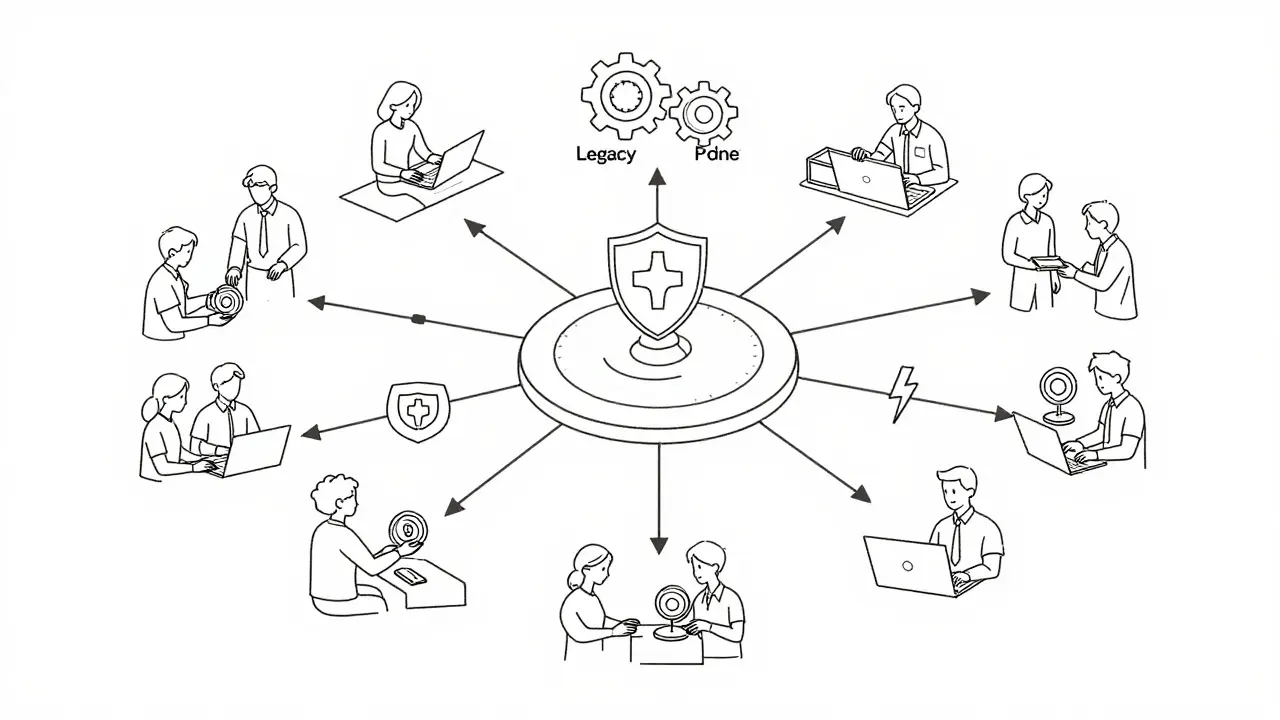
Another emerging pattern is the 'hybrid stack.' Mid-sized tech companies (200-2,000 employees) are leading this trend, with 48% maintaining hybrid approaches. They use closed-source models for quick prototyping where absolute peak performance is needed, and open-source models for production environments where data privacy, cost control, and customization are paramount. This isn't an either/or choice; it's a strategic allocation of resources.
The Reality Check: Performance vs. Customization
Let’s be honest: open-source models still face challenges. A mid-year 2025 market update noted that only 13% of total AI workloads use open-source models, down from 19% six months prior. Why? Because for many enterprises, the convenience of a closed API outweighs the benefits of ownership. Closed-source leaders like Anthropic’s Claude series have captured significant market share by offering slightly higher performance ceilings in complex reasoning tasks.
However, this statistic misses the nuance of the coding niche. While general AI workloads may be consolidating around closed models, specialized coding applications show stronger open-source retention. 62% of code review automation systems and 55% of internal documentation generators rely on open-source models. Why? Because these tasks require strict adherence to internal standards, which closed models often ignore unless explicitly prompted in expensive, repetitive ways. With open-source, you can bake those standards directly into the model weights via fine-tuning.
| Model | Parameters | Context Length | Primary Strength | Best For |
|---|---|---|---|---|
| DeepSeek-R1 | 671B (MoE) | 128K | Reasoning & Accuracy | Complex Logic & Refactoring |
| Kimi-Dev-72B | 72B | 256K | Long Context Analysis | Large Codebase Audits |
| Qwen3-Coder-480B | 480B | 128K | Agentic Workflows | Autonomous Multi-Step Edits |
| GPT-OSS-120B | 117B | 128K | Local Deployment Ease | Single-GPU Enterprise Setups |
Practical Implementation: Getting Started Without the Headache
Setting up these models used to be a nightmare of dependency conflicts and hardware sizing. That’s changing. Tools like Ollama and Cake AI have simplified integration, allowing developers to deploy open-source models into secure, scalable systems with minimal friction. If you have experience with Ollama, you can likely become proficient with local deployment in 2-3 days. Newcomers might need 1-2 weeks, but the curve is flattening rapidly.
Hardware requirements have also dropped dramatically. While 70B-parameter models typically need at least 24GB of VRAM, quantization techniques allow for significant trade-offs. 4-bit quantization reduces quality by only 8-12% but enables single-GPU deployment. For many teams, this is the sweet spot: good enough performance for daily coding tasks, without the cost of a multi-GPU cluster.
Documentation quality varies, so choose your model based on community support as much as benchmarks. The Qwen3 series documentation, for instance, scores highly among developers for consistent examples, whereas other major releases have faced criticism for sparse coding-specific guidance. Always check the GitHub issues and community forums before committing to a model for production.

Future Trends: Where Is This Heading?
As we look toward 2027, the consensus is that open-source will maintain a 25-30% market share in coding applications. It won't dominate every corner, but it will own the niches where customization is non-negotiable. Sectors requiring data privacy, such as healthcare and finance, will continue to lean heavily on local, open-source deployments. Embedded systems and legacy codebases will benefit from community fine-tunes that understand obscure, outdated technologies that major labs have little incentive to support.
The 'vibe' aspect will deepen. We’re moving toward interfaces where you describe the outcome ('make this API more resilient') rather than the code ('add retry logic'). Open-source models, with their flexibility, are perfectly positioned to handle this natural language-to-code translation in ways that respect your specific architectural constraints. The future isn't just about faster code generation; it's about more intuitive, human-centric collaboration.
Frequently Asked Questions
Is open-source AI really better for coding than closed-source?
It depends on your needs. Closed-source models often have a slight edge in raw reasoning performance for general tasks. However, open-source models excel in customization, data privacy, and cost control. If you need to adhere to strict internal coding standards or keep proprietary code off the cloud, open-source is often the superior choice due to the ability to fine-tune the model locally.
What is the minimum hardware requirement for running these models?
For 70B-parameter models, you generally need at least 24GB of VRAM. However, using 4-bit quantization can reduce this requirement, allowing some models to run on single GPUs with less memory, albeit with a minor drop in output quality (around 8-12%). Smaller models like 7B or 13B can run on consumer hardware but offer less capability for complex coding tasks.
What does 'vibe coding' actually mean in practice?
Vibe coding refers to a development style where the AI assistant feels like a seamless partner rather than a tool. It involves high-context interactions where the AI understands the broader project structure and intent, reducing friction and allowing developers to focus on high-level logic. It’s characterized by low latency, accurate context retention, and natural language interaction.
Should I use a hybrid approach with both open and closed models?
Many mid-sized companies do. A common strategy is to use closed-source models for rapid prototyping or when absolute peak performance is required for a specific difficult problem, and open-source models for daily development, code reviews, and production environments where data privacy and cost predictability are important. This leverages the strengths of both ecosystems.
How do community fine-tunes improve coding performance?
Community fine-tunes adapt base models to specific frameworks, languages, or coding styles. By training on curated datasets of high-quality code from a specific domain, these models learn the idioms and best practices of that niche. Top fine-tuned variants can show up to 18% better performance on relevant tasks compared to the unmodified base model, making them far more effective for specialized projects.
 Artificial Intelligence