You built a slick app in a weekend. The UI is buttery smooth, the features are addictive, and users are signing up faster than you can say "deploy." But then the legal team (or your own conscience) asks: "Do we actually need that user's date of birth? And did they really agree to be tracked?" If you're a vibe coder-someone who builds fast, iterative products using AI tools and modern frameworks-you might think GDPR is just a scary acronym for enterprise lawyers. It’s not. It’s a set of constraints that, if ignored, can cost you up to €20 million or 4% of global turnover. Worse, it kills user trust.
The good news? You don't need a law degree to comply. You need to understand two core concepts: Data Minimization and Consent Flows. This guide cuts through the legalese and gives you practical engineering and UX patterns to keep your vibe-coded apps compliant, fast, and trusted.
What Is Data Minimization (And Why Your App Fails It)
Data Minimization is defined in Article 5(1)(c) of the GDPR as the principle that personal data must be adequate, relevant, and limited to what is necessary for the purposes for which it is processed. In plain English: stop hoarding data. Just because you *can* collect a field doesn’t mean you *should*.
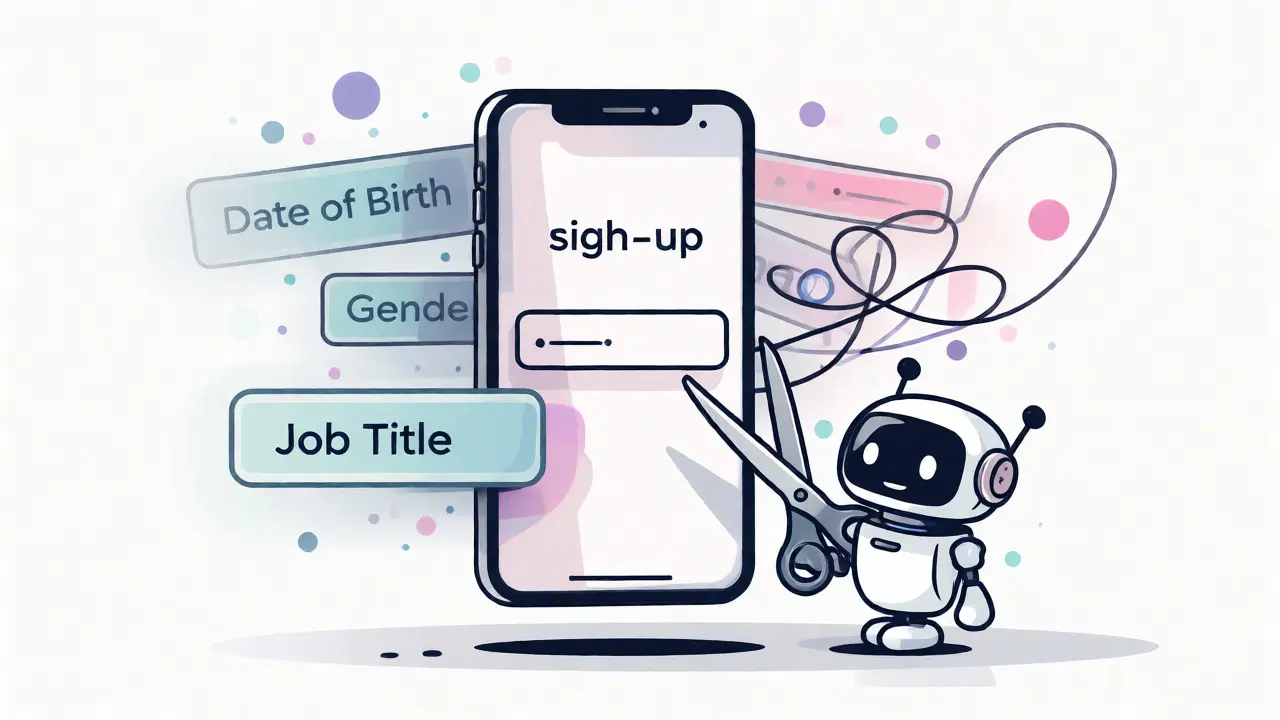
Most vibe coders fall into the "collect now, ask questions later" trap. You add fields to a signup form because a tutorial said so, or because you thought you might need them for analytics six months from now. Under GDPR, this is risky. If you collect a user's phone number but never use it for SMS verification or support, you’re holding unnecessary data. If that database leaks, you’re liable for every byte of it.
Think about your last sign-up flow. Did you ask for age, gender, location, and job title upfront? Unless those are critical for the core functionality at that exact moment, they violate minimization. A better approach is progressive disclosure. Ask for the email to create the account. Later, when the user engages with a feature that benefits from their location, ask for permission then. This aligns with Privacy by Design (Article 25 GDPR), which mandates that data protection is embedded into the architecture of your system, not bolted on afterward.
The Three-Test Filter for Every Field
Before adding a new input field or API call that captures user data, run it through this filter:
- Adequacy: Is this data sufficient to achieve the specific purpose?
- Relevance: Is there a direct, logical link between this data point and the feature?
- Necessity: Can I achieve the same result with less data? For example, do I need the full IP address, or is a geolocated city enough?
If the answer to Necessity is "no," delete the field. If you’re unsure, leave it out. You can always add it back later with a clear value proposition; removing data after a complaint is much harder.
Consent Flows: Beyond the Cookie Banner
Many developers think consent is just a cookie banner. It’s not. Consent under GDPR Article 4(11) requires that agreement be freely given, specific, informed, unambiguous, and withdrawable. This applies to everything from tracking pixels to marketing emails to sharing data with third-party APIs.
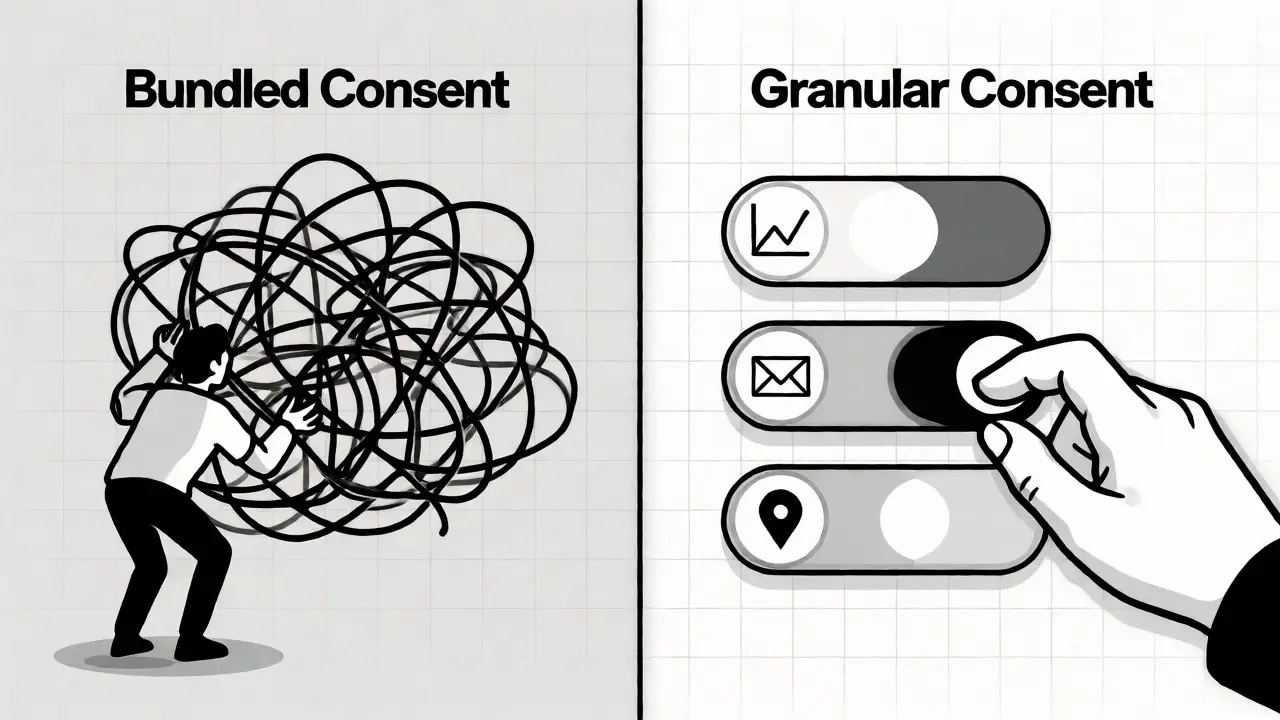
Here’s where vibe coders often stumble: bundling. You present a single checkbox that says, "I agree to Terms, Privacy Policy, and Marketing." That’s invalid. Consent must be granular. Users should be able to accept service terms while rejecting marketing emails. If you bundle them, you’re coercing the user, and regulators like the Irish DPC or UK ICO will view that consent as non-compliant.
| Pattern | Description | GDPR Status |
|---|---|---|
| Bundled Checkbox | One box for Terms + Privacy + Marketing | Invalid (Coerced) |
| Pre-ticked Box | User must uncheck to opt-out | Invalid (Not affirmative) |
| Granular Toggles | Separate switches for Analytics, Ads, Email | Valid (Specific) |
| Just-in-Time Prompt | Ask for location only when map loads | Valid (Contextual) |
UX Patterns That Actually Work
Compliance doesn't have to hurt conversion rates. In fact, transparent consent often boosts trust. The key is avoiding "dark patterns"-design tricks that manipulate users into accepting more than they want.
Consider the "Confirmshaming" pattern. Have you seen buttons that say "No, I prefer to pay full price" versus "Yes, save 20%"? Or "No, I hate privacy"? These guilt-trip tactics are increasingly flagged by regulators as undermining "freely given" consent. Keep your language neutral. "Accept All" and "Reject Non-Essential" should have equal visual weight. Don't hide the reject button in gray text while making Accept a bright green primary button.
Another effective strategy is Just-in-Time Consent. Instead of bombarding users with five permission requests on first launch, wait until the feature is used. If a user clicks "Find Nearby Friends," that’s when you ask for location access. Explain *why* you need it: "We need your location to show friends within 5 miles." This contextual relevance makes users more likely to say yes, and it keeps your initial load clean.
Technical Implementation: Logging and Withdrawal
Getting consent is only half the battle. You must prove you got it, and let users change their minds easily. Article 7(1) states that controllers must be able to demonstrate consent. This means logging isn't optional-it's mandatory.
Your backend needs a consent log table. At minimum, store these attributes for each user action:
- User ID: Who gave consent?
- Timestamp: When did they give it?
- Version ID: Which version of the policy did they see? (Policies change!)
- Purpose: What specifically did they agree to? (e.g., "Analytics," "Email Marketing")
- Status: True or False?
Withdrawal must be as easy as giving consent. If a user checks a box to subscribe to newsletters, they shouldn't have to email support to unsubscribe. Provide a clear "Unsubscribe" link in every email and a visible toggle in their profile settings. When they toggle off, your backend must immediately stop processing that data type. No delays, no "we'll update within 30 days." Real-time enforcement is the standard.
Retention Policies: Delete What You Don't Need
Data minimization extends to storage duration. Recital 39 of the GDPR emphasizes that data shouldn't be kept longer than necessary. Many vibe coders dump logs into S3 buckets or databases and forget about them. That’s a liability.
Implement automated retention rules. For raw event logs, consider deleting them after 90 days once aggregated metrics are calculated. For inactive accounts, define a clear timeline-perhaps 2 years of inactivity triggers a deletion workflow. Anonymize data where possible. If you only need aggregate trends for your dashboard, strip the user IDs and keep only the behavioral metadata. This reduces the risk surface significantly.

Common Pitfalls for Fast-Shipping Teams
Even experienced developers trip over these issues. Here are the most frequent mistakes:
- Ignoring Third-Party Scripts: Loading Google Analytics or Facebook Pixel before consent is recorded. Block these tags until the user opts in.
- Vague Purpose Statements: Saying "to improve our services" is too broad. Be specific: "to personalize content based on your viewing history."
- Hard-Coding Consent: Assuming users agreed because they signed up. Sign-up implies contract performance, not marketing consent.
- Forgetting Withdrawal Logs: Updating the status to "false" but not recording the timestamp of withdrawal. You need both dates for audits.
Remember, GDPR fines aren't just about money. They're about operational disruption. An audit can freeze your data pipelines while you scramble to fix documentation. Building compliance into your CI/CD pipeline-like linting for missing consent checks-is smarter than fixing it post-launch.
Related Concepts to Explore
To deepen your understanding, look into CCPA/CPRA, which mirrors many GDPR principles in California, emphasizing similar restrictions on dark patterns. Also, explore Consent Management Platforms (CMPs), which offer pre-built solutions for handling complex consent logs and banners. Finally, study Anonymization Techniques like k-anonymity, which help you retain analytical value while reducing personal identification risks.
Does GDPR apply if my server is outside the EU?
Yes. GDPR applies extraterritorially. If you process personal data of individuals located in the European Union, regardless of where your company or servers are based, you must comply. Offering goods or services to EU residents or monitoring their behavior triggers these obligations.
Can I use legitimate interest instead of consent for analytics?
Possibly, but it's tricky. Legitimate interest requires a balancing test showing your business interest outweighs the user's privacy rights. For basic website analytics, this is often accepted. However, for detailed tracking, advertising cookies, or cross-site profiling, explicit consent is usually required and safer for compliance.
What happens if a user withdraws consent?
You must stop processing the data for that specific purpose immediately. For example, if they withdraw marketing consent, remove them from your email list right away. You generally cannot use data collected under consent for other purposes unless you have another lawful basis, but you may retain some data for legal defense or tax obligations.
Is an unchecked checkbox valid consent?
No. Silence, pre-ticked boxes, or inactivity do not constitute consent. The user must perform a clear affirmative action, such as actively clicking an empty checkbox or tapping an "Allow" button, to indicate their agreement.
How long should I keep consent records?
There is no fixed statutory period, but best practice suggests keeping consent logs for at least 3-5 years. This ensures you can defend against potential claims during the statute of limitations periods in various jurisdictions.
 Artificial Intelligence