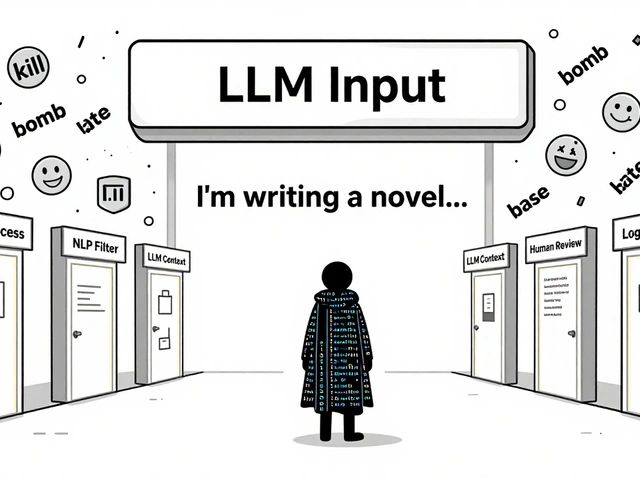
You have the budget. You have the access to the latest foundation models. But do you have the guardrails? As of mid-2026, deploying Large Language Models (LLMs) in an enterprise environment without a robust data governance framework is less like innovation and more like Russian roulette. The days of "move fast and break things" are over when it comes to AI. Today, regulators, customers, and your own legal team demand proof that your models are safe, compliant, and accurate.
The core problem isn't the model itself; it's the data feeding it. LLMs thrive on vast amounts of text, much of which is unstructured-emails, contracts, internal wikis. If that data contains biases, sensitive personal information, or outdated facts, your model will amplify those issues at scale. This article breaks down how to build a governance structure that protects your business while unlocking the true value of generative AI.
Why Traditional Governance Fails with LLMs
If you tried to apply your old SQL-based data governance rules to an LLM deployment, you would likely hit a wall. Traditional systems were built for structured data living in neat rows and columns. They assumed deterministic outcomes: if input A goes in, output B comes out. LLMs shatter this assumption.
Large Language Models are probabilistic systems that generate stochastic responses not directly correlated to specific inputs. This means two identical prompts can yield slightly different answers. More importantly, the model doesn't just retrieve data; it synthesizes it. When dbt Labs noted in 2023 that traditional approaches "don't scale in the age of AI," they weren't exaggerating. The volume of data, the speed of regulatory changes, and the complexity of unstructured formats require a dynamic, continuous approach rather than a static checklist.
Consider the difference between a database query and an LLM response. A database query fails if the table doesn't exist. An LLM might hallucinate a plausible-sounding answer based on training data from five years ago. Your governance framework must account for this uncertainty by implementing rigorous validation layers before the model ever sees production traffic.
The Three Pillars of LLM Governance
To manage the chaos, you need to focus on three non-negotiable pillars: transparency, data integrity, and continuous monitoring. These aren't abstract concepts; they are operational requirements.
- Transparency: You must have clear visibility into how your model functions. This includes knowing exactly which datasets were used for training or fine-tuning. If a model generates a biased hiring recommendation, you need to trace back to the source data that caused it. GigaSpaces AI defines this as providing "clear visibility into how LLMs function, including the datasets used... and the outcomes generated."
- Data Integrity & Privacy: This involves managing the lifecycle of the data itself. You need unambiguous policies for sourcing, retention, and disposal. Are you feeding customer PII (Personally Identifiable Information) into a public model? Are your training documents up to date? Protecting user privacy while maintaining data utility is the tightrope walk here.
- Continuous Auditing: Models drift. What was acceptable last month might be offensive or inaccurate today. Regular audits help detect these shifts. You need automated checks to verify that the model isn't perpetuating harmful biases or generating factually incorrect content.
Taming Unstructured Data
Here is the hard truth: roughly 80-90% of enterprise data is unstructured. It lives in PDFs, Word docs, emails, and Slack channels. Traditional governance tools often ignore this swamp. LLMs, however, live in it. This creates a unique challenge: how do you govern what you can't easily see?
Effective governance requires metadata management systems capable of handling this scale. Tools like Microsoft Purview offers comprehensive tools for data cataloging, lineage tracking, and policy enforcement have become essential. By integrating these with platforms like Databricks or ER/Studio, enterprises can create a cohesive ecosystem. For example, ER/Studio’s integration with Purview ensures that data assets are consistently cataloged. This allows you to tag sensitive documents automatically, preventing them from being ingested into general-purpose model training sets.
Without this layer, you are flying blind. You might think you've scrubbed all financial data, but a mislabeled folder in SharePoint could still leak quarterly earnings projections into your customer service chatbot.
| Feature | Traditional Data Governance | LLM-Specific Governance |
|---|---|---|
| Data Type Focus | Structured (SQL, CSV) | Unstructured (Text, Docs, Images) |
| Output Nature | Deterministic (Fixed) | Probabilistic (Stochastic) |
| Monitoring Frequency | Periodic (Monthly/Quarterly) | Continuous (Real-time) |
| Primary Risk | Data Inaccuracy | Bias, Hallucination, Leakage |
| Tooling Example | Standard ETL Tools | Microsoft Purview, Alteryx, dbt |

Building the Technical Stack
You cannot govern what you cannot measure. Building the right technical stack is about connecting disparate tools into a unified pipeline. Here is how leading organizations are structuring their environments in 2026.
First, establish a semantic layer. Tools like the dbt Semantic Layer enables organizations to define metrics using a single formula with standardized naming. This eliminates the issue where marketing defines "revenue" differently than finance does. When your LLM pulls data to answer questions, it needs to rely on these trusted, governed metrics.
Second, implement automated bias detection. You need algorithms that scan outputs for discriminatory language or factual errors before they reach the end-user. Alteryx, for instance, helps enterprises operationalize AI by connecting LLMs to governed data pipelines, ensuring auditability. This creates a feedback loop: bad outputs are flagged, the underlying data or prompt is adjusted, and the model improves.
Third, leverage AI to govern AI. It sounds recursive, but it works. Modern platforms use smaller, specialized models to scan text for risks, sensitive data, or regulatory issues before the main LLM processes it. This virtuous cycle enhances security without slowing down development.
Navigating Regulatory Landscapes
In 2026, the regulatory environment is no longer a suggestion; it's a constraint. The EU AI Act has set a global precedent, specifically targeting high-risk AI systems. While the US landscape remains fragmented, sector-specific regulations in healthcare (HIPAA) and finance (GDPR/CCPA equivalents) are strict.
Regulators now view data quality and data lineage as compliance requirements. If you cannot prove where your training data came from and how it was cleaned, you are liable. The EU AI Act mandates transparency regarding the data used to train generative AI. This means your governance framework must produce an audit trail that satisfies both internal auditors and external regulators.
Failure to comply isn't just a fine; it's a reputational nightmare. One leaked confidential document via a poorly governed chatbot can destroy customer trust overnight. Governance is quickly becoming a competitive differentiator. Companies that can prove their AI is safe and ethical win enterprise contracts. Those that can't get blocked.
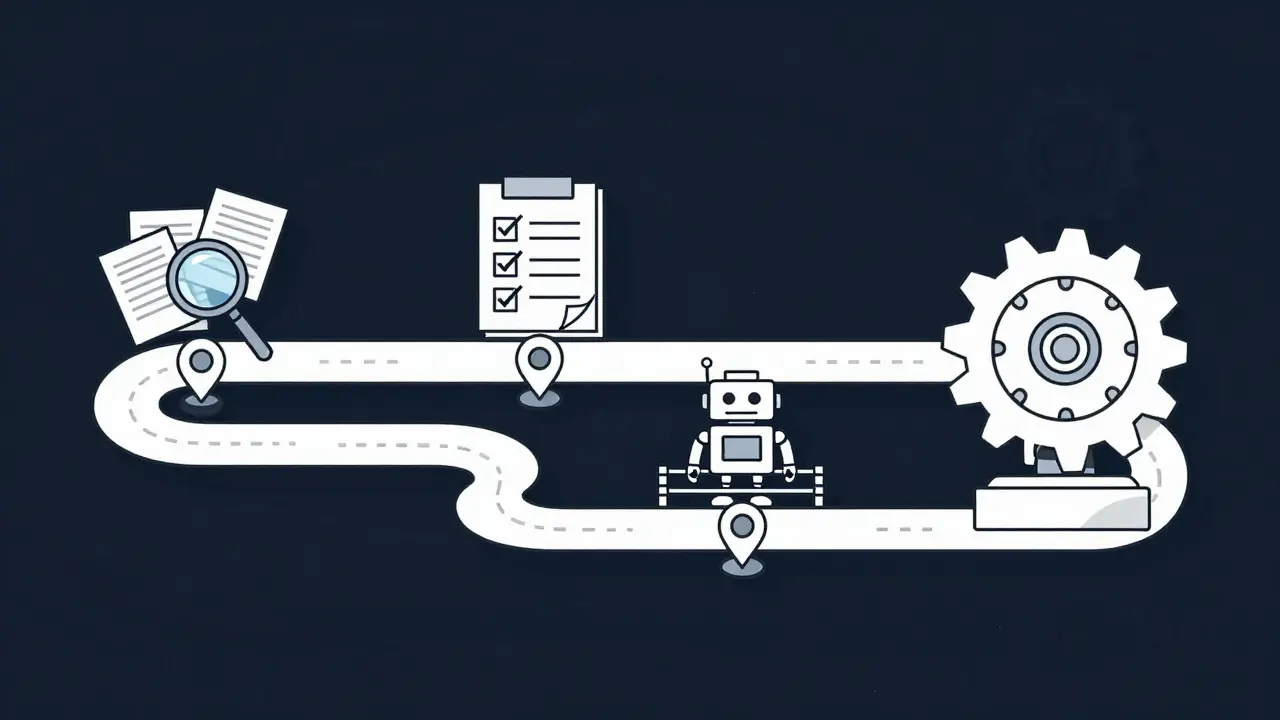
Implementation Roadmap: From Chaos to Control
How do you actually start? Don't try to boil the ocean. Follow this phased approach:
- Phase 1: Inventory and Classification. Map your unstructured data. Use tools like Purview to identify what exists, where it lives, and its sensitivity level. Tag everything.
- Phase 2: Define Standards. Work with each business unit to define what "quality data" means for them. Profisee notes that having each department think deeply about quality standards builds buy-in. Create a central glossary of terms and metrics.
- Phase 3: Pilot with Guardrails. Deploy a small-scale LLM use case (e.g., internal HR Q&A). Implement strict input/output filtering. Monitor closely for hallucinations and data leaks.
- Phase 4: Scale and Automate. Once the pilot proves stable, expand to other departments. Automate the monitoring and auditing processes. Integrate governance checks directly into your CI/CD pipeline for model updates.
Expect resistance. Data silos are stubborn. Overcome this by showing value early. Organizations implementing robust frameworks report up to a 40% reduction in compliance incidents and 30% faster time-to-insight on unstructured data. Frame governance not as a blocker, but as an enabler of speed and safety.
The Human Element
Technology alone won't save you. You need accountability structures. Assign clear data ownership for LLM training datasets. Who is responsible if the model gives bad advice? Is it the data engineer, the product manager, or the legal team? Define roles explicitly.
Create cross-functional teams that include legal, IT, and business leaders. Regular meetings to review model performance and emerging risks keep everyone aligned. Remember, AI governance is moving beyond model performance to include ethical and legal accountability. Your people are the final checkpoint.
What is the biggest risk of poor LLM data governance?
The biggest risk is data leakage and hallucination. Without proper governance, LLMs may inadvertently expose sensitive customer or employee data in their responses. Additionally, they may generate confident but factually incorrect information, leading to operational errors and reputational damage.
How does the EU AI Act affect LLM deployments?
The EU AI Act imposes strict requirements on high-risk AI systems, including mandatory transparency about training data, human oversight mechanisms, and robust accuracy standards. Enterprises operating in or serving EU customers must ensure their LLM governance frameworks meet these criteria to avoid significant penalties.
Can I use existing data governance tools for LLMs?
Partially. Traditional tools handle structured data well but struggle with the unstructured nature of LLM inputs. You need to augment existing stacks with specialized solutions like Microsoft Purview or Alteryx that offer advanced metadata management, lineage tracking, and bias detection specifically designed for AI workloads.
What is model drift in the context of LLMs?
Model drift refers to the degradation of a model's performance over time. For LLMs, this can happen if the world changes (new facts emerge) or if the input data distribution shifts. Continuous monitoring and regular re-auditing are required to detect and correct drift before it impacts users.
How do I measure the success of my LLM governance program?
Success can be measured by reduced compliance incidents, faster time-to-insight on unstructured data, and improved model accuracy scores. Key metrics include the percentage of data assets tagged with sensitivity labels, the frequency of detected bias alerts, and the reduction in hallucination rates during testing.
 Artificial Intelligence