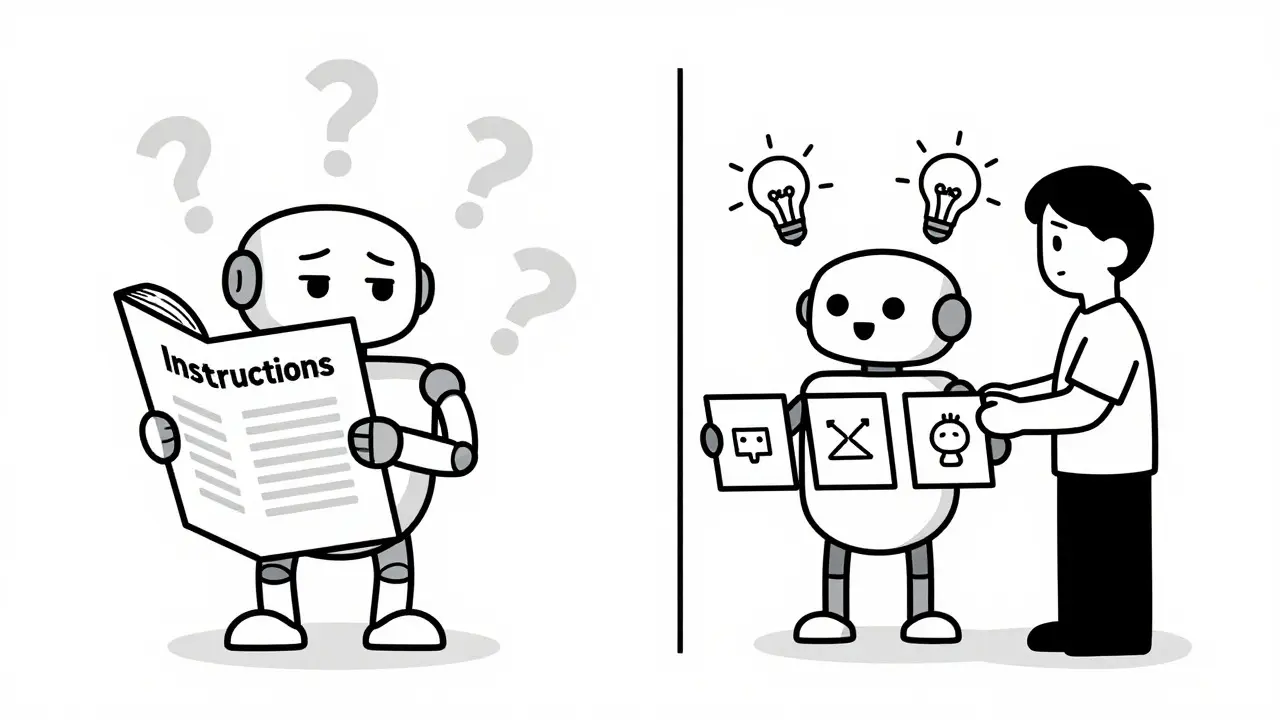
You ask an AI to write a summary, and it gives you a wall of text. You ask again, slightly differently, and it still misses the mark. It’s frustrating, but the problem usually isn’t the model-it’s your instructions. Most people treat generative AI like a search engine or a magic oracle, expecting it to just "know" what they want. But models like GPT-4 is a large language model developed by OpenAI that uses transformer architecture to process natural language and Claude is an artificial intelligence assistant developed by Anthropic designed for helpfulness, honesty, and harmlessness are actually pattern matchers at heart. They learn best by seeing, not just being told.
This is where Few-shot prompting is a technique in prompt engineering where users provide several input-output examples within the prompt to guide the model's response without retraining the model weights comes into play. Instead of writing paragraphs of abstract rules, you show the AI exactly what you mean. Research shows this simple shift can boost task accuracy by 15% to 40%. It’s the difference between telling someone to "be polite" and showing them three examples of polite emails. In this guide, we’ll break down how to use example-based instructions to get precise, consistent results from generative AI.
Why Examples Beat Instructions
Imagine hiring a new employee. You could hand them a 50-page manual on company culture (zero-shot), or you could sit them next to a top performer for a week so they can observe how things are done (few-shot). The latter works faster because humans-and AI-are wired for pattern recognition.
Generative AI models don't have feelings or intuition. They predict the next likely word based on statistical probabilities learned during training. When you provide examples, you aren't teaching the model new facts; you are conditioning its attention mechanism to focus on specific patterns. This is called In-context learning is the ability of large language models to adapt to new tasks based on examples provided in the immediate context window without updating their internal parameters.
According to research by Touvron et al. (2023) and Kaplan et al. (2020), this capability emerges when models reach a certain scale. It’s not a feature added by engineers; it’s a property of the math behind transformers. By placing examples in the prompt, you temporarily steer the probability distribution toward your desired output style. Once the interaction ends, the model forgets everything. No data is saved, no weights are updated. It’s purely contextual.
Zero-Shot vs. Few-Shot: Knowing When to Switch
Not every task needs examples. Understanding when to use Zero-shot prompting is a method of querying an AI model without providing any prior examples, relying solely on the model's pre-trained knowledge versus few-shot is crucial for saving time and token costs.
| Feature | Zero-Shot Prompting | Few-Shot Prompting |
|---|---|---|
| Definition | No examples provided | 2-8 input-output examples included |
| Best For | General questions, factual retrieval, simple translations | Complex formatting, domain-specific tone, nuanced classification |
| Accuracy Impact | Baseline performance | +15% to +40% improvement on complex tasks |
| Cost & Effort | Low effort, lower token usage | Higher effort to craft examples, higher token usage |
| Persistence | N/A | Temporary (in-context only) |
Use zero-shot when you need speed and the task is generic. Asking "What is the capital of France?" doesn’t require examples. The model knows this from its pre-training data. However, if you ask the model to "Classify these customer reviews as positive, negative, or neutral," zero-shot often fails because "neutral" is subjective. One person’s neutral is another’s slightly disappointed. Here, few-shot shines. You provide three examples of what *you* consider neutral, and suddenly the model aligns with your definition.
How to Structure Effective Few-Shot Prompts
Crafting good prompts is part art, part science. You need to follow a clear structure to avoid confusing the model. A messy prompt leads to messy outputs.
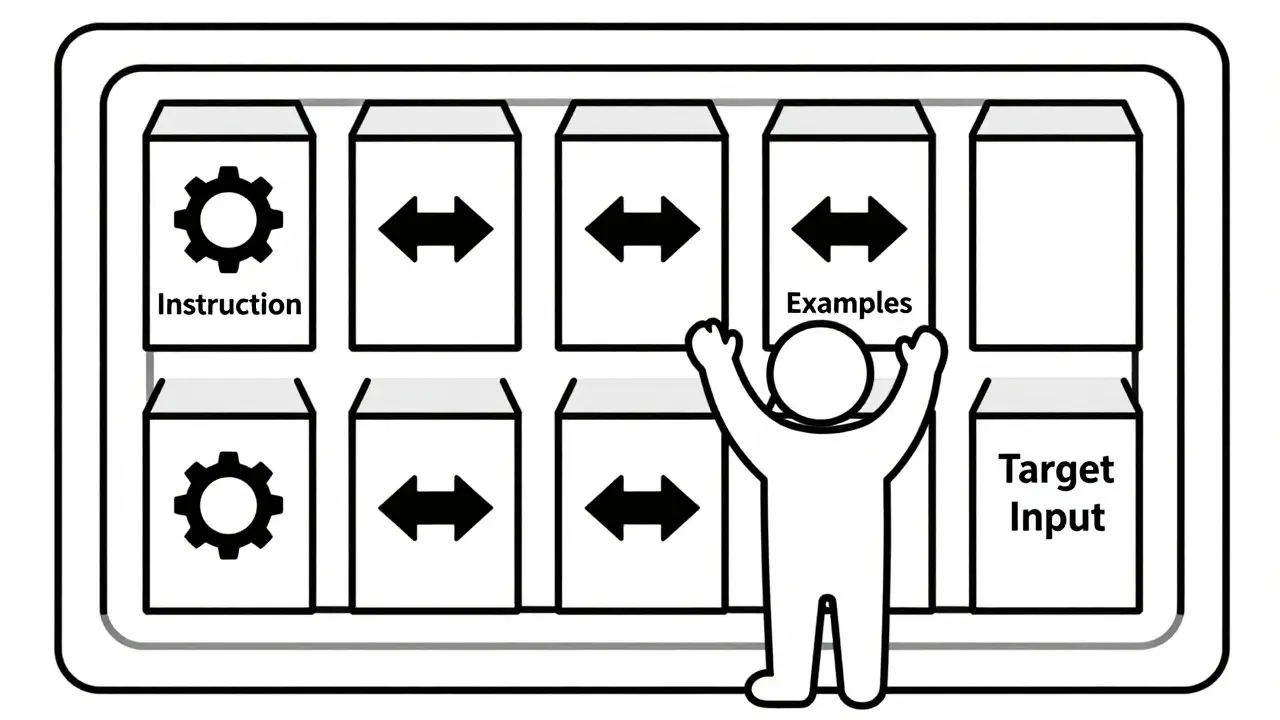
- Start with a Clear Instruction: Tell the model what role it plays or what task it must perform. Keep it brief.
- Provide Examples: Include 2 to 8 pairs of inputs and outputs. More isn’t always better; too many examples can clutter the context window and dilute the signal.
- Maintain Consistency: Use the same format for every example. If one example uses JSON and another uses plain text, the model will hesitate.
- End with the Target Input: Leave the final output blank or start it partially to invite the model to complete the pattern.
Let’s look at a concrete example. Say you want to extract product names and prices from unstructured text. A zero-shot prompt might say: "Extract product name and price." The model might return a paragraph explaining how to do it. A few-shot prompt looks like this:
Instruction: Extract the product name and price from the following sentences. Output format: Product: [Name], Price: [Amount]
Example 1:
Input: "I bought the red sneakers for forty-five dollars yesterday."
Output: Product: Red Sneakers, Price: $45.00
Example 2:
Input: "The laptop cost me nine hundred bucks."
Output: Product: Laptop, Price: $900.00
Target:
Input: "Grabbed a coffee mug for five quid."
Output:
By seeing the pattern twice, the model understands it needs to convert "quid" to "$" (assuming USD context) or keep the currency consistent, and format the output strictly. This reduces hallucination and ensures structural integrity.
Common Pitfalls to Avoid
Even experienced prompt engineers make mistakes. Here are the most common traps that undermine few-shot effectiveness.
- Using Outlier Examples: If your task is to classify spam emails, don’t include a weird, edge-case email in your examples unless you want the model to over-index on rare cases. Use representative, average examples.
- Inconsistent Formatting: Mixing markdown styles, varying capitalization, or changing delimiters between examples confuses the parser. Uniformity is key.
- Overloading the Context Window: While models like GPT-4 support long contexts, cramming 20 examples into a prompt can cause "lost in the middle" phenomena, where the model ignores the center examples. Stick to the sweet spot of 2-8 examples.
- Ambiguous Labels: If you’re doing sentiment analysis, ensure your labels are mutually exclusive. Don’t use "Happy" and "Joyful" as separate classes if they mean the same thing to the model.
Also, remember that few-shot prompting is temporary. Every time you send a new request, you must resend the examples. This increases latency and cost compared to fine-tuning, where the knowledge is baked into the model weights. However, for most applications, the flexibility of few-shot outweighs the marginal cost increase.
Advanced Techniques: Combining with Chain-of-Thought
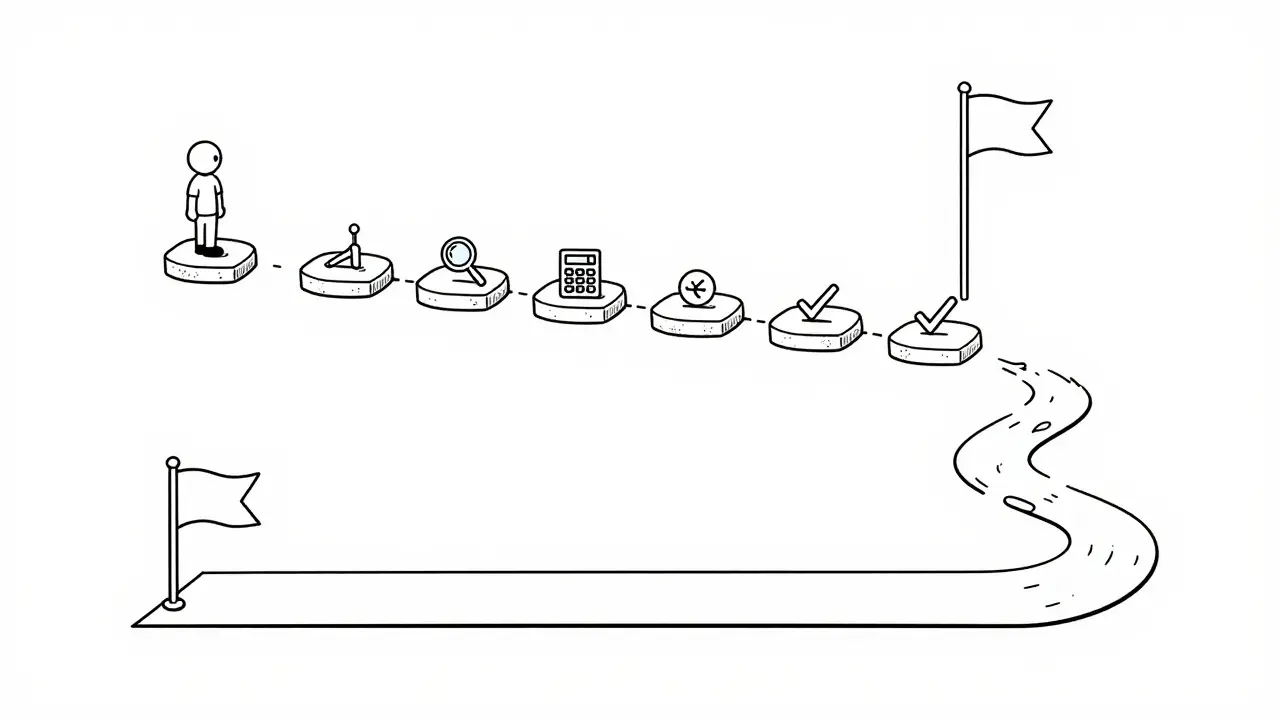
For complex reasoning tasks, few-shot prompting can be supercharged by combining it with Chain-of-thought prompting is a technique where examples demonstrate step-by-step reasoning processes rather than just final answers, improving logical deduction capabilities. Instead of just showing the input and the final answer, you show the intermediate steps.
Consider a math problem. A standard few-shot example might show: Input: "If John has 5 apples and eats 2, how many does he have?" Output: "3" A chain-of-thought few-shot example shows: Input: "If John has 5 apples and eats 2, how many does he have?" Output: "John starts with 5. He subtracts 2. 5 - 2 = 3. Answer: 3" This teaches the model *how* to think, not just what to say. This is particularly useful for coding tasks, logical puzzles, or complex data extraction where the path to the answer matters as much as the result itself.
When to Move Beyond Few-Shot
Few-shot prompting is powerful, but it’s not a silver bullet. There are scenarios where you should consider other approaches.
If you find yourself using the exact same set of examples for thousands of queries, you might be wasting tokens. In this case, Fine-tuning is a machine learning process where a pre-trained model is further trained on a specific dataset to adjust its internal weights for specialized tasks becomes more cost-effective. Fine-tuning requires computational resources and time, but once done, the model performs the task instantly without needing examples in the prompt.
Additionally, if your task requires up-to-the-minute information that wasn’t in the model’s training data, neither zero-shot nor few-shot will help alone. You’ll need to combine prompting with Retrieval-Augmented Generation (RAG), which fetches external documents before generating a response.
Practical Applications Across Industries
The versatility of few-shot prompting makes it applicable across nearly every sector leveraging AI.
- Customer Service: Train chatbots to respond in a brand-specific voice by providing examples of past successful interactions.
- Legal Tech: Classify legal clauses by providing examples of different contract types, ensuring compliance with specific regulatory frameworks.
- Healthcare: Summarize patient notes into structured formats for electronic health records, maintaining medical terminology accuracy.
- Software Development: Generate code snippets in a specific framework style (e.g., React hooks vs. class components) by showing preferred architectural patterns.
In each case, the goal is consistency. Humans vary in their output; AI, guided by few-shot examples, can replicate a specific standard indefinitely.
Conclusion
Few-shot prompting transforms generative AI from a generalist chatterbox into a specialized tool. By leveraging in-context learning, you gain control over tone, format, and accuracy without the overhead of retraining models. Start small with two or three high-quality examples, iterate on their clarity, and watch your AI’s performance soar. As models continue to evolve, the core principle remains unchanged: show, don’t just tell.
What is the optimal number of examples for few-shot prompting?
Research suggests that 2 to 8 examples are typically optimal. Three examples often provide a significant boost in accuracy compared to one, while exceeding eight may lead to diminishing returns or context window overflow issues depending on the model size.
Does few-shot prompting permanently change the AI model?
No. Few-shot prompting relies on in-context learning, which is temporary. The examples influence the current session only. Once the conversation ends, the model retains no memory of those examples, and its underlying weights remain unchanged.
How does few-shot prompting differ from fine-tuning?
Few-shot prompting provides examples within the prompt text to guide the model's immediate response without altering its parameters. Fine-tuning involves retraining the model's neural network weights on a specific dataset, which is more expensive and time-consuming but offers persistent specialization.
Can I use few-shot prompting for creative writing?
Yes, it is highly effective for creative writing. By providing examples of a specific author's style, tone, or narrative structure, you can guide the AI to generate content that mimics those characteristics consistently.
Why does my few-shot prompt sometimes fail?
Failures often stem from inconsistent formatting, ambiguous examples, or outliers that confuse the pattern recognition. Ensure all examples follow the exact same structure and represent typical cases rather than edge cases.
 Artificial Intelligence