You bought the GPUs. You hired the prompt engineers. You deployed that shiny new Generative AI model to production. And then, three weeks later, your legal team flagged a hallucinated contract clause, or worse, a competitor’s proprietary code leaked into your output. Sound familiar? It’s not just you. A 2025 report from ModelOp found that while investment in AI is skyrocketing, there is a massive gap between spending money and getting safe, reliable results. The culprit isn’t usually the tech itself; it’s the lack of structure around it.
Most companies are winging it. They either ban AI tools (which leads to shadow usage) or throw a committee at the problem and hope for the best. But as we move deeper into 2026, with agentic AI systems starting to execute tasks autonomously rather than just generating text, "winging it" is becoming a liability. You need a governance model. Not a bureaucratic nightmare, but a practical framework that keeps your AI safe, compliant, and actually useful. Let’s break down the three main ways organizations are handling this: councils, policies, and accountability structures.
The Three Pillars of Generative AI Governance
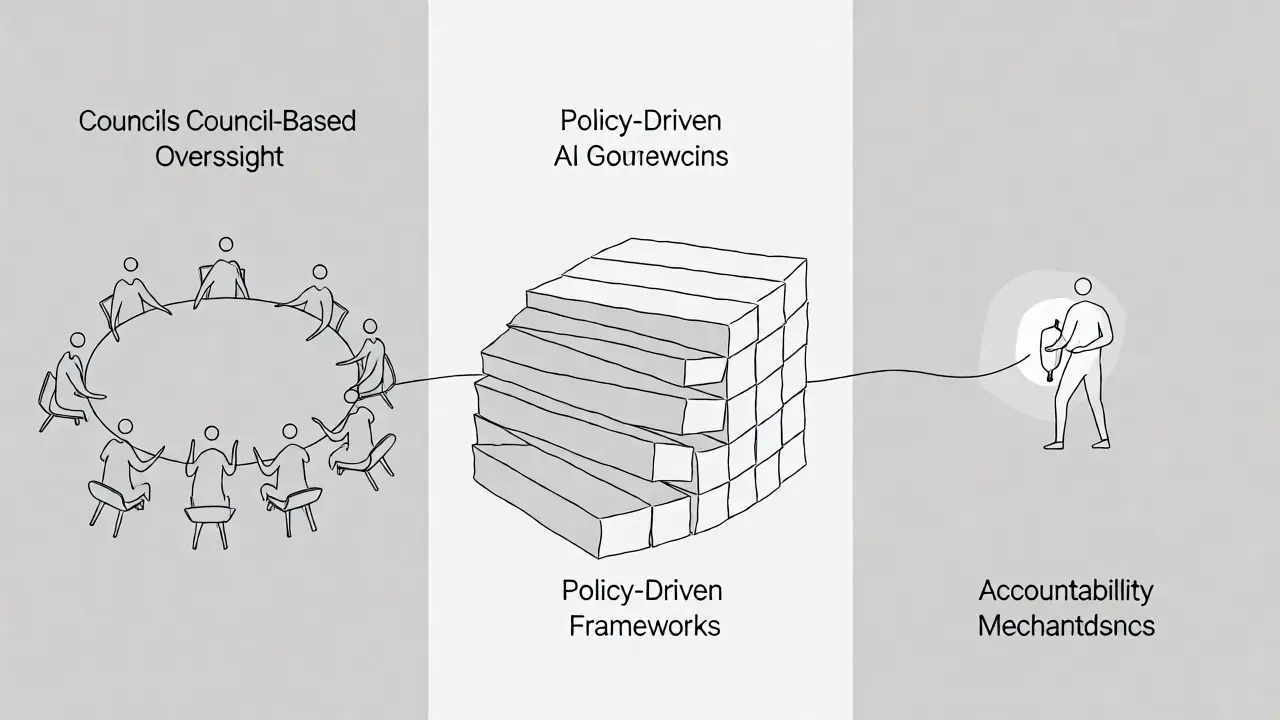
When people talk about AI Governance, they’re really talking about three distinct mechanisms. Understanding the difference is key because mixing them up causes friction.
- Council-Based Oversight: This is the traditional approach. You form a cross-functional committee-legal, data science, security, business units-that reviews AI projects before they launch. Think of it like an architectural review board. It’s thorough, but it can be slow.
- Policy-Driven Frameworks: Here, you set clear rules upfront. What data can be used? What privacy standards apply? How do we handle bias? These are static guidelines that teams must follow. It’s scalable, but if the rules are too rigid, they stifle innovation.
- Accountability Mechanisms: This is the emerging standard. Instead of just having rules or committees, you assign clear ownership. Who is responsible when the AI gets it wrong? Is it the developer? The product manager? The end-user? This model embeds governance into the workflow itself, making it faster and more responsive.
According to PwC’s 2025 Responsible AI survey, 43% of enterprises started with councils. But here’s the catch: 62% of those organizations reported that committee reviews added two to three weeks to their deployment timelines. That’s a long time to wait when your competitors are shipping features weekly.
Why Councils Are Bottlenecks (And When They Still Work)
If you’re in a highly regulated industry like healthcare or finance, a council might still be your best bet. Why? Because the cost of a mistake is enormous. In healthcare, 87% of organizations require execution graphs and explainability layers before deploying AI. You can’t rush that.
But for most businesses, especially in retail or marketing, councils create bottlenecks. Imagine trying to get approval for every new prompt template or minor model tweak through a monthly meeting. It doesn’t scale. One senior data scientist at a major bank noted that while their council reduced regulatory incidents by 63%, it initially added 18 days to every deployment cycle. That’s a trade-off many fast-moving startups can’t afford.
| Feature | Council-Based | Policy-Driven | Accountability-Focused |
|---|---|---|---|
| Primary Goal | Risk Mitigation via Review | Standardization & Compliance | Ownership & Speed |
| Deployment Speed | Slow (14-21 day delays) | Moderate (depends on rule clarity) | Fast (33% faster cycles) |
| Best For | High-risk, regulated industries | Large-scale consistency needs | Agile, innovative environments |
| Main Pitfall | Bureaucratic bottlenecks | Rigidity / Stifling innovation | Ambiguous responsibility lines |
| Adoption Rate (2025) | 43% | 38% | 19% |
The Rise of Accountability Over Committees
The trend is shifting away from shared committees toward clear lines of accountability. Dr. Sarah Chen from Stanford HAI argues that governance must evolve in real-time. Static controls don’t work when AI agents are autonomously planning and executing tasks. You need dynamic guardrails.
What does this look like in practice? Instead of a committee approving a model, the product team owns the outcome. They have access to automated testing tools, observability dashboards, and red-teaming resources. If a bias incident occurs, the owner knows exactly who fixes it and how fast. Organizations using this model saw a 33% acceleration in deployment cycles according to ModelOp data. They also saw a 37% reduction in bias incidents because monitoring was continuous, not periodic.
This shift requires a cultural change. It means moving from "Is this allowed?" to "Who owns the risk?" It’s harder to implement because it requires training and better tooling, but it pays off. Advanced-stage organizations achieving mature governance report 23% higher ROI on AI investments. Why? Because they aren’t waiting for permission to innovate; they are innovating within safe, pre-defined boundaries.
Policy Frameworks: The NIST Standard
If you’re building a policy-driven framework, you likely need a foundation. Most serious implementations lean on the NIST AI Risk Management Framework (RMF). Published in early 2023, it has become the de facto standard, with 68% of surveyed organizations citing it as their primary reference.
The NIST RMF breaks governance down into four functions: Govern, Map, Measure, and Manage. It’s comprehensive, but it’s not plug-and-play. Custom frameworks often score poorly on clarity (averaging 2.8/5), whereas NIST-based implementations score 4.3/5. Why? Because NIST provides a common language. When your legal team talks about "risk tolerance," everyone understands what that means in the context of AI.
However, policies alone are dangerous if they are too broad. A healthcare startup tried applying generic governance frameworks to their medical imaging AI. Result? 42% of models were rejected for non-critical issues, wasting 11,000 engineering hours in one quarter. The lesson? Tailor your policies to your specific use case. Don’t treat a chatbot the same way you treat a diagnostic algorithm.
Handling the "Bring Your Own AI" Chaos
Here’s a reality check: 75% of employees are already using AI at work, and 78% bring their own tools. This is the "Bring Your Own AI" (BYOAI) trend. It creates massive governance gaps. Employees paste sensitive customer data into public LLMs without thinking twice. Security risks skyrocket.
How do you govern this? Banning tools doesn’t work. Shadow AI usage jumped from 22% to 67% in organizations that tried strict bans. Instead, successful companies implement secure sandbox environments. These allow employees to use preferred tools but route data through internal gateways that scrub PII (Personally Identifiable Information) and log interactions. Northern Light case studies show this approach increased compliance from 31% to 89%.
Your governance model must account for this decentralized usage. Policy should define what data can go where. Accountability should clarify who monitors these external tools. Councils might oversee the selection of approved enterprise-grade platforms, but individual teams manage the daily usage.

Implementing Your Model: A Practical Roadmap
So, how do you actually build this? Nextgov outlines a four-step process that mirrors cloud readiness assessments. Here’s a simplified version for 2026:
- Readiness Review (10-15 Days): Audit your current AI usage. What tools are in play? Where is data flowing? Identify your biggest risks (bias, security, compliance).
- Define Goals & Boundaries: Decide what you want to achieve. Avoid "algorithmic lock-in" by choosing flexible architectures. Skipping this step leads to 3.2x higher modification costs later.
- Select the Structure: Do you need a council for high-stakes projects? Or can you empower teams with automated guardrails? Hybrid models are common: a small central team sets policies, while distributed teams own execution.
- Deploy Tooling & Training: Invest in observability platforms. Train your staff. Effective programs require 25-35 hours of instruction covering regulatory requirements and risk assessment. Expect a learning curve of 6-8 weeks for technical teams.
Don’t fall into the trap of "governance theater." Dr. Marcus Wong warns against creating the appearance of oversight without substantive controls. If your council meets monthly but never reviews actual model outputs, you’re just ticking boxes. Real governance involves continuous monitoring, automated testing, and regular audits.
The Future: Agentic AI and Dynamic Guardrails
We are entering the era of agentic AI. Systems aren’t just generating content; they are taking actions. Oliver Patel predicts that by late 2025, 45% of large enterprises will implement "dynamic guardrails" that adjust based on real-time risk assessments. Static policies won’t cut it.
Imagine an AI agent booking travel for an executive. It needs to respect budget limits, company travel policies, and personal preferences-all in real-time. Governance here isn’t about pre-approving every trip; it’s about setting thresholds and allowing the agent to operate within them. If it exceeds a threshold, it escalates to a human. This is the future of accountability: embedded, automated, and adaptive.
Gartner predicts the AI governance market will hit $14.2 billion by 2027. This growth reflects a simple truth: as AI becomes more autonomous, the need for structured oversight grows. Organizations that master this balance-between control and speed-will gain a strategic advantage. Those that don’t will find themselves stuck in compliance quicksand while their competitors scale.
What is the biggest mistake companies make with AI governance?
The biggest mistake is treating governance as a one-time project rather than a continuous process. Many companies implement a policy or form a council and then stop iterating. As AI models evolve and new regulations emerge (like the EU AI Act fully implemented in April 2025), static frameworks quickly become obsolete. Successful organizations treat governance as a living system, updating policies and tools regularly to match the velocity of AI innovation.
Do small businesses need formal AI governance models?
Yes, but they don’t need heavy bureaucracy. Small businesses should focus on basic accountability and clear policies regarding data privacy and acceptable use. A simple checklist for reviewing AI outputs and a designated person responsible for AI risks can suffice. The goal is to prevent catastrophic errors (like leaking customer data) without slowing down operations. Automated tools can help monitor usage without requiring a full-time governance officer.
How does the NIST AI Risk Management Framework help?
The NIST AI RMF provides a standardized structure for identifying and managing AI risks. It helps organizations speak a common language about risk, which simplifies communication between technical teams, legal departments, and executives. By following its four functions (Govern, Map, Measure, Manage), companies can systematically address issues like bias, transparency, and security. It serves as a credible baseline that regulators and stakeholders recognize, reducing the effort needed to prove due diligence.
What are "shadow AI" risks and how do I mitigate them?
Shadow AI refers to the uncontrolled use of AI tools by employees without official IT approval. Risks include data leakage, inconsistent outputs, and lack of audit trails. To mitigate this, avoid outright bans. Instead, provide approved alternatives, implement secure gateways that sanitize data before it reaches public APIs, and educate employees on acceptable use. Monitoring network traffic for known AI domains can also help identify unauthorized usage patterns.
How do I measure the success of my AI governance model?
Look beyond compliance checkboxes. Key metrics include the reduction in bias incidents, the speed of deployment cycles, and the number of regulatory violations. Mature governance models often show a 37% reduction in bias incidents and a 22% acceleration in deployments. Additionally, track stakeholder trust scores and the ROI of AI initiatives. If governance is working, you should see fewer emergency fixes, higher user satisfaction, and clearer ownership of AI outcomes.
 Artificial Intelligence