Remember when "coding" meant staring at a text editor, hunting down syntax errors, and hoping your teammate didn't break the build? That era is officially over. Enter vibe coding, a term coined by Gartner analysts in late 2024 that describes an emerging paradigm where AI assistance blends seamlessly with intuitive, collaborative environments. It’s not just about auto-completing code anymore; it’s about platforms that understand your team’s unique dynamics, project context, and workflow rhythms. With adoption skyrocketing 327% year-over-year among mid-sized tech companies between Q4 2024 and Q1 2025, picking the wrong tool can mean wasted budget and frustrated engineers. Picking the right one? That means faster delivery, fewer merge conflicts, and a team that actually enjoys their work.
What Exactly Is Vibe Coding?
To choose the right platform, you first need to know what you’re buying. Vibe coding isn’t a buzzword for basic autocomplete. It refers to development environments that use transformer-based models fine-tuned on billions of lines of production code to provide contextual awareness. These platforms index entire codebases-sometimes up to 2.3 million lines-and adapt suggestions based on your team’s specific standards, not just generic best practices.
The "vibe" part comes from the software’s ability to read the room. Does your team prefer functional programming? Do you have strict security protocols? A true vibe coding platform adjusts its output to match those constraints. According to IDC’s Worldwide Developer Tools 2026 Forecast, this market hit $2.8 billion by December 2025, growing at a blistering 41.3% CAGR through 2028. This isn’t a fad; it’s the new baseline for engineering efficiency.
The Big Four: Who’s Leading the Pack?
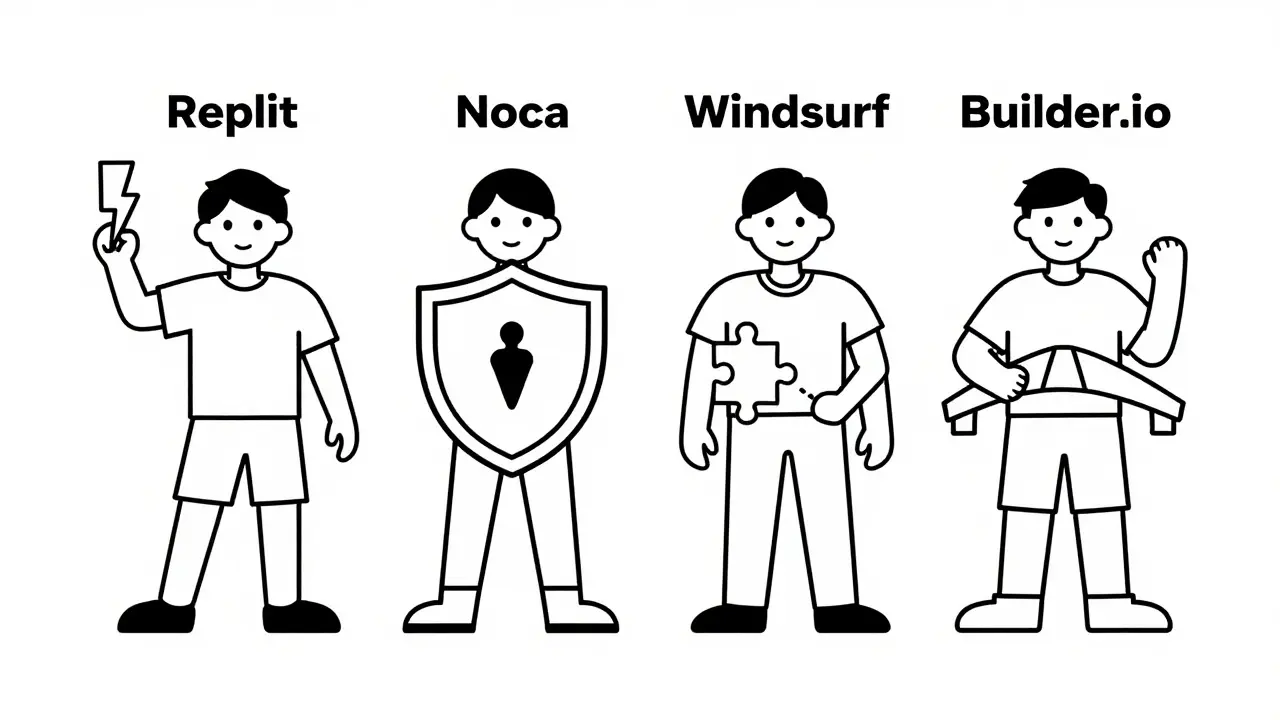
You won’t find a single "best" tool because different teams have different needs. However, four players dominate the conversation as of early 2026: Replit, a browser-based IDE founded in 2016 known for real-time collaboration, Noca, a no-code platform launched in Q2 2024 by former Google AI engineers, Windsurf, released in January 2025 featuring a context-aware workspace, and Builder.io, acquired by Vercel in March 2025, focusing on visual AI IDEs.
| Platform | Best For | Pricing (Approx.) | Key Strength | Main Weakness |
|---|---|---|---|---|
| Replit | Startups, Education, Real-time Collab | $20/user/month | Sub-100ms latency multiplayer editing | Weaker enterprise security features |
| Noca | Business Analysts, Internal Tools | $35/user/month (min 10 seats) | No-code visual builder + AI automation | Limited customization for complex apps |
| Windsurf | Experienced Engineering Teams | ~$42/user/month (usage-based) | 94.7% relevance accuracy on large codebases | Steep learning curve (17+ hours) |
| Builder.io | Product-Design Alignment, Frontend | $28/user/month | Cross-functional alignment (React/Vue/Angular) | Struggles with legacy backend code |
Matching the Tool to Your Team Structure
Your team composition dictates your choice more than any feature list. If you have a mix of junior and senior developers, the learning curve matters immensely. JetBrains’ 2025 Developer Ecosystem Survey found that teams with more than 30% junior developers need 23.7 average hours of training per person to effectively use vibe coding platforms. Experienced teams only need 14.2 hours.
If you are managing a team of seasoned engineers who value speed and precision, Windsurf is likely your best bet. Its "context-aware workspace" indexes entire repositories and provides AI suggestions with high relevance. However, be prepared for an initial productivity dip. One Reddit user reported a 40% drop in output during the first month of switching to Windsurf, but saw a 22% increase in feature delivery speed after onboarding completed.
On the flip side, if your goal is to bridge the gap between business stakeholders and technical teams, Noca shines. Atlassian’s 2025 survey showed that 68% of teams using Noca reported improved collaboration between developers and business units. It’s ideal for creating internal tools without bogging down your core engineering staff in maintenance tasks.
Budgeting for AI Inference Costs
Pricing in the vibe coding space is tricky because it often hides the cost of AI inference. The Information reported in January 2026 that some platforms spend $18-$25 per user monthly just on AI processing costs. This makes profitability challenging at current pricing models.
Replit offers the most predictable pricing at $20 per user per month, billed annually. This works well for startups and educational institutions. Windsurf uses a usage-based model, which averages $42 per user but can spike if your team engages heavily with AI refactoring tools. Builder.io sits in the middle at $28 per user, with enterprise plans starting at $50,000 annually. Before signing a contract, ask vendors how they calculate "AI interactions." You don’t want to be surprised by a bill when your team decides to refactor the entire codebase in one sprint.
Security and Compliance: Don’t Ignore the Risks
Vibe coding platforms ingest massive amounts of data to function. This raises serious questions about data privacy and compliance. The EU’s January 2026 AI Act update requires documentation of training data sources for development tools used in critical infrastructure. This directly affects platforms like Noca, which uses broad public codebases from GitHub.
If you operate in fintech or healthcare, security is non-negotiable. Replit scored lower on enterprise security (3.2/5 on G2 Crowd), making it risky for regulated industries. Noca recently released "Enterprise Governance" (version 1.8) in January 2026, adding SOC 2 compliance and custom approval workflows for AI-generated code. If you need to ensure PCI compliance, test the platform’s ability to reject suggestions that violate your specific rules. One fintech startup abandoned Windsurf after the AI repeatedly suggested code that violated PCI requirements, despite extensive customization.
Implementation Strategy: Phased Rollouts Win
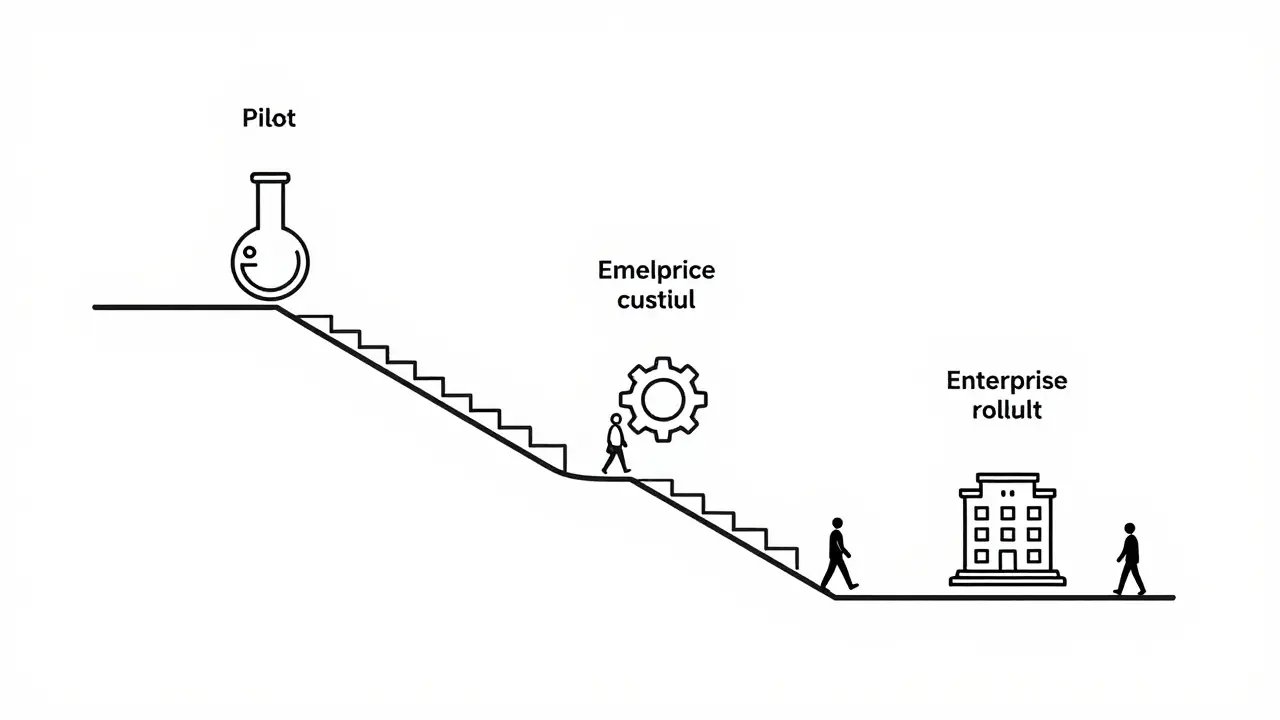
Don’t roll out a vibe coding platform to your entire organization overnight. ThoughtWorks’ 2025 Technology Radar recommends a phased approach:
- Pilot Phase (2-4 weeks): Select a non-critical project. Let a small group of power users test the waters.
- Customization Phase (3-6 weeks): Train the AI on your team-specific patterns. This includes defining coding standards, naming conventions, and security protocols.
- Enterprise Rollout (4-8 weeks): Expand to the wider team with clear guidelines and support channels.
This approach mitigates the risk of "context pollution," where poorly configured platforms lead to higher merge conflicts. Gartner analyst Thomas Bittman warned that organizations adopting these tools without assessing impact on code ownership patterns see 22% higher merge conflicts.
Future-Proofing Your Choice
The landscape is shifting fast. GitHub acquired Cognition Labs in November 2025 for $400 million, signaling deeper integration between version control and AI coding assistants. Microsoft also integrated GitHub Copilot deeply with Azure DevOps in January 2026. Look for platforms that offer open APIs and easy integration with your existing CI/CD pipelines.
Also, watch for changes in underlying AI models. Anthropic’s announcement of Claude 3.5 optimized for code generation could reduce inference costs by 60%, potentially changing the pricing dynamics of platforms like Windsurf and Builder.io. Choose a vendor that is transparent about their model updates and cost structures.
Is vibe coding suitable for junior developers?
Yes, but with caveats. Junior developers benefit from the guided nature of AI suggestions, but they require more training time. JetBrains data shows teams with >30% juniors need ~24 hours of training per person. Platforms like Replit and Noca are more beginner-friendly due to their intuitive interfaces and lower learning curves compared to Windsurf.
Which vibe coding platform is best for enterprise security?
As of early 2026, Noca leads with its Enterprise Governance module offering SOC 2 compliance and custom approval workflows. Builder.io also has strong enterprise features, especially for frontend security. Replit lags in enterprise security ratings and is better suited for startups or less regulated environments.
How much does a vibe coding platform cost per user?
Prices vary significantly. Replit charges $20/user/month. Noca is $35/user/month with a 10-seat minimum. Windsurf averages $42/user/month based on usage. Builder.io starts at $28/user/month. Always ask about hidden AI inference costs, which can add $18-$25 per user depending on usage intensity.
Can vibe coding platforms handle legacy codebases?
Most struggle here. Builder.io explicitly faces limitations with legacy code. Windsurf performs better on complex refactorings (92% accuracy) but requires significant customization to align with older architecture patterns. Expect a 3-month configuration period for large legacy systems, as seen in Shopify’s case study.
What is the biggest risk of adopting vibe coding?
The primary risk is loss of code ownership and increased merge conflicts. Gartner reports a 22% increase in conflicts in poorly configured teams. Additionally, there are compliance risks regarding training data sources, especially under the EU’s 2026 AI Act, which mandates transparency for tools used in critical infrastructure.
 Artificial Intelligence