
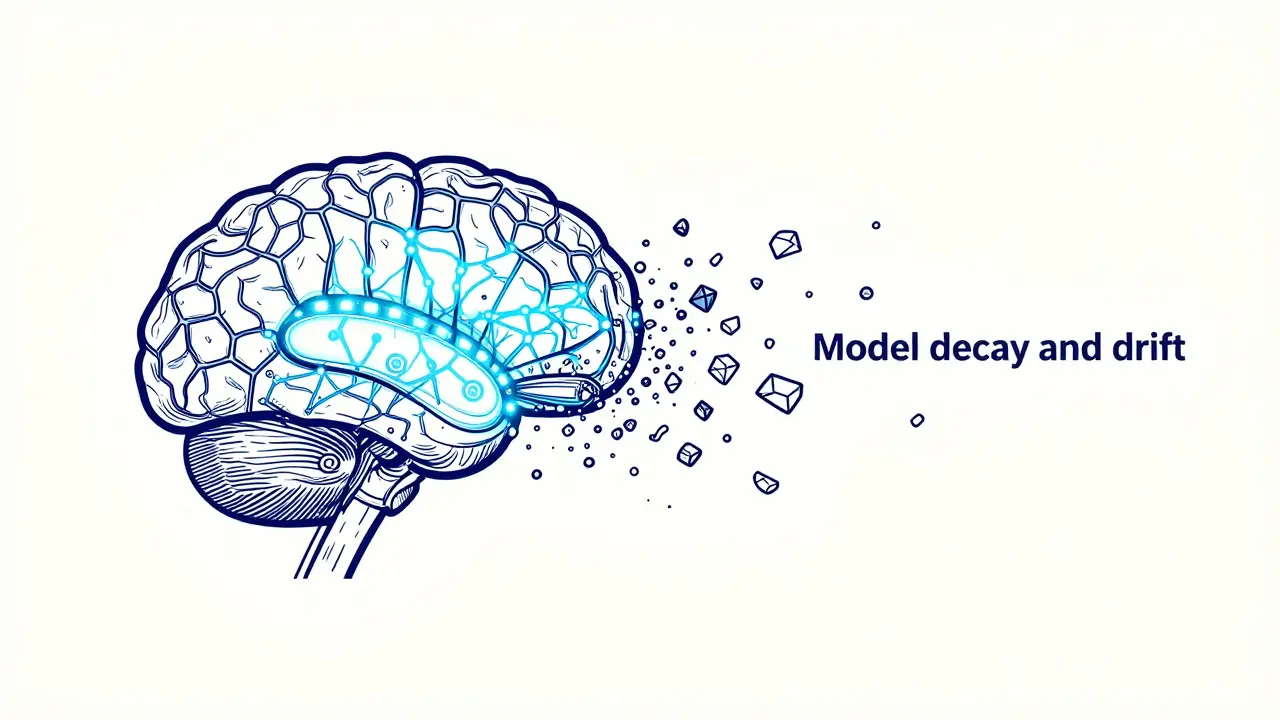
You've spent weeks perfecting your dataset, ran the training jobs, and finally deployed your fine-tuned model. It looks great in the staging environment, but then something happens: a month later, the quality of the answers starts to dip. Users are complaining that the model feels "stale" or is giving outdated advice. This is the reality of model drift, and if you aren't tracking it, your LLM drift monitoring strategy is basically non-existent. In fact, some experts suggest that without continuous checks, fine-tuned models can lose 3-5% of their accuracy every single month.
The Core Problem: Why Models "Rot" After Deployment
When you fine-tune a model, you're essentially teaching it a specific behavior or a set of knowledge based on a snapshot of data. But the world doesn't stand still. Data Drift is the phenomenon where the statistical properties of the input data change over time. Imagine you fine-tuned a coding assistant on general Python questions, but suddenly your users start asking about a brand-new framework like Bun or Astro. The model isn't "broken," but the inputs it's seeing now are fundamentally different from what it saw during training. This is called covariate shift.
Then there's Concept Drift, which is even sneakier. This happens when the definition of a "good" answer changes. Maybe a response that was considered helpful a year ago is now seen as insensitive or outdated due to changing social norms. Because the ground truth has shifted, the model's original logic no longer applies. If you're using an RLHF (Reinforcement Learning from Human Feedback) pipeline, you're especially at risk because user preferences are a moving target.
Measuring the Slide: Technical Detection Methods
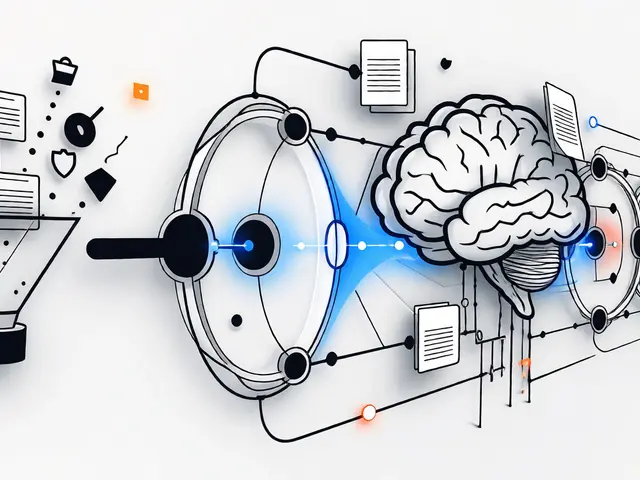
You can't fix what you can't measure. To catch drift, you need to compare your current production outputs against a historical baseline. Most teams do this by analyzing sentence embeddings-essentially turning text into mathematical vectors-and measuring the distance between them.
One of the most reliable tools for this is Jensen-Shannon Divergence (JS divergence), a method used to quantify the similarity between two probability distributions. In a production setting, if your JS divergence score hits a threshold of 0.15 to 0.25, it's usually a signal to trigger an alert. Another heavy hitter is the Wasserstein distance, which helps determine how much "effort" it would take to transform the current data distribution back into the baseline distribution.
| Metric | What it Measures | Typical Alert Threshold |
|---|---|---|
| JS Divergence | Similarity between output distributions | 0.15 - 0.25 |
| Reward Model Score | Drop in perceived quality/alignment | 15% - 20% deviation |
| Cluster Shift (K-means) | Emergence of new prompt types | 30% - 40% novel clusters |
The Infrastructure Required for Stability
Monitoring isn't free. You can't just run a script once a week and call it a day. To do this at scale, you need a dedicated pipeline. Most enterprise setups require a historical data snapshot of 3-6 months of production logs to serve as the "truth" for comparison. To generate the necessary embeddings in real-time, you'll likely need a cluster of 8-16 NVIDIA A100 GPUs, depending on your request volume.
If you're seeing a massive influx of new types of questions, try using K-means Clustering or Latent Dirichlet Allocation (LDA) on your prompt embeddings. If you notice that 30% or more of your incoming prompts are falling into clusters the model has never seen before, it's a clear sign that your fine-tuning data is obsolete and you need to retrain.
Choosing Your Monitoring Tool: Build vs. Buy
You have a few paths here. You can go the open-source route with tools like NannyML. It's free in terms of licensing, but it requires a lot of engineering hours to set up and maintain. If you have a dedicated MLOps team, this gives you the most control.
Alternatively, commercial platforms offer more "out-of-the-box" value. Azure Monitor for LLMs, for example, provides a more streamlined experience but comes with a price tag-often around $42 per 1,000 monitored requests. Specialized tools like Ango Hub focus specifically on RLHF pipelines, which is critical if your model relies heavily on human-in-the-loop feedback. The big trade-off is that while commercial tools are faster to deploy, they can be expensive and sometimes feel like a black box.
Avoiding the "False Alarm" Trap
Here is where things get tricky: not all drift is bad. Sometimes a model's behavior shifts because it's actually getting better, or because users are simply using the tool more efficiently. Google Research found that roughly 25-30% of detected drift signals are actually beneficial evolutions rather than degradations.
If you set your alerts too sensitively, you'll suffer from alert fatigue. Your engineers will start ignoring the notifications, and that's when a real catastrophe happens. A better approach is a tiered system: if performance drops by more than 15%, it's a "code red" and requires immediate intervention. If it's between 5% and 15%, it goes into a weekly review queue for a human to analyze.
Practical Steps to Get Started
If you're staring at a deployed model and wondering where to begin, follow this workflow:
- Establish a Baseline: Collect 10,000 to 50,000 representative samples from your initial successful deployment. This is your gold standard.
- Pick an Embedding Model: Use a standard like text-embedding-ada-002 to ensure your vector representations are consistent and reliable.
- Set Up a Monitoring Pipeline: Integrate your logs with an MLOps framework like MLflow or Weights & Biases to track metrics over time.
- Implement a Feedback Loop: Don't rely solely on math. Create a way for power users to flag "bad" answers. This helps you catch concept drift that statistical tools might miss.
What is the difference between data drift and concept drift?
Data drift (or covariate shift) happens when the input prompts change-for example, users start asking about a new technology. Concept drift happens when the meaning of a "correct" answer changes-for example, a legal advice model becoming outdated because a new law was passed, even if the questions remain the same.
How often should I retrain my model after detecting drift?
There is no fixed schedule, but you should retrain when your drift metrics (like JS Divergence) consistently exceed your predefined thresholds or when novel prompt clusters exceed 30% of your total traffic. Many enterprises aim for quarterly refreshes, but high-velocity domains like finance may require monthly updates.
Can't I just use a larger model to avoid drift?
No. While larger models generally have more robust general knowledge, they still suffer from drift. In fact, larger models can sometimes be more prone to subtle semantic shifts that are harder to detect but can lead to confidently incorrect (hallucinated) answers.
How do I distinguish between drift and legitimate model improvement?
The best way is through a "golden dataset"-a fixed set of high-quality prompt-response pairs that must always be answered correctly. If the model's performance on the golden set remains stable but the production distribution shifts, it's likely legitimate user behavior change. If the golden set performance drops, you have genuine degradation.
Is drift monitoring required for regulatory compliance?
In many sectors, yes. The EU AI Act and regulators like the NYDFS for financial institutions now require continuous monitoring of AI systems. For financial firms, a drop of more than 10% in accuracy from the baseline can be flagged as a material performance degradation, leading to potential legal issues.
 Artificial Intelligence
Kristina Kalolo
April 12, 2026 AT 02:15Using JS divergence is a solid approach, but I've found that the threshold of 0.15 to 0.25 can be way too sensitive depending on the domain. In some of my projects, we saw huge spikes in divergence that didn't actually impact the end-user experience at all. It really comes down to how much noise is inherent in your specific dataset. Also, the hardware requirements mentioned are pretty steep for smaller teams. A cluster of A100s just for monitoring seems like overkill unless you're processing millions of requests per hour. Most of us just batch the embedding generation every few hours on a single T4 or L4 and it's usually plenty. The real struggle is usually the labeling of the golden dataset, not the math. Getting a clean set of 10k samples that actually represent the 'truth' is a nightmare when the subject matter is subjective. I've spent more time arguing with SMEs about what a 'good' answer is than I have actually tuning the monitoring pipeline. It's a constant battle between statistical significance and practical utility. Plus, if you're using a managed service for embeddings, the cost can sneak up on you. You have to be really careful with the token counts when you're doing this at scale. Overall, the framework is sound, but the implementation details are where most people hit a wall. It's not just about the tool you buy, but how you define the baseline in the first place. Without a rock-solid baseline, all those divergence numbers are basically meaningless.
Ashton Strong
April 13, 2026 AT 06:03This is an incredibly helpful breakdown of a complex topic. It is wonderful to see such a clear path forward for those struggling with model decay!
Pamela Tanner
April 14, 2026 AT 20:09The distinction between data drift and concept drift is a crucial point that many practitioners overlook. Ensuring the baseline is representative is the only way to maintain long-term reliability.
ravi kumar
April 16, 2026 AT 01:00I agree. Setting up a proper feedback loop with power users is usually the most effective way to catch these shifts early.
Steven Hanton
April 17, 2026 AT 09:13It seems like a balanced approach to combine both statistical metrics and human feedback to avoid the false alarm trap.