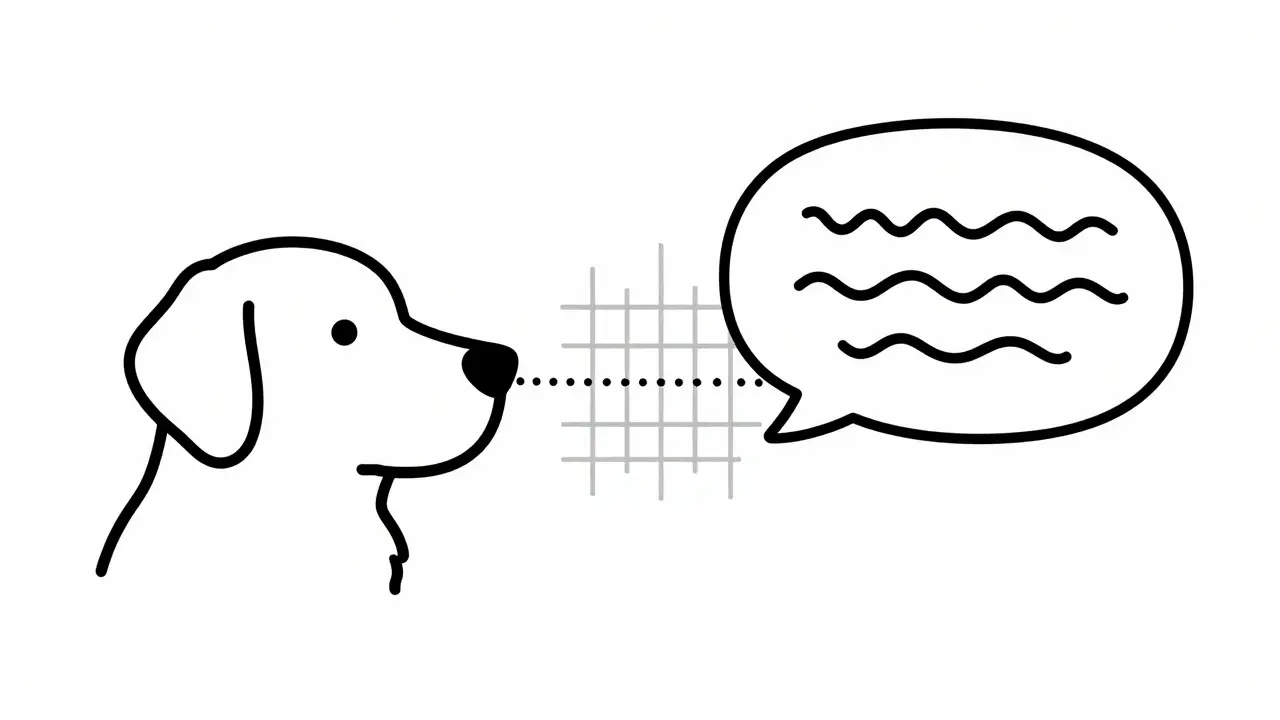
Imagine showing a picture of a golden retriever to an AI and asking it to write a poem about the dog’s loyalty. For that to happen, the system needs to do more than just recognize pixels or process words separately. It has to understand that the visual concept of "dog" and the linguistic concept of "loyalty" live in the same conceptual neighborhood. This is the core challenge of Vision-Language Models, often abbreviated as VLMs. These systems are the backbone of modern multimodal AI, blending computer vision with natural language processing to create a shared understanding of the world.
The magic happens in something called the embedding space. Think of this as a giant, multidimensional map where every image and every sentence gets its own coordinate. If your model is working correctly, the coordinates for a photo of a cat and the text "a fluffy feline" should be right next to each other on this map. Meanwhile, the text "a barking canine" should be miles away. The process of getting these coordinates to line up is known as embedding alignment, and it is the single most critical factor in how well a VLM performs.
The Two Main Paths to Alignment
When researchers build these models, they generally choose between two primary strategies: contrastive alignment and generative alignment. Each approach shapes the final behavior of the AI in distinct ways.
Contrastive alignment works like a game of hot and cold. The model is shown pairs of images and captions. If the caption matches the image (like a picture of a beach and the text "sandy shore"), the model pulls their embeddings closer together in the vector space. If they don't match (the beach picture and the text "icy mountain peak"), the model pushes them apart. Techniques like InfoNCE loss are commonly used here. This method creates sharp, precise boundaries. It’s excellent for tasks like image retrieval, where you need to find the exact match from a database of millions of photos.
Generative alignment takes a different route. Instead of just pushing and pulling vectors, it trains the language model to generate text based on visual inputs. The model looks at an image and tries to predict the correct tokens for a caption. While this produces very natural-sounding text, early versions suffered from "soft" mappings. The connection between specific parts of the image and specific words was often blurry. A recent breakthrough showed that combining generative losses with patch-level contrastive learning fixes this. By forcing the model to align small patches of an image with specific word tokens, developers can achieve state-of-the-art performance in Visual Question Answering (VQA) using only 10% of the typical training data.
| Strategy | Primary Mechanism | Best Use Case | Data Efficiency |
|---|---|---|---|
| Contrastive | Pulls matching pairs together, repels non-matches | Image Retrieval, Classification | Moderate |
| Generative | Conditions text generation on visual features | Captioning, Creative Writing | Low (without hybrid methods) |
| Hybrid (Contrastive + Generative) | Combines token prediction with patch-level similarity | Visual Question Answering, Grounded Reasoning | High (95% performance with 10% data) |
Decoding the Black Box: What Harvard Found in 2025
For years, the internal structure of these embedding spaces was a bit of a black box. We knew they worked, but we didn’t fully understand *how* concepts were stored. In April 2025, researchers from Harvard's Kempner Institute published a study that changed our understanding significantly. They analyzed four major models: CLIP, SigLIP, SigLIP2, and AIMv2.
They used a technique called sparse autoencoders (SAEs) to peel back the layers of the embedding space. An SAE is a type of neural network that forces information through a narrow bottleneck, identifying the most essential "concepts" the model uses. The team found that while rare, specific concepts (like "a red bicycle on Mars") might shift around depending on the training seed, the core, common concepts (like "dog," "sky," or "running") were remarkably stable.
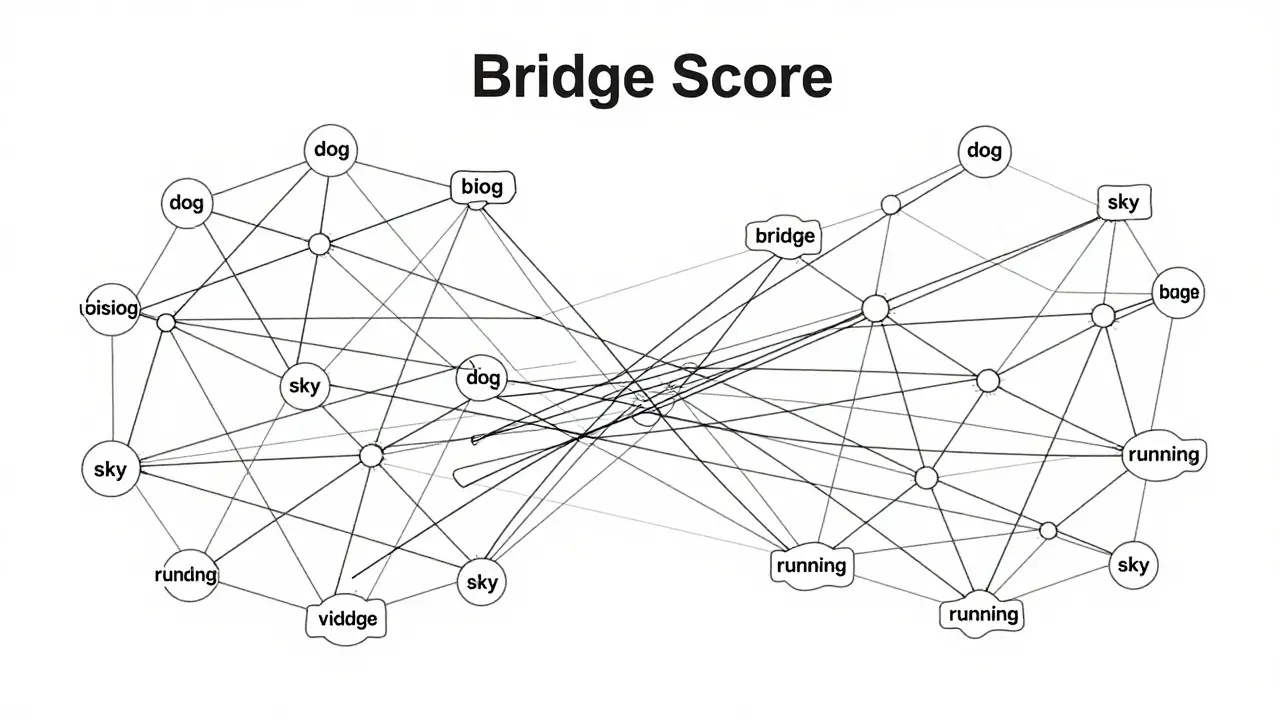
Here is the surprising part: most of these concepts activate for only one modality. A "dog" concept fires mostly when the model sees a dog image or reads the word "dog." However, the researchers discovered that many of these unimodal concepts are not entirely separate. They are almost orthogonal-but not quite-to the subspace that defines the modality itself. This slight misalignment allows them to act as bridges.
To measure this, the team introduced a metric called the Bridge Score. This score identifies concept pairs that co-activate across aligned image-text inputs and are geometrically aligned in the shared space. Essentially, it measures how well a visual feature and a textual feature collaborate to support cross-modal integration. The finding suggests that VLMs don't just store separate lists of images and words; they build a web of semantic connections where single-modality concepts help translate meaning between sight and speech.
Solving Cognitive Misalignment
Even with advanced alignment techniques, models can still stumble. This often happens due to cognitive misalignment. Imagine a vision encoder that detects a high density of features in a complex cityscape, but the language model expects simple, categorical labels like "building" or "car." When the feature density doesn't match the language model's prior expectations, the output becomes garbled or hallucinated.
Recent studies have addressed this by introducing entity-enriched supervision. Instead of just labeling an image as "landmark," datasets now include hierarchical and fine-grained descriptors. For example, instead of just "Eiffel Tower," the model learns about "iron lattice," "Paris skyline," and "tourist attraction." This multi-granularity approach helps the model handle unknown entities better, boosting landmark recognition accuracy significantly.
Another innovative solution came from research by Masry et al. in February 2025. They introduced AlignVLM, which uses convex-hull constraints. In simple terms, this forces the vision-derived inputs to stay within the "convex hull" of the language model's text embedding simplex. Think of it as keeping the visual data inside the fence of what the language model already understands. This prevents the model from drifting into nonsensical territory and improves robustness against noisy inputs.
Fine-Grained Spatial Alignment
Knowing that an image contains a cat is useful. Knowing exactly *where* the cat is, and which part of the sentence refers to it, is even more powerful. This is the realm of spatial alignment.
Models like MiniGPT-4 use a linear projection layer to align image representations from a visual encoder (often based on ViT backbones) with the input space of large language models like Vicuna. While effective, this can sometimes lose spatial detail.
More advanced approaches, such as those explored by Mahajan et al. in late 2025, utilize cross-attention fusion. Here, interleaved cross-attention blocks allow the vision and language streams to talk to each other continuously. These blocks are often supervised by auxiliary grounding losses, such as segmentation masks from models like SAM (Segment Anything Model). This ensures that when the model says "the man in the blue shirt," it is actually looking at the blue shirt in the image, not just guessing based on context.
This level of precision is crucial for applications like autonomous robotics or medical imaging, where pointing out the wrong object can have serious consequences. It transforms the VLM from a passive observer into an active, grounded reasoner.
Evaluating Success: Metrics That Matter
How do we know if alignment is working? We can't just look at the code; we need measurable outcomes. The industry relies on several key metrics:
- Precision@k: This measures the fraction of correct matches in the top-k results from a cross-modal query. For example, if you search for "red car," does the actual red car appear in the first 5 results? Research from January 2026 shows that decoder-only language models can achieve Precision@15 scores up to 0.93, indicating extremely high alignment quality.
- Bridge Score: As mentioned earlier, this quantifies the strength of cross-modal semantic bridges. Higher scores indicate better integration between visual and textual concepts.
- Reconstruction Error (R²): Used in conjunction with Sparse Autoencoders, this measures how well the extracted sparse concepts can reconstruct the original embeddings. High R² values with low sparsity norms indicate efficient, interpretable representation learning.
Interestingly, studies show that action representations and BLIP-based models converge toward a shared geometric core. This suggests that there is a fundamental, modality-independent semantic structure underlying human-like understanding. When models align with this core, they become capable of cross-modal transfer, allowing skills learned in one domain (like reading diagrams) to apply to another (like navigating physical spaces).
Practical Implementation Tips
If you are looking to implement or fine-tune a Vision-Language Model, keep these practical considerations in mind:
- Start with Pre-trained Bases: Don't train from scratch unless necessary. Models like CLIP, SigLIP, and AIMv2 provide robust starting points. Their embedding spaces are already well-aligned for general concepts.
- Choose Your Loss Function Wisely: If your goal is retrieval, stick with contrastive losses. If you need detailed descriptions or reasoning, opt for a hybrid approach that combines generative objectives with patch-level contrastive learning.
- Data Quality Over Quantity: Recent findings suggest that 10% of high-quality, carefully paired data can outperform 100% of noisy data when using hybrid alignment strategies. Focus on cleaning your image-text pairs.
- Monitor for Cognitive Misalignment: Watch for cases where the visual complexity overwhelms the language prior. Using entity-enriched datasets can mitigate this.
- Leverage Sparse Autoencoders for Debugging: If your model is behaving unpredictably, use SAEs to inspect the internal concepts. Check the Bridge Score to ensure that visual and textual features are actually collaborating rather than operating in silos.
The Future of Multimodal Understanding
We are moving beyond simple image-captioning. The future of VLMs lies in embodied agents-robots and AI assistants that interact with the physical world. These agents need to not only see and speak but also touch, gaze, and react in real-time. The alignment techniques developed today, particularly those involving cognitive alignment and fine-grained spatial grounding, are laying the groundwork for this next generation of AI.
As research continues to unify geometric, cognitive, and task-driven alignment mechanisms, we can expect models that are not just smarter, but more interpretable and robust. The goal is no longer just to make the AI guess correctly, but to ensure it understands the world in a way that mirrors human cognition, bridging the gap between pixels and prose seamlessly.
What is the difference between contrastive and generative alignment?
Contrastive alignment focuses on positioning matching image-text pairs close together in vector space while pushing non-matching pairs apart. It is ideal for retrieval tasks. Generative alignment trains the model to produce text conditioned on visual inputs, making it better for captioning and creative tasks, though it can suffer from blurry mappings without hybrid techniques.
What is the Bridge Score in Vision-Language Models?
The Bridge Score is a metric introduced by Harvard researchers to quantify how well concepts from different modalities (vision and language) collaborate. It measures the co-activation and geometric alignment of concept pairs in the shared embedding space, revealing how single-modality features support cross-modal integration.
Why are Sparse Autoencoders (SAEs) important for VLMs?
SAEs help decode the internal structure of embedding spaces by extracting sparse, interpretable concepts. They allow researchers to see which specific features drive the model's decisions, improving interpretability and ensuring that core concepts remain stable across different training runs.
What is cognitive misalignment in multimodal AI?
Cognitive misalignment occurs when the density or structure of features detected by the vision encoder does not match the categorical expectations (priors) of the language model. This mismatch can lead to errors or hallucinations. It can be mitigated using entity-enriched supervision and convex-hull constraints.
Which models currently lead in embedding alignment performance?
As of 2026, models like CLIP, SigLIP, SigLIP2, and AIMv2 are considered state-of-the-art benchmarks. Decoder-only language models integrated with advanced alignment techniques have shown Precision@15 scores up to 0.93, demonstrating superior cross-modal semantic alignment compared to older architectures like BERT.
 Artificial Intelligence