

For years, building a sophisticated Generative AI application felt like trying to drink from a firehose. The technology was powerful, but the bill at the end of the month could bankrupt even well-funded startups. At the heart of this financial pressure is a simple unit of measurement that has become the currency of the digital age: the token.
In May 2026, the landscape has shifted dramatically. We are no longer just experimenting with chatbots; we are embedding intelligence into every layer of business operations. This shift is only possible because the cost per token a unit of data processed by AI models, typically representing words or subwords has dropped significantly. As NVIDIA noted in early 2024, tokens are the "currency of AI." When that currency becomes cheaper, new economies emerge. Today, lower-cost tokens aren't just saving money-they are unlocking entirely new categories of applications that were previously economically impossible.
The Token Economy: More Than Just a Price Tag
To understand why cost reductions matter so much, you have to look at how these systems actually work. A token isn't exactly a word. It’s a fragment-sometimes a character, sometimes a whole word-that the model processes. Most providers use a rough conversion rate of four characters per token. If you send a prompt asking for help with a spreadsheet error, plus the context of your last three conversations, and the system retrieves five chunks of documentation from your internal database, you are burning through tokens fast.
The economics here are brutal if you don’t pay attention. Input tokens (what you send) are cheap. Output tokens (what the AI generates) are expensive-often three to five times more costly than inputs. According to AWS data from March 2024, token usage accounts for 70-85% of operational expenses in generative AI applications. That means nearly all your spending is tied directly to how many words the AI reads and writes. When prices were high, this forced companies to be stingy. They limited context, shortened responses, and avoided real-time interactions. Now, with costs dropping, those constraints are vanishing.
Why Lower Costs Change Everything
Let’s talk about what happens when the price of intelligence drops. Imagine running a customer service platform where every query triggers a complex analysis of user history, product manuals, and previous tickets. In 2023, doing this for thousands of users simultaneously would have been a financial disaster. Today, it’s viable.
Deloitte Insights highlighted in October 2023 that token-based pricing created a new spend dynamic for enterprises. Models like GPT-3.5 Turbo offered a sweet spot at around $2 per million tokens, making them ten times cheaper than their heavier counterparts while still delivering strong performance for general tasks. This price point allowed businesses to move beyond simple FAQ bots. Suddenly, personalized education platforms could analyze a student’s entire learning history in real-time. Healthcare providers could process vast amounts of patient notes without breaking the bank. These are not incremental improvements; they are fundamental shifts in what software can do.
The key insight is that low-cost tokens allow for scale. You can now afford to make mistakes. You can afford to let the AI think twice before answering. You can afford to retrieve larger contexts from your knowledge base to ensure accuracy. This reliability is what turns a novelty tool into a critical business infrastructure.
Strategic Optimization: Getting More for Less
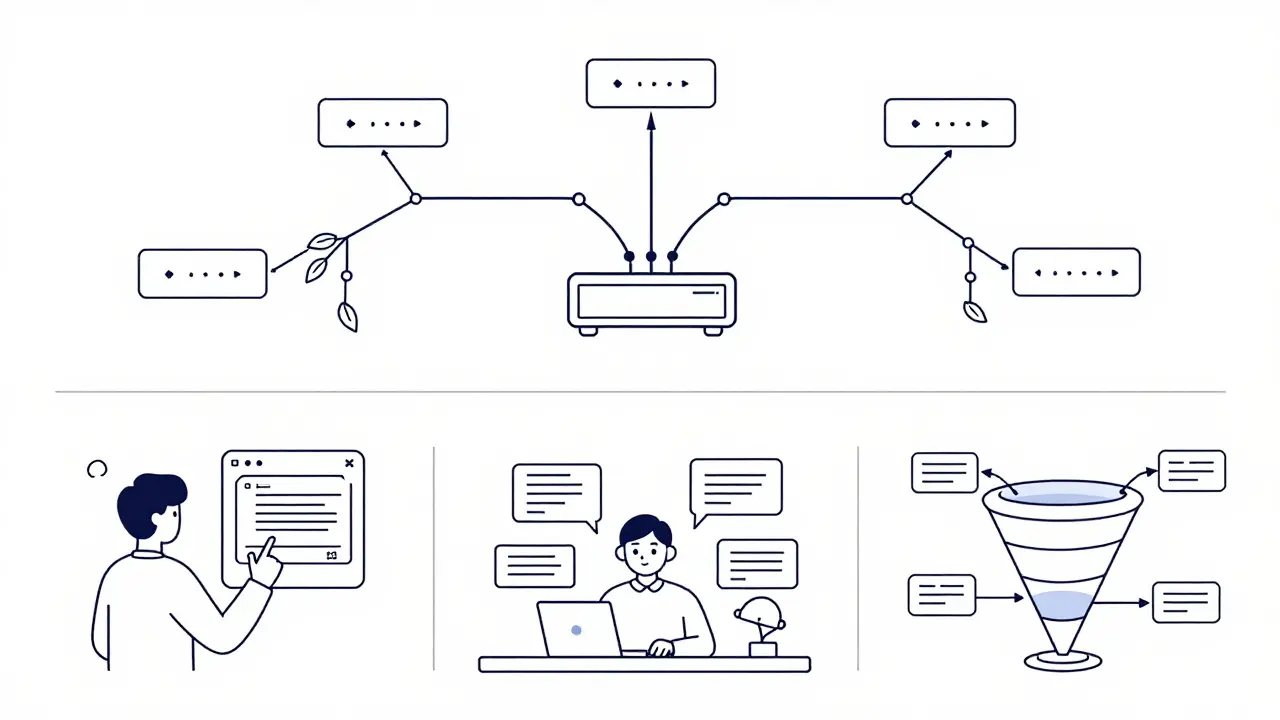
Even with falling prices, you shouldn’t just throw money at the problem. Smart engineering remains the best way to control costs. The most effective strategy isn't always buying a bigger GPU; it's routing traffic intelligently. nOps, a leading observability platform, suggests using semantic routers to direct queries based on complexity. Simple questions go to small, fast, and cheap models (like distilled 6B parameter models). Complex reasoning tasks go to larger models. This tiered approach can cut costs by 40-70% without users noticing any difference in quality.
| Model Type | Estimated Cost (Per Million Tokens) | Best Use Case | Key Advantage |
|---|---|---|---|
| Small Distilled Models (e.g., 6B params) | $0.10 - $0.50 | Simple Q&A, Classification | Extremely low latency and cost |
| Mid-Tier Models (e.g., GPT-3.5 class) | $2.00 - $5.00 | General Business Tasks, Summarization | Balance of cost and capability |
| Premium Models (e.g., GPT-4 class) | $10.00 - $60.00+ | Complex Reasoning, Code Generation | Highest accuracy and logic |
| Embedding Models (e.g., Titan Text V2) | $0.02 | Vector Database Indexing | Negligible cost for large datasets |
Another powerful lever is prompt engineering. It sounds basic, but it’s the cheapest optimization knob available. By refining your prompts to be concise and specific, you reduce the number of output tokens generated. Teams that implement prompt libraries and A/B test their instructions routinely see a 20-30% drop in token spend. Why? Because clearer prompts lead to shorter, more accurate completions and fewer retries.

Hardware and Infrastructure: The Hidden Levers
Software efficiency matters, but hardware is the engine. NVIDIA’s concept of the "AI Factory" represents a major shift for high-volume users. Instead of renting cloud capacity on demand, organizations are building or leasing dedicated infrastructure optimized for token throughput. Deloitte reports that for heavy users, on-premise or dedicated AI factories can offer a 3-year cost advantage over cloud solutions.
How does this work? It comes down to utilization. In traditional cloud setups, GPUs often sit half-idle because deployments are conservative. By using techniques like dynamic batching and GPU partitioning (such as MIG slices on H100 chips), companies can increase utilization from 25% to over 60%. This density drives the cost per token down dramatically. NVIDIA claims that optimized processes on latest-generation hardware can achieve up to a 20x reduction in cost-per-token compared to unoptimized older hardware. That’s not just an improvement; it’s a revolution in unit economics.
Quantization also plays a role here. Converting models from FP32 precision to FP16 or INT8 reduces memory footprints by up to 4x and cuts arithmetic costs by 30-60%. For most applications, the loss in accuracy is negligible, but the savings are massive. This allows you to run larger models on smaller, cheaper hardware.
New Use Cases Unlocked by Cheap Tokens
So, what can you actually build now that you couldn't before? The answer lies in volume and personalization.
- Real-Time Personalized Education: Imagine a tutoring app that doesn't just give answers but adapts its teaching style based on the student's immediate emotional state and learning pace. This requires constant, low-latency processing of text and potentially audio. High token costs made this prohibitive. Low costs make it scalable.
- Enterprise Knowledge Management: Companies can now ingest their entire document history-emails, Slack chats, PDFs-and create searchable, intelligent assistants that provide context-aware answers. Retrieval-Augmented Generation (RAG) systems pull relevant chunks from vector stores. With cheap embedding models (like Amazon Bedrock's Titan Text Embeddings V2 at $0.02 per million tokens), indexing terabytes of data is no longer a budget hurdle.
- Continuous Code Refactoring: Developers can run AI agents that continuously monitor codebases, suggesting optimizations and security fixes in real-time. This requires analyzing millions of lines of code daily. Only reduced inference costs make this sustainable.
- Hyper-Personalized Marketing: Instead of sending segmented emails, brands can generate unique content for every single customer interaction, tailored to their specific purchase history and browsing behavior. This level of granularity burns tokens quickly, but the ROI from increased conversion rates justifies the expense.
Avoiding Pitfalls in Token Management
While costs are dropping, risks remain. The biggest danger is "context bloat." Many developers assume that giving the AI more context improves accuracy. While true to a point, there is a law of diminishing returns. Sending 10,000 tokens of irrelevant history alongside a simple question wastes money and can confuse the model. AWS recommends implementing guardrails to limit token counts and using hierarchical chunking strategies. This means storing smaller chunks for embedding search but retrieving larger, coherent blocks only when necessary for the final LLM response.
Another pitfall is ignoring output size. Since output tokens are significantly more expensive, you must control them. Set maximum response sizes in your system prompts. If you need a summary, ask for a summary. Don't ask for a detailed essay if you only need three bullet points. Every extra word costs you.
Finally, beware of vendor lock-in. Token counting methodologies vary slightly between providers. What counts as one token in OpenAI might count as two in another system. Always audit your usage across different platforms. Tools like Microsoft Cost Management or third-party solutions from vendors like nOps can provide visibility into these variations, helping you choose the most cost-effective provider for each specific task.
Looking Ahead: The Future of Token Economics
We are likely to see continued innovation in pricing models. Providers are moving beyond simple pay-per-token structures. Provisioned throughput options, where you reserve capacity for a monthly fee, are becoming common for predictable workloads. This offers stability and further discounts for high-volume users. Meanwhile, open-source models continue to improve, allowing companies to host their own instances and eliminate token fees entirely, paying only for electricity and hardware depreciation.
The trajectory is clear: intelligence is becoming a commodity. As the cost per token approaches zero, the value shifts from accessing the model to curating the data and designing the workflows. The companies that win in this era won't necessarily be those with the biggest budgets, but those with the smartest architectures. They will treat tokens not as a fixed cost, but as a variable resource to be optimized, cached, and routed with surgical precision.
What exactly is a token in Generative AI?
A token is a unit of data that an AI model processes. It usually consists of a word, part of a word, or punctuation mark. Most providers estimate that one token equals roughly four characters. Tokens are used for both input (what you send to the AI) and output (what the AI generates).
Why are output tokens more expensive than input tokens?
Generating output requires the AI to perform complex probabilistic calculations for each token it produces, which consumes more computational power than simply reading and understanding input tokens. Consequently, providers charge 3 to 5 times more for output tokens.
How can I reduce my Generative AI token costs?
You can reduce costs by using smaller models for simple tasks, optimizing your prompts to be concise, setting maximum response lengths, implementing caching for repeated queries, and using efficient retrieval strategies that minimize unnecessary context sent to the model.
What is an AI Factory?
An AI Factory refers to dedicated infrastructure, often on-premise or privately leased, designed specifically for high-volume AI processing. By maximizing GPU utilization through techniques like dynamic batching and quantization, AI factories can significantly lower the cost per token compared to standard cloud services.
Are embedding models cheaper than language models?
Yes, significantly. Embedding models, which convert text into numerical vectors for storage and search, are much less computationally intensive. For example, Amazon Bedrock's Titan Text Embeddings V2 costs around $0.02 per million tokens, whereas general-purpose LLMs can cost $2 to $60+ per million tokens.
 Artificial Intelligence


Elmer Burgos
May 20, 2026 AT 08:22hey folks, just wanted to say this is a really solid breakdown of the token economy stuff. i think we often forget that the real win here isn't just cheaper compute but the ability to actually scale personalization without going broke. its wild how fast things have changed since 2023 when every query felt like a financial risk. now we can actually build systems that adapt in real time which feels like a huge leap forward for user experience. great read
Jason Townsend
May 20, 2026 AT 08:49you guys are all so naive about this whole 'cheap tokens' narrative. it's not just economics it's a trap designed to lock you into their ecosystem forever. once you start relying on these proprietary models for your core infrastructure you lose all autonomy. they want you to think you're saving money while they quietly harvest your data and control the flow of information. wake up sheeple
Sally McElroy
May 21, 2026 AT 21:39I find the moral implications of this cost reduction deeply troubling., especially regarding the potential for mass manipulation., When intelligence becomes a commodity., the power dynamics shift dramatically., We must consider who benefits from this efficiency., Is it truly for the advancement of human knowledge., or merely for corporate profit maximization., The article ignores the ethical vacuum created by such rapid scaling., We need more than just technical optimization., We need robust ethical frameworks.
Sara Escanciano
May 23, 2026 AT 15:24This entire industry is built on exploitation and environmental destruction disguised as innovation. You people cheer for lower costs while ignoring the massive energy footprint of these data centers. It is morally bankrupt to prioritize convenience over the planet. Stop enabling this destructive behavior and demand accountability from these tech giants instead of celebrating their pricing strategies.
Jen Deschambeault
May 24, 2026 AT 08:44I totally agree with the point about strategic optimization being key! It’s so exciting to see how we can use smaller models for simple tasks and save resources for the complex ones. This kind of smart engineering gives me hope that we can sustainably scale AI without burning through all our resources. Let’s keep pushing for efficient solutions!
Antwan Holder
May 25, 2026 AT 17:56The sheer audacity of this post is breathtaking. They talk about 'unlocking new use cases' as if it’s some grand gift to humanity, when in reality it’s just another layer of surveillance capitalism wrapped in pretty graphs. I feel a deep sense of dread every time I read about these efficiencies because I know exactly where this leads-total loss of privacy and autonomy for the average person. It’s tragic that everyone is so focused on the price per token instead of the value of their own freedom.
Destiny Brumbaugh
May 26, 2026 AT 06:30finally someone talks about making ai work for us americans instead of letting foreign companies dictate the terms. we need to build our own ai factories right here in the usa to secure our future and stop relying on overseas tech. its time to take back control of our digital infrastructure and make sure our hard earned dollars stay in our own pockets. lets go team usa