

What if you could learn how to build complex software systems before you even knew how to write a for loop? That’s the promise of vibe coding-a new way to teach software architecture by having students study AI-generated code before writing any of their own.
Why Traditional Coding Classes Fail at Teaching Architecture
For decades, computer science courses started with syntax: variables, conditionals, loops. Only after months of typing basic programs did students get to talk about architecture-MVC, microservices, API design. By then, most were overwhelmed. A Stanford study in January 2024 found that 63% of students couldn’t connect their low-level code to the bigger picture. They could write a function, but not explain why a system used a database layer instead of in-memory storage. This gap left them unprepared for real-world teams where architecture decisions matter more than perfect indentation. In bootcamps, pair programming became popular to fix this. But even there, students needed to be fluent in syntax before they could discuss design trade-offs. The result? Many graduates could build simple apps, but couldn’t scale them, debug performance bottlenecks, or explain why their code was structured the way it was.What Is Vibe Coding?
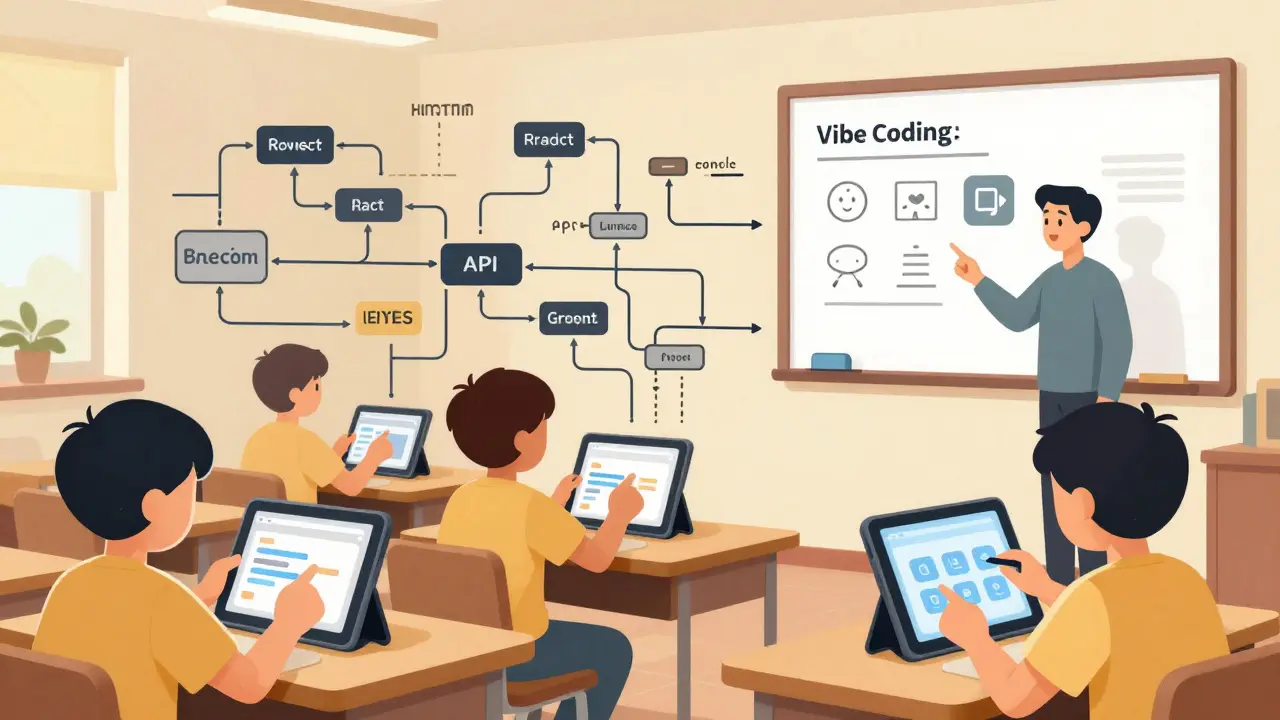
Vibe coding flips the script. Instead of starting with syntax, students start with architecture. They’re given fully working applications generated by AI tools like Google AI Studio, Replit, or Vibecode. Their first task isn’t to write code-it’s to inspect it. They open the files, trace how data flows, identify components, and ask: Why did the AI choose this pattern? This isn’t passive reading. It’s active analysis. Students use tools like Vibecode’s “Pinch to Build” interface to tweak UI elements and watch the underlying code change in real time. They see how a button click triggers an API call, how state is managed, how error handling is layered. They don’t just learn what the code does-they learn why it’s built that way. The Vibe Programming Framework, released in March 2024, formalizes this approach with five core rules:- Augmentation Not Replacement: AI helps, but doesn’t replace understanding.
- Verification Before Trust: Students must prove they understand every component before modifying it.
- Maintainability First: Code must be readable and modifiable by others.
- Security by Design: Students learn to spot vulnerabilities in generated code.
- Knowledge Preservation: Every decision must be documented in the student’s own words.
How It Works in Practice
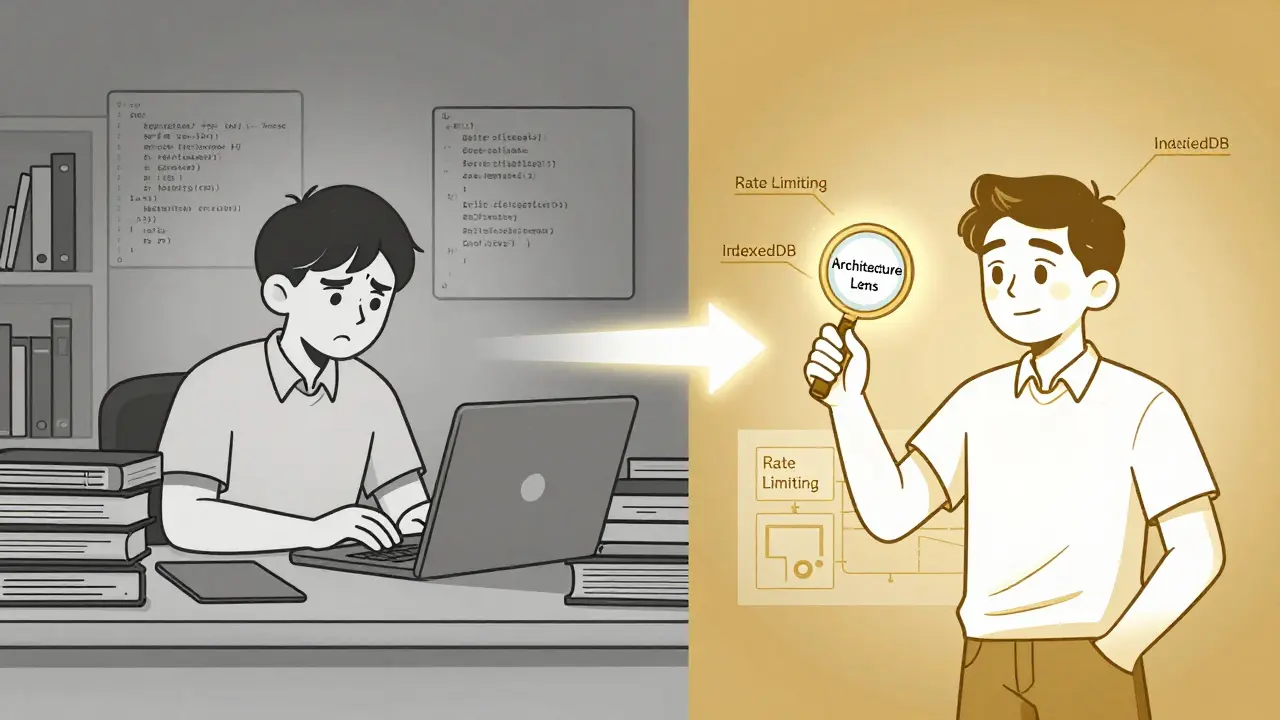
Imagine a student’s first assignment: build a to-do app. In a traditional class, they’d spend two weeks learning JavaScript syntax. In a vibe coding class, they’re handed a fully functional app generated by AI. Their task? Break it down. They open the folder structure. They see asrc/components folder, a src/api folder, and a public folder. They ask: Why is the data stored in localStorage instead of a server? Why is the UI split into separate components? They use the AI’s built-in “Architecture Lens” feature (launched by Google in December 2024) to get pop-up explanations: This uses React’s Context API to avoid prop drilling. This endpoint uses rate limiting to prevent abuse.
Before they change a single line, they answer three questions:
- What does this component do?
- Why was this pattern chosen over another?
- What would break if we removed this part?
Results: Faster Learning, Deeper Understanding
A University of Washington study in August 2024 found students using vibe coding grasped architectural patterns 42% faster than those in traditional courses. One student, Maria Rodriguez, went from zero coding experience to building a full e-commerce app with user auth, payment integration, and inventory tracking in eight weeks. She didn’t memorize syntax-she learned how systems fit together. At General Assembly’s San Francisco campus, 82% of students reported feeling confident discussing architecture after just two weeks. Instructors noticed something unexpected: students started asking better questions. Instead of “How do I fix this error?”, they asked: “Why did the AI use a monolithic structure here instead of microservices?” But it’s not perfect. A pilot at a community college in Ohio found that 61% of students couldn’t explain architectural decisions without AI help. The difference? They skipped the verification step. Without enforced inspection protocols, vibe coding becomes just another way to generate code without learning.The Hidden Challenge: Prompt Dependency
The biggest risk isn’t the AI-it’s the student. The IEEE SIGCSE white paper in May 2024 found that 57% of beginners developed “prompt dependency.” They’d type: “Make a secure login page with JWT and role-based access.” The AI delivers. They run it. It works. They move on. No inspection. No understanding. That’s why the Vibe Framework insists on documentation. Every change must be accompanied by a written explanation: “I replaced the API endpoint with a GraphQL query because it reduces network round trips by 30%. This matches the maintainability principle.” Instructors now spend less time lecturing and more time coaching. They don’t teach syntax-they teach curiosity. “What if we changed this?” “What would happen if ten thousand users hit this endpoint?” “Why does this component have a timeout of 5 seconds?”Tools You Need to Get Started
You don’t need a fancy lab to try vibe coding. Here are the most accessible tools as of early 2026:- Google AI Studio: Free for educators. Includes the “Architecture Lens” feature that highlights design patterns in generated code.
- Replit Edu: $15 per student/year. Offers built-in inspection checklists and version history to track student thought process.
- Vibecode for Education: $20 per student/year. Features the “Pinch to Build” interface and mandatory verification quizzes before code edits.
What This Means for the Future of Coding Education
Gartner predicts that by 2026, 80% of intro CS courses will use some form of AI-assisted code inspection. LinkedIn’s 2024 workforce report shows a 210% spike in job postings asking for “experience with AI-assisted development and code inspection.” Amazon, Microsoft, and Google now use vibe coding techniques to onboard new engineers. The ACM Education Board’s 2024 roadmap says it clearly: by 2027, vibe coding with architectural inspection will become the standard first approach to teaching software development. Traditional syntax-first instruction will be saved for specialized courses-like embedded systems or operating systems-where fine-grained control matters more than rapid prototyping. This isn’t about replacing programmers with AI. It’s about raising the bar for what we expect from them. In a world where AI can write boilerplate code in seconds, the real skill isn’t typing-it’s thinking. Understanding why systems are built the way they are. Recognizing trade-offs. Making intentional choices.Is Vibe Coding Right for You?
If you’re an instructor tired of students who can code but can’t design, vibe coding offers a path forward. If you’re a learner who’s frustrated by memorizing syntax without seeing the big picture, this approach puts architecture front and center. But it demands discipline. You can’t skip inspection. You can’t trust the AI blindly. You have to ask why. The tools are here. The research backs it. The industry is already using it. The question isn’t whether vibe coding will change education-it’s whether you’re ready to learn differently.Is vibe coding just another way to get AI to write code for me?
No. Vibe coding requires you to inspect, question, and document every piece of AI-generated code before you modify it. It’s not about letting AI do the work-it’s about using AI to teach you how real systems are built. The goal is to understand architecture so deeply that you could rebuild it yourself-even without AI.
Do I need to know how to code before trying vibe coding?
No. Many students start with zero experience. Vibe coding works because it teaches architecture first, not syntax. You learn variables and loops as you encounter them in the AI-generated code, not as abstract concepts. This makes learning more meaningful and less overwhelming.
Can vibe coding teach low-level programming like C or assembly?
Not well. Vibe coding excels at teaching modern full-stack architecture-web apps, APIs, cloud services. But for low-level systems where you need direct memory control or hardware interaction, traditional methods still work better. AI can’t yet generate reliable assembly code with clear architectural intent. So vibe coding is best for higher-level design, not system-level programming.
What if the AI generates bad architecture?
That’s the point. AI-generated code often includes flawed patterns-tight coupling, duplicated logic, insecure endpoints. Vibe coding turns these into teaching moments. Instead of hiding mistakes, students learn to spot them. One study found students using vibe coding identified 3x more architectural flaws than those learning through textbooks.
How do I assess if a student truly understands the architecture?
Don’t grade their code. Grade their explanations. Require them to write a short report: “Explain why you chose this data structure,” or “What trade-off did you make when replacing this component?” The Vibe Framework requires 100% traceability between student decisions and learning goals. If they can’t explain it in their own words, they don’t understand it.
Is vibe coding just a trend?
Unlikely. Industry adoption is accelerating fast. Amazon, Google, and Microsoft now use it for onboarding. Job postings demand these skills. The ACM and IEEE are formalizing standards. This isn’t a fad-it’s the next evolution of how we teach software design.
 Artificial Intelligence


Sumit SM
January 6, 2026 AT 15:04So let me get this right-we’re teaching architecture before syntax because… the brain can’t handle abstraction until it’s been beaten into submission by semicolons and indentation? I mean, sure, if you’ve ever stared at a 500-line React file wondering why there are 17 layers of wrappers, you know this isn’t just pedagogy-it’s survival. But let’s not pretend this isn’t just AI doing the heavy lifting while we call it ‘learning.’ We’ve been here before: ‘Just use the calculator!’ ‘Just use the spellchecker!’ Now it’s ‘Just use the architect!’ And somehow, we’re supposed to feel enlightened? I’m not against it-I’m just waiting for the first student to ask, ‘Why does the AI hate my component?’ and realize the AI doesn’t have preferences. It just mirrors what it’s seen. And what it’s seen… is mostly bad code with a nice UI.
Jen Deschambeault
January 8, 2026 AT 00:46I tried this with my niece-she’s 14, never coded before-and she built a full todo app with auth in 3 days. Not because she memorized anything-but because she asked why everything was where it was. She kept pointing at the API folder and saying, ‘Why doesn’t it just go straight to the database?’ And that’s the magic. She didn’t learn code. She learned systems. And now she’s the one teaching her friends. This isn’t about replacing teachers. It’s about giving them a better tool to spark curiosity. I wish I’d had this when I was learning.
Kayla Ellsworth
January 9, 2026 AT 15:18Oh great. Another ‘AI will save education’ fairy tale. So now we’re rewarding students for being good at reading AI-generated code instead of writing their own? Brilliant. Let’s just hand out pre-made essays and call it ‘literature class.’ At least with syntax, you know if someone actually wrote it. Now? You get a student who can explain why a microservice architecture is better than monolith… but can’t write a function that doesn’t crash if you pass it null. And don’t even get me started on the ‘verification quiz.’ That’s just a fancy way of saying, ‘Read the AI’s pop-up notes and regurgitate them.’
Soham Dhruv
January 10, 2026 AT 13:35man i tried vibe coding last semester and honestly it changed everything for me. i was so lost in traditional class, just typing stuff without knowing why. but with vibe, i opened up this AI-generated app and just stared at the folder structure for like an hour. then i went ‘ohhh so that’s what a context provider does’ and it just clicked. no memorizing, no panic. just curiosity. i still mess up syntax all the time but now i know what i’m trying to build. instructors dont even need to teach anymore-they just ask ‘why?’ and you figure it out. best thing ever.
Bob Buthune
January 12, 2026 AT 11:35Okay but what if the AI is wrong? What if it’s trained on garbage code? What if it’s just copying Stack Overflow answers from 2018 with no security patches? I’ve seen AI generate code that uses eval() in a production app and calls it ‘dynamic routing.’ And now we’re telling students to trust it? This isn’t education-it’s a slow-motion train wreck. You think students are learning architecture? They’re learning how to lie convincingly. ‘I chose this because it’s scalable’-no, you chose it because the AI said so and you didn’t read the 17 warnings it buried in the comments. And now we’re going to let them build real systems? I’m sorry, but I’d rather have someone who knows how to write a for loop than someone who can explain why a Redux store is ‘optimal’ without knowing what a closure is.
Jane San Miguel
January 13, 2026 AT 15:24The notion that syntax is somehow an obstacle to architectural understanding is not merely misguided-it is a fundamental misrepresentation of the cognitive scaffolding required for mastery in computational disciplines. Syntax is not incidental; it is the lexical substrate upon which abstraction is built. To omit its systematic acquisition is to construct a cathedral on sand, where the arches may appear elegant but lack tensile integrity. The Vibe Coding Framework, while rhetorically compelling, risks producing a generation of articulate parrots who can recite design patterns but cannot instantiate them without a proprietary IDE. This is not pedagogy-it is performative cognition, commodified by edtech and sold as innovation.
Kasey Drymalla
January 13, 2026 AT 21:23AI is watching us. This is how they train the next generation to be obedient. First they give you code you didn't write. Then they make you explain it. Then they make you document it. Then they make you submit it. Then they take your data. Then they train the next AI on YOUR explanations. You think this is education? It's data harvesting with a diploma. They don't want you to learn. They want you to become a label for their training data. And the schools? They're in on it. They get paid per student. You're not a student. You're a data point.
Dave Sumner Smith
January 15, 2026 AT 20:54They’re using AI to teach architecture? Who’s training the AI? Big Tech? Google? Microsoft? They’re the ones designing the systems. They’re the ones writing the ‘best practices.’ So now we’re teaching students to think like corporations? To build exactly what Big Tech wants? No creativity. No innovation. Just follow the AI’s script. And the ‘verification quiz’? That’s just a gate to make sure you don’t question the architecture. They don’t want you to think differently. They want you to think like them. This isn’t education. It’s indoctrination with a UI.
Cait Sporleder
January 17, 2026 AT 20:04While I find the philosophical underpinnings of vibe coding both intellectually stimulating and pedagogically provocative, I must emphasize the epistemological tension inherent in its implementation. The displacement of syntactic mastery as a prerequisite for architectural comprehension presumes a Cartesian separation between form and function-a distinction that, in computational systems, is ontologically untenable. Syntax is not merely the vessel; it is the very medium through which architectural intent is materially instantiated. To divorce the two is to risk creating a class of students who can narrate the architecture of a distributed system but cannot articulate the semantic implications of a race condition in a concurrent context. Furthermore, the reliance on AI-generated artifacts as pedagogical primers introduces a profound hermeneutic vulnerability: the interpretive authority of the machine, trained on corpora that may reflect corporate norms, legacy patterns, or even deliberate obfuscation, becomes the de facto curriculum. Without rigorous, human-mediated critical interrogation-beyond the performative verification quiz-this approach risks institutionalizing algorithmic orthodoxy as pedagogical truth. I propose, therefore, that vibe coding be implemented not as a replacement, but as a dialectical complement: a counterpoint to syntactic rigor, not its negation.