You probably think you're being careful when you paste a customer email into ChatGPT or Claude. You remove the name, maybe hide the phone number. But research from late 2024 suggests you are still leaking way more than you realize. In fact, users share between 69% and 94% more personal information than actually needed to get a good answer. That’s not just sloppy; it’s a massive privacy liability.
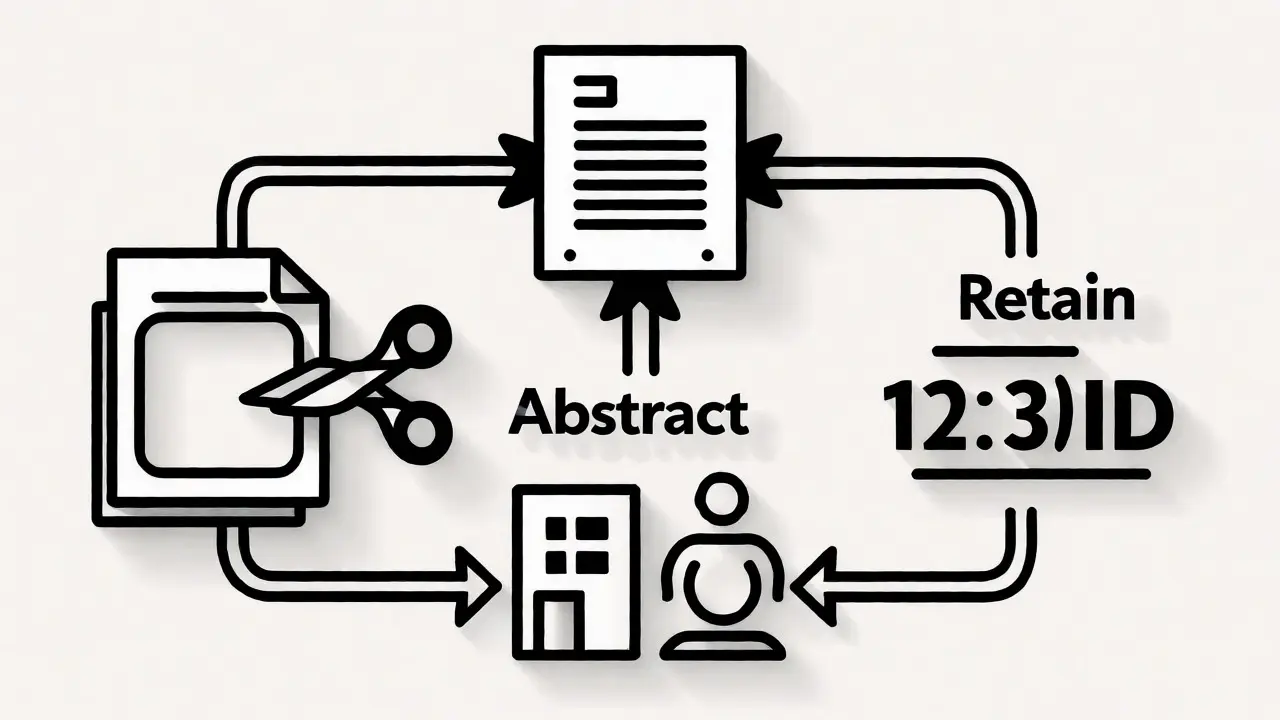
This is where Data Minimization becomes critical. It isn't just about hiding names. It's about finding the exact minimum amount of context an AI needs to do its job without exposing extra secrets. A major framework released by researchers at Carnegie Mellon University and Stanford University calls this "quantifying the least privacy-revealing disclosure that maintains utility." Sounds complex? It’s simpler than it looks once you break it down into three moves: Redact, Abstract, and Retain.
The Three Moves: Redact, Abstract, Retain
Think of your prompt as a package you’re handing to a stranger. You have three choices for every piece of sensitive info inside that package. The Carnegie Mellon-Stanford framework formalizes these as distinct strategies. Understanding them is the first step to building safer AI workflows.
- REDACT: This is the nuclear option. You completely remove the sensitive element. If the model doesn’t need the specific date of birth to summarize a contract, cut it out. Replace it with a placeholder like
[DATE]. This offers the highest privacy protection but can hurt accuracy if the date was crucial for context. - ABSTRACT: Here, you replace specifics with general terms. Instead of saying "John Doe, born in 1985 in Seattle," you might say "a middle-aged male from the Pacific Northwest." You keep the semantic meaning (age group, region) but lose the unique identifiers. This balances privacy and utility well for many tasks.
- RETAIN: Sometimes, you just have to keep it. If the task requires precise calculation based on a specific ID number, removing it breaks the output. The goal of minimization isn't to always REDACT; it's to know exactly when RETAIN is unavoidable.
A study published in arXiv:2510.03662v1 showed that top-tier models like GPT-4-class systems can handle aggressive minimization surprisingly well. They achieved 85.7% success rate with REDACT strategies on open-ended conversations. Smaller models, however, struggle. If you’re using a tiny local model like qwen2.5-0.5b, it only managed a 19.3% REDACT success rate. Why? Larger models have enough architectural complexity to infer missing context from minimal cues. Small models need the hand-holding.
Why Bigger Models Handle Less Data Better
This counterintuitive fact trips people up. You’d think a smaller, faster model would be easier to feed less data. But the opposite is true. Frontier models (70B+ parameters) tolerate high levels of data removal because they have vast internal knowledge bases. They can guess that "Pacific Northwest" implies certain weather patterns or economic contexts without needing the city name.
Smaller models lack this breadth. When you strip away details, they don't have the background knowledge to fill in the gaps. The gap is huge: frontier models tolerated 78.4% minimization on knowledge-intensive tasks, while smaller models dropped to 32.1%. If you are running privacy-critical apps on edge devices or small local LLMs, you can’t be as aggressive with your prompts. You’ll lose too much accuracy.
| Model Type | REDACT Success Rate | ABSTRACT Success Rate | Utility Preservation |
|---|---|---|---|
| GPT-4 Class (Frontier) | 85.7% | 8.6% | High |
| Qwen2.5-0.5b (Small) | 19.3% | 11.0% | Low |
| Specialized Fine-Tuned | ~50% | ~30% | Moderate |
Implementation: The Priority-Queue Tree Search
How do you decide what to cut? You don’t just guess. The leading technical approach uses a priority-queue tree search algorithm. Imagine a decision tree where each branch represents a different level of detail removal. The algorithm explores these branches, starting with the most private options (heavy redaction) and checking if the model still gives a useful answer. If the answer quality drops below a threshold, it backtracks and keeps slightly more info.
This method outperforms naive minimization by 37.2% in utility preservation. Naive methods often over-redact, stripping away context the model didn’t know how to ignore. The tree search finds the sweet spot automatically. However, this comes at a cost. You face an additional processing time of 320-450ms per query. For real-time chatbots, that latency matters. For batch processing emails overnight? Not so much.
Another popular technique is Retrieval-Augmented Generation (RAG). RAG systems show 72.4% minimization effectiveness. By pulling specific facts from a database rather than stuffing everything into the prompt, you naturally minimize the data sent to the LLM. But RAG requires vector databases and infrastructure changes, which adds complexity.
Regulatory Pressure and Real-World Risks
Privacy isn’t just a nice-to-have feature anymore. It’s a legal requirement. The European Data Protection Board (EDPB) issued guidance in April 2025 warning that excessive data collection infringes on GDPR Article 5(1)(c). If you send entire customer support tickets to an API without scrubbing, you might be violating this principle.
Healthcare and finance lead adoption here. Healthcare companies saw a 58.7% adoption rate for minimization tools because HIPAA audits are brutal. One CTO reported passing 100% of HIPAA audits after implementing layered Data Loss Prevention (DLP) with pre-scan prompts, up from just 62% before. Financial services aren’t far behind at 52.3%.
But beware of false positives. Automated PII detection tools flag things that aren’t actually sensitive. Users report a 42.7% false positive rate. You might redact a company name that’s public knowledge, confusing the model. Balancing strict privacy with operational efficiency is hard. Dr. Jane Chen, lead author of the CMU-Stanford study, notes that larger models’ robustness allows us to push these boundaries further than we could two years ago.

Common Pitfalls and How to Avoid Them
Most teams fail at minimization because they treat it as a one-time filter. It’s not. It’s a dynamic process. Here are the traps to watch for:
- Over-Minimization: Cutting too much data leads to hallucinations. If you remove all dates from a financial report summary, the model might invent a timeline. Always validate utility. Set a threshold-say, 85% similarity to the original answer-and stick to it.
- Ignoring Context Dependencies: Some data points seem redundant individually but matter together. Removing "Seattle" and "1985" separately might be fine, but removing both loses the cultural context of the user. Use ABSTRACT instead of REDACT when relationships between data points matter.
- Assuming All Models Are Equal: As noted, small models hate vague prompts. If you switch from GPT-4 to a local Llama 3 variant, you must loosen your minimization rules. Test rigorously after any model swap.
- Static Rules: Your prompt strategy should adapt. A creative writing task tolerates heavy abstraction. A legal extraction task does not. Implement dynamic minimization oracles that adjust based on the task type.
Tools like Proofpoint’s DSPM can reduce sensitive data exposure by 83.7% when combined with prompt pre-scanning. But technology alone won’t save you. You need human oversight for the tricky cases where the algorithm can’t tell if a medical diagnosis is necessary context or just noise.
Looking Ahead: Where Is This Going?
The market for AI data minimization tools hit $2.78 billion in Q3 2024. Gartner predicts that by 2026, 70% of enterprises will have formal protocols in place. We’re moving toward automated calibration. DeepMind researchers are working on tools that automatically balance the privacy-utility tradeoff without manual tuning.
For now, start simple. Audit your current prompts. Identify the top three types of sensitive data you send out. Try replacing them with ABSTRACT terms. See if the output quality holds. If it does, try REDACT. Measure the latency impact. Iterate. You don’t need a PhD in computer science to start protecting your data; you just need to stop dumping raw text into black boxes.
Does data minimization slow down my AI application?
Yes, but usually marginally. Implementing advanced minimization techniques like priority-queue tree search adds approximately 320-450ms of processing time per query. For real-time interactive applications, this latency might be noticeable. However, for batch processing or non-interactive tasks, this delay is negligible compared to the privacy benefits gained.
Can I use data minimization with smaller local LLMs?
You can, but it’s harder. Smaller models (under 7B parameters) have lower tolerance for missing context. Studies show they achieve only about 30% total minimization effectiveness compared to nearly 95% for frontier models. If you use small models, you may need to retain more data or invest in specialized fine-tuning to boost their ability to infer context from minimal cues.
What is the difference between REDACT and ABSTRACT?
REDACT involves completely removing sensitive information and replacing it with a placeholder (e.g., [NAME]). ABSTRACT replaces specific details with broader categories (e.g., changing "Dr. Smith" to "the physician"). REDACT offers higher privacy but risks losing semantic nuance, while ABSTRACT preserves context better but retains some generalizable traits that could potentially aid re-identification.
Is data minimization required by law?
In jurisdictions like the EU, yes. GDPR Article 5(1)(c) mandates data minimization, requiring that data collected is adequate, relevant, and limited to what is necessary. The EDPB has explicitly warned that excessive data collection in LLM workflows violates this principle. Similar regulations exist in California (CCPA) and other regions, making minimization a compliance necessity, not just a best practice.
Do automated PII detectors catch everything?
No. Research indicates a false positive rate of around 42.7% for many automated tools. They often flag public information or contextual clues as sensitive, which can degrade model performance if removed unnecessarily. Human review or hybrid approaches combining rule-based filters with LLM-based assessment are recommended to balance security with utility.
 Artificial Intelligence