
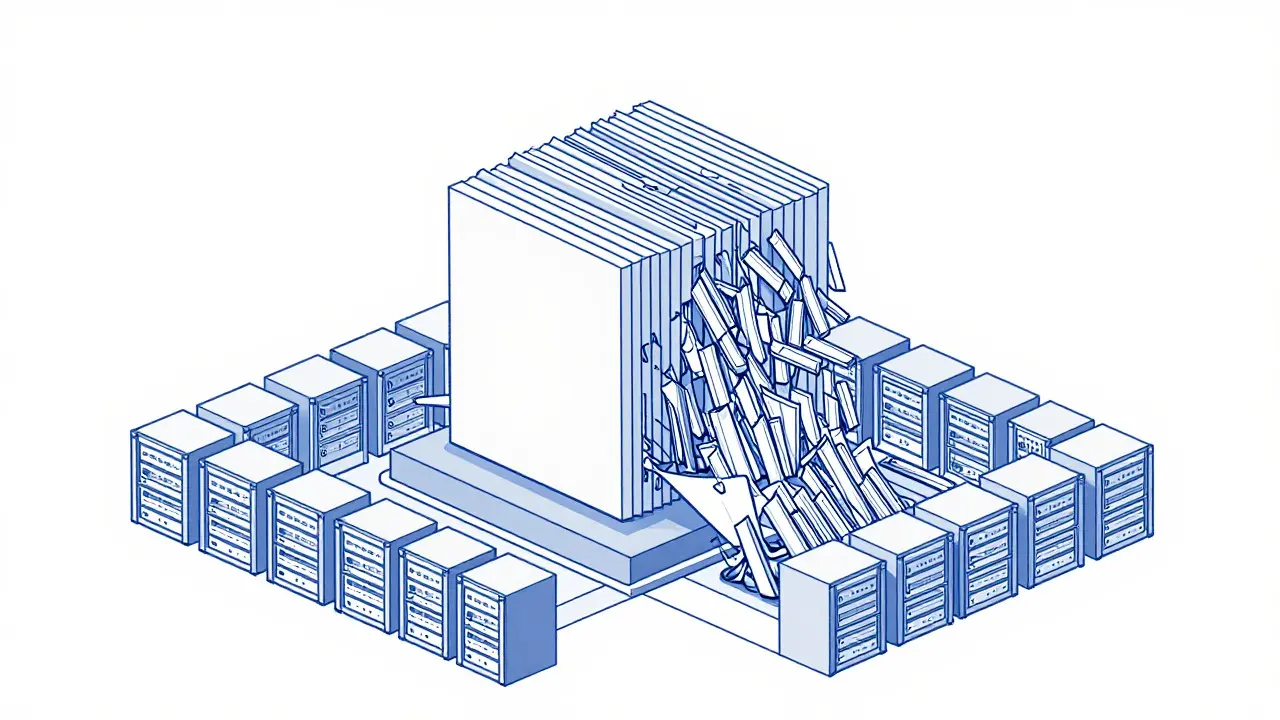
Training a large language model on a single machine is no longer just difficult; it's often impossible. The bottleneck isn't usually the compute power of individual GPUs, but how you feed them data and manage the massive memory overhead required to keep training running without crashing. When dealing with petabyte-scale LLM datasets, the architecture of your data pipeline determines whether your cluster trains efficiently or sits idle waiting for I/O.
The core problem is simple: modern LLMs require storing model parameters, gradients, and optimizer states simultaneously in GPU memory during training. This tripling of memory requirements means that even high-end hardware can choke on models with tens of billions of parameters if the data isn't handled correctly. Sharding and optimized data loading are the two critical levers you pull to solve this. They transform an unmanageable monolithic dataset into a stream of efficient, parallelizable chunks that keep every GPU busy.
Why Sharding Is Non-Negotiable at Scale
Sharding is the process of splitting data or model components across multiple devices to distribute workload and reduce memory pressure per node. In the context of petabyte-scale data management, this means serializing raw files-whether text tokens, images, or audio clips-into compressed formats like .tar, .tgz, or .tar.lz4. These shards typically number in the thousands or millions, creating a granular structure that allows distributed systems to access specific pieces of data without loading the entire dataset into RAM.
This approach emerged from a hard constraint: inference might fit on one GPU with quantization tricks, but training requires simultaneous access to weights, gradients, and optimizer states. The memory requirement approximation follows the formula: Memory Requirement ≈ α × Model Size, where α ranges between 3 and 5. If you're training a 70-billion parameter model, you're looking at hundreds of gigabytes of VRAM just for the state, before counting activations. By dividing these components into smaller shards, each device manages only a fraction of the total, making it possible to train models that would otherwise exceed physical hardware limits.
Beyond memory, sharding enables larger batch sizes. Larger batches improve convergence and model generalization, which is crucial for pretraining runs that last months. Without proper sharding, increasing the batch size often leads to out-of-memory (OOM) errors because the system tries to load too much data into local cache at once. Sharded data parallelism specifically addresses this by sharding trainable parameters, gradients, and optimizer states across GPUs in a sharding group, rather than replicating them everywhere.
Tiered Storage Architectures for Massive Datasets
You don't store everything in the fastest, most expensive drive. Efficient pipelines use a tiered storage approach that balances cost, access frequency, and performance. The primary repository is almost always object storage systems like AWS S3, Google Cloud Storage, or Azure Blob Storage. These serve as the cold or warm storage for raw, large-scale datasets, offering virtually unlimited capacity at low cost per terabyte.
However, reading directly from object storage during active training can introduce latency spikes. To mitigate this, teams layer in distributed file systems such as HDFS, CephFS, Lustre, GPFS, or WekaIO. These systems present data as a single hierarchical namespace accessible across many nodes, providing higher throughput for hot data. Alternatively, data lakes and lakehouses using technologies like Apache Iceberg, Delta Lake, or Hudi add transactional capabilities and schema evolution on top of object storage, giving you structure without losing the scalability of the underlying bucket.
The optimal flow typically stages data from cost-effective object storage to a high-performance caching layer or distributed file system closer to the compute cluster. Think of it as a supply chain: the warehouse (object storage) holds the inventory, while the local distribution center (distributed FS/cache) holds what's needed for immediate processing. This prevents storage from becoming a bottleneck, ensuring that network bandwidth between storage and compute keeps pace with the speed of training.
| Storage Type | Examples | Primary Use Case | Performance Characteristics |
|---|---|---|---|
| Object Storage | AWS S3, GCS, Azure Blob | Raw dataset repository, long-term archival | High durability, lower latency than local disk, scalable bandwidth |
| Distributed File System | Lustre, CephFS, GPFS | Hot data access during active training epochs | High throughput, low latency, shared namespace |
| Data Lakehouse | Apache Iceberg, Delta Lake | Structured metadata, schema evolution, transactions | Query optimization, versioning, ACID compliance |

Optimizing Data Loading to Prevent GPU Idling
Even with perfect storage, if your data loader is slow, your GPUs sit idle. This is wasted money. Data loading efficiency depends on network bandwidth and the speed of decoding data. Frameworks like DistributedSampler combined with PyTorch's DataLoader, TensorFlow's tf.data, NVIDIA DALI, and WebDataset coordinate which compute node reads which shard. They often prefetch data for upcoming batches, ensuring that the next batch is ready in CPU memory or pinned memory before the current one finishes computing.
Randomness is another critical factor. If your data is not shuffled properly, the model may see correlated patterns, leading to poor generalization. AIStore and similar tools facilitate bias-eliminating data shuffling through global shuffling of shard names combined with client-side shuffle buffers. This ensures adequate randomization without requiring the entire dataset to be in memory at once. For instance, you can shuffle the order of shards globally, then apply a smaller shuffle buffer within each shard to mix samples further. This two-level sharding strategy maintains randomness while keeping memory footprint low.
When working with datasets several orders of magnitude greater than server RAM, customized category-based sharding can be beneficial. For example, in image classification tasks, you might use external key maps to specify exact mapping from samples to output shards. This allows treating related categories as single units for loading purposes, simplifying the pipeline. Tools like ishard offer flexible configuration options to manage arbitrarily structured datasets, allowing users to associate files that constitute computable samples and group them into easily consumable shards.
Sharded Data Parallelism vs. Tensor Parallelism
Once data is loaded, how you distribute the model itself matters. Standard data parallelism replicates the entire model and optimizer states on every GPU, which is memory-intensive. Sharded data parallelism modifies this by sharding the trainable parameters, gradients, and optimizer states across GPUs in a sharding group. This reduces the memory footprint per GPU significantly, allowing you to fit larger models or use larger batch sizes.
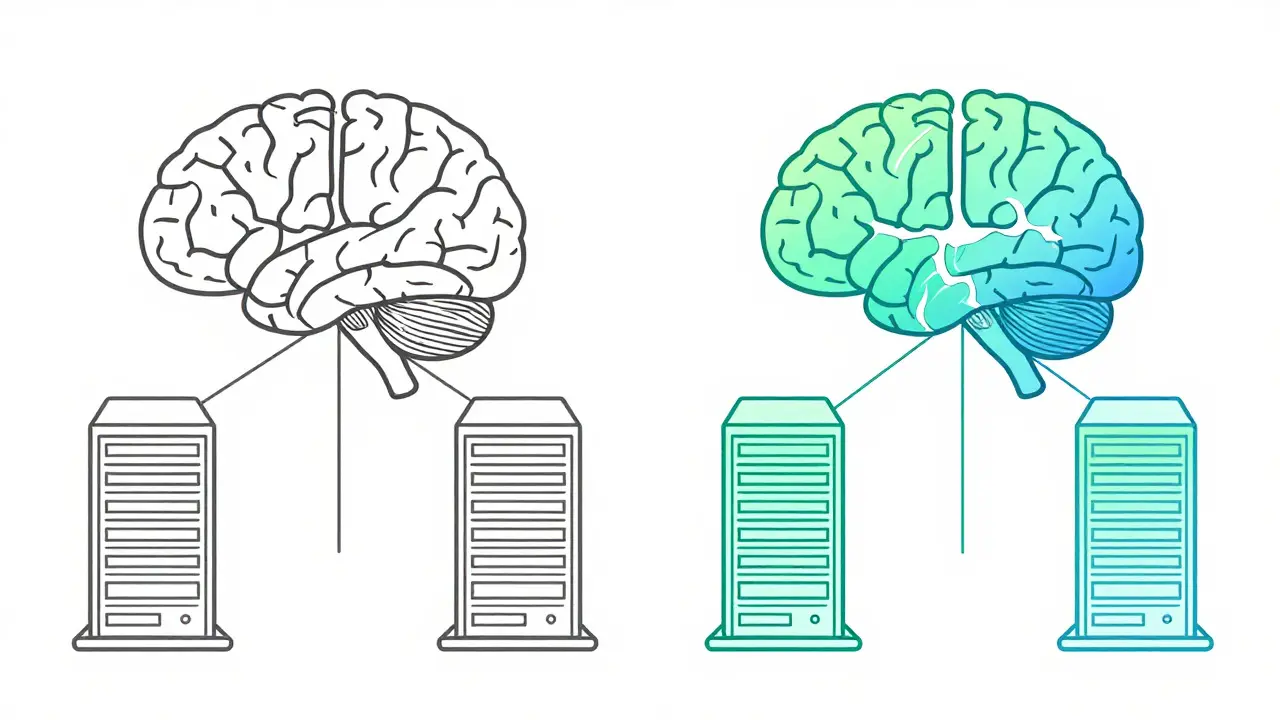
Tensor parallelism, on the other hand, splits individual layers across multiple GPUs. It's useful when fitting very large models into clusters, especially when dealing with long sequence lengths that require careful GPU memory management. The combined usage of sharded data parallelism and tensor parallelism represents the current state-of-the-art for handling very large models on large-scale clusters, typically 128 nodes or beyond.
Consider a practical scenario: training over a cluster of 1,536 GPUs (192 nodes with 8 GPUs each). With sharded data parallelism degree of 32 and batch size per GPU of 1, each batch contains 4,096 token sequence length. This results in 1,536 model replicas and a global batch size of 1,536, with each global batch containing approximately 6 million tokens. If you combine this with tensor parallelism, grouping GPUs for model parallelism with batch size 4 per tensor parallel group results in a global batch size of 768 with approximately 3 million tokens per global batch. While this reduces the global batch size by half, it allows for more complex model architectures to fit within memory constraints.
Practical Configuration Strategies
Selecting the right batch size and sharding degree is an iterative process. Best practice suggests starting from batch size 1 and gradually increasing until reaching out-of-memory (OOM) errors. If OOM errors occur even with the smallest batch size, you need to apply a higher degree of sharded data parallelism or combine it with tensor parallelism. This systematic approach ensures optimal training configuration discovery for specific GPU cluster configurations.
Recent research also challenges assumptions about dataset size. Pretraining datasets traditionally encompass petabyte-scale collections, but domain adaptation strategies employing focused datasets achieve competitive performance using substantially smaller amounts of data. For instance, domain adaptation for cybersecurity LLMs employed datasets of 118.8 million tokens compared to existing specialized models using 2.77 billion tokens. This suggests that while petabyte-scale sharding is necessary for foundation models, fine-tuning and specialization can be done with much tighter, more efficiently managed datasets.
When configuring your pipeline, remember that distributed storage systems scale out by adding more storage nodes. This incremental expansion ensures data throughput keeps pace with training pipeline requirements. Avoid static storage configurations; design your infrastructure to grow horizontally as your dataset and model size increase.
Frequently Asked Questions
What is the main benefit of sharding LLM datasets?
The main benefit is enabling parallel access to data across distributed compute resources while reducing memory pressure on individual nodes. It allows training on datasets larger than any single machine's RAM and facilitates better randomization of data for improved model generalization.
How does sharded data parallelism differ from standard data parallelism?
Standard data parallelism replicates model parameters, gradients, and optimizer states on all GPUs. Sharded data parallelism splits these components across GPUs in a sharding group, so each GPU only stores a fraction of the total state. This significantly reduces memory usage per device, allowing for larger models or batch sizes.
Which storage systems are best for petabyte-scale LLM training?
A hybrid approach is best. Use object storage (like AWS S3) for the primary repository due to its low cost and infinite scalability. Pair this with a distributed file system (like Lustre or CephFS) or a high-performance cache layer near the compute cluster to handle hot data with low latency during active training epochs.
How do I prevent GPU idling during data loading?
Use frameworks that support prefetching, such as PyTorch's DataLoader with num_workers set appropriately, or specialized libraries like NVIDIA DALI. Ensure your network bandwidth between storage and compute is sufficient, and optimize your shard size to balance I/O operations with memory usage. Prefetching the next batch while the current one is being processed is key to keeping GPUs busy.
Is tensor parallelism necessary for all large LLMs?
Not necessarily. For many models up to 70 billion parameters, sharded data parallelism alone may suffice depending on the available GPU memory. However, for very large models or when using long sequence lengths that consume significant activation memory, combining sharded data parallelism with tensor parallelism becomes essential to fit the model within hardware constraints.
 Artificial Intelligence


Courtney Wagstaff
August 21, 2026 AT 02:11Okay so I just read this and honestly it feels like someone finally explained the plumbing of AI without making me want to take a nap. The part about the memory tripling is such a real pain point, we all pretend it doesn't happen until our GPUs start throwing tantrums at 3 AM. I love how they break down the storage tiers because it makes sense that you wouldn't keep your most expensive data in the slowest warehouse right? It's like keeping your favorite sneakers in the attic instead of by the door. Also the bit about shuffling data without loading everything into RAM is genius, who knew randomization could be such a logistical nightmare? It really highlights how much of this work is just moving bytes around efficiently rather than pure magic math. Thanks for the clear breakdown on why S3 alone isn't enough for hot data, that saved me from a potential architecture headache.
Elisabeth Ballet
August 21, 2026 AT 10:09You guys need to stop underestimating the power of good data pipelines! This post is a game changer for anyone trying to scale up without breaking the bank. Look at that table comparing storage layers, it’s basically a roadmap to success if you follow it step by step. Don’t let the complexity scare you off, once you set up the tiered storage correctly, your training runs will flow like butter. I’ve seen teams waste months on bad I/O configs when they could have just used a distributed file system for the hot data. Let’s get out there and optimize those clusters, the future of LLMs depends on efficient data loading not just bigger models!
Joanna Mucha
August 22, 2026 AT 15:29One must consider the existential weight of these petabyte-scale datasets, don't you think?
It’s almost poetic how we shard reality into tiny .tar files to appease our silicon gods. The pretentiousness of calling it 'sharding' when it’s just chopping things up is amusingly trivial, yet essential for the ego of the architect.
We are merely servants to the optimizer states, aren't we? Dancing around the memory constraints like moths to a flame. The tiered storage architecture is just a modern metaphor for social hierarchy, with S3 at the bottom and Lustre basking in the sun.
But tell me, does the model truly understand what it reads, or is it just mimicking the shuffle buffer’s chaos? A philosophical question for another day, perhaps. For now, we continue to feed the beast, one shard at a time, hoping the convergence brings enlightenment rather than just a loss curve that goes down.
It’s a beautiful, terrible dance of compute and memory, isn't it?
Kim Edwards
August 24, 2026 AT 14:11WAIT FOR IT...
I was literally staring at my OOM errors last night crying into my keyboard thinking I was broken. Turns out I just needed better sharding?? THE AUDACITY of the GPU to fail me over something as simple as data loading efficiency!
This article is a lifeline, a beacon of hope in the dark void of distributed systems. Who knew that prefetching could save my sanity AND my cluster budget? It’s dramatic, it’s intense, it’s exactly the kind of technical thriller I didn’t know I needed.
If you haven’t read the section on tensor parallelism yet, buckle up, it’s wild. We are splitting brains across machines like some kind of digital Frankenstein experiment. And it WORKS. Mostly. Until it doesn’t. But mostly works counts!
Bonnie Watt
August 26, 2026 AT 12:27Oh please, another post telling us that storage is the bottleneck. We already know that. It’s always the same story, buy more disks, pay more for bandwidth, complain about latency.
The real issue is that everyone thinks they’re building the next GPT-4 but they’re actually just running scripts on a rented server farm. Sharding is fine, sure, but it’s overhyped. You can just quantize the model and call it a day. Why bother with all this complex distributed file system nonsense when you can just use less precision?
Also, who decided that 'petabyte-scale' was the new normal? Sounds like marketing fluff to justify expensive infrastructure. Most of us are fine with terabytes. Stop trying to make us feel small with your massive datasets. Just train on what you have and move on.
Meagan Mueller
August 26, 2026 AT 17:49they are watching us through the shards
notice how the data flows in perfect loops controlled by the big tech companies who own the object storage. its not an accident that S3 is everywhere. its a conspiracy to keep us dependent on their cloud while we burn money on electricity.
the 'randomness' they talk about is just a way to hide the patterns in the data. they want us to believe the model learns from randomness but its really learning from the curated biases of the dataset creators. think about it. who decides which shards get shuffled first? the elites.
we need to break free from the tiered storage trap. go local. go offline. trust no network. the GPUs are idle because they are waiting for permission from the central servers. wake up people. the petabyte scale is a lie designed to sell you more hardware.
Dave Gibbeson
August 27, 2026 AT 22:37Good points on the storage tiers but you missed the critical detail about network saturation during peak load. When you have 1500+ GPUs pulling from a single Lustre mount, the metadata server becomes the choke point fast. We hit this exact wall in our last run. Had to implement a two-tier cache with local NVMe pre-fetching before hitting the distributed FS. Saved us about 15% in total training time. Also, don't sleep on the impact of compression ratios on decode speed. LZ4 is great for throughput but if your CPU cores are busy decompressing, you're stealing cycles from the dataloader workers. Profile your I/O wait times specifically for decompression overhead. It's subtle but adds up over millions of steps. Start with batch size 1 as suggested, but monitor your CPU utilization per worker thread, not just GPU util. If CPUs are pegged at 100%, your sharding granularity might be too fine, causing excessive small file reads. Coalesce smaller shards into larger logical blocks for the initial load phase. It's a balance act but worth the tuning effort. Solid read overall though, kept the focus on practical implementation which is rare in these theoretical posts.