Imagine you are about to spend $10 million training a new AI model. You have no idea if it will be smart enough to justify the cost until it finishes. That uncertainty used to paralyze AI labs. Then, Scaling Laws arrived, turning AI development from blind gambling into predictable engineering. These mathematical relationships allow researchers to predict exactly how good a model will be before they even start the expensive training run.
This isn't just academic theory. It is the reason we have GPT-4, Claude, and Gemini. By understanding how performance scales with data and compute, companies can allocate resources efficiently. If you want to understand why modern Large Language Models (LLMs) look the way they do, you need to understand the math that built them.
The Core Definition of Neural Scaling Laws
A neural scaling law is an empirical statistical relationship between four key parameters: model size (N), dataset size (D), compute budget (C), and loss (L). In plain English, it means that as you make your model bigger or feed it more data, its error rate drops in a very specific, predictable way. This relationship follows a power law, not a linear one.
Before these laws were formalized, engineers guessed. They would tweak network width or depth randomly, hoping for better results. The breakthrough came when researchers realized that architectural details mattered far less than raw scale. If you have enough data and enough compute, a simple transformer architecture will outperform a complex, hand-tuned design. This shifted the entire industry's focus toward scaling up rather than optimizing down.
The 2020 Breakthrough: Predicting Performance Before Training
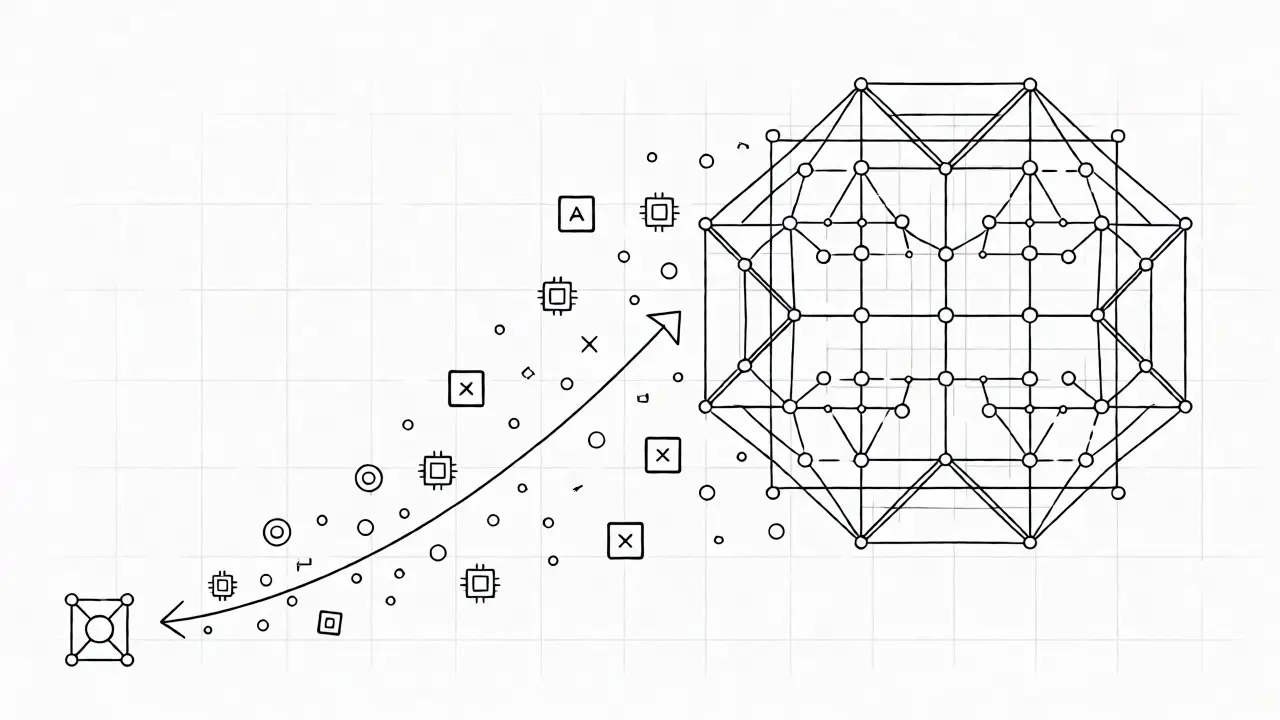
In 2020, a seminal paper titled "Scaling Laws for Neural Language Models" changed everything. Researchers discovered that loss scales as a power law with model size, dataset size, and compute, spanning over seven orders of magnitude. This meant you could train ten small models, plot their performance on a graph, fit a curve, and then accurately predict how a model 1,000 times larger would perform.
Why does this matter? Because training massive models is incredibly expensive and slow. You cannot afford to fail. By using power laws to extrapolate, labs saved millions. They could decide whether a 175-billion-parameter model was worth the electricity bill by looking at the trajectory of 1-billion-parameter models. This methodology turned AI research into a discipline where budgets could be planned with confidence.
Chinchilla Scaling: Correcting the Compute-Optimal Path
For a while, everyone thought bigger models were always better, even if trained on less data. Then, in 2022, DeepMind published the Chinchilla scaling analysis. It proved that previous assumptions were wrong. To get the best performance for a fixed compute budget, you shouldn't just make the model huge; you must scale the number of training tokens proportionally.
| Strategy | Model Size (N) | Data Size (D) | Outcome |
|---|---|---|---|
| GPT-3 Era Approach | Very Large | Relatively Small | Undertrained; wasted potential |
| Chinchilla Optimal | Moderately Large | Proportionally Larger | Better performance per dollar |
The Chinchilla findings showed that optimal scaling requires both N and D to grow together. Specifically, both should scale with the square root of the compute budget ($C^{0.5}$). This insight led to a wave of "data-heavy" models. Instead of building a giant brain and teaching it briefly, labs started building slightly smaller brains and teaching them much longer. The result? Smarter models for the same money.

The Myth of Exponential Returns
People often hear "exponential growth" and think AI will become infinitely smart quickly. Scaling laws tell a different story. They follow an exponential decay pattern regarding returns. To get a small improvement in loss, you need exponentially more compute. Doubling your model size might only give you a tiny drop in error rate after a certain point.
This creates a hard ceiling on what pretraining alone can achieve. You hit diminishing returns fast. This is why the field didn't stop at just making models bigger. If scaling laws were purely about size, we would have stopped growing models years ago because the costs became prohibitive relative to the gains. The fact that progress continued suggests we found other ways to use those scaling principles.
Beyond Pretraining: Inference-Time Scaling
By 2024 and 2025, a new paradigm emerged: inference-time scaling. Models like OpenAI's o1 demonstrated that you don't just scale during training. You can also scale during the thinking process. By allowing a model to generate more tokens internally to "reason" through a problem, you buy accuracy at the cost of latency.
This is a distinct type of scaling. Traditional scaling laws focused on pretraining loss. Inference scaling focuses on downstream task performance. It proves that there are multiple axes along which we can scale intelligence. We are no longer just stacking parameters; we are stacking reasoning steps. This keeps the momentum of AI progress alive even as pretraining costs reach astronomical levels.
The Role of Data Quality in Modern Scaling
Recent research challenges the old idea that all data is equal. A 2025 study presented to the Association for Computational Linguistics questioned traditional scaling laws by highlighting the role of data quality. It turns out that feeding a model 1 trillion tokens of low-quality web scrape isn't the same as 100 billion tokens of curated textbooks.
Traditional laws assumed data was fungible. New insights suggest that the "effective" dataset size depends heavily on curation. High-quality data allows a model to learn faster and reach lower loss with fewer parameters. This has shifted the job of AI engineers from just collecting data to aggressively filtering and synthesizing it. The next big leap in scaling might come from better data, not just more of it.
Practical Application: How Labs Use Scaling Today
So, how does a team actually use this? They don't guess. Here is the standard workflow:
- Train Mini-Models: Run dozens of small experiments with varying sizes and data amounts.
- Fit the Curve: Plot the loss against compute and parameters to find the power-law exponent.
- Extrapolate: Use the fitted equation to predict the loss of the target mega-model.
- Validate: Check if the predicted performance meets business goals.
- Execute: Launch the full training run only if the prediction holds up.
This process reduces risk. It prevents burning cash on a model that won't meet expectations. It also helps in choosing hardware. If you know you need 10x more compute, you can plan your GPU cluster procurement months in advance.
Do scaling laws apply to all types of AI?
Primarily, yes, but they are most well-documented in Natural Language Processing. Computer Vision and Multimodal models also exhibit scaling behaviors, though the exact exponents and thresholds differ due to the nature of image data versus text tokens.
What is the difference between model size and dataset size?
Model size refers to the number of trainable parameters (weights) in the neural network. Dataset size refers to the number of tokens or examples the model sees during training. Chinchilla scaling proved that balancing these two is crucial for optimal performance.
Can we keep scaling models forever?
Not indefinitely with current technology. Energy consumption and hardware limits pose physical constraints. Additionally, we are running out of high-quality human-generated text. Future scaling may rely more on synthetic data or inference-time techniques rather than just increasing parameter counts.
Why did GPT-3 seem undertrained according to Chinchilla?
GPT-3 had 175 billion parameters but was trained on relatively few tokens compared to what Chinchilla suggested was optimal for its compute budget. Chinchilla recommended a smaller model trained on significantly more data to achieve better loss, which subsequent models adopted.
How does inference-time scaling work?
Instead of making the model bigger during training, you let it use more compute during the answer generation phase. It generates multiple intermediate steps or "thoughts" before outputting the final answer, effectively trading speed for higher accuracy on complex tasks.
 Artificial Intelligence