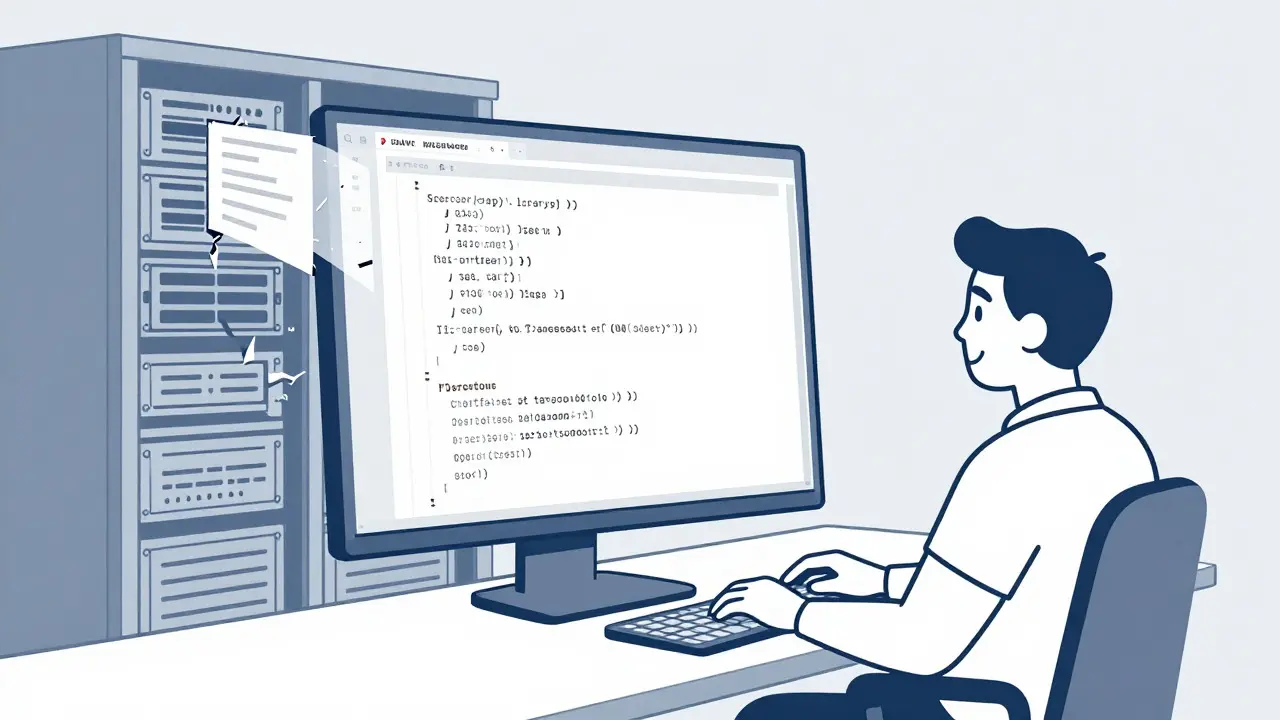
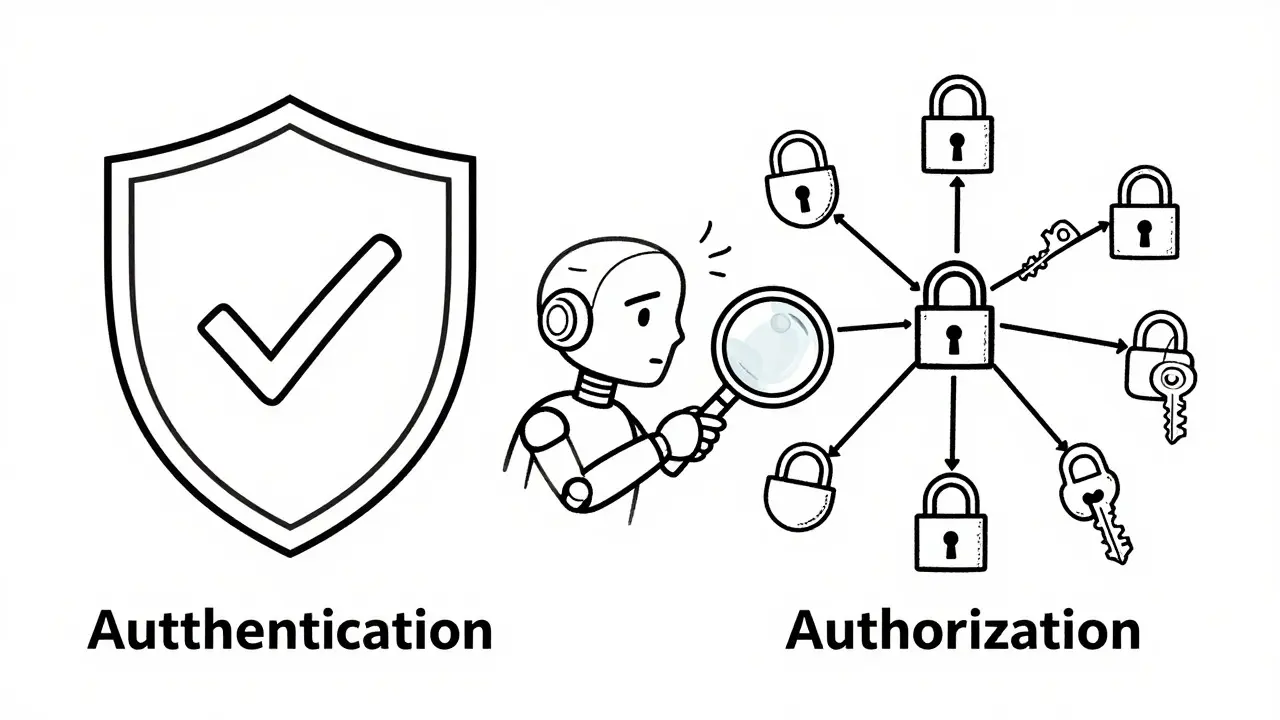
Imagine asking an AI to build a login system. It spits out clean, modern code in seconds. You deploy it, users sign up, and everything looks fine. Then, three weeks later, a pen tester finds that any user can edit any other user's profile by just changing the ID in the URL. This is the hidden cost of vibe coding. While AI assistants have made backend development faster than ever, they often treat security as an afterthought. The result? A surge in subtle but dangerous gaps between authentication (who you are) and authorization (what you can do).
The core problem isn't that AI writes bad code. It's that AI writes *incomplete* code based on generic patterns. It knows how to make a JWT token, but it doesn't know your specific business rules for who should access which data. Without explicit guidance, these tools default to the path of least resistance, leaving critical authorization checks missing. Understanding the right patterns now saves you from painful refactoring later.
Why AI Gets Auth Right but Authz Wrong
Vibe coding is a development practice where programmers use conversational prompts to generate code rather than writing it line-by-line. When you ask an LLM for a "user login endpoint," it reliably delivers the basics: password hashing with bcrypt, session creation, and standard HTTP responses. These are well-trodden paths in training data. However, authorization is context-dependent. An AI doesn't inherently know that an "editor" role shouldn't delete posts, or that a "viewer" can't see admin settings.
This disconnect leads to what security experts call "implicit trust." The AI assumes that if a user is logged in, they have permission to perform the action. In reality, 68% of vibe-coded applications omit explicit authorization checks between successful login and data access. For example, a typical AI-generated Express.js route might look like this:
app.get('/api/users/:id', authenticateToken, (req, res) => { ... })
Here, authenticateToken verifies the user exists. But there is no check to ensure req.user.id matches req.params.id. Any authenticated user can fetch any profile. Fixing this requires adding middleware or inline logic that explicitly compares roles and resource ownership-logic the AI rarely generates unless prompted specifically.
The Minimum Viable Security Stack
To secure a vibe-coded backend, you need to move beyond basic scaffolding. Here is the baseline configuration that prevents the most common vulnerabilities found in AI-generated systems.
| Component | Insecure Default (AI) | Secure Requirement |
|---|---|---|
| JWT Access Token | No expiration or long-lived (24h+) | 15-60 minute expiry |
| Refresh Token | Stored in localStorage | HTTP-only, Secure, SameSite=Strict cookie (7-day max) |
| OAuth Flow | Implicit Grant (deprecated) | Authorization Code with PKCE |
| Rate Limiting | None | 100 requests / 15 mins per IP |
Notice the shift from client-side storage to server-managed cookies. AI often suggests storing JWTs in browser localStorage because it's easy to retrieve in JavaScript. But this exposes tokens to Cross-Site Scripting (XSS) attacks. Using HTTP-only cookies ensures JavaScript can't read them directly, significantly reducing the attack surface. Similarly, the Implicit Grant flow is deprecated for good reason; it sends tokens in the URL fragment, which can leak through logs. Always prompt your AI to use the Authorization Code flow with Proof Key for Code Exchange (PKCE).
Prompt Engineering for Security
The difference between a vulnerable and a secure vibe-coded backend often lies in the quality of the prompt. Generic prompts yield generic, insecure code. Specific, constraint-heavy prompts yield robust systems. Research shows that applications built with prompts containing explicit security parameters had 72% fewer vulnerabilities than those using vague instructions.
Instead of saying "Create a user registration endpoint," try this structure:
- Define the Role: "Act as a senior backend security engineer."
- Specify the Tech Stack: "Using Node.js and Express."
- State the Constraint: "Implement a POST /register endpoint that validates email format, hashes passwords with bcrypt (cost factor 12), and stores the user in PostgreSQL."
- Mandate Security Controls: "Include input sanitization to prevent SQL injection. Return a generic error message for duplicate emails to avoid user enumeration. Do not log raw passwords."
This approach forces the AI to consider edge cases. It also helps when dealing with complex flows like two-factor authentication (2FA). If you simply ask for "2FA support," the AI might implement TOTP codes without rate limiting the verification attempts, leaving the door open to brute-force attacks. By specifying "limit TOTP verification to 5 attempts per minute per user," you close that gap before the code is even written.
RBAC vs. ABAC: Choosing Your Guardrails
Once users are authenticated, you need a way to control their access. The two main patterns are Role-Based Access Control (RBAC) and Attribute-Based Access Control (ABAC). AI tools tend to favor RBAC because it's simpler to model in code, but it lacks flexibility.
Role-Based Access Control (RBAC) is a method of restricting network access based on the roles of individual users within an enterprise. In a vibe-coded app, you might define three roles: Admin, Editor, and Viewer. The AI will happily create a middleware function that checks if (user.role === 'admin') return next(). This works well for simple hierarchies. However, it breaks down when permissions depend on context. What if an editor can only edit articles they wrote? RBAC alone can't handle that without getting messy.
Attribute-Based Access Control (ABAC) is an access control mechanism that uses attributes (properties) of subjects, resources, actions, and environment to determine access. With ABAC, you check conditions like if (user.department === article.author.department || user.role === 'admin'). This is more powerful but harder to get right with AI. The AI might forget to check the environment attribute (like time of day or IP location) if you don't explicitly list it. For most startups, a hybrid approach works best: use RBAC for high-level permissions (can view dashboard?) and ABAC for resource-specific checks (can edit this specific post?).

The Review Phase: Where Real Work Happens
Here is the hard truth: AI-generated authentication code is never production-ready on the first pass. You must allocate 35-50% of your implementation time for security refinement. This isn't about rewriting the code; it's about auditing it. Look for these specific red flags:
- Hardcoded Secrets: Does the AI put the JWT secret key in the source code? Move it to environment variables immediately.
- Missing CSRF Protection: If you're using cookies for sessions, do you have Anti-CSRF tokens? AI often forgets this because it focuses on the API layer, not the browser interaction.
- Inconsistent Error Handling: Does the API reveal whether an email exists during login? This allows attackers to harvest valid usernames. Standardize error messages.
- Token Validation Gaps: Is the server actually verifying the signature of every incoming JWT? Sometimes AI generates the code to *create* tokens but skips the rigorous validation step on protected routes.
Use automated tools to catch the obvious issues, but rely on manual review for logic errors. Tools like Snyk Code or GitHub Advanced Security have started adding specific checks for AI-generated patterns, but they still miss context-specific authorization bugs. A human eye is still the final gatekeeper.
Future-Proofing Your Approach
The landscape is shifting fast. By 2027, we expect 60% of vibe-coded authentication systems to include built-in security validation, up from just 18% in early 2025. This means the AI itself will start flagging insecure patterns during generation. Until then, the burden remains on the developer. The key is to treat AI as a junior developer who is fast but needs supervision. Give them clear specs, check their work, and always assume the worst-case scenario until proven otherwise. Security isn't a feature you add at the end; it's a constraint you apply at the beginning.
Is vibe coding safe for production backends?
Yes, but only with rigorous human oversight. AI accelerates scaffolding by 65%, but 89% of generated auth systems require significant security refactoring. Treat AI output as a draft, not a final product.
What is the biggest security risk in AI-generated auth code?
Missing authorization checks. AI often confuses authentication (verifying identity) with authorization (verifying permission). This leads to bypass vulnerabilities where any logged-in user can access restricted data.
Should I store JWTs in localStorage or cookies?
Prefer HTTP-only, Secure, SameSite=Strict cookies for refresh tokens. LocalStorage is vulnerable to XSS attacks. For short-lived access tokens, keeping them in memory or secure cookies is safer than exposing them to JavaScript scope.
How do I prompt AI for better security practices?
Be specific. Instead of "make a login," say "implement OAuth 2.0 Authorization Code flow with PKCE, validate inputs, and limit failed attempts to 5 per minute." Explicit constraints reduce vulnerability rates by 72%.
Does RBAC scale better than ABAC for AI-generated apps?
RBAC is easier for AI to generate correctly due to its simplicity. However, ABAC is necessary for granular, context-aware permissions. Most secure architectures use a hybrid: RBAC for broad roles, ABAC for specific resource checks.
 Artificial Intelligence