
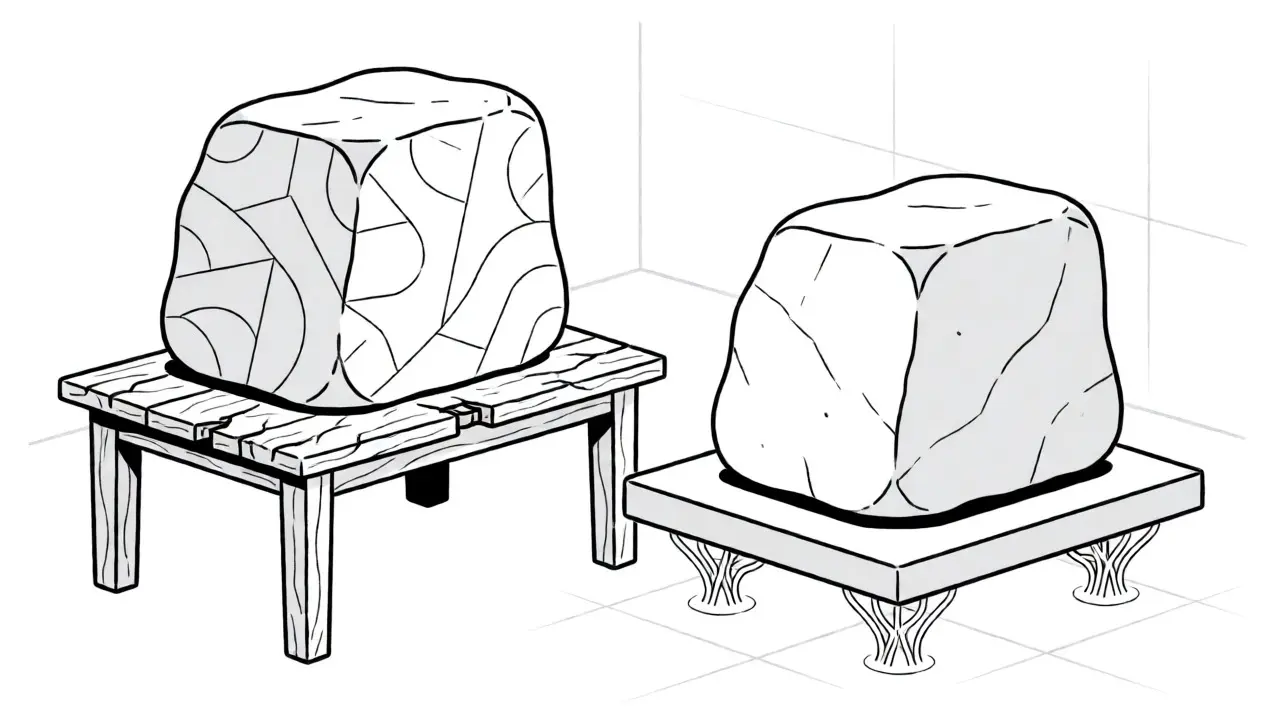
You have a massive Large Language Model (LLM) like GPT-3 or Llama 2. It’s smart, but it doesn’t know your specific business data. The old way to fix this was full fine-tuning-updating all 175 billion parameters. That meant buying multiple A100 GPUs just to train one model for one task. It was expensive, slow, and impractical for most teams.
Enter Parameter-Efficient Fine-Tuning (PEFT). This approach lets you customize huge models by training only a tiny fraction of their weights. Two techniques dominate this space: Low-Rank Adaptation (a method that injects trainable low-rank decomposition matrices into transformer layers while freezing pre-trained weights) and Adapter Layers. If you’re trying to decide which one to use for your project in 2026, the answer isn't always obvious. One is faster for single tasks; the other is better for multi-task switching. Let’s break down how they work, where they fail, and how to pick the right tool for your hardware budget.
The Core Problem: Why Full Fine-Tuning Fails at Scale
Imagine deploying ten different versions of a 175-billion parameter model. Each version handles a different customer support ticket type. With full fine-tuning, you need ten separate copies of those 175 billion parameters stored in memory. That’s over 1.7 trillion parameters total. The storage cost alone would bankrupt most startups, not to mention the GPU VRAM required to run them simultaneously.
PEFT solves this by keeping the base model frozen. You don’t touch the original weights. Instead, you add small, trainable components alongside them. When the model runs, it combines the frozen base knowledge with your new, lightweight adjustments. This reduces trainable parameters by up to 10,000 times compared to full fine-tuning. For a model like GPT-3, you might go from updating 175 billion parameters to updating just 17 million. That fits on a consumer-grade GPU like an NVIDIA RTX 4090.
How LoRA Works: The Math Behind the Magic
LoRA is a technique that decomposes weight updates into two smaller, low-rank matrices instead of updating the full weight matrix directly.
Here is the intuition. In a standard transformer layer, there is a large weight matrix $W$ (say, 1024x1024). During fine-tuning, we want to learn a change $ΔW$. Normally, $ΔW$ is also 1024x1024. But research suggests that the "intrinsic rank" of these updates is very low. They don’t need all that complexity.
LoRA approximates $ΔW$ as the product of two smaller matrices, $A$ and $B$. If we choose a rank $r=8$, matrix $A$ becomes 1024x8 and $B$ becomes 8x1024. Instead of storing 1,048,576 numbers, you store roughly 16,384. That’s a 98% reduction in size for that layer. Crucially, during inference, you can merge $A$ and $B$ back into $W$. This means LoRA adds zero latency to your production API calls. The speed is identical to the base model.
A common pitfall here is choosing the wrong rank. If $r$ is too low (e.g., $r=1$), the model underfits and misses complex patterns. If $r$ is too high (e.g., $r=64+$), you lose efficiency gains. Most practitioners start with $r=8$ or $r=16$ and scale up only if performance lags. The alpha parameter ($α$) controls the scaling factor; a common rule of thumb is setting $α = 2 imes r$.
Adapter Layers: Modular Blocks for Multi-Task Learning
Adapter Layers are small neural networks inserted between existing transformer blocks to perform task-specific transformations.
Unlike LoRA, which modifies the linear projection matrices, adapters are separate modules. A typical adapter consists of a down-projection layer (shrinking dimensions from 768 to 64), a non-linear activation function (like ReLU or GELU), and an up-projection layer (expanding back to 768). These sit inside each transformer block.
The main advantage of adapters is modularity. Because they are distinct blocks, you can swap them out easily. Want to switch from medical QA to legal summarization? Just unload the medical adapter and load the legal one. The base model stays loaded in VRAM. This makes adapters ideal for continuous learning scenarios where you need to handle many tasks without reloading the entire 13GB+ base model every time.
However, this modularity comes at a cost. Adapters introduce sequential processing steps. Every token must pass through the down-project, activate, and up-project layers. Measurements show this increases inference latency by 15-25% compared to the base model. In a real-time chatbot application, that delay is noticeable. Users hate lag.
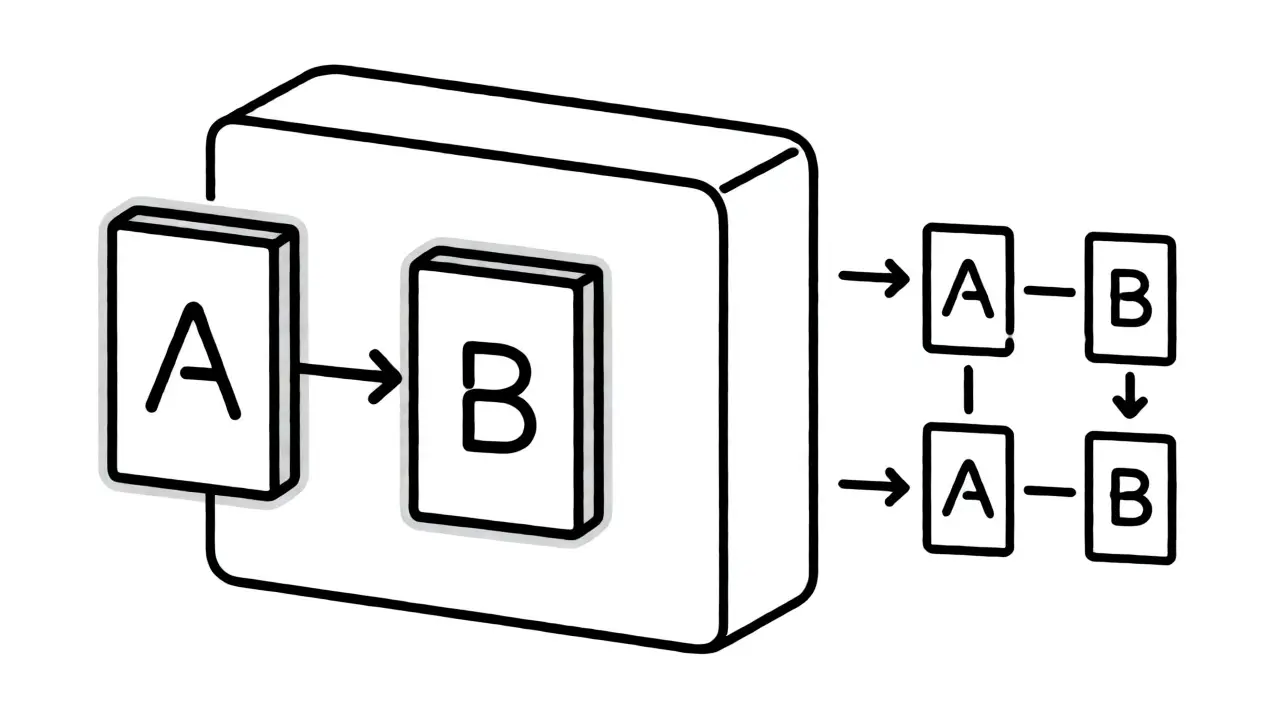
LoRA vs. Adapters: Which One Should You Pick?
Choosing between these two depends entirely on your deployment constraints. Are you optimizing for speed, memory, or flexibility? The table below breaks down the key trade-offs based on current industry standards and benchmarks.
| Feature | LoRA | Adapter Layers |
|---|---|---|
| Inference Latency | Zero overhead (weights merged) | +15-25% slower due to sequential layers |
| Trainable Parameters | 0.1% - 0.7% of total | 3% - 4% of total |
| Multi-Task Switching | Requires merging/unmerging or separate instances | Fast hot-swapping of adapter modules |
| Quantization Compatibility | Excellent (QLoRA works well) | Moderate (can interfere with quantized weights) |
| Best Use Case | Single-task, high-throughput APIs | Multi-task, continual learning, edge devices |
| Implementation Complexity | Low (standard in Hugging Face PEFT) | Medium (requires careful insertion points) |
If you are building a customer service bot that handles one specific domain, pick LoRA. The zero-latency benefit is critical for user experience. If you are running a platform that serves fifty different specialized agents (e.g., coding assistant, writing coach, translator) on the same hardware, adapters save you massive amounts of VRAM because you share the base model instance.
QLoRA: Breaking Hardware Barriers
Standard LoRA still requires loading the full precision base model into VRAM. For a 65B parameter model, that’s about 130GB of memory. Not many people have that lying around. Enter QLoRA, a variant combining 4-bit NormalFloat quantization with LoRA to enable fine-tuning on consumer hardware.
QLoRA quantizes the frozen base model weights to 4 bits, reducing memory usage by nearly 75%. Then, it applies LoRA adapters to these quantized weights. This trick allows you to fine-tune massive models like Llama-2-70B on a single NVIDIA RTX 4090 (24GB VRAM). Without QLoRA, you’d need four A100s.
The catch? Quantization introduces some noise. Early versions had a 1-2% performance drop compared to full precision. By late 2023 and into 2024, improvements in calibration reduced this gap to under 0.7%. For most practical applications, this loss is negligible. If you are a researcher or a startup with limited cloud credits, QLoRA is your best friend. It democratizes access to state-of-the-art model customization.
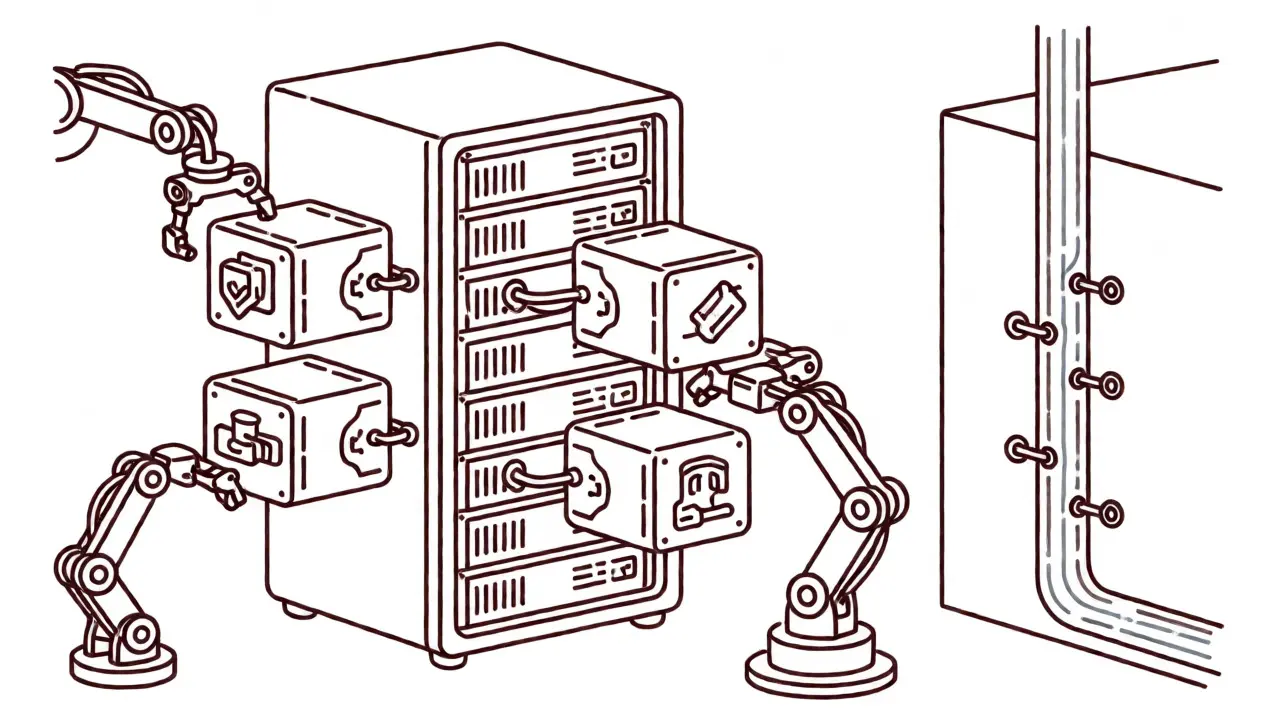
Practical Implementation Tips and Pitfalls
Don’t just install the library and hope for the best. Here are three things that trip up engineers new to PEFT:
- Target the Right Layers: Don’t apply LoRA to everything. Focus on the attention mechanisms (Query and Value projections). Adapting Feed-Forward networks often yields diminishing returns and slows down training. Start with attention-only LoRA, then expand if needed.
- Watch Your Batch Size: Because PEFT uses less memory, you can increase your batch size significantly. Larger batches lead to more stable gradient estimates. If your loss curve is noisy, try doubling your batch size before tweaking the learning rate.
- Storage Footprint: Remember that LoRA adapters are tiny files (often under 100MB). You can store hundreds of them cheaply. However, managing version control for these adapters requires discipline. Tag them clearly with the base model version and training dataset hash.
One frequent complaint involves domain adaptation limits. If you are moving from general English to highly technical medical jargon, a low rank ($r=8$) might struggle. In such cases, incrementally increase the rank to $r=32$ or $r=64$. Monitor validation loss closely. If performance plateaus despite increasing rank, your issue might be data quality, not model capacity.
The Future of Efficient Tuning
The market for PEFT tools is exploding. Enterprise adoption rates hit 68% in late 2023, driven largely by cost pressures. We are seeing a shift toward hybrid approaches. Meta AI has demonstrated combining LoRA with prompt tuning for low-resource languages, boosting accuracy by 5-8%. Google Research is exploring dynamic rank adjustment, where the model learns which layers need higher ranks during training.
For now, LoRA remains the dominant choice for production environments due to its seamless integration with inference servers like Predibase’s LoRAX. Adapters hold steady in niche areas requiring rapid task switching. As hardware improves and quantization techniques get smarter, the line between "fine-tuning" and "prompt engineering" continues to blur. But understanding the mechanics of LoRA and Adapters gives you the control to build efficient, scalable AI systems without breaking the bank.
Does LoRA affect inference speed?
No, if implemented correctly. After training, you can merge the LoRA weights ($A imes B$) into the original base model weights ($W$). This results in a single, unified model with no additional computational overhead during inference. The speed is identical to the original unmodified model.
Can I use LoRA with quantized models?
Yes, this is exactly what QLoRA does. Standard LoRA requires the base model to be in float16 or bfloat16 precision. QLoRA extends this capability to 4-bit quantized models, allowing you to fine-tune very large models on consumer GPUs with limited VRAM.
What is the best rank value for LoRA?
There is no single best value. Start with $r=8$ or $r=16$. For simple tasks like classification, $r=4$ might suffice. For complex generative tasks or domain shifts, try $r=32$ or $r=64$. Increasing rank increases parameter count and training time, so start low and scale up only if validation metrics improve.
Why are adapters slower than LoRA?
Adapters insert extra layers (down-projection, activation, up-projection) between transformer blocks. These layers must process every token sequentially during inference, adding computational steps. LoRA modifies existing linear layers, which can be mathematically merged into the original weights, eliminating extra steps.
Do I need special hardware for PEFT?
Not necessarily. While high-end GPUs help, QLoRA enables fine-tuning 7B-13B parameter models on consumer cards like the RTX 3090 or 4090 (24GB VRAM). For larger models (65B+), you might need multi-GPU setups or aggressive offloading strategies, but it is far cheaper than full fine-tuning.
 Artificial Intelligence




Onyinyechi Nwosu
September 1, 2026 AT 14:55honestly this was so helpful i've been struggling with my gpu limits and the qlora section really clicked for me
thanks for breaking it down without being too technical
Chandan Singh
September 2, 2026 AT 22:05Actually, the claim that adapters add 15-25% latency is slightly outdated if you're using fused kernels in modern PyTorch versions. The overhead can be reduced to under 5% with proper optimization.
Also, regarding rank selection, starting at r=8 is standard but for domain-specific tasks like legal or medical, you often need r=32 minimum to capture the semantic shifts properly. Don't just blindly follow the 'start low' advice if your validation loss plateaus early.
Brannen Hall
September 3, 2026 AT 10:24Yeah but who actually cares about 15% latency when half of us are running these models on cloud instances where network latency dwarfs compute time? This whole guide feels like it's written for people buying their own RTX 4090s which is a niche use case in enterprise anyway. Most companies just throw more A100s at full fine-tuning because engineering time costs more than GPU hours. You're optimizing for pennies while ignoring the dollar bills of dev effort.
tiffany King
September 3, 2026 AT 13:32I love how clear the comparison table is! It really helps visualize why LoRA is better for single-task bots versus adapters for multi-agent systems. I'm definitely going to try QLoRA on my laptop next weekend since I don't have access to big servers yet. Exciting times for small teams!
Brenna Gonedrman
September 3, 2026 AT 23:44OH MY GOD FINALLY SOMEONE EXPLAINED WHY ADAPTERS ARE SLOW WITHOUT MAKING ME FEEL STUPID
The bit about merging weights for LoRA is literally magic. I tried doing this last month and thought I broke my model because the files were so tiny. But it works!! Just remember to tag your datasets or you will cry later. Seriously do not skip version control or you will lose your mind trying to figure out which adapter goes with which base model checkpoint. It saved my project from total disaster.