You’ve probably heard the phrase "Attention is All You Need" thrown around in tech circles. It’s not just a catchy title for a 2017 paper; it’s the fundamental truth behind every major generative AI model you use today, from ChatGPT to Claude. But what does that actually mean? Why did researchers decide that focusing on specific parts of data was better than processing everything equally? And more importantly, how did we go from basic attention concepts to Flash Attention, a technique that makes these massive models run fast enough for real-time use?
If you’re trying to understand why your AI chatbot can remember a conversation from ten minutes ago, or why training large language models (LLMs) costs so much money, the answer lies in attention mechanisms. This article breaks down the journey from simple alignment weights to the complex, memory-efficient kernels powering modern hardware. We’ll skip the heavy math jargon where possible and focus on what actually happens inside the model.
The Problem with RNNs and the Birth of Attention
Before Transformers dominated the landscape, Recurrent Neural Networks (RNNs) were the standard for sequence tasks like translation. Imagine reading a long book. An RNN reads one word at a time, carrying a small summary of what it has read so far in its "hidden state." The problem? As the sentence gets longer, that summary gets fuzzy. Important details from the beginning of a paragraph get lost by the end. This is known as the vanishing gradient problem.
In 2014, Bahdanau, Cho, and Bengio proposed a fix. Instead of forcing the decoder to rely solely on a fixed-length summary vector, they allowed it to look back at the entire encoder output for every single word it generated. They called this Additive Attention. It worked by assigning a weight to each source word, telling the model which parts of the input were most relevant for producing the current output token.
- Soft Attention: The model calculates probabilities for all positions, allowing gradients to flow through during training.
- Hard Attention: The model picks one position and ignores the rest, but this discrete choice made training difficult without reinforcement learning.
This shift didn’t just improve BLEU scores on translation benchmarks; it fundamentally changed how neural networks process sequences. By letting the model "attend" to relevant information, we solved the bottleneck of fixed-length context vectors.
Self-Attention: The Transformer Revolution
The next leap came in 2017 with Vaswani et al.’s paper, "Attention Is All You Need." They realized that if attention was so powerful, why keep the recurrent structure at all? They removed recurrence entirely, creating the Transformer.
At the heart of the Transformer is Self-Attention. Unlike the earlier cross-attention used in translation (where the decoder looks at the encoder), self-attention allows a sequence to attend to itself. Every token in the input considers every other token to determine its own representation.
How does it work? Think of three matrices: Queries (Q), Keys (K), and Values (V).
- Query (Q): What am I looking for?
- Key (K): What do I contain?
- Value (V): What information do I provide?
The model computes a score between the Query of one token and the Key of another. High scores mean strong relationships. These scores are normalized using Softmax to create a probability distribution, which then weights the Values. The result is a new representation for each token that incorporates context from the entire sequence.
| Feature | Cross-Attention | Self-Attention |
|---|---|---|
| Source of Q | Decoder State | Input Sequence |
| Source of K/V | Encoder Output | Input Sequence |
| Primary Use Case | Translation, Summarization | Contextual Understanding, Generation |
| Complexity | O(n*m) | O(n^2) |
This parallel processing capability meant Transformers could be trained much faster on GPUs than RNNs. However, it introduced a new challenge: computational complexity. For a sequence of length $n$, the attention matrix is $n \times n$. If you double the sequence length, you quadruple the computation and memory requirements.
Multi-Head Attention: Seeing Different Perspectives
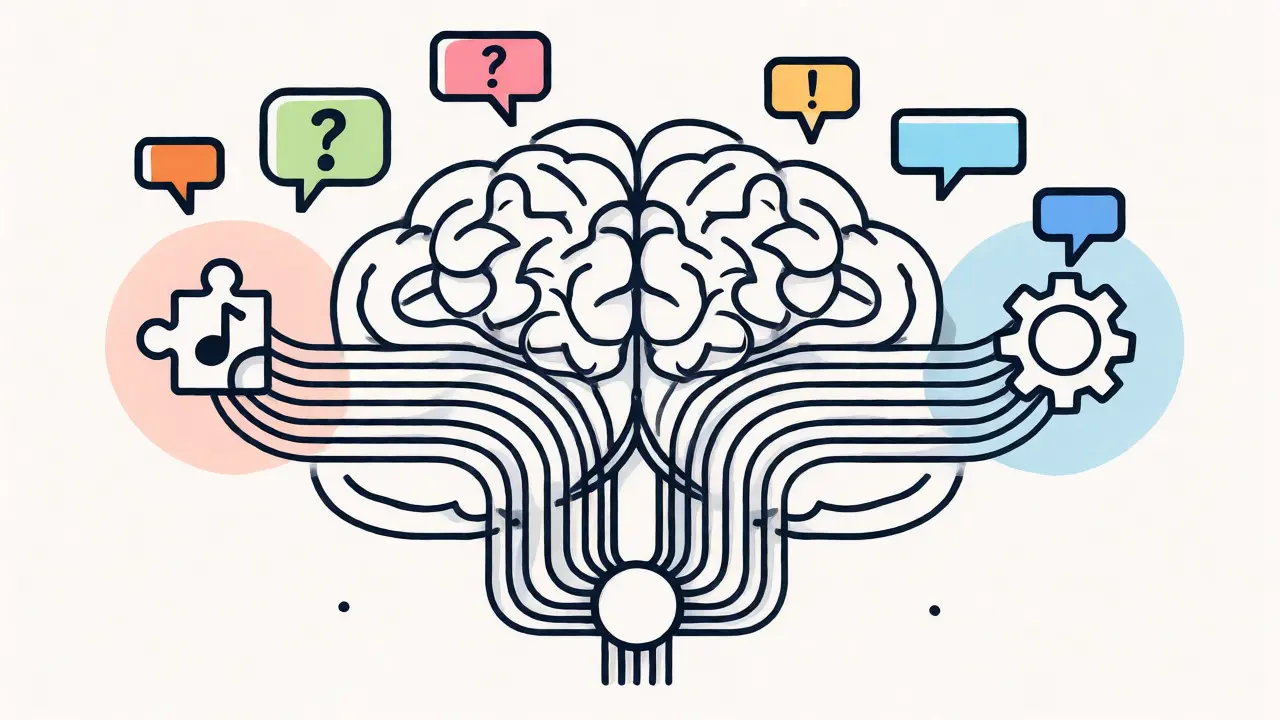
A single attention head might only capture one type of relationship, such as syntactic dependency. To capture richer patterns, the original Transformer introduced Multi-Head Attention. Instead of performing one large attention operation, the model splits the embedding dimension into multiple smaller heads.
For example, GPT-3 uses 96 heads. Each head learns different subspaces of the data. One head might focus on grammatical structure, while another focuses on semantic similarity or positional proximity. These heads operate in parallel, and their outputs are concatenated and projected back to the original dimension.
This design allows models to handle heterogeneous relationships simultaneously. It’s why an LLM can understand that "bank" means a financial institution in one context and the side of a river in another, depending on which heads are activated.
The Memory Bottleneck: Why Standard Attention Struggles
As models grew larger, the quadratic cost of attention became a severe bottleneck. Consider a model with a 4,096-token context window. The attention matrix requires storing 16 million values per head. In FP16 precision, that’s about 32 MB per head. Multiply that by dozens of layers and hundreds of heads, and you hit GPU memory limits quickly.
Standard implementations suffer from poor Input/Output (IO) efficiency. They load Q, K, and V from High Bandwidth Memory (HBM) to the GPU’s fast on-chip SRAM, compute the scores, write the massive intermediate attention matrix back to HBM, reload it for Softmax, and then multiply by V. This constant swapping between slow HBM and fast SRAM creates a significant bandwidth bottleneck.
Researchers tried various approximations to fix this. Methods like Reformer, Linformer, and Performer reduced complexity to linear or near-linear time by hashing keys or projecting them to lower dimensions. While faster, these methods often sacrificed accuracy, introducing small errors in perplexity or generation quality.
Flash Attention: Exactness Meets Efficiency
Enter Flash Attention, proposed by Tri Dao et al. in 2022. Unlike previous methods, Flash Attention doesn’t approximate the math. It produces numerically identical results to standard softmax attention but achieves this by optimizing how data moves across the GPU hierarchy.
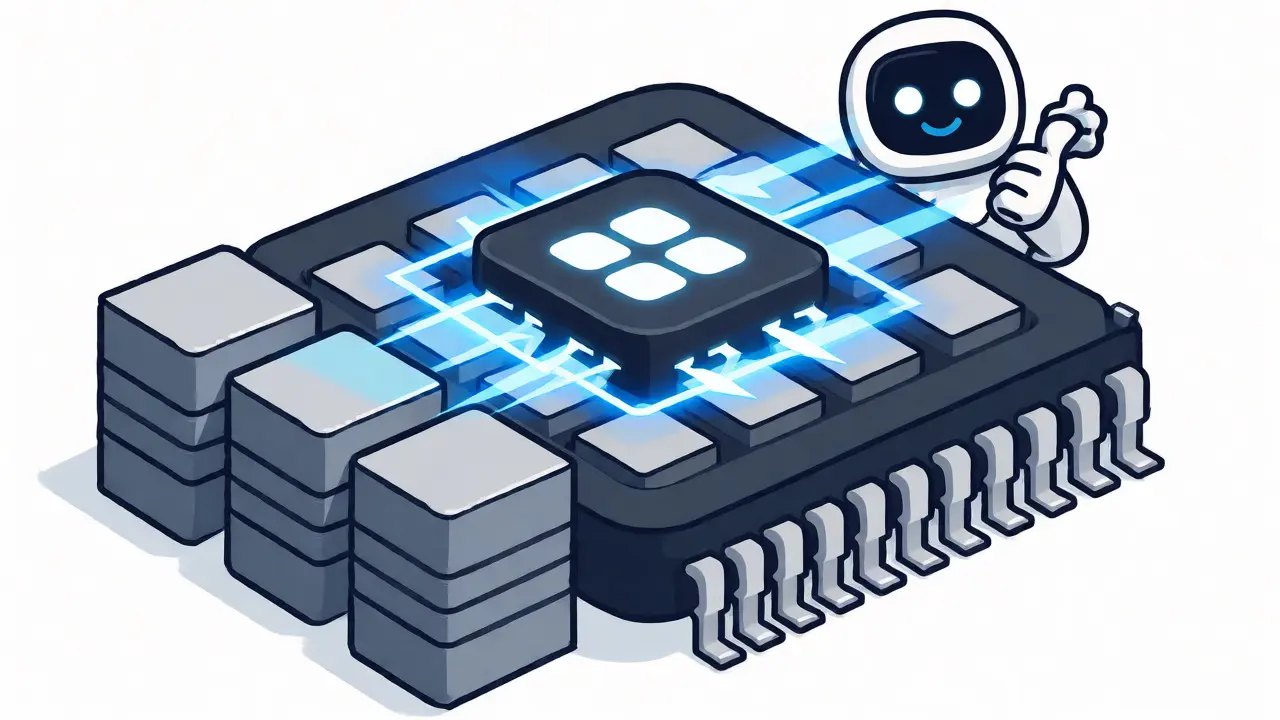
The core idea is IO-awareness. Flash Attention tiles the Q, K, and V matrices into blocks that fit into the GPU’s fast SRAM. It computes partial attention scores for these blocks and updates the running sum and maximum values using an online softmax algorithm. Crucially, it never materializes the full $n \times n$ attention matrix in HBM.
By fusing the matrix multiplication, Softmax, and dropout operations into a single CUDA kernel, Flash Attention reduces memory traffic dramatically. This leads to two major benefits:
- Speedup: Training and inference times drop significantly, often by 2x-4x.
- Memory Savings: Peak memory usage decreases because the huge intermediate matrix isn’t stored.
Since its release, Flash Attention has become the default backend for many frameworks. PyTorch 2.0 integrated it via `torch.nn.functional.scaled_dot_product_attention`, and Hugging Face’s libraries support it out of the box. Subsequent versions, like Flash Attention-2 and the emerging Flash Attention-4, have pushed utilization rates even higher, approaching theoretical peak performance on NVIDIA A100 and H100 GPUs.
Real-World Impact on Generative AI
The shift to Flash Attention has democratized access to long-context models. Before this optimization, serving a model with a 32k or 128k context window required expensive multi-GPU setups. Now, consumer-grade hardware like the RTX 4090 can handle larger contexts thanks to reduced memory overhead.
For developers, enabling Flash Attention is often as simple as setting a flag in their configuration. The gains are tangible: lower latency for users, higher throughput for servers, and reduced cloud costs for training. Companies report 20%-50% savings in GPU hours when fine-tuning models using these optimized kernels.
Moreover, exactness matters. In production environments, slight deviations in attention calculations can alter the style or coherence of generated text. Because Flash Attention is mathematically equivalent to standard attention, teams don’t need to re-evaluate model quality after switching backends. It’s a pure engineering win.
What is the difference between self-attention and cross-attention?
Self-attention occurs within a single sequence, where tokens attend to each other to build contextual representations. Cross-attention involves two different sequences, typically where a decoder attends to encoder outputs, common in translation or summarization tasks.
Why is Flash Attention considered "exact"?
Unlike approximation methods like Performer or Linformer, Flash Attention computes the same mathematical operations as standard softmax attention. It simply optimizes the order of operations and memory access to avoid storing large intermediate matrices, ensuring numerical equivalence.
Does Flash Attention require specific hardware?
While highly optimized for NVIDIA GPUs (Ampere architecture and newer, like A100/H100), compatible kernels exist for other architectures. However, the greatest speedups are seen on hardware with high-bandwidth memory and sufficient SRAM capacity to support tiling strategies.
Can attention weights be used to explain model decisions?
Not reliably. Research shows that attention distributions can vary significantly without changing the final prediction. While useful for debugging and qualitative analysis, attention maps should not be treated as rigorous explanations of feature importance.
How does multi-head attention help the model?
It allows the model to jointly attend to information from different representation subspaces at different positions. One head might learn syntax, while another learns semantics, enabling the model to capture diverse relationships in the data simultaneously.
Next Steps for Developers
If you’re building or deploying generative AI applications, check your stack for Flash Attention support. Most modern libraries like Hugging Face Transformers and vLLM enable it by default or with minimal configuration. Monitor your GPU memory usage; if you’re hitting limits with long contexts, ensure you’re using fused attention kernels rather than naive implementations.
Keep an eye on emerging techniques like KV-cache quantization and sparse attention patterns. These complement Flash Attention by further reducing memory footprints, potentially unlocking million-token contexts on affordable hardware in the near future.
 Artificial Intelligence