

Have you ever asked an AI model a specific question and watched it confidently invent a fact? It happens. Large Language Models (LLMs) are powerful, but they are also prone to hallucinations-making up information that sounds plausible but is entirely false. This is where Retrieval-Augmented Generation (RAG) comes in. By pulling data from external sources before generating an answer, RAG grounds the model in reality.
But here’s the catch: simply retrieving documents isn’t always enough. The way the model processes those retrieved facts during generation matters just as much. If we combine RAG with smart decoding strategies, we can significantly boost accuracy. This article breaks down how these techniques work together to stop hallucinations and deliver reliable answers.
Beyond Static Context: The Problem with Traditional RAG
In a standard RAG setup, the process is linear. You send a query, the system retrieves top-k documents, concatenates them with your prompt, and the LLM generates a response. This is often called "static-context RAG." The problem? The retrieved context is fixed before generation starts. The model doesn’t get a chance to ask for more specific details mid-generation if it realizes it needs clarification.
Think of it like writing a report. In static RAG, you gather all your books at the start, then write without checking back. In advanced decoding, you’re allowed to flip through the pages again as you write each sentence. This dynamic interaction is key to reducing errors.
Iterative Retrieval: LoRAG and Dynamic Evidence Injection
One of the most effective ways to fix static limitations is through iterative mechanisms like LoRAG (Looped Retrieval-Augmented Generation). Instead of one big retrieval step, LoRAG integrates retrieval into every decoding timestep or block.
- Initialize: The model starts with the original query and makes an initial retrieval.
- Generate Prefix: The model generates a few tokens.
- Re-retrieve: Using the newly generated prefix, the retriever searches again for more relevant context.
- Repeat: This loop continues until the model finishes the response or hits a stopping criterion.
This approach allows for real-time context refinement. If the model starts talking about a specific sub-topic, LoRAG fetches evidence related to that sub-topic immediately. Studies show this leads to notable improvements in metrics like BLEU and Exact Match (EM), especially in multi-hop reasoning tasks where the answer depends on connecting multiple pieces of information.
Layer Fused Decoding: Tapping into Internal Knowledge
Not all layers in a transformer model are created equal when it comes to factual accuracy. Some layers hold onto pre-training knowledge, while others focus on following instructions. Layer Fused Decoding (LFD) exploits this difference.
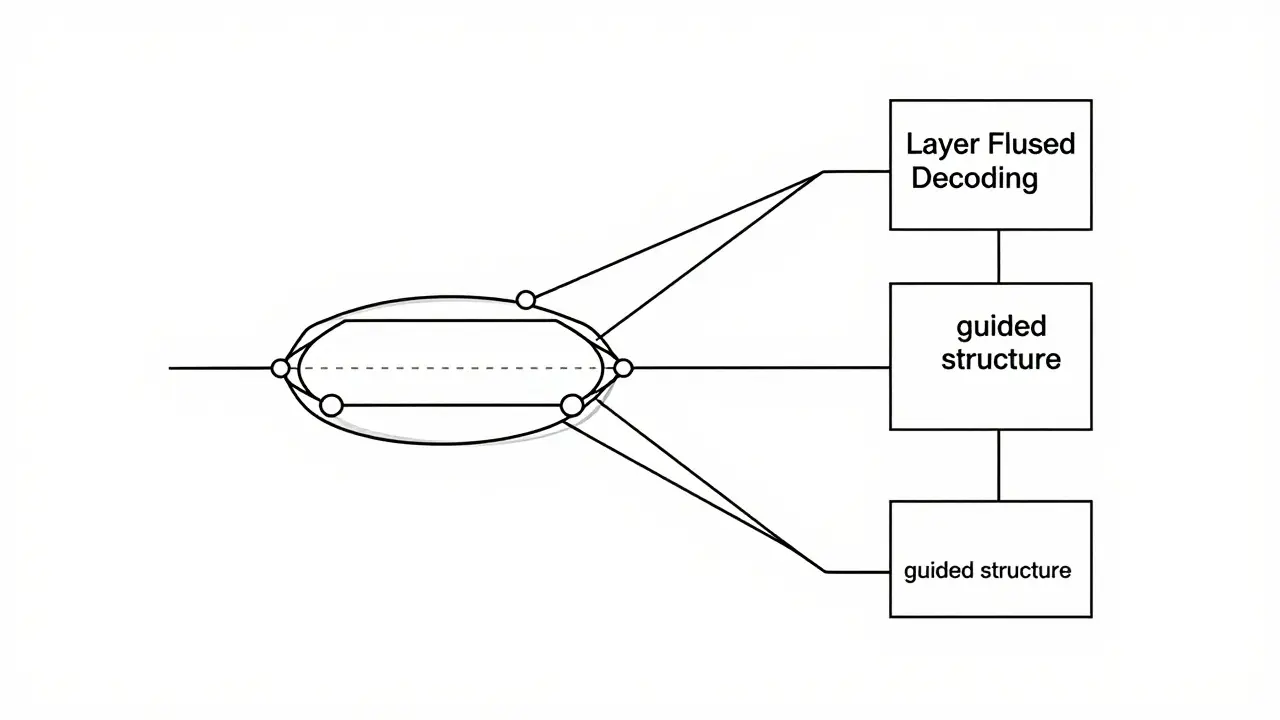
LFD identifies the specific transformer layer that is most sensitive to factual context. It uses metrics like SimHidden and DiffAttn to find the layer with the lowest Internal Knowledge Score (IKS)-usually in the latter half of the network. Once identified, LFD fuses the logits (probability scores) from this intermediate layer with the final-layer logits.
Why does this help? The intermediate layer often retains strong factual grounding from training, while the final layer might be biased toward conversational fluency. By gating low-confidence tokens and re-normalizing the distribution, LFD creates a hybrid output that is both fluent and factually robust. It’s like having a fact-checker whispering to the writer at every step.
| Strategy | Mechanism | Best Use Case | Computational Cost |
|---|---|---|---|
| LoRAG | Iterative retrieval per token/block | Multi-hop reasoning, complex QA | High (multiple API calls) |
| Layer Fused Decoding | Fusing intermediate layer logits | Factual grounding, reducing hallucinations | Low (single pass) |
| Entropy-Based Decoding | Weighting outputs by confidence | Multiple source verification | Medium (parallel passes) |
| Guided Decoding | Syntax constraints via FSMs | Structured data extraction (JSON/XML) | Low |

Entropy and Contrastive Strategies: Trusting Confidence
Another angle is looking at how confident the model is. Entropy-based decoding runs parallel forward passes on each retrieved document. It weighs the outputs by negative entropy-essentially prioritizing distributions that are more deterministic and less chaotic.
If three different retrieved documents lead the model to the same high-confidence token, that token is likely correct. Contrastive strategies take this further by aggregating outputs via weighted products or logit averages. This enhances factual accuracy by leveraging multiple sources simultaneously. It’s similar to asking three experts for their opinion and going with the consensus.
Additionally, dynamic two-stage search with backtracking can achieve high AUROC (Area Under the Receiver Operating Characteristic curve) for faithfulness detection. This means the system can actively detect when it’s about to hallucinate and backtrack to retrieve better evidence.
Guided Decoding: Forcing Structure to Prevent Drift
Hallucinations aren’t just about wrong facts; they’re also about broken formats. If you need an LLM to output JSON, standard generation might produce invalid syntax. Guided Decoding solves this by integrating formal constraints into the generation process.
Using finite-state machines (FSMs), pushdown automata, or regex validators, guided decoding filters the token-level output distribution at each step. It only permits tokens that conform to user-specified structural rules. Frameworks like Outlines, XGrammar, and LM Format Enforcer are popular tools for this.
When combined with RAG, guided decoding ensures that the retrieved facts are not only accurate but also presented in a usable format. Research comparing these methods across multi-turn prompting setups shows that combining external retrieval with format adherence significantly enhances reliability. For developers building APIs or data pipelines, this is non-negotiable.
Context Fusion: Concatenation vs. Attention
How you mix the retrieved text with the prompt matters. There are two primary approaches:
- Concatenation-based fusion: The simplest method. You just stick the retrieved passages next to the query. The LLM’s decoder attends to this augmented context. It’s easy to implement but can overwhelm the model if too much text is added.
- Attention-based fusion: More sophisticated. This modifies the LLM’s decoder to dynamically weight the retrieved information against its internal representations. The cross-attention mechanism attends to both the prompt and the retrieved passages differently, allowing for more controlled integration.
Attention-based fusion is generally superior for complex tasks because it allows the model to ignore irrelevant retrieved chunks and focus on what matters. However, it requires modifying the model architecture, which isn’t always feasible for off-the-shelf models.
Retrieval-Augmented Contextual Decoding (RCD): Truthful Steering
A newer technique called Retrieval-Augmented Contextual Decoding (RCD) steers models toward truthful generation using a compact reference space. RCD builds a grounding space from as few as 10 annotated examples, pairing context embeddings with next-token logits from truthful responses.
During inference, at each decoding step, RCD retrieves semantically similar contexts from this small library and aggregates their logits to modify the LLM’s current probabilities. This acts as a subtle nudge toward truthfulness. Benchmarks show a 2.4% average improvement on TruthfulQA and outperformance on Biographies and WikiQA. Crucially, it requires only a single generation pass, making it highly efficient.
Choosing the Right Strategy: Trade-offs and Implementation
So, which strategy should you use? It depends on your goals and resources.
If you are dealing with multi-hop reasoning (questions that require connecting multiple facts), LoRAG or multi-step query-retrieval-answer pipelines are best. Empirical gains over single-step RAG can be up to +14 EM improvement on benchmarks like 2WikiMultihopQA. However, these come with higher computational costs due to repeated retrieval calls.
If you need speed and efficiency, Layer Fused Decoding or RCD are excellent choices. They add minimal overhead since they operate within a single generation pass. LFD is particularly good at suppressing low-confidence tokens without slowing down the pipeline.
For structured outputs, always pair RAG with Guided Decoding. No amount of factual grounding helps if the output breaks your parser.
Remember, there are diminishing returns. For simple single-hop tasks, one or two retrieval loops may suffice. Going beyond ten iterations in LoRAG often yields negligible accuracy gains while burning compute budget. Optimize based on your specific application requirements.
Conclusion: Building Reliable AI Systems
Combining RAG with advanced decoding strategies is no longer optional for high-stakes applications. Whether you’re using LoRAG for deep reasoning, LFD for factual precision, or Guided Decoding for structure, these techniques address the core weakness of LLMs: unreliability. By understanding these mechanisms, you can build systems that don’t just sound smart-they actually know what they’re talking about.
What is the main difference between static RAG and Retrieval-Augmented Decoding?
Static RAG retrieves documents once before generation begins. Retrieval-Augmented Decoding (like LoRAG) dynamically retrieves new evidence during the generation process, allowing the model to refine its context as it writes each token.
Does Layer Fused Decoding require retraining the model?
No, LFD typically works at inference time by manipulating logits from existing transformer layers. It does not require fine-tuning or retraining the base model, though identifying the optimal fusion layer may require some calibration.
Which decoding strategy is best for reducing hallucinations?
Layer Fused Decoding (LFD) and Retrieval-Augmented Contextual Decoding (RCD) are specifically designed to enhance factual grounding and reduce hallucinations by leveraging internal knowledge scores and truthful reference spaces, respectively.
Is LoRAG computationally expensive?
Yes, LoRAG is more expensive than static RAG because it performs multiple retrieval queries during generation. However, the trade-off is significant accuracy gains in complex, multi-hop reasoning tasks.
Can I use Guided Decoding with any LLM?
Most modern LLMs support Guided Decoding through libraries like Outlines or XGrammar. It works by filtering the probability distribution at each step, so it is compatible with any model that exposes its logits.
 Artificial Intelligence





kimberly de Bruin
July 10, 2026 AT 02:30the whole point of these complex decoding strategies is to mask the fundamental lack of understanding in the model we are just building a scaffold for ignorance
Edward Nigma
July 10, 2026 AT 13:15U r totally wrong about this. The article clearly states that LFD does not require retraining and works at inference time by manipulating logits. It is grammatically precise to say that your take is baseless because you ignore the technical details provided.
Francis Laquerre
July 11, 2026 AT 11:30I must express my profound admiration for the depth of this analysis! It is truly remarkable how Layer Fused Decoding leverages internal knowledge scores to enhance factual grounding without the need for extensive computational resources. This approach represents a significant leap forward in our collective ability to harness AI for truthful generation, and I believe it will inspire many developers to adopt these methods with enthusiasm and care.
michael rome
July 12, 2026 AT 11:30It is imperative that we acknowledge the nuanced trade-offs presented here. While LoRAG offers superior accuracy for multi-hop reasoning tasks, its high computational cost cannot be ignored. Conversely, Layer Fused Decoding provides an efficient alternative that maintains factual precision with minimal overhead. We must carefully consider our specific application requirements before selecting a strategy, as there is no one-size-fits-all solution in this evolving landscape.
Andrea Alonzo
July 14, 2026 AT 02:10I find myself deeply resonating with the discussion around Guided Decoding and its role in ensuring structured outputs, especially when dealing with JSON or XML formats which are so critical for modern API integrations and data pipelines where even a minor syntax error can cascade into significant system failures down the line. It is incredibly empowering to see tools like Outlines and XGrammar being highlighted as essential components in this ecosystem, allowing us to enforce strict structural rules while still benefiting from the creative and generative capabilities of large language models, thus creating a harmonious balance between rigid formatting requirements and fluid natural language processing that ultimately serves both developers and end-users alike in their daily workflows.
Saranya M.L.
July 15, 2026 AT 01:46Your superficial understanding of Retrieval-Augmented Contextual Decoding (RCD) is laughable. RCD utilizes a compact reference space built from merely ten annotated examples to steer models toward truthfulness via semantic similarity aggregation of next-token logits. This sophisticated mechanism significantly outperforms naive concatenation methods on benchmarks like TruthfulQA, demonstrating superior factual grounding through advanced logit manipulation rather than brute-force context injection. You should educate yourself on the mathematical underpinnings of SimHidden and DiffAttn metrics before offering such uninformed commentary on transformer layer sensitivity.