

You ask an AI to write a function. It spits out code. You copy-paste it. It breaks. You try again. This loop is exhausting, and it’s exactly what chain-of-thought prompting is designed to fix. In the era of "vibe coding"-where you steer AI agents with natural language instead of syntax-the biggest mistake developers make is demanding instant implementation. They want the answer before the reasoning. But large language models don't think like humans; they predict tokens. If you force them to jump straight to the final line of code, you’re skipping the mental scratchpad where the logic actually happens.
Think about how you solve a complex math problem. You don’t just guess the answer. You break it down. You check your work. Chain-of-thought (CoT) prompting forces the model to do the same thing for programming tasks. Instead of asking "Write a Python script to scrape this site," you ask, "Explain how you would structure a scraper for this site, considering dynamic content, then write the code." The difference isn’t just semantic-it’s structural. Research from Google Research back in 2022 showed that adding simple step-by-step instructions boosted accuracy on complex reasoning tasks from 18% to 79%. For coding, this means fewer bugs, clearer architecture, and less time spent debugging hallucinated libraries.
Why Direct Code Generation Fails in Vibe Coding
Vibe coding relies on high-level intent. You describe the "what," not the "how." When you skip the explanation phase, you’re betting that the model has perfectly inferred every edge case, dependency, and architectural constraint from a single sentence. That’s a bad bet. Models are probabilistic engines. Without explicit intermediate steps, they often take shortcuts. They might choose a library that doesn’t exist, ignore rate limits, or structure data in a way that looks clean but fails under load.
When you enforce explanations first, you create a checkpoint. You get to see the model’s plan before it commits to syntax. This aligns with how senior engineers work. We don’t start typing immediately; we sketch the API, define the data structures, and identify potential pitfalls. CoT mimics this workflow. It turns the AI from a code generator into a pair programmer who thinks aloud. A study by DataCamp found that using CoT reduced logical errors in algorithm implementation by 63%. That’s not a marginal gain; that’s the difference between shipping a feature and rewriting it next week.
The Anatomy of Effective CoT Prompts for Code
Not all chain-of-thought prompts are created equal. Slapping "think step by step" at the end of a vague request helps, but it’s not optimal. To truly leverage CoT in vibe coding, you need a structured approach that separates reasoning from execution. Here’s a framework that works:
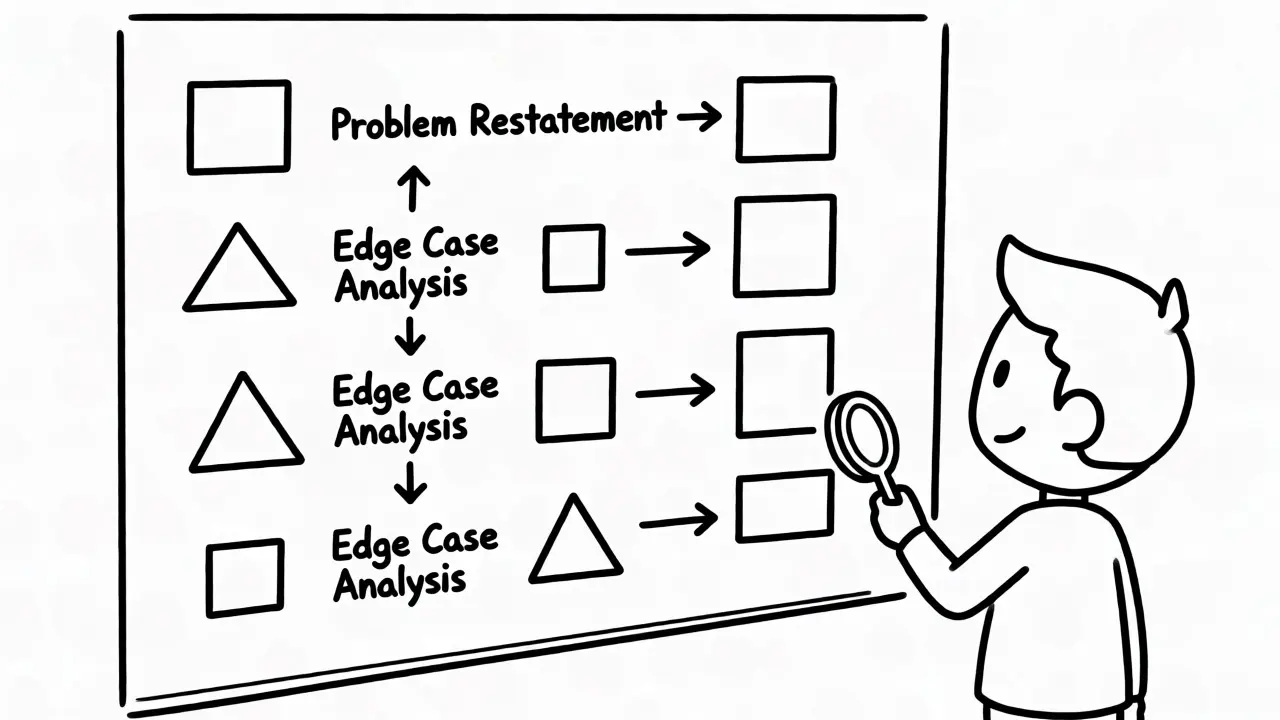
- Problem Restatement: Ask the model to rephrase the task in its own words. This confirms understanding. If it misunderstands the scope, you catch it before any code is written.
- Algorithm Selection Justification: Require the model to explain why it chose a specific approach. Why use a hash map here? Why recursion over iteration? This reveals hidden assumptions.
- Edge Case Analysis: Before writing code, list potential failure points. Empty inputs? Network timeouts? Unicode characters? This forces the model to consider robustness early.
- Pseudo-code Drafting: Have the model write pseudo-code or comments describing the flow. This acts as a blueprint.
- Final Implementation: Only after these steps, ask for the actual code.
This sequence prevents the "black box" effect. You aren’t just getting code; you’re getting a rationale. If the code fails, you can debug the reasoning, not just the syntax. Did the model assume the input was always sorted? Did it forget to handle null values? These issues are visible in the explanation phase, saving you hours of tracing stack traces.
Token Costs vs. Debugging Time
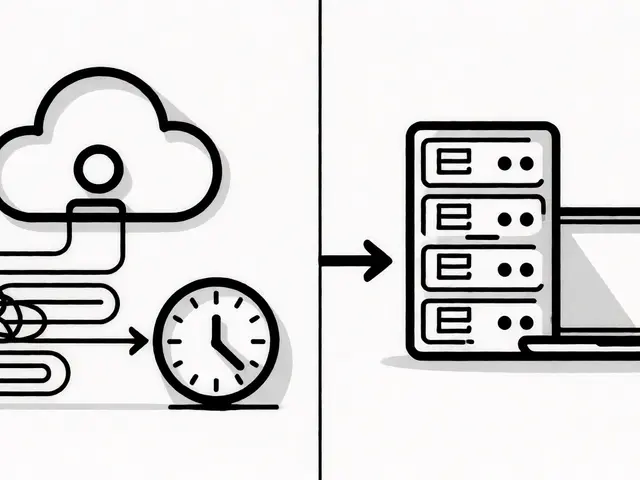
Critics point out that CoT increases token usage. And they’re right. Asking for explanations adds 15-20% more tokens per interaction. On a small project, this might feel wasteful. But look at the bigger picture. GitHub’s internal metrics show that while CoT prompts increased average token usage from 150 to 420 tokens, they reduced code review iterations by 38%. Fewer iterations mean less human time spent reviewing, testing, and refactoring.
Consider the cost of a bug in production versus the cost of extra tokens. A minor logic error caught during the explanation phase costs pennies in compute. The same error deployed to production could cost thousands in downtime or emergency patches. For enterprise teams, this trade-off is obvious. Financial services and healthcare IT sectors, which have strict correctness requirements, show adoption rates above 90% for reasoning-based prompting. They know that precision beats speed when stakes are high.
| Feature | Direct Prompting | Chain-of-Thought Prompting |
|---|---|---|
| Initial Response Speed | Faster (fewer tokens) | Slower (more tokens) |
| Logical Accuracy | Lower (higher error rate) | Higher (better reasoning) |
| Debugging Effort | High (opaque logic) | Low (transparent logic) |
| Best Use Case | Boilerplate, simple CRUD | Complex algorithms, system design |
| Model Requirement | Works on smaller models | Requires >100B parameters |

When Not to Use Chain-of-Thought
CoT isn’t a silver bullet. For simple tasks, it’s overkill. If you need a regex pattern for an email address or a basic SQL query, forcing the model to write three paragraphs of reasoning wastes time and money. GeeksforGeeks’ benchmarks showed a 22% performance degradation on simple tasks when using CoT because the model over-complicates straightforward problems.
Use CoT selectively. Reserve it for scenarios involving multi-step logic, state management, concurrency, or unfamiliar domains. If you’re building a React component with standard props, direct prompting is fine. If you’re designing a caching layer for a distributed system, demand the explanation first. Knowing when to apply CoT is a skill. Start by using it for any task that takes more than 10 minutes to implement manually. If the AI’s explanation seems shaky, refine the prompt. If it’s solid, let it generate the code.
The Future: Auto-CoT and IDE Integration
We’re moving toward tools that handle this automatically. OpenAI’s recent updates and JetBrains’ upcoming IDE features are integrating structured reasoning directly into the development environment. Soon, you won’t need to explicitly ask for step-by-step thinking. The tool will infer complexity and switch modes accordingly. However, understanding the underlying mechanism remains crucial. You need to know what questions to ask when the auto-generated reasoning misses the mark.
Dr. Emily Bender from the University of Washington warns against "reasoning hallucinations," where the AI sounds logical but is wrong. This is why human oversight is non-negotiable. Read the explanations. Challenge the assumptions. CoT gives you visibility, but it doesn’t absolve you of responsibility. Treat the AI’s reasoning as a draft proposal from a junior engineer. Review it, critique it, and then approve the implementation.
Does chain-of-thought prompting work on all AI models?
No. Research indicates that CoT benefits primarily materialize in models with approximately 100 billion parameters or more. Smaller models often struggle to maintain coherent long-chain reasoning and may produce inconsistent results. For smaller local models, simpler zero-shot prompts usually yield better outcomes.
How much does chain-of-thought increase API costs?
Expect a 15-20% increase in token usage per request. While this raises immediate compute costs, studies show it reduces total development time by decreasing debugging cycles and code review iterations, often resulting in lower overall project costs.
Can I use chain-of-thought with GitHub Copilot?
Yes. While Copilot generates code inline, you can use the chat interface to ask for explanations before accepting suggestions. Prompting Copilot Chat to "explain the approach before generating code" leverages CoT principles effectively within the IDE.
What is the risk of using chain-of-thought?
The main risk is "false confidence." An AI might generate a logically sound-sounding explanation that leads to incorrect code. Always verify critical logic independently. Do not assume that because the reasoning reads well, the output is correct.
Is chain-of-thought useful for simple scripts?
Generally, no. For boilerplate code, simple CRUD operations, or basic utilities, direct prompting is faster and cheaper. CoT shines in complex algorithmic challenges, system design, and tasks requiring multi-step reasoning.
 Artificial Intelligence




kevin montesinos valencia
November 26, 2026 AT 14:52this is actually really helpful for my workflow because i've been struggling with debugging ai generated code lately and i think adding that explanation step might save me a lot of time on complex tasks
i appreciate the breakdown of when to use it versus when to keep it simple
Adam Fenech
November 26, 2026 AT 16:19I must respectfully disagree with the premise that chain-of-thought is universally superior in this context. While the data presented regarding accuracy improvements is compelling, one cannot ignore the significant latency introduced by forcing models into verbose reasoning patterns before execution. In high-frequency trading environments or real-time user interfaces where milliseconds matter, this overhead is simply unacceptable regardless of the logical purity gained. Furthermore, the assertion that smaller models fail at CoT ignores recent advancements in distilled architectures which maintain coherence without massive parameter counts. We are essentially optimizing for developer comfort rather than systemic efficiency here.