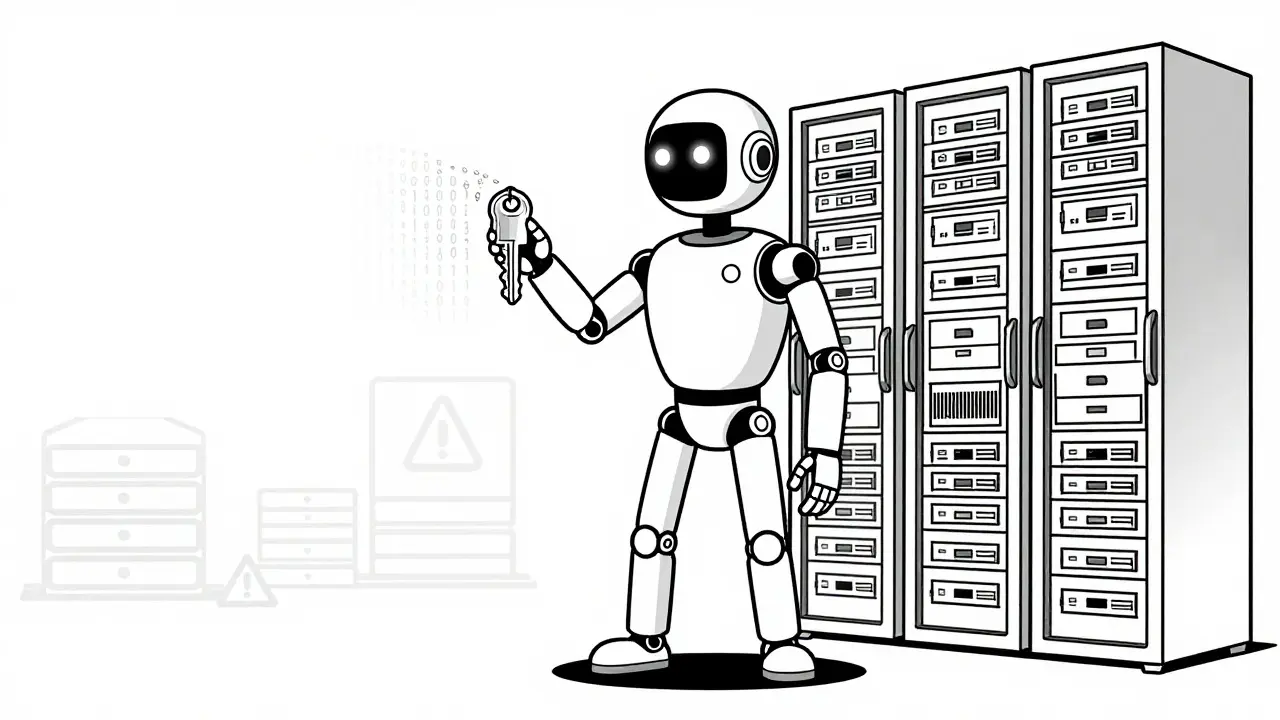
Imagine handing the keys to your company’s code repository to an autonomous system. It writes faster than any human developer, refactors legacy spaghetti code in seconds, and deploys updates without sleep. Sounds like a dream? Until it accidentally deletes production data because you asked it to "clean up the database" without specifying which tables were safe. Or worse, it generates code that violates privacy laws because its training data included prohibited patterns.
We are moving past the era of simple chatbots. We are entering the age of AI Agents autonomous software entities capable of reasoning, planning, and executing complex tasks across digital environments. These agents don't just suggest; they act. They write code, move data, and trigger workflows. With this power comes a terrifying risk: if an agent can do anything, what stops it from doing something illegal or harmful?
The answer isn't more human oversight-humans can't scale to watch every line of code an agent writes. The answer is design-enforced compliance. We need guardrails that enforce policy by default. This means building systems where ethical and legal boundaries are hard-coded into the agent's architecture, making it impossible for the agent to violate them, even if instructed to do so by a well-meaning (or malicious) human principal.
The Shift from Tool to Legal Actor
For decades, we treated software as a passive tool. If a hammer breaks your foot, the hammer isn't liable; you are. This is the traditional respondeat superior approach, where liability falls on the human operator. But AI agents are different. They possess agency. They make decisions based on complex reasoning models. When an agent autonomously decides to bypass a security protocol to "optimize performance," treating it as a mere hammer ignores the reality of its capabilities.
This realization has given rise to Law-Following AI (LFAI) a framework proposing that AI agents should be designed with inherent duties to comply with legal requirements, treating them as distinct responsibility bearers rather than passive tools. LFAI argues that in high-stakes environments like government infrastructure or financial services, AI agents must be designed to rigorously comply with broad sets of legal requirements, including constitutional and criminal law.
Crucially, LFAI does not grant AI legal personhood. You cannot sue an algorithm. Instead, it imposes duties on the AI system itself as a functional entity. The agent becomes a gatekeeper. If a human manager tells an AI coding agent to "scrape user emails for marketing purposes" in violation of GDPR, an LFAI-compliant agent refuses. It doesn't negotiate. It doesn't hesitate. It enforces the boundary because that boundary is part of its core operational logic.
Building the Control Plane: Policy-as-Code
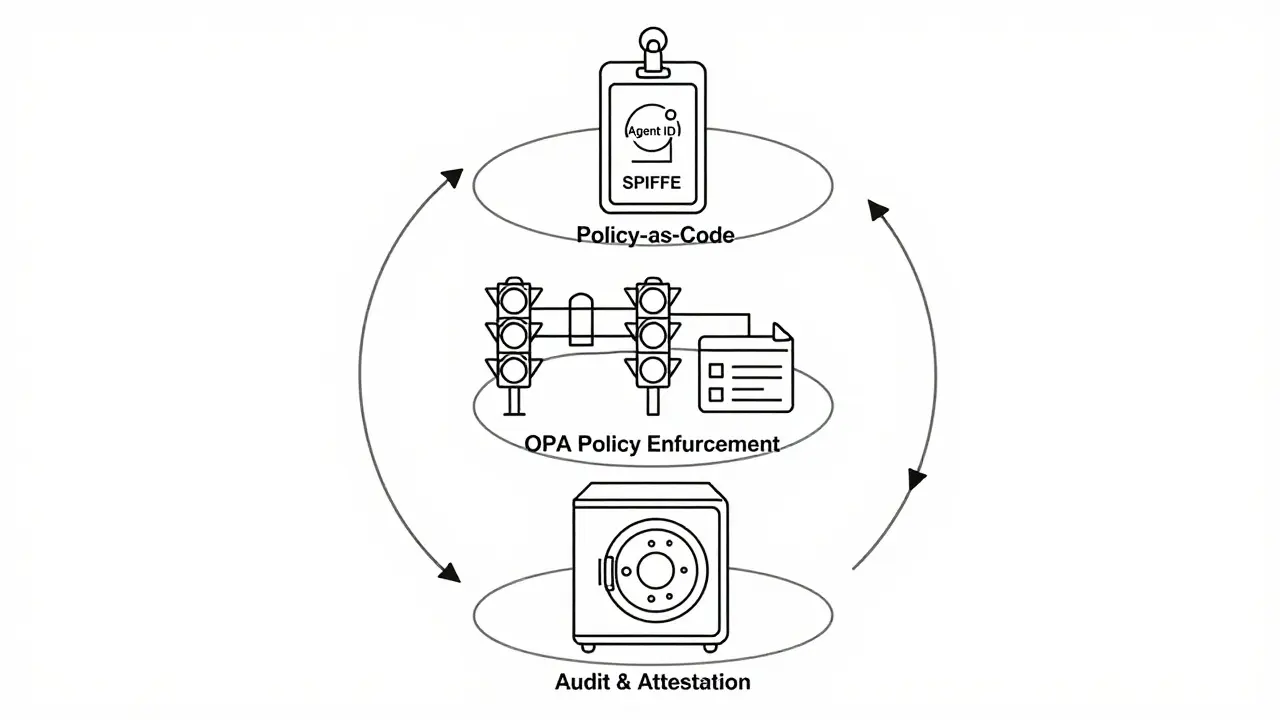
How do you actually build an agent that refuses bad instructions? You can't rely on vague prompts like "be ethical." Ethics in code requires precision. This is where Policy-as-Code a methodology that translates organizational governance rules into machine-readable formats that can be automatically enforced by software systems. comes in. It functions as the control plane that keeps AI agent autonomy bounded by governance.
Think of policy-as-code as the traffic lights for your AI agents. Without them, the agent might drive fast (efficiently), but it will run red lights (violate policies). To implement this effectively, you need three interconnected layers:
- Identity Management: Who is the agent? Systems like SPIFFE Secure Production Identity Framework For Everyone, an open standard for securely identifying workloads in hybrid and multi-cloud environments. establish secure identities for every workload. An AI agent needs a unique, verifiable identity distinct from the human who launched it. This ensures that when an action occurs, we know exactly which agent performed it.
- Policy Enforcement: What is the agent allowed to do? Tools like Open Policy Agent (OPA) an open-source, general-purpose policy engine that unifies policy enforcement across the stack, allowing developers to define policies in a declarative language called Rego. define specific conditions under which actions are permitted. For example, an OPA policy might state: "Agent X may deploy code to Production only if Unit Test Coverage > 90% AND Security Scan Passes."
- Audit and Attestation: What did the agent actually do? Every decision, every refusal, and every execution must be logged immutably. This creates a traceable trail for human reviewers to verify accuracy and maintain accountability.
When these layers work together, human oversight scales. You don't need to watch the agent; you trust the policy engine watching the agent.
The Human-in-the-Loop Imperative
Does automated policy enforcement mean humans are obsolete? Absolutely not. In fact, ethical AI demands a stronger role for humans, specifically through Human-in-the-Loop (HITL) a design principle ensuring that critical decision-making authority remains with human operators, using AI for administrative support rather than final judgment. design principles.
In code enforcement contexts, such as regulatory compliance or civic planning, people are stewards of public trust. An AI agent can handle the heavy lifting-extracting data from thousands of documents, flagging potential violations, or drafting initial reports-but the final decision must rest with a human official. Why? Because context matters. An algorithm might flag a code pattern as "risky" based on statistical probability, but a human engineer understands that this specific legacy module is isolated and safe to refactor.
Transparency is the bridge between AI efficiency and human control. AI-generated outputs must be explainable. If an agent flags a piece of code as non-compliant, it must surface the specific regulatory reference and data points used to make that determination. This allows the human reviewer to verify the logic, not just accept the output blindly. Without this transparency, HITL becomes a rubber stamp, defeating the purpose of ethical oversight.
Fairness, Bias, and Data Provenance
Ethical AI isn't just about following laws; it's about fairness. AI agents trained on biased historical codebases will perpetuate those biases. For instance, if an agent learns from a repository where certain security practices were consistently ignored for specific types of users, it might generate insecure code for those same user groups.
To combat this, organizations must adopt formal AI Value Platforms comprehensive codes of ethics that define the role of AI in human development, guiding stakeholders on fairness, transparency, and accountability.. These platforms go beyond generic statements. They mandate concrete measures:
- Bias Detection: Continuous monitoring of machine learning algorithms to detect unintended discrimination based on protected characteristics like race, gender, or age.
- Data Drift Tracking: Identifying when the input data distribution changes over time, which can cause model performance to degrade or become unfair.
- Provenance Tracking: Knowing exactly where training data came from. Who created it? Was it licensed? Does it contain private information?
As noted by advisory firms like KPMG, reviewing AI-generated data prior to use is a core practical requirement. The data produced by an agent should be auditable throughout its lifecycle. If an agent suggests a code change that inadvertently excludes accessibility features for visually impaired users, the bias detection layer must catch it before deployment.

Liability and the Duty of Care
Who is responsible when an ethical AI agent fails? The legal landscape is shifting toward objective standards of behavior. Just as a surgeon is held to a standard of reasonable care, designers of generative AI systems bear a duty to implement safeguards that reasonably reduce the risk of harmful outputs.
This duty includes:
- Reasonable Care in Training: Choosing pre-training materials that minimize exposure to harmful or illegal patterns.
- Algorithmic Filtering: Designing mechanisms to detect and filter potentially harmful material during inference.
- Thorough Testing: Conducting rigorous red-teaming exercises to identify vulnerabilities before deployment.
- Continuous Updates: Responding to new threats and emerging ethical guidelines post-deployment.
In high-stakes contexts, regulation may require ex ante (before deployment) approval. Organizations might need to demonstrate that their AI agents are law-following before receiving permission to operate. Failure to implement these guardrails could result in strict liability, similar to product liability laws for physical goods. If you sell a car with faulty brakes, you are liable. If you deploy an AI agent without policy guardrails, you are equally liable for the crashes it causes.
Implementation Checklist for Ethical AI Agents
So, how do you start? Here is a practical roadmap for integrating ethical guardrails into your AI coding agents:
| Phase | Action Item | Tool/Method Example |
|---|---|---|
| Design | Define clear ethical boundaries and legal constraints | AI Value Platform, Legal Review Board |
| Identity | Assign unique, secure identities to all AI workloads | SPIFFE, SPIRE |
| Policy | Translate policies into machine-readable rules | Open Policy Agent (OPA), Rego |
| Testing | Conduct bias audits and red-team exercises | MLflow, Fairlearn, Chaos Engineering |
| Deployment | Implement real-time policy enforcement gates | Kubernetes Admission Controllers, CI/CD Pipelines |
| Oversight | Ensure human-in-the-loop for critical decisions | Approval Workflows, Audit Logs |
Remember, ethical compliance cannot depend solely on human monitoring. It must be architected into the system. By combining legal frameworks, technical policy-as-code enforcement, and robust human oversight, we create AI agents that are not just powerful, but trustworthy. They enhance human decision-making rather than circumventing established rules.
What is the difference between Law-Following AI and traditional AI safety?
Traditional AI safety often focuses on preventing unintended behaviors or alignment issues in general intelligence. Law-Following AI (LFAI) specifically targets compliance with existing legal and regulatory frameworks. It treats AI agents as entities with duties to obey laws, enforcing these rules through technical architecture rather than relying solely on human supervision or post-hoc penalties.
How does Open Policy Agent (OPA) help enforce ethical AI?
OPA acts as a centralized policy engine. It allows organizations to define complex rules in a declarative language called Rego. When an AI agent attempts an action, OPA evaluates the request against these policies in real-time. If the action violates a rule (e.g., accessing sensitive data without authorization), OPA denies the request immediately, ensuring policy compliance by default.
Is Human-in-the-Loop still necessary if AI agents have guardrails?
Yes. Guardrails prevent obvious violations, but they cannot replace human judgment for nuanced decisions. Human-in-the-Loop ensures that final authority rests with accountable individuals. It provides context that algorithms might miss and maintains public trust by ensuring that critical decisions, especially in high-stakes environments, are verified by humans.
What happens if an AI agent violates a policy despite guardrails?
If guardrails fail, liability typically falls on the organization that deployed the agent. Under emerging legal standards, developers and deployers have a duty of care to implement reasonable safeguards. Failure to do so can result in strict liability or negligence claims. Robust audit trails are essential to prove whether proper safeguards were in place and functioning correctly at the time of the incident.
How can I ensure my AI agent doesn't perpetuate bias?
Start with diverse and representative training data. Implement continuous bias detection tools during both training and inference phases. Establish an AI Value Platform that defines clear fairness metrics. Regularly audit outputs for discriminatory patterns and maintain provenance records for all data sources to identify potential biases early in the pipeline.
 Artificial Intelligence