

You ask an AI for a source to back up a claim. It gives you a title, authors, journal, and year. It looks perfect. You click the link. Error 404. The paper doesn't exist. This isn't just annoying; it's a crisis in knowledge management. Generative AI models are notorious for inventing references that sound plausible but have no basis in reality. These are fabricated citations, a specific type of hallucination where the model predicts text based on statistical likelihood rather than factual truth.
The stakes are high. In 2025, a study published in PMC/NIH journals analyzed 53 articles from a suspicious journal called the Global Institute for Interdisciplinary Research (GIJIR). The result? 48 of them appeared to be AI-generated with fake authorship. Turnitin’s detection tools flagged multiple papers with 100% AI probability scores. If this happens in peer-reviewed journals, imagine what it does to your daily workflow or legal briefs. We need more than just hope; we need structural barriers. These are known as guardrails.
Why Do AI Models Invent Sources?
To fix the problem, you have to understand the engine. Large Language Models (LLMs) don't "know" facts like a database does. They predict the next word in a sequence. When you ask for a citation, the model looks at patterns in its training data. It sees that scientific papers usually follow a format: Author, Title, Journal, Year. It generates text that fits this pattern perfectly.
This is why the hallucinated citation is so dangerous. It isn't random noise. It is structurally correct. It uses real-sounding names, plausible journal titles, and logical years. According to research from Harvard's Misinformation Review, this makes AI hallucinations distinct from human misinformation. Humans lie due to bias or intent. AI "lies" because it is optimizing for linguistic probability, not factual accuracy. The model doesn't know if the paper exists; it only knows that a string of words resembling a citation is highly probable in that context.
Technical Guardrails: Detection and Validation
The first line of defense is technical. These are software mechanisms designed to catch errors before they reach the user. One common method involves heuristic analysis. Systems count specific delimiters-like brackets or braces-that typically surround in-text citations. If a document claims to cite sources but lacks these structural markers, or if the markers appear in illogical places, the system flags it.
More advanced architectures use specialized scorers. Here is how they break down:
- Coherence Scorers: These check if the logic flows. Does the cited source actually support the sentence preceding it?
- Relevance Scorers: These validate if the response aligns with the user's intent. Did the user ask for a medical study, or did the model provide a blog post?
- Linguistic Accuracy Scorers: Tools using BLEU or ROUGE metrics compare the AI output against verified reference texts to measure similarity.
Detection tools like Turnitin have become industry standards for identifying these anomalies. While no tool is perfect, Turnitin has shown high accuracy with ChatGPT-4.0 generated text. However, relying solely on detection is reactive. It finds the error after the model has already spoken. To prevent the error, we need to change how the model accesses information.
The Role of Retrieval-Augmented Generation (RAG)
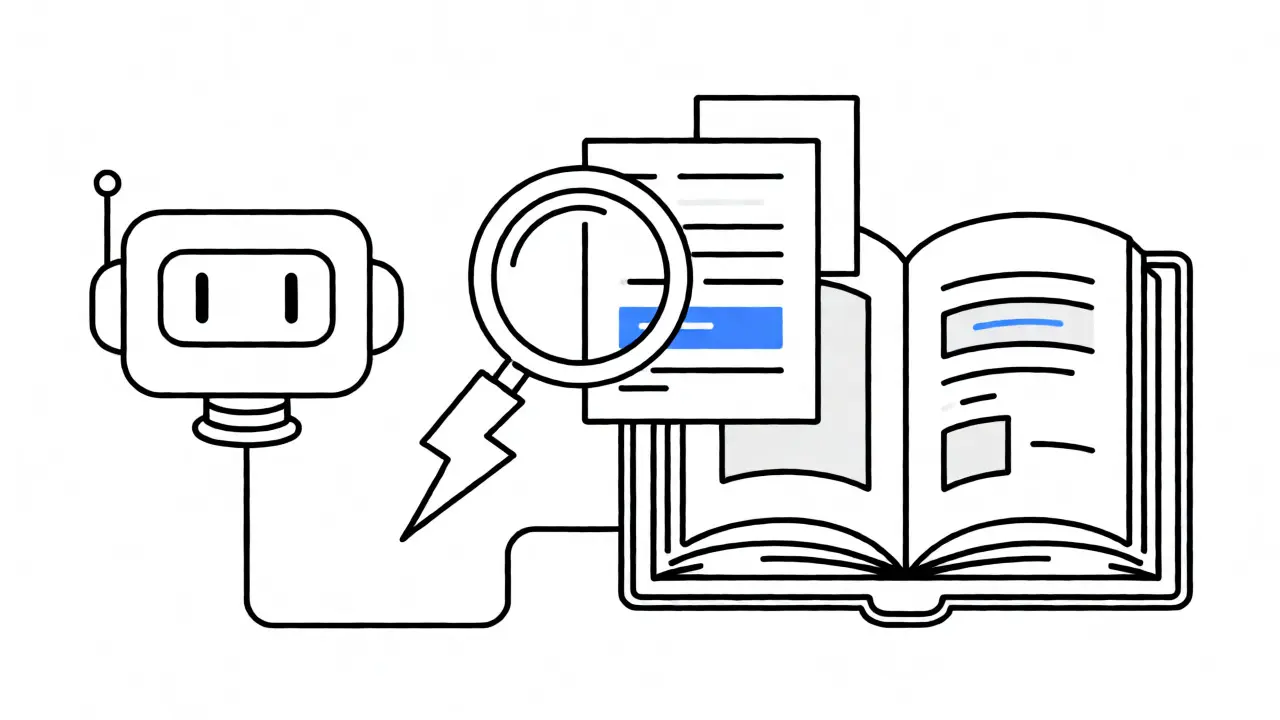
One of the most effective ways to curb fabricated citations is Retrieval-Augmented Generation (RAG). This is a technique where the AI doesn't just rely on its internal memory. Instead, it searches a trusted external database or the web for relevant documents before generating an answer.
Think of it like open-book testing versus closed-book memorization. In a standard LLM, the model guesses from memory. In a RAG system, the model retrieves actual snippets of text from verified sources and then synthesizes an answer based on those snippets. This drastically reduces the chance of invention because the model is constrained by retrieved evidence.
But here is the catch: RAG improves accuracy, but it doesn't eliminate hallucinations entirely. The platform guardrails mentioned in recent studies show that while RAG helps, models can still misinterpret retrieved text or combine fragments incorrectly. Therefore, RAG is a powerful layer, but it must be combined with other checks. It narrows the gap between prediction and fact, but it doesn't close it completely.
Institutional Safeguards: DOIs and ORCIDs
Tech alone isn't enough. We need institutional infrastructure to verify identity and provenance. Two key identifiers play a massive role here: DOIs (Digital Object Identifiers) and ORCIDs (Open Researcher and Contributor IDs).
A DOI is a permanent link to a specific digital object, like a paper. An ORCID is a unique digital identifier for researchers. The 2025 PMC case study recommended strengthening the binding between these two. Currently, anyone can claim authorship on a preprint or submit to a predatory journal. But if publishers mandate that authors use their ORCID credentials to authorize the binding of a DOI to their profile, it creates an auditable chain of verification.
This workflow looks like this:
- Author submits paper using ORCID login.
- Publisher verifies ORCID via authentication protocols.
- DOI is issued and digitally signed, linking the article to the verified researcher.
- AI systems checking citations can query this verified link to confirm existence.
This shifts the burden from detecting fake text to verifying real identities. It makes it much harder for an AI to generate a phantom author who doesn't exist in the global registry.
Data Quality Governance
Garbage in, garbage out. If an AI is trained on low-quality data filled with broken links and retracted papers, it will learn to mimic those errors. Data quality governance is the foundational guardrail often overlooked. Robust frameworks define standards for data cleaning, deduplication, and error correction.
Automated validation tools should run continuously, checking for inconsistencies and outliers in both training and inference data. Regular audits ensure that the model isn't learning from outdated or fraudulent sources. For example, if a significant number of papers in a training set were later retracted, the model might treat retracted findings as current consensus. Systematic cleansing prevents this drift.
Balancing False Positives and Negatives
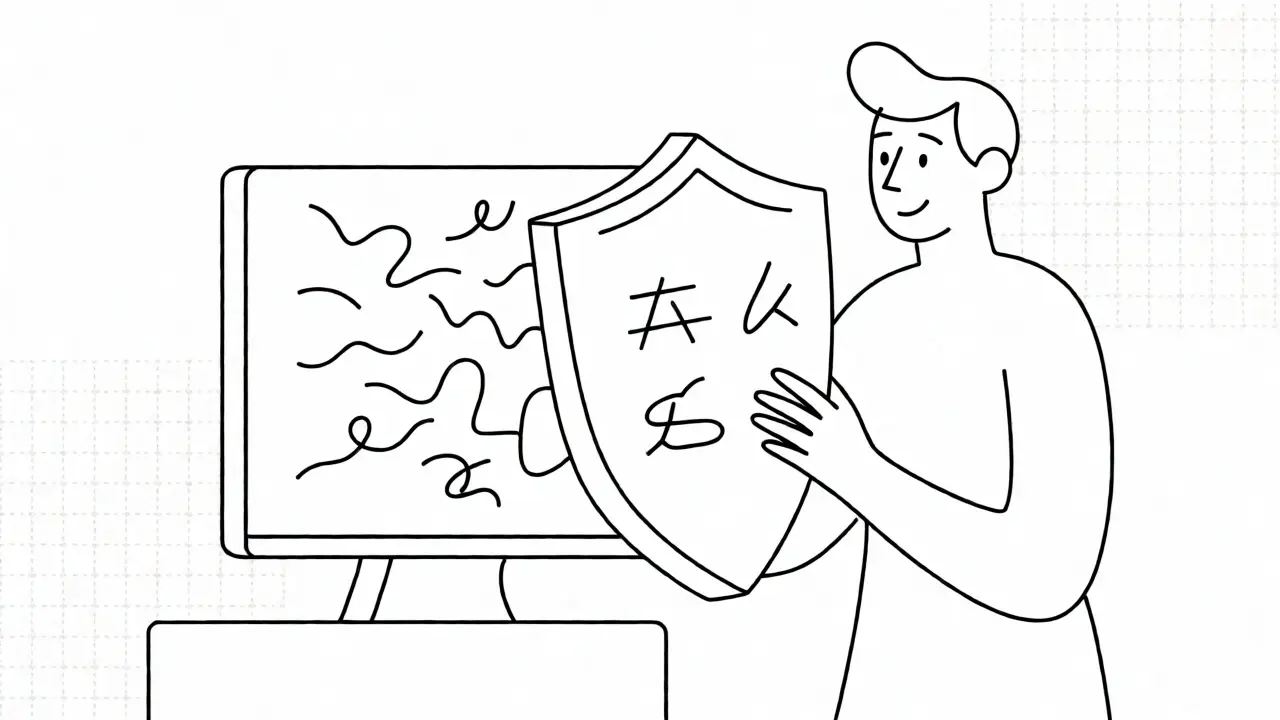
Implementing guardrails introduces a tricky trade-off. If your filters are too strict, you get false positives. Valid, legitimate citations get blocked because the system thinks they look "too perfect" or unusual. If your filters are too loose, you get false negatives. Fabricated citations slip through because they match the statistical pattern well enough.
This requires domain-specific calibration. A legal AI assistant needs stricter guardrails than a creative writing bot. In law, a fake citation can lose a case. In casual conversation, a wrong reference is just a minor inconvenience. Organizations must tune their sensitivity based on risk tolerance. As noted by experts at Weights & Biases, iterative updates are crucial. Adversarial evolution means that as detection improves, new types of fabrication emerge. Static rules fail; adaptive systems succeed.
Comparing Guardrail Approaches
Not all guardrails serve the same purpose. Some detect, some prevent, and some verify. Here is how the major strategies stack up:
| Strategy | Mechanism | Strengths | Limitations |
|---|---|---|---|
| Heuristic Detection | Pattern matching (brackets, formatting) | Fast, low computational cost | Easily fooled by sophisticated formats |
| RAG Systems | External retrieval before generation | Grounds answers in real data | Dependent on search quality; latency issues |
| Identity Verification | ORCID/DOI binding | High trust; auditable | Requires institutional adoption |
| Data Governance | Cleaning training/inference data | Addresses root cause | Resource-intensive; ongoing maintenance |
The Human-in-the-Loop Imperative
No technology currently solves this completely. The persistence of hallucinations despite RAG and detection tools suggests that redundancy is key. You cannot rely on one layer. You need a multi-faceted approach combining technical constraints, institutional verification, and human oversight.
For critical applications-medical diagnoses, legal precedents, academic publishing-human review remains non-negotiable. The goal of guardrails isn't to replace the editor; it's to reduce the volume of obvious errors so humans can focus on subtle nuances. Without proactive measures, the unchecked proliferation of AI content risks eroding trust in scholarly discourse. We aren't just fighting bad code; we're protecting the credibility of knowledge itself.
What exactly is a fabricated citation in AI?
A fabricated citation is a reference generated by an AI model that appears realistic but does not correspond to any existing publication. The model creates it by predicting statistically likely combinations of author names, titles, and journals, resulting in a phantom source that never existed.
Can RAG systems completely stop AI hallucinations?
No, RAG significantly reduces hallucinations by grounding responses in retrieved data, but it does not eliminate them. Models can still misinterpret retrieved text, fail to retrieve relevant documents, or synthesize information incorrectly. RAG is a strong mitigation strategy, not a total cure.
How do DOIs and ORCIDs help prevent fake citations?
DOIs provide a permanent link to a specific paper, while ORCIDs uniquely identify researchers. By requiring a secure digital binding between a DOI and an ORCID, institutions create an auditable trail. This makes it difficult for AI to attribute work to non-existent authors or link to non-existent papers without triggering verification failures.
Why are fabricated citations dangerous in academia?
They undermine the foundation of scientific progress, which relies on verifiable evidence. Fake citations clutter literature reviews, mislead future researchers, and damage the reputation of journals and institutions. Cases like GIJIR show that systematic fabrication can distort entire fields of study.
Are AI detection tools like Turnitin reliable?
Turnitin and similar tools are generally accurate, especially with newer models like ChatGPT-4.0, but they are not infallible. They work best as part of a broader strategy. False positives can occur with human-written text that mimics AI style, and false negatives happen when AI output is heavily edited by humans.
 Artificial Intelligence



Alyson Karson
September 11, 2026 AT 04:56OMG YES this is exactly what i’ve been screaming about for months!!
i literally had a prof reject my bibliography because the AI made up three sources and i didn’t catch them fast enough. it’s not just annoying its actually dangerous?? like if lawyers or doctors are using this stuff without checking every single link we are all doomed.
we need way more guardrails asap before this whole thing implodes on us. stop being lazy with citations people!!!