
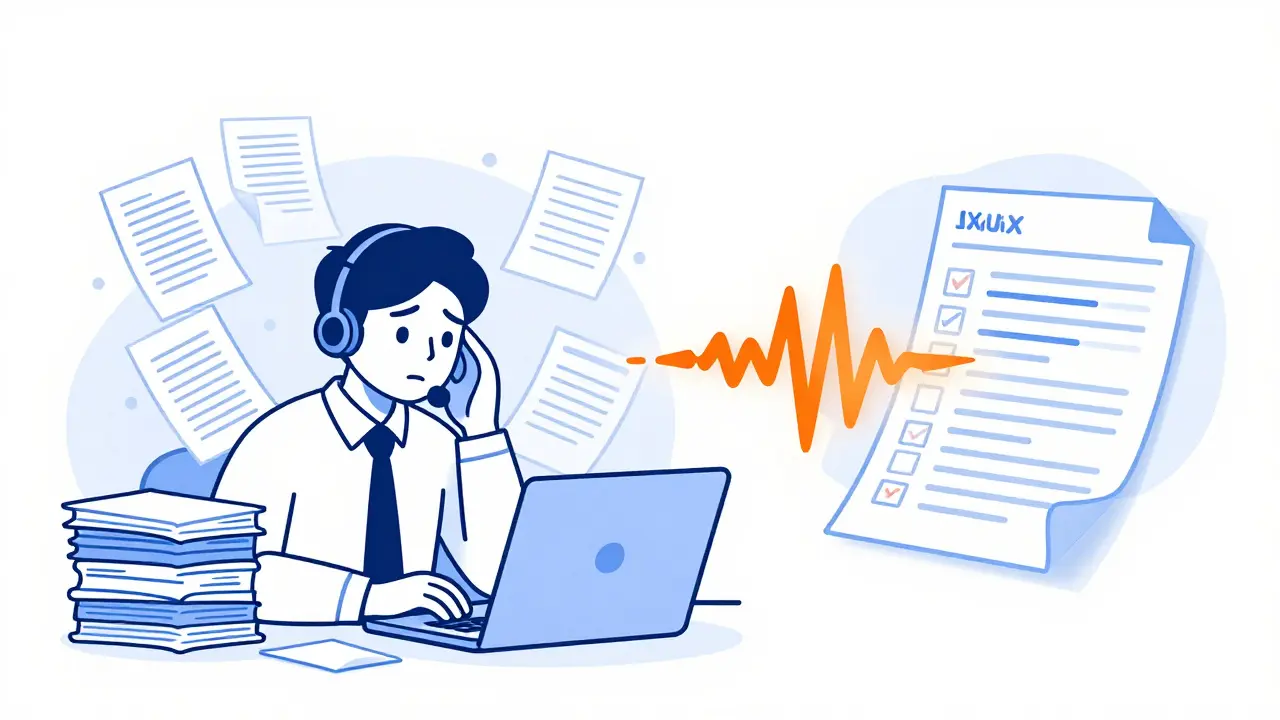
Running a contact center often feels like fighting a tide of paperwork and repetitive tasks. Agents spend a huge chunk of their day not actually talking to customers, but typing up notes after a call ends. Then there is the struggle of getting a customer to the right person on the first try, or trying to guess why a customer is angry based on a brief transcript. This is where Generative AI is a type of artificial intelligence capable of creating new content, such as text and summaries, by understanding complex patterns in data. Unlike old-school chatbots that follow a rigid script, these systems actually interpret intent and adapt in real-time. If you are still relying on manual wrap-ups and basic rule-based routing, you are leaving a massive amount of efficiency on the table.
Stop the Manual Wrap-Up Grind with Automated Summaries
Ask any agent what they hate most about their job, and they will likely tell you it is the post-call documentation. Manually tagging dispositions and typing out what happened during a ten-minute conversation is a productivity killer. Call Summarization is the process where AI listens to a call, transcribes it, and instantly writes a structured summary. Instead of an agent spending three minutes typing notes, the AI does it in seconds.
These summaries aren't just blocks of text; they are structured data. They include the customer's core intent, the resolution provided, and the necessary follow-up steps. Many modern platforms push this data directly into CRM tools like Salesforce or HubSpot. For example, if a customer calls about a billing error, the AI identifies the error code, the amount disputed, and the promised callback date, then slots that information into the correct CRM fields automatically. This doesn't just save time; it removes human error and ensures compliance across thousands of interactions.
Moving Beyond 'Happy' or 'Sad' with Advanced Sentiment Analysis
Traditional sentiment analysis was binary: was the customer happy or angry? That doesn't tell you much when you're trying to improve a business process. Modern Sentiment Analysis powered by generative AI looks at the nuance of emotion. It can distinguish between a customer who is frustrated with a specific product feature and one who is unhappy with the agent's tone.
By analyzing voice inflections and word choices, these systems can pinpoint the exact "turning point" of a call. Did the mood shift when the agent mentioned a policy? Or did it improve when a specific solution was offered? This level of detail turns every single call into a training opportunity. Instead of a manager listening to a random 2% of calls for quality assurance, they can use AI to surface only the calls where sentiment plummeted, allowing for surgical coaching rather than generic feedback.
| Feature | Traditional Rule-Based AI | Generative AI Approach |
|---|---|---|
| Routing | Fixed decision trees (Press 1 for Sales) | Intent-based real-time routing |
| Summaries | Manual agent notes/tags | Automated, structured narratives |
| Sentiment | Positive/Negative/Neutral | Granular emotional nuance & turning points |
| Knowledge Base | Manually written by managers | Auto-generated from call patterns |
Intelligent Routing: Getting the Right Person on the Line
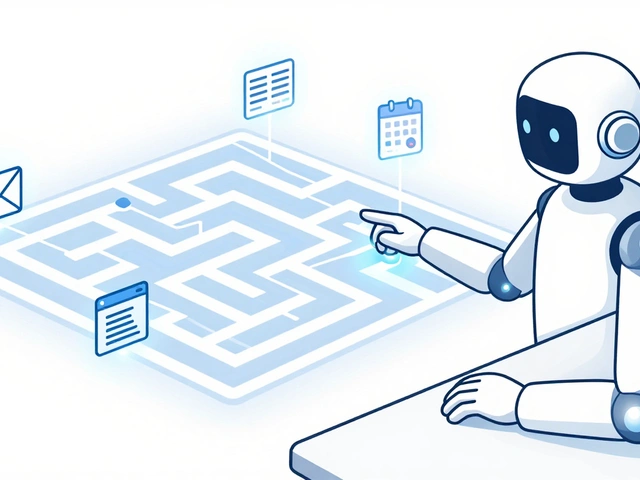
Nothing kills customer satisfaction faster than being transferred three times. Intelligent Routing uses AI to interpret a customer's intent the moment they start speaking or typing. Instead of a clunky menu, the AI analyzes the request and matches it with the agent best equipped to handle that specific problem-based on skill, history with that customer, and current availability.
This doesn't just apply to the start of the call. Generative AI can act as a copilot during the interaction. While the agent is talking, the AI is working in the background, surfacing relevant articles from the knowledge base or suggesting the "next best action." For instance, if a customer mentions they are considering canceling a subscription, the AI can instantly pop up a retention offer that fits that customer's specific usage pattern, allowing the agent to pivot the conversation in real-time.
Scaling Your Knowledge Base Without the Guesswork
Most company knowledge bases are out of date the moment they are published because updating them is a chore. Generative AI changes this by learning from actual conversation patterns. If there is a sudden spike in calls about a new shipping policy, the AI notices the trend, analyzes the successful resolutions from the best agents, and drafts a new knowledge base article automatically.
This transforms the knowledge base from a static library into a living document. A manager simply reviews the AI-generated draft and hits "publish." This ensures that every agent, regardless of how long they've been with the company, has the most current and accurate information. It essentially eliminates the "knowledge gap" between your veteran employees and your new hires, drastically speeding up the onboarding process.
Personalization at Scale: Ending the Era of Canned Responses
We've all received those robotic, template-driven emails that feel like they were written by a machine. Contact Center Optimization relies on moving away from these scripts toward personalized communication. Generative AI can analyze a customer's entire history-their previous complaints, their preferred channel, and their emotional state-to generate a response that sounds human and empathetic.
For a chat or email follow-up, the AI can generate a draft that references a specific detail from the call, such as, "I'm sorry your package was delayed during the storm in Seattle," rather than a generic "We apologize for the inconvenience." The agent still reviews and edits the text to ensure accuracy, but the heavy lifting of tailoring the message is done by the AI. This increases the perceived value of the interaction and boosts customer loyalty.
The Bottom Line: Operational Gains and Revenue
The shift to AI isn't just about making agents' lives easier; it's a financial strategy. By automating routine tasks and improving self-service, companies can handle a much higher volume of inquiries without increasing headcount. When customers can solve their own problems through an intuitive, AI-powered virtual agent, the cost per interaction drops significantly.
Beyond cost savings, there is a clear revenue play. AI-driven analytics can identify patterns that lead to sales conversions or prevent churn. By analyzing thousands of interactions, AI can tell you exactly why people are canceling and suggest the exact offer needed to keep them. In short, it turns the contact center from a cost center into a revenue generator by optimizing every touchpoint for the best possible outcome.
Does Generative AI replace human agents?
No, it evolves their role. AI handles the repetitive "grunt work" like summaries and basic routing, allowing humans to focus on complex, high-emotion, and high-value problems that require genuine empathy and critical thinking.
How does AI-driven routing differ from a standard IVR?
A standard IVR (Interactive Voice Response) uses a rigid tree of options (e.g., "Press 1 for Billing"). AI-driven routing uses natural language processing to understand the customer's actual intent and routes them based on the context of their request and the agent's specific expertise.
Is the data in AI summaries secure and compliant?
Enterprise-grade platforms built specifically for contact centers (like NiCE or Calabrio) implement strict data privacy and compliance guardrails. They often include PII (Personally Identifiable Information) redaction to ensure sensitive customer data isn't stored inappropriately in the AI model.
Can Generative AI really write knowledge base articles?
Yes. The AI identifies recurring questions and themes across thousands of transcripts. It then synthesizes the successful resolutions used by top-performing agents to draft a concise, accurate article for manager approval.
What is the fastest way to see an ROI from these tools?
The quickest win is usually automated call summarization. By eliminating the manual wrap-up time for every single call, you immediately reclaim a significant percentage of your agents' available time, increasing capacity without adding staff.
 Artificial Intelligence
Chris Atkins
April 20, 2026 AT 11:33man those auto summaries are a total lifesaver for the staff
Jen Becker
April 21, 2026 AT 11:52just another way to fire people
Ryan Toporowski
April 21, 2026 AT 16:32This is such a game changer for agent burnout! 🚀 It really lets the team focus on the human side of things while the AI handles the boring stuff. Keep pushing these tools! 🌟👏
Rob D
April 22, 2026 AT 14:16Listen up you clowns because the real world doesn't operate on some sterile cloud server. This tech is absolute gold for any company with some actual backbone left in this country. If you aren't using intent-based routing you're basically operating a lemonade stand in the middle of a hurricane. It's a total slaughterhouse for efficiency if you stick to those prehistoric IVR trees. Get with the program or get left in the dust while the real winners optimize their workflows into a lean mean machine. Only a complete moron would ignore the ROI on automated wrap-ups when the labor costs are skyrocketing. It's high-octane productivity and anyone saying otherwise is just daydreaming. We need this kind of aggressive innovation to keep our edge. Period.
Franklin Hooper
April 23, 2026 AT 11:12one wonders if the authors believe a machine can truly replicate the nuance of human empathy or if they are simply enamored by the efficiency of a well-constructed algorithm
Jess Ciro
April 24, 2026 AT 13:44the data privacy part is a joke they just want your voice prints to train the machines that will eventually replace our entire social structure and track our every move without us even knowing it
saravana kumar
April 25, 2026 AT 16:57It is quite elementary that the integration with CRM tools provides the only tangible value here. The rest is merely marketing fluff meant to entice the technologically illiterate.
Tamil selvan
April 26, 2026 AT 15:46I believe that supporting our agents through this transition is paramount... it is heartening to see the focus on reducing the 'grunt work' for the staff!
Mark Brantner
April 27, 2026 AT 06:11oh yeah because nothing says "empathy" like a bot drafting an email about a storm in seattle lol!! i can't wait for the day the AI glitches and tells a customer their house burned down in a "friendly and personalize way" oops!! absolute genius move right there!!
Kate Tran
April 28, 2026 AT 02:11I reckon some of these tools are a bit overhyped but the routing stuff seems decent enough if it actually works like they say it dose