Imagine trying to understand a sentence where every word is shouted simultaneously. You hear the words, but you have no idea which came first, which modifies which, or how they relate across the distance of a paragraph. That’s what early neural networks faced before Transformers arrived. They were slow, sequential, and prone to forgetting the beginning of a long story by the time they reached the end. Then, in June 2017, a group of researchers from Google Brain published a paper titled "Attention is All You Need," and everything changed. This wasn't just an incremental update; it was a fundamental shift in how machines process language. At the heart of this revolution are two specific mechanisms: self-attention and positional encoding. Without them, tools like ChatGPT, Claude, and Midjourney wouldn't exist in their current form.
You might wonder why these two concepts matter if you're not building your own model from scratch. The answer lies in understanding how AI actually "thinks." It doesn't think like you do. It calculates probabilities based on relationships between tokens (chunks of text). Self-attention allows the model to look at all parts of a sentence at once and decide which parts are important for predicting the next word. Positional encoding solves the problem that attention alone creates: chaos. Because attention looks at everything equally, it loses track of order. "Dog bites man" and "Man bites dog" would look identical to a pure attention mechanism without positional cues. Together, these components enable parallel processing, which makes training massive models feasible, and they provide the structural backbone for modern Generative AI.
The Problem with Sequential Processing
Before Transformers, we relied heavily on Recurrent Neural Networks (RNNs) and Long Short-Term Memory (LSTM) networks. These architectures processed text one word at a time, left to right. Think of it like reading a book with your eyes fixed on a single letter at a time, moving forward strictly sequentially. If you wanted to know what happened on page 5 while reading page 50, you had to rely on the memory passed along from page 49, which relied on page 48, and so on. This chain gets fragile. By the time information reaches the end of a long sequence, it's often diluted or lost entirely. This is known as the vanishing gradient problem.
Moreover, RNNs couldn't be easily parallelized. Since step 2 depends on step 1, you can't compute step 2 until step 1 is finished. This made training on huge datasets incredibly slow. The Transformer architecture broke this dependency chain. It processes all tokens in a sequence simultaneously. This isn't just a speed boost; it's a paradigm shift. The original paper demonstrated that Transformers could train 5.3 times faster than previous state-of-the-art models on translation tasks. This speed allowed researchers to scale up model size and data volume exponentially, leading directly to the era of Large Language Models (LLMs).
How Self-Attention Works
Self-attention is a mechanism that allows a model to weigh the importance of different words in a sequence relative to each other when producing a representation of that word. In simpler terms, it lets the model ask: "Which other words in this sentence help me understand this specific word?"
To do this, the model uses three vectors for every token: Query (Q), Key (K), and Value (V). Imagine you are looking for a specific book in a library. Your search query is Q. Each book has a label or index card that describes its contents, which acts as K. The actual content of the book is V. The model calculates how well your query matches each key. If the match is strong, the value associated with that key gets a higher weight. Mathematically, this is expressed as Attention(Q,K,V) = softmax(QK^T / √d_k)V. The scaling factor √d_k prevents the dot products from becoming too large, which would push the softmax function into regions where gradients are tiny, slowing down learning.
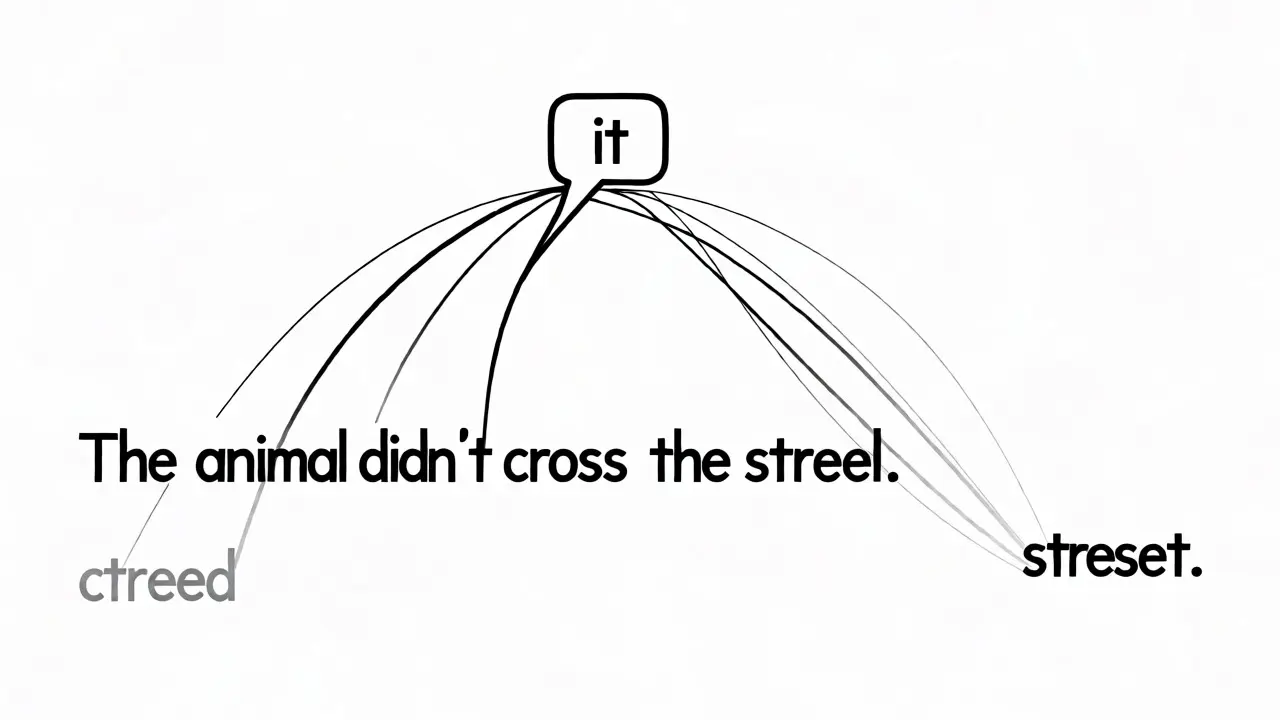
This mechanism captures context beautifully. Take the sentence: "The animal didn't cross the street because it was too tired." When the model processes the word "it," self-attention allows it to look back at "animal" rather than "street" or "crossed." It learns that "it" refers to the subject, not the object. In multi-head attention, the model performs this operation multiple times in parallel with different learned projections. One head might focus on syntactic structure (subject-verb agreement), while another focuses on semantic meaning (entity resolution). This diversity allows the model to capture complex linguistic patterns that a single attention head might miss.
Why Positional Encoding Is Essential
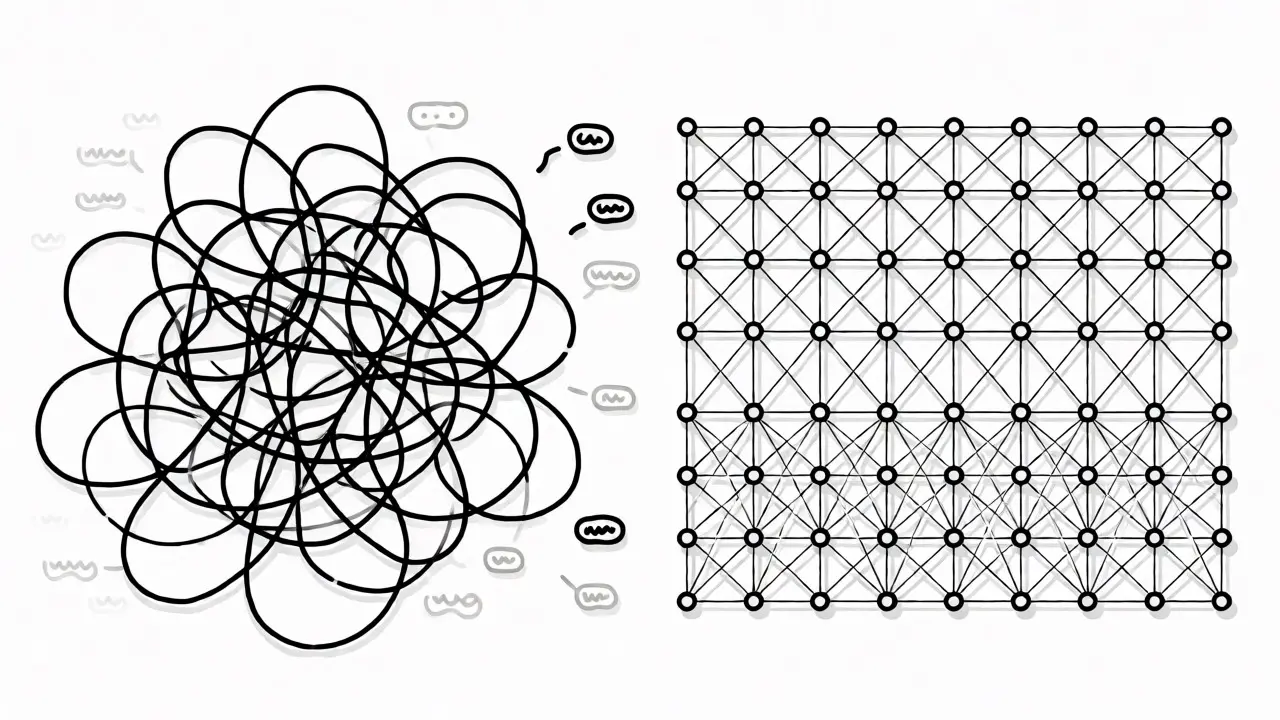
If self-attention is the brain, positional encoding is the clock. As mentioned earlier, self-attention is permutation-invariant. If you shuffle the words in a sentence, the attention scores between pairs of words remain the same, even though the meaning changes completely. To fix this, we inject information about position into the input embeddings.
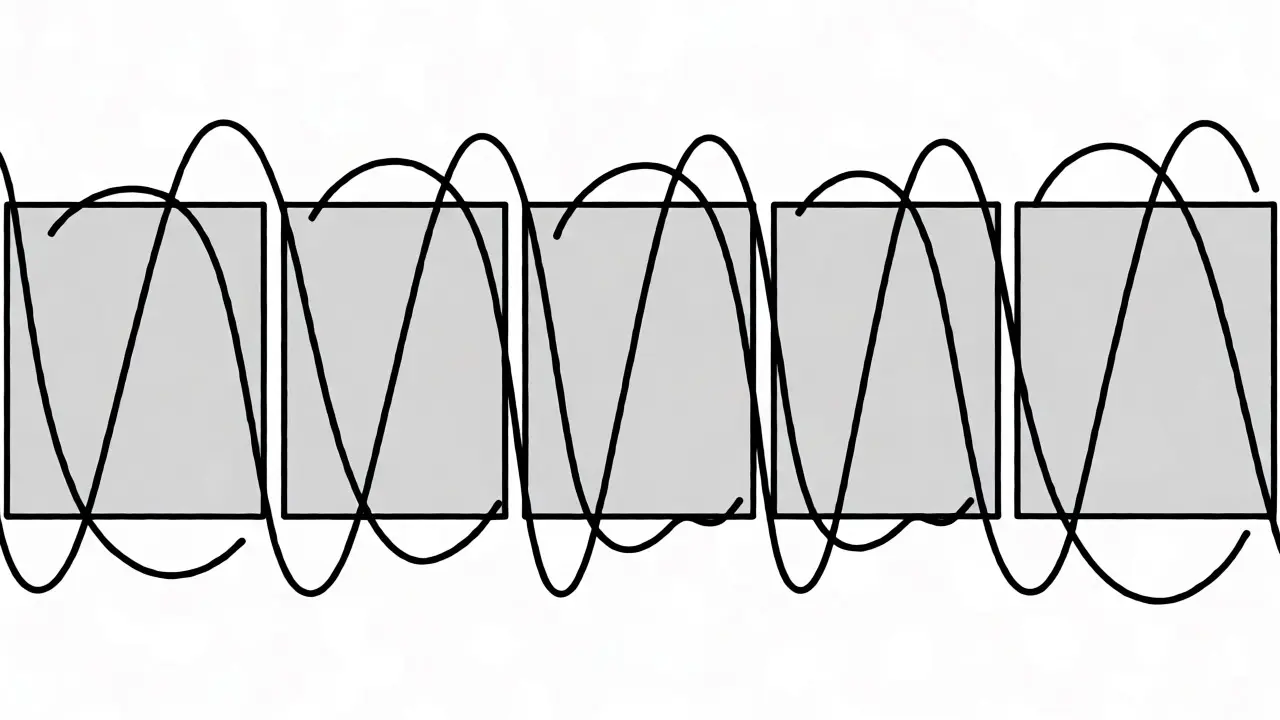
The original implementation used sinusoidal functions. For a given position pos and dimension i, the encoding is calculated using sine and cosine functions with different frequencies. Low-frequency waves change slowly across positions, while high-frequency waves change rapidly. This creates a unique fingerprint for each position. Why use sine and cosine instead of just adding integers 1, 2, 3...? Because sinusoidal encodings allow the model to learn relative positions easily. The difference between position i+δ and i can be represented as a linear transformation of the encoding at i. This mathematical property helps the model generalize better to sequences longer than those seen during training.
| Strategy | Mechanism | Pros | Cons |
|---|---|---|---|
| Sinusoidal | Fixed sine/cosine waves | Extrapolates to unseen lengths; no parameters to learn | Harder to interpret; may struggle with very long contexts |
| Learned Embeddings | Trainable vectors per position | Flexible; can adapt to task-specific patterns | Cannot extrapolate beyond max training length; more parameters |
| Rotary (RoPE) | Rotation matrices applied to Q/K | Better relative position modeling; popular in LLaMA | Complex implementation; computational overhead |
| ALiBi | Linear bias added to attention scores | No extra parameters; good extrapolation | Limited expressiveness compared to full PE |
Modern variants have emerged. BERT uses learned positional embeddings, which work well for shorter sequences but fail when asked to handle texts longer than the maximum length seen during training. GPT-3 initially used learned embeddings but later shifted toward methods that support better extrapolation. Newer approaches like Rotary Position Embedding (RoPE), used in models like LLaMA, apply rotations to the query and key vectors, embedding position information directly into the attention calculation rather than adding it to the input. This tends to improve performance on long-context tasks.
From Architecture to Generative Power
So, how does this translate to generating text? The Transformer decoder uses masked self-attention. When generating the next word, the model shouldn't peek at future words that haven't been generated yet. A triangular mask ensures that each token only attends to itself and previous tokens. This autoregressive property is crucial for generation. You predict word 1, then feed word 1 back in to predict word 2, and so on.
The combination of parallelizable training (thanks to full attention) and sequential inference (thanks to masking) strikes a balance. During training, the model sees the entire correct sequence and learns to predict each next token efficiently. During inference, it generates one token at a time, conditioning on the history. This architecture enabled the creation of models with billions of parameters. GPT-3, with 175 billion parameters, relies entirely on these mechanisms. It achieved state-of-the-art results on benchmarks like GLUE and SuperGLUE, proving that attention-based models could outperform specialized RNNs in almost every NLP task.
The impact extends beyond text. Vision Transformers (ViT) apply the same principles to images, treating pixels or patches as tokens. Multimodal models combine text and image encoders, both leveraging self-attention to align concepts across modalities. The versatility of the Transformer architecture stems from its ability to model dependencies regardless of modality or sequence type, provided there is a way to encode position.
Common Pitfalls and Practical Insights
If you're implementing Transformers yourself, watch out for common mistakes. One frequent issue is improper scaling of attention scores. Forgetting to divide by √d_k can cause the softmax output to become saturated, effectively turning the attention weights into one-hot vectors. This destroys the model's ability to blend information smoothly, leading to poor convergence.
Another challenge is handling long sequences. Standard self-attention has quadratic complexity O(n²), meaning memory usage grows exponentially with sequence length. For a 4,096-token sequence, this can require significant GPU memory. Techniques like FlashAttention optimize memory access patterns to reduce this burden, allowing for longer contexts without proportional increases in hardware costs. Additionally, developers often struggle with masking logic. Incorrectly applying masks in the decoder can leak future information, causing the model to cheat during training and perform poorly during real-world generation.
Positional encoding also requires careful tuning. Adding positional vectors directly to token embeddings can sometimes interfere with semantic information, especially in lower-dimensional spaces. Some research suggests that separating positional and semantic dimensions or using alternative encodings like RoPE can mitigate this interference, improving model stability and accuracy.
Frequently Asked Questions
Why did Transformers replace RNNs?
Transformers replaced RNNs primarily due to parallelization capabilities. RNNs process data sequentially, making them slow to train on large datasets. Transformers process all tokens simultaneously, allowing for much faster training and the ability to scale to billions of parameters. Additionally, Transformers handle long-range dependencies better because attention connects any two points directly, whereas RNNs suffer from vanishing gradients over long distances.
What happens if you remove positional encoding?
Without positional encoding, the model becomes permutation-invariant. This means it cannot distinguish between "Cat sat on mat" and "Mat sat on cat." The model would treat both sentences as having the same set of word relationships, losing critical grammatical and semantic structure. Essentially, grammar and syntax would become impossible to learn accurately.
Is sinusoidal positional encoding still used today?
Yes, sinusoidal encoding is still widely used, particularly in encoder-only models like BERT variants and some vision transformers. However, many modern large language models like LLaMA use Rotary Position Embedding (RoPE) or other learned variants because they offer better performance on long-context tasks and improved extrapolation capabilities.
How does multi-head attention improve performance?
Multi-head attention allows the model to attend to different subspaces of the input simultaneously. Instead of averaging all relationships into one score, separate heads can specialize in different types of dependencies-such as syntactic structures, coreference resolution, or semantic similarity. This diversification enables the model to capture richer and more nuanced patterns in the data.
Can Transformers handle infinite text length?
No, standard Transformers have a limit defined by their positional encoding and memory constraints. While techniques like ALiBi and RoPE improve extrapolation, the quadratic complexity of attention eventually becomes prohibitive. Current research focuses on sparse attention and linear-complexity alternatives to extend effective context windows to hundreds of thousands of tokens.
Next Steps for Understanding Generative AI
Understanding self-attention and positional encoding gives you a solid foundation for grasping how modern AI works. If you want to dive deeper, explore how fine-tuning adapts these pre-trained models to specific tasks. Look into techniques like LoRA (Low-Rank Adaptation) which allow efficient customization of massive Transformers. Also, investigate recent advancements in efficient attention mechanisms, such as FlashAttention and Mamba, which aim to solve the scalability issues inherent in the original design. The field moves fast, but the core principles of attending to relevant context and respecting order remain central to every breakthrough.
 Artificial Intelligence