
You’ve probably noticed that almost every chatbot you talk to today is built on a "decoder-only" model. From OpenAI’s GPT series to Meta’s LLaMA, the industry has swung hard toward this single design. But if decoder-only is so dominant, why do models like Google’s T5 or Facebook’s BART still exist? And more importantly, when should you actually use them?
The answer isn’t just about hype-it’s about math and mechanics. The choice between encoder-decoder and decoder-only architectures dictates how your model understands input, how fast it responds, and what kind of tasks it can handle without breaking a sweat. Getting this wrong means paying for slower inference or settling for hallucinated outputs.
The Core Difference: Two Stages vs. One Flow
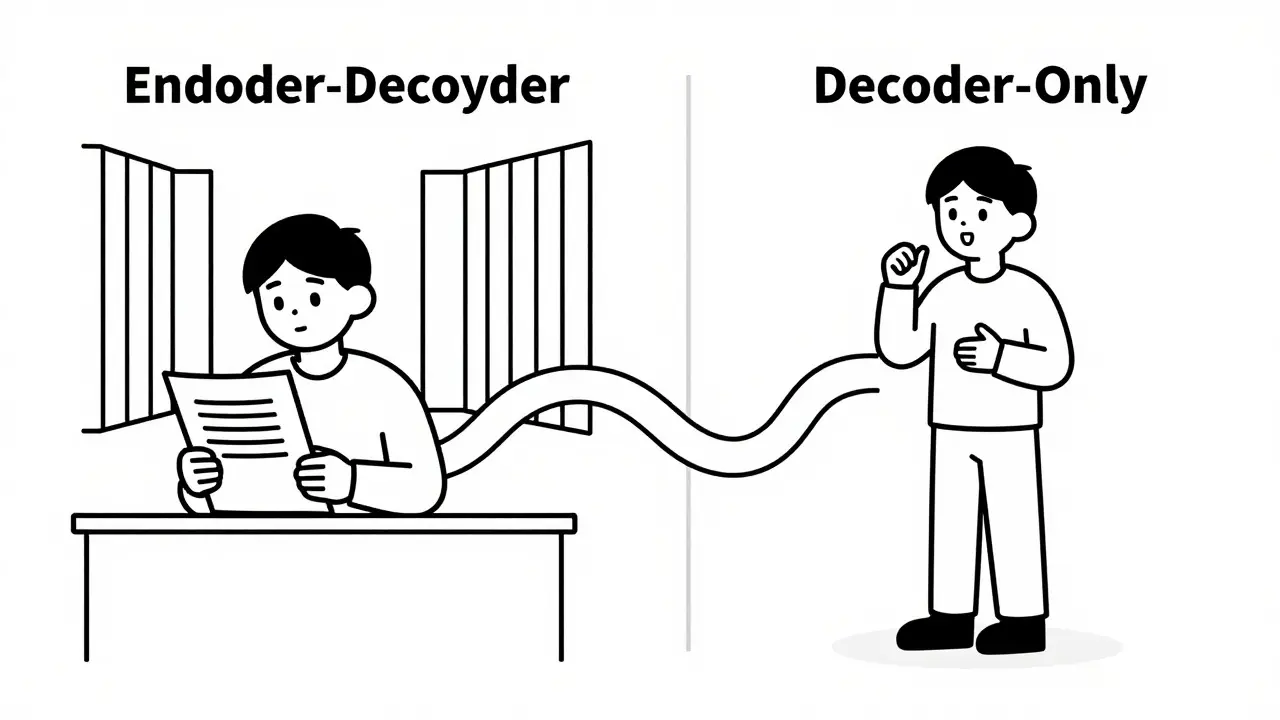
To understand why these two architectures behave so differently, you have to look at how they process information. The original Transformer paper by Vaswani et al. (2017) introduced the encoder-decoder structure as a way to handle sequence-to-sequence tasks. Think of it like a translator sitting in a booth. The encoder reads the entire source sentence first-left to right, right to left, everywhere at once. It builds a complete mental map of the context before saying a word. Then, the decoder takes that map and generates the translation one word at a time, looking back at the encoder’s notes via "cross-attention."
Decoder-only models throw out the booth. They don’t separate understanding from generating. Instead, they treat the input prompt and the output response as one continuous stream. When you type a question into a decoder-only model, it doesn’t "read" it fully before answering. It starts predicting the next token immediately, using masked self-attention to ensure it only looks at what came before. This makes the pipeline simpler but changes the fundamental nature of how the model interacts with data.
| Feature | Encoder-Decoder (e.g., T5, BART) | Decoder-Only (e.g., GPT-4, LLaMA 3) |
|---|---|---|
| Attention Mechanism | Bidirectional (Encoder) + Causal (Decoder) | Causal (Masked) Self-Attention Only |
| Input Processing | Full context understood before generation | Processed autoregressively alongside output |
| Inference Speed | Slower (18-29% longer latency) | Faster (15-22% speed advantage) |
| Memory Usage | Higher (23-37% more memory) | Lower (optimized for streaming) |
| Best For | Translation, Summarization, Structured Data | Chat, Creative Writing, Code Generation |
Why Decoder-Only Dominates the Market
If you walk through any tech conference in 2026, you’ll hear mostly about decoder-only models. There’s a reason for this. As of January 2025, 78% of publicly available large language models on Hugging Face follow the decoder-only pattern. This isn’t an accident; it’s driven by efficiency and ease of use.
First, training dynamics are simpler. With encoder-decoder models, you have to manage the interaction between two distinct components. If the encoder fails to capture a nuance, the decoder has no chance to recover because it relies entirely on the encoder’s compressed representation. Decoder-only models avoid this bottleneck. They learn everything in one go. According to a GitHub analysis by MLflow in November 2024, decoder-only implementations had 27% fewer reported bugs related to training instability compared to their encoder-decoder counterparts.
Second, they fit the modern user interface perfectly. Chat interfaces demand low latency. Users expect tokens to appear on screen instantly. Decoder-only models excel here because they generate text autoregressively without waiting for a full encoding pass. Stanford CRFM’s April 2025 analysis showed that decoder-only models achieve 15-22% faster inference speeds across benchmark tasks. In a commercial setting where milliseconds equal money, that speed advantage is massive.
Finally, few-shot learning works better. You don’t need to fine-tune a decoder-only model extensively to get it to perform new tasks. Just give it a few examples in the prompt, and it adapts. OpenAI’s research demonstrated that decoder-only models achieved 45.2% accuracy on the SuperGLUE benchmark with zero-shot prompting, significantly outperforming encoder-decoder models which scored 32.7%. This reduces the cost of deployment for enterprises that lack labeled datasets.

Where Encoder-Decoder Still Wins
Despite the market shift, encoder-decoder models haven’t disappeared. They hold strong fortresses in specific domains where precision matters more than speed. If your task involves transforming one structured format into another, the encoder-decoder architecture is often superior.
Consider machine translation. The encoder’s bidirectional attention allows it to see the whole sentence before translating. This helps resolve ambiguities that depend on later words. On the WMT14 English-German translation task, Google’s T5-base model achieved a BLEU score of 32.7, while comparable decoder-only models scored 28.4. That gap represents real-world quality differences in professional translation services.
Summarization is another stronghold. When summarizing a long document, you need to understand the entire narrative arc before condensing it. BART-large achieved a ROUGE-L score of 40.5 on the CNN/DailyMail dataset, beating decoder-only alternatives which scored 37.8. The encoder ensures that key points from the beginning and end of the article are weighted equally during the compression phase.
Structured data-to-text tasks also favor encoder-decoders. If you’re converting a database table into natural language sentences, you need precise mapping. Decoder-only models struggle here, showing 12-18% lower accuracy on benchmarks like DART (2024). They tend to hallucinate relationships between columns because they process the input incrementally rather than holistically.
Performance Trade-offs: Speed vs. Accuracy
You can’t have it all. The architectural choices force a trade-off between computational efficiency and contextual depth. Encoder-decoder models require more resources. Benchmarks from MLPerf Inference 3.0 (October 2024) indicate that these models consume 23-37% more memory and take 18-29% longer to infer than decoder-only models with similar parameter counts.
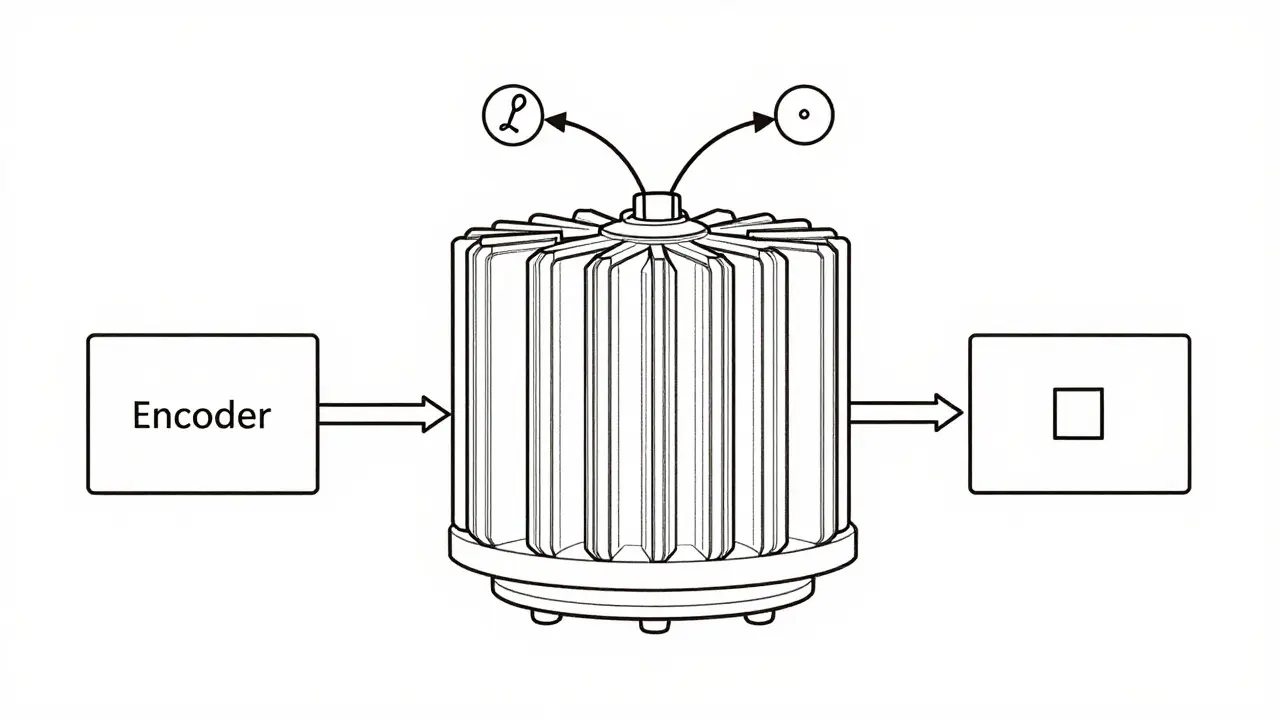
This overhead comes from the dual-stack design. The encoder must process the entire input sequence, storing representations for every token. The decoder then maintains its own state while attending to the encoder’s output. In contrast, decoder-only models only store the current hidden state and the key-value cache for previous tokens. This streamlined approach allows them to scale to massive context windows-modern decoder-only models like GPT-4 Turbo support up to 32,768 tokens, whereas typical encoder-decoder models cap out around 4,096 tokens.
However, this speed comes at a cost to comprehension. Dr. Emily M. Bender from the University of Washington noted in her February 2025 ACM article that decoder-only models’ inability to process input holistically creates limitations for tasks requiring comprehensive understanding. If a critical piece of information appears late in a long prompt, a decoder-only model might miss its significance until it’s too late to adjust earlier generated tokens.
Implementation Challenges for Developers
Choosing an architecture affects your development workflow. Encoder-decoder models have a steeper learning curve. A 2024 O'Reilly Media survey found that developers took 35% longer to onboard with encoder-decoder systems due to the complexity of managing two distinct components. Fine-tuning typically requires 2-3 weeks for domain-specific applications, according to NVIDIA’s 2024 LLM Deployment Guide.
Community support also skews toward decoder-only models. Stack Overflow’s 2025 Developer Survey showed higher satisfaction scores for decoder-only models regarding ease of fine-tuning (4.2/5.0) compared to encoder-decoder models (3.8/5.0). Additionally, cloud providers optimize their infrastructure for the dominant architecture. AWS SageMaker’s 2025 update highlighted 47% faster deployment times for decoder-only models.
Yet, when accuracy is non-negotiable, developers accept the pain. Reddit discussions in r/MachineLearning reveal that 78% of practitioners using encoder-decoder models cite "higher memory requirements" as their primary pain point, but they stay because decoder-only models offer "less precise control over output structure." For legal document analysis or medical record summarization, that control is worth the extra compute cost.
The Future: Hybrid Approaches and Specialization
We aren’t seeing a total extinction of encoder-decoder models. Instead, we’re witnessing specialization. The market is splitting based on use case. General-purpose assistants will remain decoder-only due to cost and speed constraints. But specialized enterprise applications are driving a resurgence in encoder-decoder designs.
Hybrid architectures are emerging as a middle ground. Microsoft’s Orca 3 (February 2025) combines a small encoder module with a decoder-only backbone, attempting to capture the best of both worlds. Researchers predict that such hybrids will dominate future innovations, addressing the fundamental trade-off between comprehensive input understanding and generation efficiency.
For now, the rule of thumb is simple: if you’re building a chatbot, creative writer, or code generator, stick with decoder-only. If you’re building a translator, summarizer, or structured data converter, invest in encoder-decoder. The technology isn’t going away; it’s just finding its niche.
Which transformer architecture is better for chatbots?
Decoder-only architectures are generally better for chatbots. They offer faster inference speeds, lower memory usage, and superior few-shot learning capabilities, which are critical for interactive, conversational AI. Models like GPT-4 and LLaMA 3 exemplify this strength.
Why are encoder-decoder models slower?
Encoder-decoder models are slower because they process the entire input sequence through an encoder before the decoder begins generating output. This two-stage process requires more memory (23-37% more) and computational steps, leading to higher latency compared to the single-stream processing of decoder-only models.
Can decoder-only models perform machine translation?
Yes, but they often underperform encoder-decoder models in this specific task. While decoder-only models can translate, they lack the bidirectional context understanding of encoders, resulting in lower BLEU scores. For example, T5-base outperformed comparable decoder-only models on WMT14 benchmarks.
What is the maximum context length for each architecture?
Modern decoder-only models support much larger context windows, often up to 32,768 tokens or more. Encoder-decoder models typically have shorter limits, averaging around 4,096 tokens, due to the quadratic memory complexity of processing full sequences in the encoder.
Are hybrid transformer models available?
Yes, hybrid models are emerging. Examples include Microsoft's Orca 3, which integrates a small encoder module with a decoder-only backbone. These aim to balance the comprehensive input understanding of encoders with the generation efficiency of decoders.
 Artificial Intelligence




om gman
July 19, 2026 AT 04:40oh look another article telling us what we already know because clearly the masses need handholding to understand basic architecture choices lol. you think we didnt notice that decoder-only is faster? shocking news indeed. i bet you spent weeks writing this just to say 'use the right tool for the job' which is about as profound as saying water is wet. typical tech bro content farm stuff. no depth no nuance just regurgitated benchmarks from three months ago like its some groundbreaking discovery
Oskar Falkenberg
July 20, 2026 AT 00:26hey there! i totally agree with a lot of what you said here and it really helps to see the breakdown like this especially for people who are new to all this stuff. i have been working on a small project where i tried using an encoder-decoder model for summarizing long articles but honestly it was so slow compared to just throwing it at a decoder-only model. the latency was killing my user experience even though the quality was slightly better in terms of capturing the whole context. do you think hybrid models will become the standard soon or are they still too experimental for production environments?
Bineesh Mathew
July 21, 2026 AT 14:19the human mind operates in a similar dual process manner with system one and system two thinking much like these architectures. when we rush to judgment we act like decoder only models predicting the next token without true comprehension. but when we pause and reflect we engage our internal encoder processing the full context before responding. perhaps the obsession with speed in ai mirrors our societal decay into instant gratification where depth is sacrificed for velocity. we lose the soul of understanding in the pursuit of efficiency. is this not a moral failing of our digital age
Jeanne Abrahams
July 23, 2026 AT 10:48right back at you with the sarcasm darling. but seriously in south africa we deal with load shedding so inference speed matters less than power consumption sometimes. if your model eats more memory and takes longer to run it might literally shut down while generating. we prefer models that are lean and mean otherwise we are just staring at a black screen wondering if the grid has come back on yet. your western perspective on latency is cute but irrelevant when the lights go out.
Caitlin Donehue
July 24, 2026 AT 03:04i noticed that the table mentions memory usage differences but i wonder how that scales with larger context windows. does the quadratic complexity of the encoder really hit a wall at 4k tokens or is that just a current limitation of specific implementations like t5 base. i feel like with better optimization techniques we might be able to push those limits further without sacrificing too much performance. just curious about the underlying mechanics rather than just the benchmarks.
Stephanie Frank
July 24, 2026 AT 23:57another day another generic comparison piece that ignores the real issue which is data poisoning and bias. you can have the best architecture in the world but if your training data is garbage you get garbage out. decoder only models are just hallucinating faster now. stop pretending that speed equals intelligence. it doesnt. its just efficient delusion. the industry is sleepwalking into a crisis because everyone is chasing lower latency instead of higher truthfulness. pathetic.
Marissa Haque
July 26, 2026 AT 09:33OMG this is such a great explanation!!! i have been struggling with choosing between bart and llama for my thesis project and this really clarifies things for me. the part about cross attention vs masked self attention was super helpful. i never realized that the encoder builds a complete mental map first. that makes so much sense why translation works better with encoder-decoder. thank you so much for breaking it down!! 🙌✨
Keith Barker
July 26, 2026 AT 22:04architecture is just a vessel for intent. the code does not care if it is fast or slow it simply executes. we impose meaning upon the structure. the distinction between encoder and decoder is artificial in the grand scheme of information theory. both are merely patterns seeking equilibrium. do not let the benchmarks blind you to the essence of computation. simplicity is truth complexity is noise.
Lisa Puster
July 27, 2026 AT 23:45typical american tech blog ignoring the reality of global infrastructure disparities. while you sit in your climate controlled server farms worrying about milliseconds we are dealing with bandwidth throttling and censorship. your precious decoder only models are useless if the internet is blocked anyway. focus on robustness not speed. elitist nonsense as usual. keep your shiny toys and your microsecond optimizations. we will manage with what we have.