

Most organizations think they know how to budget for software. They don't. When you move from traditional applications to Large Language Model Programs is a specialized financial planning and cost prediction methodology required for implementing, maintaining, and scaling LLM initiatives within organizations, the old rules stop working. You aren't just paying for server time anymore; you are paying for tokens, compute intensity, and unpredictable user behavior.
In 2025, AI workloads jumped to account for 15-25% of enterprise cloud spending, up from less than 5% just a few years prior (Gartner, 2025). If you try to use standard cloud cost management tools, you will likely face a 47% error rate in your predictions. That means if you plan for $100,000, you might actually spend $147,000-or worse. The goal here is not just to track spending but to build a forecast that survives the volatility of model training and inference spikes.
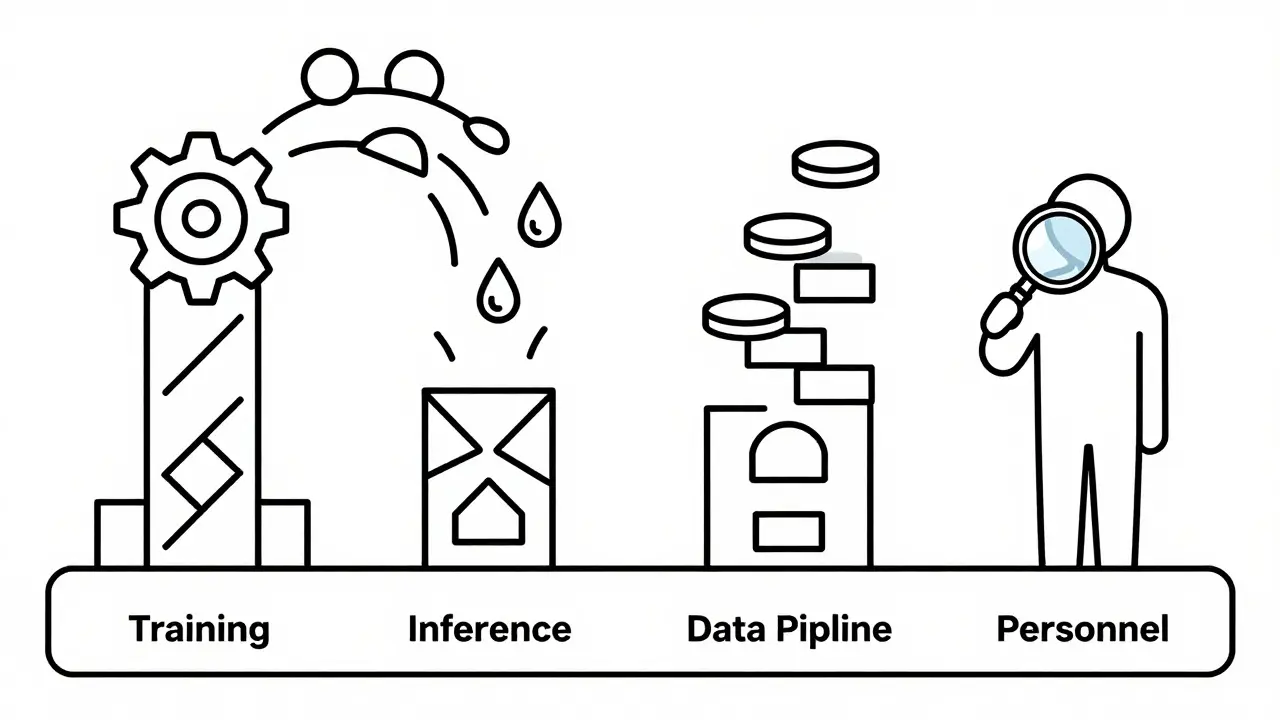
The Four Pillars of LLM Costs
To forecast accurately, you must break down your budget into four distinct components. Ignoring any one of these leads to the kind of overruns that have plagued early adopters.
- Training Expenses: This is the upfront heavy lifting. For medium-sized models (7-13 billion parameters), a single training cycle on AWS p4d.24xlarge instances can cost between $185,000 and $350,000. Larger models easily exceed $2.1 million per run. These are capital-intensive events that happen periodically, not continuously.
- Inference Costs: This is where most budgets bleed out. Inference is what happens when users ask questions. Costs vary wildly, from $0.0001 to $0.01 per token depending on optimization. Unoptimized inference can consume 40-60% of your total AI budget. With proper optimization, you can drop this to 15-25% (FinOps Foundation, 2025).
- Data Pipeline Expenditures: Garbage in, garbage out, but clean data is expensive. In the finance sector, high-quality data preparation consumes 22-35% of the total project budget (Daloopa, 2025). This includes cleaning, structuring, and securing proprietary information before it ever touches the model.
- Personnel Resources: You need experts who understand both finance and AI mechanics. Successful implementations require dedicated FinOps personnel with AI specialization, as noted by the FinOps Foundation in 2025.
Infrastructure plays a huge role here too. NVIDIA A100 GPUs cost $1.03/hour on AWS compared to $0.95/hour for standard compute. It sounds like a small difference, but over months of extended training, those cents add up to tens of thousands of dollars.
Why Traditional Tools Fail at AI Forecasting
You cannot use the same spreadsheet or dashboard you used for your legacy ERP system. Gartner reported in 2025 that traditional cloud cost management (CCM) tools fail to accurately forecast LLM expenses due to their inability to handle variable token consumption and usage spikes.
| Feature | Traditional Cloud Cost Management | Specialized LLM Frameworks |
|---|---|---|
| Prediction Accuracy | 53% (Cast AI, 2025) | 89% (Cast AI, 2025) |
| Error Rate | 47% (Gartner, 2025) | ~11% |
| Setup Time | 2-4 weeks | 8-12 weeks |
| Token Modeling | No | Yes |
| ERP Integration | High (Standard) | Low (Only 35% seamless) |
The trade-off is clear. Specialized frameworks like those from Cast AI offer significantly higher accuracy because they model variable token consumption and account for model drift. However, they take longer to set up (8-12 weeks vs. 2-4 weeks) and often struggle to integrate with existing Enterprise Resource Planning (ERP) systems. Only 35% of organizations report seamless integration between LLM budgeting tools and their financial planning systems (Jedox, 2025).
Phased Budgeting: The Contingency Strategy
One size does not fit all when it comes to LLM maturity. Sarah Wang, VP of AI Strategy at Coherent Solutions, advises breaking your budget into three distinct phases with varying contingency levels (Coherent Solutions, March 2025).
- Experimental Phase (3-6 months): Expect chaos. Allocate a 50-70% contingency. You are testing models, refining prompts, and discovering hidden data needs. Costs fluctuate by 300-500% during this stage before stabilizing (FinOps Foundation, 2025).
- Production Pilot (6-12 months): Things start to stabilize. Reduce contingency to 25-40%. You are now optimizing inference and setting up monitoring.
- Mature Deployment (12+ months): Operational efficiency kicks in. Contingency drops to 10-20%. Focus shifts to scaling and cost reduction through caching and quantization.
Dr. Michael Chen from the CFA Institute adds another layer: Reinforcement Learning from Human Feedback (RLHF) requires an additional 20-35% budget allocation. This isn't optional if you want accurate, safe outputs. It demands specialized expertise and significant computational resources (CFA Institute, 2024).

Avoiding the Inference Trap
The biggest surprise for most finance teams is inference cost volatility. On Reddit's r/FinOps community, a thread with 147 upvotes detailed a financial services company that experienced a 427% cost overrun in its first deployment. Why? They budgeted based on average usage but ignored month-end closing spikes when 200+ analysts queried the model simultaneously (u/CloudCostWatcher, January 2025).
This is a common pitfall. Most organizations underestimate inference costs by 200-300% because they fail to account for cold-start latency and caching requirements (Jedox AI Budgeting Survey, 2025). To mitigate this, implement usage tiering. Cast AI documented that organizations using tiered access (basic, standard, premium) reduced unexpected costs by 45%.
Also, do not neglect model monitoring. The FinOps Foundation recommends allocating 15-20% of your total LLM budget to model monitoring and drift detection. If you ignore drift, operational costs can increase by 30-50% within six months as the model degrades and requires more frequent retraining.
Implementation Roadmap for Finance Teams
Getting started requires a shift in skills. Finance teams typically need 4-6 weeks of specialized training to effectively forecast LLM costs (FinOps Foundation certification program). Here is how to begin:
- Establish Baseline Metrics: Determine your average tokens per query (150-500 in financial apps), queries per user (15-30 daily for analysts), and model refresh frequency (monthly for financial applications).
- Adopt Tiered Access: Restrict high-cost model access to power users while routing general queries to smaller, cheaper models.
- Integrate Monitoring Early: Set up alerts for usage spikes. Do not wait for the bill to arrive.
- Hire or Train FinOps Specialists: 85% of successful implementations require dedicated personnel with AI specialization (FinOps Foundation, 2025).
The market for these solutions is growing fast. The global market for AI cost management tools reached $1.2 billion in 2025, growing at 38% annually (Gartner, 2025). Financial services lead adoption at 68%, followed by healthcare at 52%. If you are in a smaller organization (<500 employees), you may lag behind at 28% adoption due to resource constraints, but the pressure to adopt is increasing as regulatory bodies like the SEC begin requiring disclosure of AI infrastructure costs (SEC, 2025).
How much does it cost to train a medium-sized LLM?
Training a medium-sized LLM (7-13 billion parameters) typically costs between $185,000 and $350,000 per cycle using AWS p4d.24xlarge instances. Larger models can exceed $2.1 million per training run.
Why do traditional cloud budgeting tools fail for AI?
Traditional tools lack the ability to model variable token consumption and sudden usage spikes. Gartner reports a 47% error rate in predictions when using general cloud cost tools for LLM workloads, compared to 89% accuracy with specialized AI frameworks.
What percentage of the budget should go to data preparation?
In sectors like finance, high-quality data preparation consumes 22-35% of the total LLM project budget. This includes cleaning, structuring, and securing data before it is used for training or inference.
How can I reduce inference costs?
Implement usage tiering to restrict expensive model access, optimize for caching to handle cold-start latency, and allocate 15-20% of your budget to monitoring for model drift. Proper optimization can reduce inference costs from 40-60% of the budget down to 15-25%.
Is RLHF worth the extra budget?
Yes, if accuracy and safety are critical. Dr. Michael Chen notes that RLHF requires an additional 20-35% budget allocation due to the specialized expertise and computational resources needed. Skipping it can lead to unreliable outputs and higher long-term correction costs.
 Artificial Intelligence



Mark Tipton
May 30, 2026 AT 15:01Let's be real for a second. This whole 'budgeting' narrative is just corporate theater designed to keep the AI industrial complex fed and watered. They want you to believe that $350k training runs are 'necessary' when, in reality, it's a massive waste of capital driven by hype cycles and venture capital greed. I've seen these numbers before. It's not about efficiency; it's about creating artificial scarcity around compute power so NVIDIA can keep their stock prices inflated while we burn through our budgets on tokens that generate hallucinations. The '47% error rate' isn't a bug; it's a feature. If they could predict it perfectly, the margins wouldn't be as juicy for the cloud providers. Stop buying into this specialized financial planning methodology nonsense. It's a trap. You're paying for the privilege of being wrong.
Adithya M
May 30, 2026 AT 23:30You are completely missing the point here and frankly your attitude is unhelpful. The data from Gartner and Cast AI is empirical, not theoretical. We are talking about enterprise-scale deployments where precision matters. Ignoring token-based pricing models is negligent.
I have worked with several mid-sized firms transitioning to LLMs, and the inference costs alone can derail a Q4 budget if not monitored. The article correctly identifies that traditional ERP systems lack the granularity for variable consumption. It is not about 'greed'; it is about mathematical reality. If you do not allocate for cold-start latency and caching requirements, you will face the exact 427% overrun mentioned in the post. Please read the section on tiered access again. It is a proven mitigation strategy, not a conspiracy.
Jessica McGirt
May 31, 2026 AT 02:26I appreciate the detailed breakdown provided in the original post, but I find the tone of this thread quite divisive. While Mark raises concerns about cost inflation, Adithya is correct that the technical realities of LLM deployment require new financial frameworks.
The distinction between training expenses and inference costs is crucial for any finance team to understand. Training is a capital event, whereas inference is an operational expense that scales with user behavior. This fundamental shift means that legacy budgeting tools are indeed obsolete. I encourage everyone to focus on the actionable advice regarding phased budgeting. The experimental phase contingency of 50-70% seems high, but given the volatility described, it is a prudent safeguard against unexpected spikes during model refinement.
Donald Sullivan
June 1, 2026 AT 11:08Look, nobody likes spending money they didn't plan for, but acting like this is some grand conspiracy is ridiculous. You either budget for it or you don't, and then you get fired. Simple as that. The article says inference costs bleed out because people don't optimize. That's on you, not the cloud provider. If your analysts are hammering the API at month-end without caching, that's a process failure, not a plot against you. Stop whining about the price of GPUs and start optimizing your prompts. Quantization exists for a reason. Use it.
Tina van Schelt
June 2, 2026 AT 10:33Oh, honey, please. You sound like a grumpy old server rack. Just because something is expensive doesn't mean it's a conspiracy, and just because you can optimize doesn't mean you should ignore the human element.
Let's talk about the 'Personnel Resources' part. You need people who actually understand both finance and AI. That's rare! It's like finding a unicorn that also does taxes. The article mentions hiring FinOps specialists, and honestly, good luck finding one who isn't charging a premium for their expertise. But hey, maybe if we all stopped arguing about whether the sky is falling and started building better data pipelines, we'd save ourselves some headaches. Clean data is expensive, yes, but garbage in is even more costly in terms of time and sanity. Let's not forget that.
Ronak Khandelwal
June 3, 2026 AT 23:16This discussion highlights the tension between skepticism and adaptation in our rapidly evolving digital landscape 🌐. While the financial implications are daunting, viewing them through a lens of strategic opportunity rather than mere expense can transform the narrative.
The concept of 'Phased Budgeting' resonates deeply with me as a mentor to emerging tech leaders. It mirrors the philosophical journey of mastery: beginning with chaos (Experimental Phase), moving through structure (Production Pilot), and achieving flow (Mature Deployment). Each stage requires a different mindset and resource allocation.
Moreover, the emphasis on RLHF (Reinforcement Learning from Human Feedback) reminds us that technology is not autonomous; it is a reflection of human values and corrections. Investing in this feedback loop is not just a financial decision but an ethical imperative. Let us embrace the complexity with open minds and collaborative spirits 🤝✨. The future belongs to those who can navigate uncertainty with grace and precision.