Have you ever wondered how an AI can finish your sentence or write a coherent paragraph in seconds? It isn't magic, and it isn't just pattern matching in the way older programs worked. It is all down to a specific design called the Transformer. This architecture is the engine behind every major Large Language Model (LLM) you have heard of recently. Without it, we would still be stuck with clunky chatbots that couldn't understand context.
The Transformer changed everything because it solved a massive problem in computer science: how to process long sequences of data efficiently. Before 2017, models read text one word at a time, from left to right. If a sentence was long, the model often forgot the beginning by the time it reached the end. The Transformer fixes this by reading the whole sentence at once. It looks at every word in relation to every other word simultaneously. This allows it to capture complex meanings, nuances, and long-range connections that older architectures missed entirely.
The Core Components of the Architecture
To understand how a Transformer works, you need to look at its building blocks. It is not a single black box but a pipeline of mathematical operations. Think of it like a factory line where raw materials (text) go in, get processed through various stations, and come out as finished products (predictions).
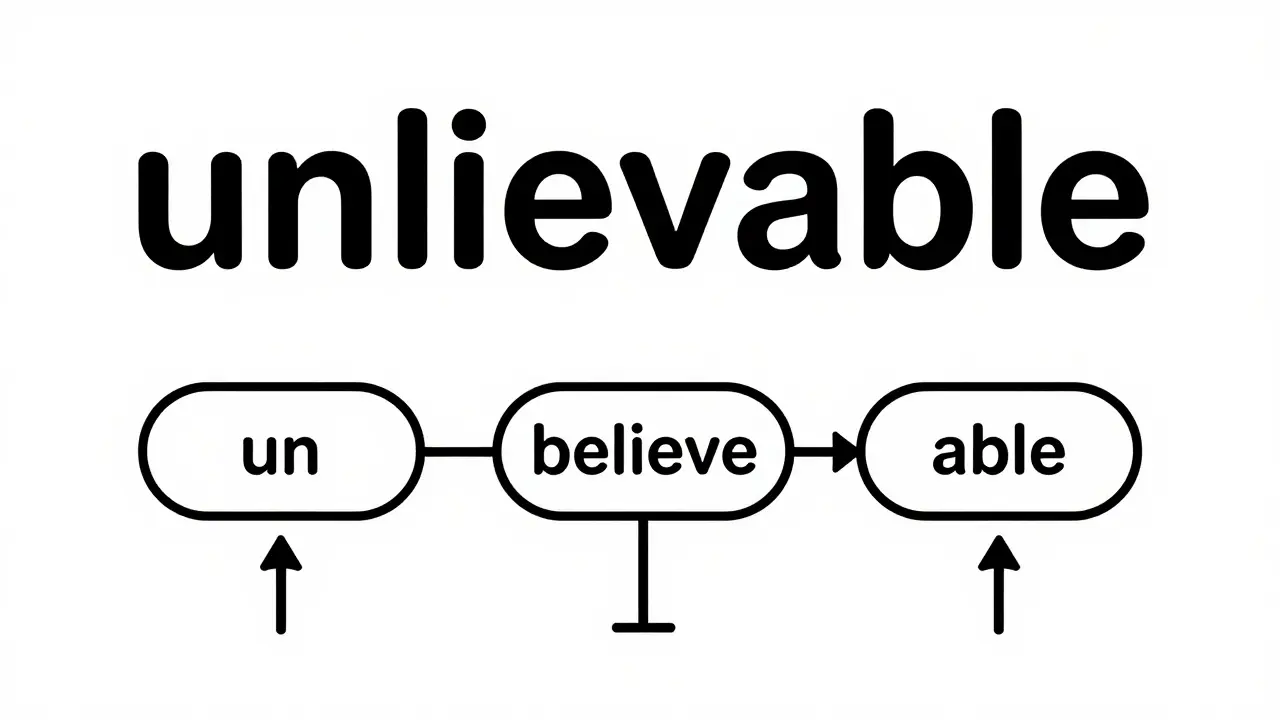
The process starts with TokenizationThe process of breaking text into smaller units called tokens. You might think a token is a word, but it is often smaller. A tokenizer splits sentences into subwords. For example, the word "unbelievable" might be split into "un", "believe", and "able". This helps the model handle rare words by combining common pieces. Once tokenized, these units are converted into numbers. This step is crucial because computers cannot process letters; they only understand vectors-lists of numbers.
These vectors live in an embedding space. In this high-dimensional geometry, words with similar meanings sit close together. "King" and "Queen" will have vector representations that are mathematically near each other. The model learns these positions during training on massive datasets. But position in the sentence matters too. To fix this, the model adds Positional EncodingA method to inject information about the order of tokens into the embeddings. Since the Transformer processes all tokens in parallel, it has no inherent sense of sequence. Positional encoding gives each token a unique signature based on where it appears in the input, ensuring the model knows that "Dog bites man" is different from "Man bites dog".
How Self-Attention Works
The heart of the Transformer is the Self-Attention MechanismA mechanism that allows the model to weigh the importance of different parts of the input relative to each other. This is where the magic happens. When the model reads a sentence, it doesn't just look at the current word. It calculates a relationship score between the current word and every other word in the sequence.
Imagine you are reading the sentence: "The animal didn't cross the street because it was too tired." What does "it" refer to? A human instantly knows "it" refers to "the animal," not "the street." An older Recurrent Neural Network (RNN) might struggle here if the sentence were longer. The Transformer solves this using three vectors for every token: Query, Key, and Value.
- Query: What is this token looking for?
- Key: What does this token contain?
- Value: What information should be passed along if there is a match?
The model takes the Query of one word and compares it against the Keys of all other words. If the Query matches a Key, the attention score goes up. The model then uses this score to weight the Values. So, when processing "it," the Query strongly matches the Key of "animal." The Value associated with "animal" flows into the representation of "it." This allows the model to resolve pronouns and maintain context over long distances effortlessly.
But it doesn't stop at one comparison. The model uses Multi-Head AttentionA technique that runs multiple attention mechanisms in parallel to capture different types of relationships. Instead of doing this calculation once, it does it multiple times in parallel-often 12 or more heads. One head might focus on grammatical structure, another on semantic meaning, and another on syntactic dependencies. These results are concatenated and linearly transformed. This multi-perspective approach makes the model incredibly robust at understanding language.
The Role of MLP Layers and Residual Connections
After the attention layer figures out the relationships, the data moves to the Multi-Layer Perceptron (MLP)A feed-forward neural network that processes each token independently to refine its representation. While attention handles the interaction between tokens, the MLP refines each token individually. It acts as a feature extractor.
The MLP typically expands the dimensionality of the data before compressing it back down. For instance, in a model like GPT-2, the input might be 768 dimensions. The MLP expands this to 3,072 dimensions. Why? Because expanding the space allows the model to find more complex, non-linear patterns that weren't visible in the lower-dimensional space. Then, it projects it back to 768. This expansion and contraction help the model learn intricate linguistic rules without losing the core information.
You might wonder why these layers don't collapse under their own weight. Deep networks often suffer from the vanishing gradient problem, where updates to early layers become negligible during training. The Transformer avoids this using Residual ConnectionsShortcuts that add the input of a layer directly to its output, preserving information flow. Mathematically, this is expressed as $y = F(x) + x$. The original input $x$ is added to the output of the function $F(x)$. This ensures that even if the layer learns nothing useful, the information still passes through unchanged. It stabilizes training and allows models to stack dozens or hundreds of layers deep.
Another critical component is Layer Normalization. Early Transformers used post-normalization, which was unstable and required careful tuning. Modern models use pre-normalization, applying normalization before the attention and MLP layers. This simple change made training significantly faster and more stable, removing the need for complex learning rate warm-up schedules.
Encoder vs. Decoder Architectures
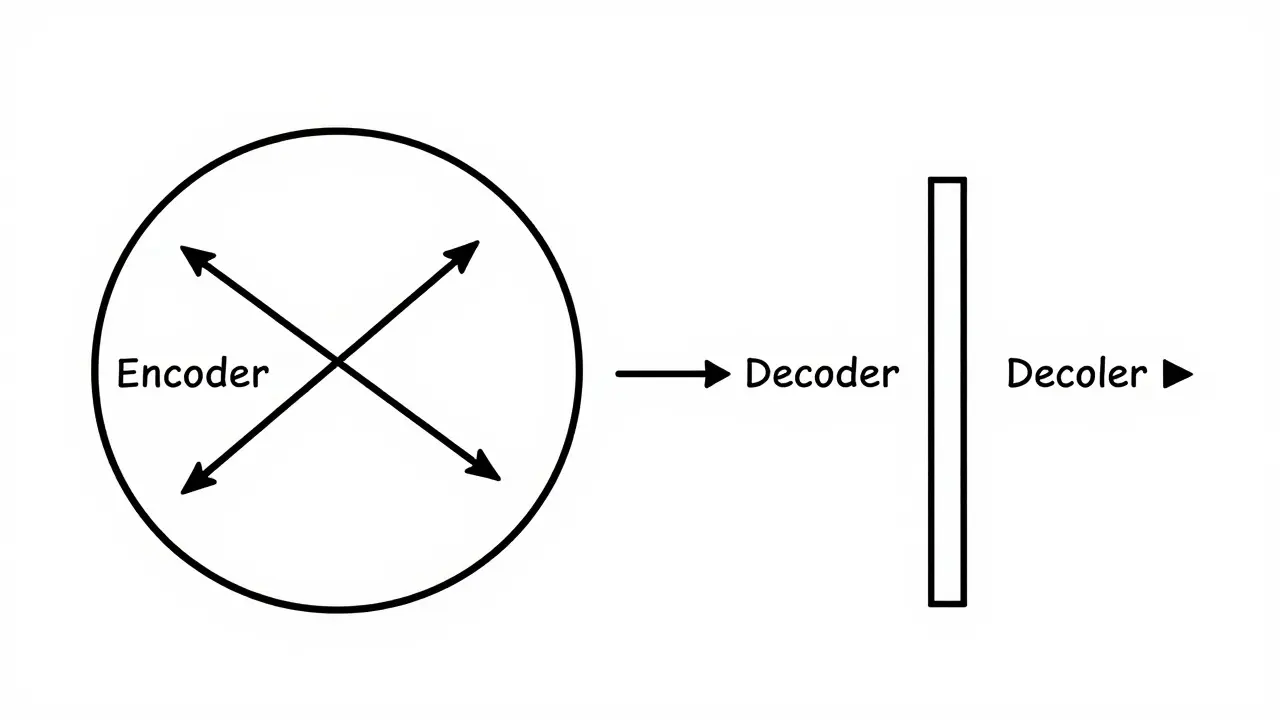
Not all Transformers are built the same. There are two main variants: Encoder-only and Decoder-only models. Understanding the difference is key to knowing what a model can do.
| Feature | Encoder-Only | Decoder-Only |
|---|---|---|
| Primary Use Case | Text Classification, Embeddings | Text Generation, Chatbots |
| Attention Scope | Bidirectional (sees past and future) | Causal (sees only past) |
| Example Models | BERT, RoBERTa | GPT-4, Llama 3 |
| Output Type | Fixed-size vector or classification label | Sequence of tokens |
Encoder-only models, like BERT, are great at understanding. They look at the entire context of a sentence, including words that come after the target word. This makes them excellent for tasks like sentiment analysis or extracting entities from text. However, they cannot generate text sequentially because they rely on future context.
Decoder-only models, like the ones powering modern chat assistants, are designed for generation. They use a causal mask. This means when predicting the next word, the model is blind to any words that come after it. It can only look at what has already been generated. This prevents cheating during training and ensures that during inference, the model generates text one token at a time, autoregressively. This is why you see text appear word-by-word when chatting with an LLM.
Training and Inference Dynamics
Building the architecture is only half the battle. Training a Transformer is computationally expensive. It requires vast amounts of data and significant hardware resources. During training, the model predicts the next token in a sequence millions of times. Each time it makes a mistake, it calculates the loss and adjusts its weights via backpropagation.
The weights are adjusted incrementally. Over billions of examples, these small adjustments accumulate. The model learns statistical regularities of language. It doesn't memorize facts in a database sense; it learns probabilities. If it sees "The sky is..." followed by "blue" thousands of times, the probability distribution for "blue" becomes very high given that prefix.
During inference, the process changes slightly. The model takes your prompt, encodes it, and then enters a loop. It predicts the next token, adds that token to the input, and predicts the one after that. This continues until it hits a stop token or reaches a maximum length limit. Techniques like temperature sampling allow you to control creativity. Low temperature makes the model deterministic and safe; high temperature makes it more random and creative.
Why Transformers Dominated AI
The shift to Transformers wasn't just incremental; it was revolutionary. Previous architectures like RNNs and LSTMs struggled with parallelization. Because they processed data sequentially, you couldn't easily train them on multiple GPUs at once. Transformers, by processing all tokens in parallel, scaled beautifully with hardware advancements.
This scalability led to the emergence of Foundation Models. By scaling up parameters and data, researchers discovered emergent abilities. Models started showing skills they weren't explicitly trained for, such as basic reasoning or code generation. The Transformer's ability to capture long-range dependencies and its efficient training profile made it the perfect candidate for this scale-up.
Today, the Transformer is the standard. Whether you are building a translation tool, a coding assistant, or a creative writing partner, you are likely using a variant of this architecture. Its elegance lies in its simplicity: attention, feed-forward networks, and residual connections. Yet, combined, they create systems capable of mimicking human-like language understanding and generation.
What is the difference between an encoder and a decoder in a Transformer?
An encoder processes input text to create a rich representation of its meaning, often seeing the entire context at once (bidirectional). A decoder generates output text sequentially, relying only on previous tokens (causal). Encoder-decoder models combine both for tasks like translation, while decoder-only models are used for chat and generation.
How does multi-head attention improve model performance?
Multi-head attention allows the model to focus on different aspects of the input simultaneously. One head might track grammatical roles, while another tracks semantic similarities. By concatenating these diverse perspectives, the model gains a deeper and more nuanced understanding of the text than a single attention head could provide.
Why are positional encodings necessary in Transformers?
Transformers process all tokens in parallel, so they have no inherent sense of order. Positional encodings add unique numerical values to each token based on its position in the sequence. This ensures the model understands that "cat sat on mat" is different from "mat sat on cat," preserving syntactic and semantic structure.
What is the role of residual connections in deep learning?
Residual connections solve the vanishing gradient problem in deep networks. By adding the input directly to the output of a layer, they ensure that information flows freely through the network. This stabilizes training, allowing models to have many more layers without degrading performance or becoming impossible to optimize.
Can Transformers process data other than text?
Yes. While originally designed for NLP, the Transformer architecture is versatile. Variants like Vision Transformers (ViTs) apply self-attention to image patches. Audio transformers process sound waves. The core principle of attending to relevant parts of a sequence applies to any modal data that can be tokenized or segmented.
 Artificial Intelligence