

Imagine you are reading a sentence where the words are shuffled randomly. "Dog the chased cat." It makes no sense, right? The meaning collapses because word order is everything in language. Now, imagine an artificial intelligence model that reads every word in a sentence at the exact same time, all in parallel. This is how Transformers work. They do not read left-to-right like humans or older Recurrent Neural Networks (RNNs). Because they process everything simultaneously, they have a major blind spot: they don't know which word came first, second, or last. Without this knowledge, "The dog bit the man" and "The man bit the dog" look identical to the model.
This is where Positional Encoding comes in. It is the mathematical trick that tells the AI where each word sits in the sequence. It is the invisible glue that holds context together. If you want to understand how modern Large Language Models (LLMs) like GPT-4, Llama 3, or Claude actually "think," you need to understand this mechanism. It is not just a minor detail; it is the foundation of their ability to handle syntax, grammar, and logic.
The Problem: Transformers Are Order-Blind
To get why we need positional encoding, we first have to look at the core design of the Transformer architecture introduced in the 2017 paper Attention Is All You Need. Before Transformers, most NLP models used RNNs or LSTMs. These processed text one word at a time, carrying memory from step to step. That naturally gave them a sense of order. But RNNs are slow because they can’t parallelize. You have to wait for word one to finish before starting word two.
Transformers solved the speed problem by processing the entire input sequence at once. This is called parallelization. However, this efficiency came with a cost: permutation invariance. If you feed the set of tokens {"cat", "sat", "on", "mat"} into a Transformer without any position data, the output will be exactly the same whether the input was "Cat sat on mat" or "Mat on sat cat." The attention mechanism calculates relationships between all words based on their semantic content, but it has no built-in clock or ruler to measure distance or sequence.
Without explicit positional information, the model cannot distinguish between subjects and objects, past and future tenses, or conditional clauses. It would treat language as a bag of words rather than a structured stream of thought. Positional encoding fixes this by adding a unique signal to each token that represents its index in the sequence.
How Sinusoidal Positional Encoding Works
The original 2017 paper proposed a specific mathematical solution: Sinusoidal Positional Encoding. Instead of learning positions from scratch, the authors used fixed sine and cosine functions of different frequencies. This might sound abstract, but the logic is elegant.
For each position pos in the sequence and each dimension i in the embedding vector, the encoding uses these formulas:
PE(pos, 2i) = sin(pos / 10000^(2i/d_model))PE(pos, 2i+1) = cos(pos / 10000^(2i/d_model))
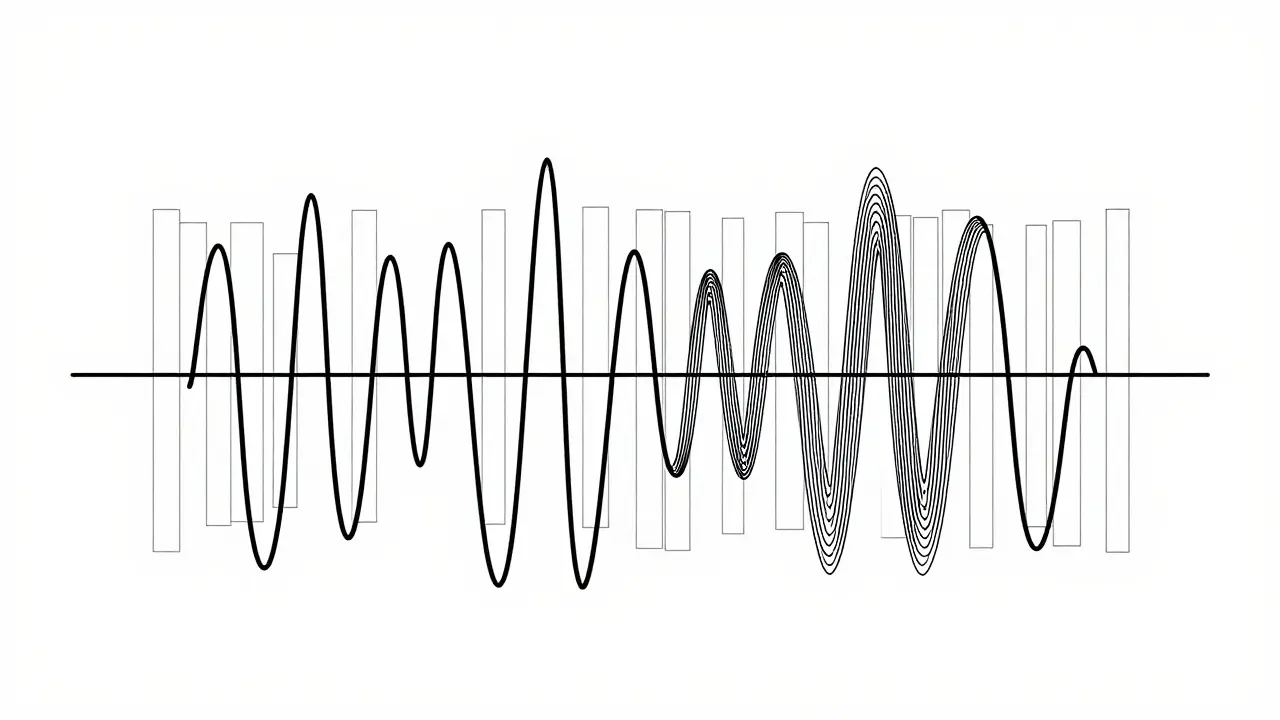
Here, d_model is the dimensionality of the embeddings (often 512, 768, or higher). The key insight here is frequency. Lower dimensions use longer wavelengths (low frequency), capturing broad positional trends. Higher dimensions use shorter wavelengths (high frequency), capturing fine-grained details. Think of it like a map: low frequencies tell you if you are in the northern or southern hemisphere, while high frequencies tell you your exact street address.
Why use sine and cosine waves? There are two main reasons. First, these functions create a unique pattern for every position. No two positions share the exact same encoding vector. Second, and more importantly, this structure allows the model to learn relative positions easily. Because sine and cosine have known mathematical properties regarding shifts, the model can theoretically generalize to sequence lengths it has never seen during training. If you train a model on sentences up to 512 words long using sinusoidal encoding, it might still handle a 600-word sentence reasonably well because the pattern continues logically.
Sinusoidal vs. Learned Positional Embeddings
While the original Transformer used fixed sinusoidal functions, many subsequent models took a different approach. Instead of calculating positions with math, they treated positions as another type of vocabulary. This is called Learned Positional Embeddings.
In this method, the model creates a lookup table of vectors, just like it does for words. Position 0 has a specific vector, Position 1 has another, and so on. During training, the model adjusts these vectors to optimize performance. Models like GPT-2 and BERT popularized this approach.
| Feature | Sinusoidal (Fixed) | Learned Embeddings |
|---|---|---|
| Flexibility | Low (Fixed formula) | High (Trained parameters) |
| Extrapolation | Good (Handles unseen lengths) | Poor (Fails beyond training length) |
| Computational Cost | Minimal (O(1) calculation) | Higher (Memory for table) |
| Best Use Case | Variable length inputs | Fixed length tasks |
The trade-off is clear. Learned embeddings often perform slightly better on specific tasks because the model can tailor the position signals to the data distribution. However, they struggle with extrapolation. If you trained a model with learned embeddings on sequences of max length 1024, feeding it a sequence of 2048 tokens results in undefined behavior-the model has no concept of position 1500. Sinusoidal encodings avoid this trap by providing a continuous function that extends infinitely.
The Evolution: Rotary Positional Embeddings (RoPE)
As LLMs grew larger and context windows expanded, both sinusoidal and learned methods showed limitations. Handling contexts of 100,000+ tokens required a more robust way to encode relative distances. This led to the rise of Rotary Positional Embeddings (RoPE), introduced by researchers at Tencent and later adopted by Meta in Llama 2 and Llama 3.
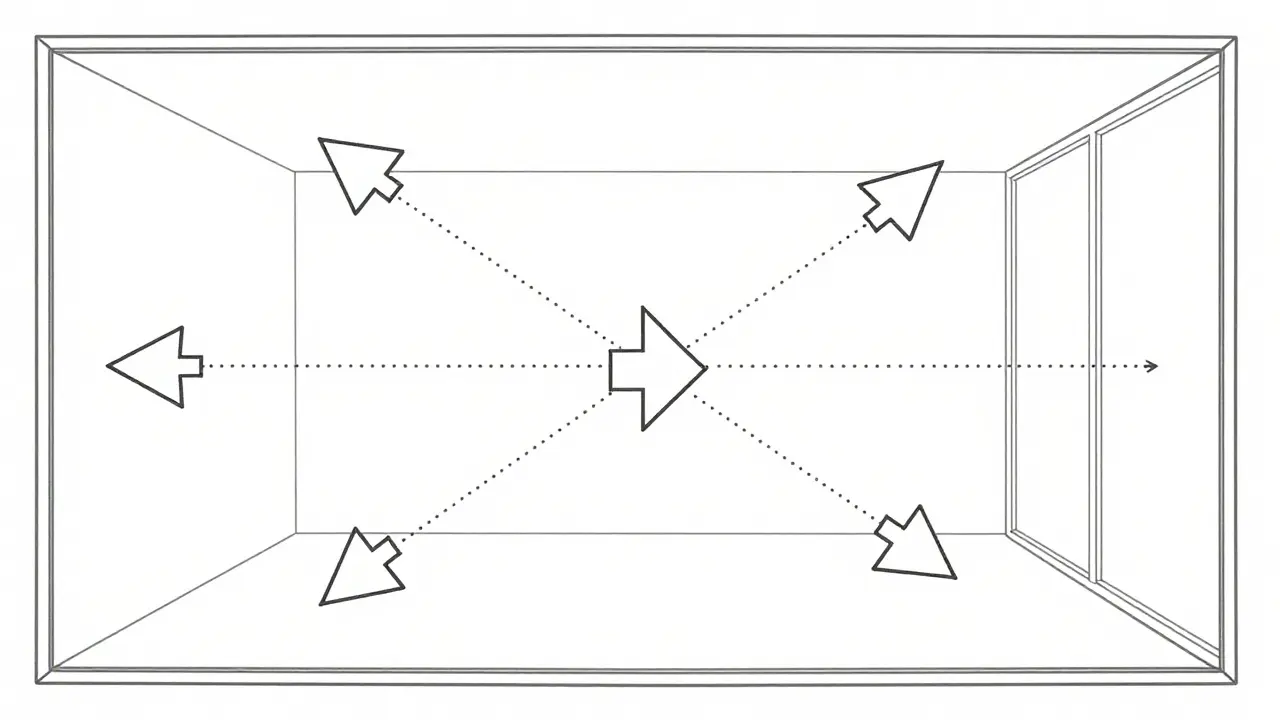
RoPE works differently. Instead of adding a positional vector to the token embedding, it rotates the token embedding itself. Imagine each token embedding as an arrow pointing in a certain direction in multi-dimensional space. RoPE rotates this arrow by an angle determined by its position. The further apart two tokens are, the greater the difference in their rotation angles.
This approach has several advantages. First, it explicitly encodes relative positions. The dot product between two rotated vectors depends only on the distance between them, not their absolute indices. This aligns perfectly with how attention mechanisms work, which rely heavily on dot products. Second, RoPE has shown superior performance in long-context tasks. In benchmarks, models using RoPE maintained coherence over much longer sequences compared to those using absolute positional encodings. As of 2025, RoPE has become the standard for most state-of-the-art open-source models.
Why This Matters for Developers and Users
You might wonder why you should care about the math behind positional encoding if you are just using an API. The answer lies in context limits and reliability. When you send a prompt to an LLM, you are hitting a hard limit defined by the model's positional encoding strategy. If the model uses learned embeddings, exceeding the training length causes hallucinations or garbage output. If it uses RoPE or sinusoidal methods, it may degrade gracefully but still lose precision in distant relationships.
For developers building applications, understanding this helps in prompt engineering. Placing critical instructions at the beginning or end of a long context window matters because the model's attention to those positions varies. Some studies suggest that models pay more attention to recent tokens (recency bias) due to how positional encodings interact with attention heads. Knowing this, you can structure your prompts to put key constraints where the model is most likely to attend to them.
Furthermore, as we move toward infinite context windows, new techniques like ALiBi (Attention with Linear Biases) are emerging. ALiBi doesn't add positional information to the embeddings at all. Instead, it adds a linear penalty to the attention scores based on the distance between tokens. This allows the model to handle arbitrarily long sequences without retraining. Understanding these variations gives you a roadmap of what to expect from future model releases.
Common Misconceptions About Positional Encoding
There are a few myths floating around in the AI community. Let’s clear them up.
Myth 1: Transformers understand time. They don't. Positional encoding provides an index, not a timestamp. A model doesn't know that "yesterday" happened before "today" unless it learned that relationship from the training data. The encoding just ensures the word "yesterday" appears earlier in the sequence than "today" in the example sentences it saw.
Myth 2: More complex encoding always means better performance. Not necessarily. Simpler methods like ALiBi are gaining traction because they are computationally cheaper and easier to scale. Complexity introduces parameters that need tuning and can lead to instability. Sometimes, a simple linear bias is more effective than a complex rotation matrix.
Myth 3: Positional encoding replaces semantic meaning. Absolutely not. The positional vector is added to the semantic token embedding. They coexist. The model learns to separate the "what" (semantics) from the "where" (position). If the encoding interferes too much with semantics, the model fails to converge. That’s why careful initialization and scaling are crucial during training.
Looking Ahead: The Future of Position Awareness
We are currently in a transition period. Pure sinusoidal encoding is becoming rare in top-tier proprietary models. Learned embeddings are being phased out for long-context applications. RoPE and its variants dominate the current landscape. But the research frontier is moving toward adaptive and dynamic positional encoding.
Researchers are exploring methods where the positional encoding changes based on the syntactic role of the word. For example, a noun phrase might have a different positional signature than a verb phrase, regardless of its linear index. This could help models better understand hierarchical structures in language, not just linear sequences. Google Research and other labs are actively investigating "Contextual Positional Encoding" projects that aim to make position representations vary based on local context.
Additionally, as we integrate multimodal data-text, images, audio-the definition of "position" becomes multidimensional. A pixel in an image has x,y coordinates. A word in a sentence has a linear index. Future architectures will need unified positional encoding schemes that can handle grid-like and sequential data simultaneously. This is a significant challenge, but solving it will unlock truly universal AI models.
Positional encoding is small in code but massive in impact. It is the silent partner to attention, ensuring that the power of parallel processing doesn't come at the cost of logical structure. Whether you are a researcher tweaking hyperparameters or a developer crafting prompts, respecting the position of your data is key to getting the best results from today's powerful LLMs.
What happens if I remove positional encoding from a Transformer?
If you remove positional encoding, the Transformer becomes permutation-invariant. It will treat any arrangement of the same words as identical. For example, "I love you" and "you love I" would produce the same output. The model would fail to capture grammar, syntax, and logical flow, rendering it useless for natural language tasks.
Why do some models use RoPE instead of sinusoidal encoding?
RoPE (Rotary Positional Embeddings) explicitly encodes relative positions through rotation, which aligns better with the dot-product operations in attention mechanisms. It has demonstrated superior performance in long-context tasks, maintaining coherence over thousands of tokens better than traditional sinusoidal or learned absolute encodings.
Can Transformers handle sequences longer than their training length?
It depends on the encoding method. Models with sinusoidal or RoPE encodings can often extrapolate to longer sequences with varying degrees of success. Models with learned positional embeddings typically fail or produce poor results when exposed to sequences longer than those seen during training, as they have no defined representation for those new positions.
Is positional encoding part of the attention mechanism?
No, it is a separate component added before the input enters the Transformer layers. Positional encoding is added element-wise to the token embeddings. The attention mechanism then processes these combined vectors. However, some advanced methods like ALiBi modify the attention scores directly rather than the embeddings.
How does positional encoding affect prompt engineering?
Because models exhibit recency bias and varying attention weights across positions, the placement of instructions matters. Critical constraints placed at the very beginning or end of a long context may be attended to differently than those in the middle. Understanding positional encoding helps you place key information where the model is most likely to retain and act upon it.
 Artificial Intelligence



Lisa Nally
June 12, 2026 AT 15:48Let's be real here because the nuance is often lost in these oversimplified explainers. The distinction between absolute and relative positional encoding isn't just a minor implementation detail; it is the fundamental architectural decision that dictates whether your model can generalize to out-of-distribution sequence lengths or if it will catastrophically fail when faced with context windows larger than its training distribution. Sinusoidal encodings, while elegant in their mathematical purity using sine and cosine functions of varying frequencies, suffer from significant interference patterns when the dimensionality of the embedding space increases, leading to what we in the field call 'positional ambiguity' at higher indices. This is precisely why Rotary Positional Embeddings (RoPE) have become the de facto standard for modern large language models like Llama and Mistral, as they encode relative positions directly into the rotation of the query and key vectors, thereby preserving the geometric relationships between tokens regardless of their absolute position in the sequence. Furthermore, the claim that learned embeddings are strictly inferior for extrapolation ignores recent advancements in NTK-aware interpolation and YaRN (Yet another RoPE extension) which allow learned-like flexibility within the rotational framework. You cannot simply dismiss the computational overhead of calculating these rotations without acknowledging the massive gains in perplexity reduction on long-context benchmarks. It is not just about 'knowing where words sit'; it is about maintaining the integrity of the attention mechanism's dot-product calculations across vast distances in the token stream. If you are still using naive additive sinusoidal encodings in 2025, you are effectively handicapping your model's ability to perform complex reasoning tasks that require tracking dependencies over thousands of tokens. The future is clearly moving towards dynamic, context-aware positional biases rather than static, pre-computed vectors.
Edward Gilbreath
June 13, 2026 AT 12:17they always say it matters but i bet half the people reading this dont even know what a tensor is let alone how rotary embeddings work
big tech wants us to think its magic so we keep paying for api calls instead of running local models
Michael Richards
June 14, 2026 AT 12:46The issue with most discourse on this topic is that it treats positional encoding as an isolated component rather than an integral part of the attention mechanism's failure modes. You see developers complaining about hallucinations in long contexts and blaming the 'model,' when in reality, they are failing to understand the limitations of their chosen positional strategy. If you use learned embeddings and exceed your training length, you are not getting 'garbage output' by accident; you are getting garbage because the model has literally no representation for those positions, resulting in undefined behavior that propagates through every subsequent layer. It is negligent engineering to deploy such architectures for variable-length tasks without robust fallback mechanisms. The superiority of RoPE is not debatable; it is empirical fact supported by countless benchmarks showing better retention of information at distant positions. To suggest otherwise is to ignore the mathematical properties of rotation matrices in high-dimensional spaces. Stop making excuses for poor architecture choices and start implementing solutions that actually scale.
Laura Davis
June 15, 2026 AT 05:33I really appreciate the detailed breakdown here because it helps clarify why my prompts were failing earlier! I was placing critical instructions in the middle of a huge context window and wondering why the model kept ignoring them. Now that I understand the recency bias and how positional encodings interact with attention heads, I'm going to try restructuring my inputs to put the most important constraints at the very end. It makes total sense that the model pays more attention to recent tokens due to the way the positional signals decay or rotate. Thanks for sharing this knowledge!
kimberly de Bruin
June 16, 2026 AT 05:42position is just an illusion we impose on chaos
the model doesnt care about order any more than a dream cares about logic
we project meaning onto the void