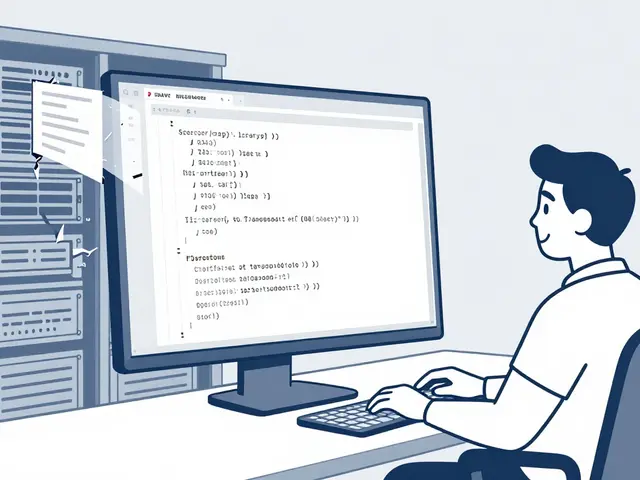
You’ve probably hit that wall. You’re trying to feed a document into your language model, but the context window is too small, or the inference cost is skyrocketing. The obvious fix? Use a bigger model. But what if you don’t have the budget for massive GPU clusters? What if you need speed, privacy, or just want to run things locally on a modest laptop?
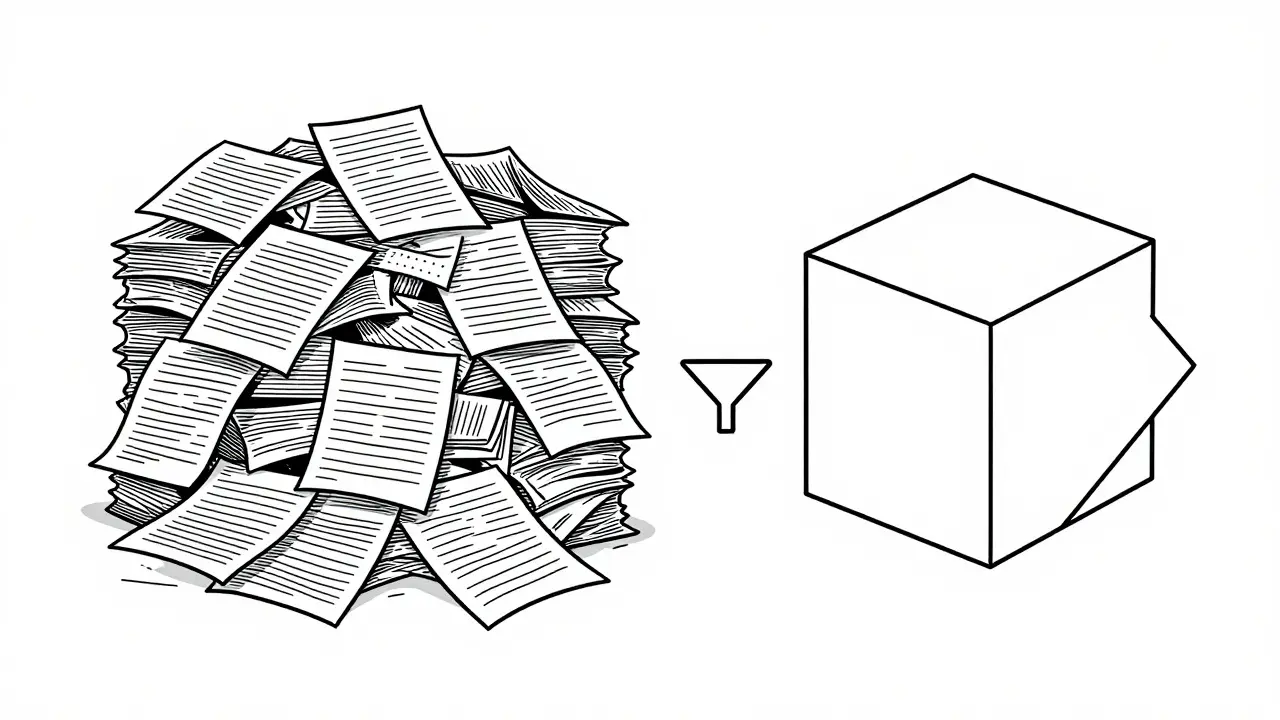
This is where compression-aware prompting changes the game. It’s not about making the model smaller-it’s about making the input smarter. By distilling long, messy prompts into dense, high-signal summaries before they ever reach the model, you can get performance that rivals much larger systems using fraction of the compute. For developers working with small LLMs (like those under 7 billion parameters), this isn’t just an optimization trick; it’s a necessity.
The Problem with Raw Context
Let’s talk about why raw text is so expensive. When you send a 10,000-word document to a Large Language Model (LLM), the model doesn’t just read it. It processes every single token. In technical terms, the computational cost scales quadratically with the length of the sequence in many architectures. This means doubling the prompt length doesn’t just double the work-it often quadruples the attention calculation overhead.
For small LLMs, this bottleneck is even more severe. These models have less capacity to filter out noise. If you give them a prompt full of irrelevant details, legal jargon, or repetitive boilerplate, their limited parameters struggle to find the signal. They hallucinate more, reason worse, and consume more memory per useful output. Traditional prompting assumes the model can handle infinite context gracefully. In reality, especially with smaller models, garbage in equals garbage out-just slower and more expensive.
How Compression-Aware Prompting Works
Compression-aware prompting shifts the burden of summarization from the target LLM to a specialized preprocessing step. Instead of asking the final model to ignore irrelevant parts of a long document, you use a dedicated mechanism to strip away the fluff before the main inference begins.
Think of it like editing a news article. A journalist doesn’t read every word of a press conference transcript to write a headline. They identify the key facts, discard the filler, and construct a concise narrative. Compression-aware prompting automates this editorial process.
There are three primary ways this happens:
- Filtering: Identifying and removing redundant sentences or tokens based on relevance scores.
- Knowledge Distillation: Using a smaller helper model to generate a condensed representation of the original text.
- Embedding-Based Selection: Ranking chunks of text by semantic similarity to the query and keeping only the top matches.
The goal is simple: reduce the token count while preserving the semantic integrity required for the specific task. If the compressed prompt allows the small LLM to answer correctly, you’ve won. You’ve saved time, money, and memory.
Key Techniques and Frameworks
Several frameworks have emerged as leaders in this space. Understanding which one fits your stack depends on whether you prioritize ease of use, maximum compression, or task-specific accuracy.
| Method | Mechanism | Best For | Trade-off |
|---|---|---|---|
| TPC (Task-Agnostic) | Generates a task descriptor via RL-tuned causal LM, then filters sentences by embedding similarity. | General purpose, unknown tasks, diverse domains. | Higher setup complexity due to training requirements. |
| LJMLingua | Uses a small external LM to score and remove unimportant tokens. | Closed-source LLMs, high compression ratios (up to 20x). | Requires access to a capable auxiliary model. |
| PromptOptMe | Optimizes prompt structure to reduce token usage without quality loss. | Evaluation metrics, cost-sensitive applications. | Focuses on metric efficiency rather than pure content summary. |
| TCRA-LLM | Context-aware embeddings for summarization and semantic compression. | Semantic search, RAG pipelines. | Dependent on quality of sentence encoder. |
TPC stands out for its versatility. It doesn’t need you to handcraft templates for every new type of question. Instead, it uses a lightweight causal language model trained on context-query pairs to generate a "task description." This description acts as a lens, helping the system decide which parts of the original prompt matter most. It’s particularly effective when you’re dealing with unpredictable user inputs.
On the other hand, LJMLingua is a powerhouse for aggressive compression. By employing a smaller external language model to manage the compression process, it achieves ratios up to 20x. This means a 20,000-token document can be reduced to 1,000 tokens while retaining enough information for accurate inference. This is crucial for closed LLMs where you can’t modify the internal architecture-you must optimize the input instead.

Why This Matters for Retrieval-Augmented Generation (RAG)
If you’re building a RAG system, you know the pain point. You retrieve five documents from your vector database. Each document is 2,000 words. That’s 10,000 words of context. Add the user’s question and system instructions, and you’re quickly approaching the limits of even mid-sized models. Worse, much of that retrieved text is irrelevant noise.
Compression-aware prompting acts as a pre-filter for RAG. Instead of stuffing all retrieved chunks into the context window, you compress them first. Research shows that controlling compression granularity can improve downstream performance by up to 23 percentage points. It also improves grounding scores significantly, meaning the model sticks closer to the facts in the source material.
Imagine a customer support bot. Without compression, it might get confused by contradictory policies in different retrieved documents. With compression, the system identifies the single most relevant policy clause and feeds only that to the small LLM. The result? Faster responses, lower costs, and fewer hallucinations.
Implementing Compression in Your Workflow
You don’t need a PhD in machine learning to start using these techniques. Here’s a practical approach to integrating compression-aware prompting into your existing pipeline:
- Choose Your Compressor: Start with an off-the-shelf tool like LJMLingua if you need high compression ratios. If you need task-specific precision, look into fine-tuning a TPC-style descriptor model.
- Define Granularity: Decide whether you’re compressing at the sentence level or the token level. Sentence-level is faster and easier to debug. Token-level offers higher fidelity but requires more compute during the compression phase.
- Set a Budget: Determine your maximum token limit for the final prompt. For example, if your small LLM has a 4K context window, reserve 500 tokens for the system prompt and user query, leaving 3,500 tokens for the compressed context.
- Evaluate Fidelity: Don’t just measure compression ratio. Measure output quality. Compare the answers generated from the compressed prompt against those from the full prompt. If the accuracy drops below your threshold, loosen the compression settings.
A common pitfall is over-compression. Stripping too much information leads to ambiguous contexts. Always test with edge cases-complex reasoning tasks, multi-hop questions, and domain-specific jargon. If the compressed prompt fails here, your general case will likely suffer too.

The Economic Impact
Let’s talk numbers. Token costs vary by provider, but reducing prompt size by 50% directly cuts your input costs by half. For high-volume applications, this adds up quickly. Beyond direct costs, there’s latency. Smaller prompts mean faster inference times. Users perceive speed as quality. A response that takes 2 seconds feels instant; one that takes 10 seconds feels sluggish.
Furthermore, compression enables the use of smaller models. Running a 7B parameter model locally on a consumer GPU is feasible. Running a 70B model is not. By compressing prompts effectively, you unlock the ability to deploy powerful AI capabilities on hardware you already own. This democratizes access to advanced NLP features for startups, researchers, and individual developers.
Future Directions
The field is moving toward end-to-end optimization. Future systems may dynamically adjust compression levels based on real-time feedback from the LLM. Imagine a loop where the model signals uncertainty, triggering a re-fetch of uncompressed context for specific sections. This adaptive approach balances cost and accuracy on the fly.
We’re also seeing tighter integration between retrieval and compression. Instead of retrieving then compressing, next-gen systems will retrieve compressed representations directly from the database. This shifts the heavy lifting to indexing time, making inference nearly instantaneous.
As small LLMs continue to improve in reasoning capabilities, the role of prompt engineering-and specifically compression-aware prompting-will only grow. The models are getting smarter, but they still benefit immensely from clean, concise inputs. Mastering this technique isn’t just about saving money; it’s about unlocking the true potential of efficient AI.
What is the difference between prompt compression and model compression?
Model compression reduces the size of the neural network itself (e.g., quantization, pruning). Prompt compression reduces the size of the input text sent to the model. They are complementary: you can use both to maximize efficiency.
Does prompt compression always improve accuracy?
Not always. Poorly implemented compression can lose critical context, leading to worse results. However, well-tuned compression typically improves accuracy for small LLMs by reducing noise and focusing the model’s attention on relevant information.
Which compression method is best for RAG systems?
Methods like TPC and TCRA-LLM are highly effective for RAG because they preserve semantic relationships between retrieved documents and the query. LJMLingua is also strong if you need extreme compression ratios.
Can I use prompt compression with closed-source APIs like GPT-4?
Yes. Since prompt compression happens before the API call, it works with any model. Tools like LJMLingua are designed specifically to help users get better results from closed models by optimizing the input.
How much can I expect to save in token costs?
Savings depend on your initial prompt length and the compression ratio. Ratios of 2x to 20x are common. A 10x reduction means you pay for 10% of the original input tokens, resulting in significant cost savings for large-scale deployments.
 Artificial Intelligence