
Author: Phillip Ramos - Page 4

Only 14% of enterprises successfully scale Generative AI from PoC to production. Learn how to avoid the 'valley of death' by focusing on security, cost management, and clear ROI metrics.

Struggling with LLM costs or performance? Learn when to compress models via quantization versus switching to smaller architectures. Make smarter AI deployment decisions.

Learn how to reduce memory footprint for hosting multiple LLMs. Discover techniques like QLoRA, quantization, and pruning to fit 3-5 models on a single GPU.

Discover how generative AI transforms legal services through automated document creation, intelligent contract review, and efficient knowledge management. Learn about top platforms like CoCounsel and Gavel, real-world ROI metrics, and best practices for implementation.

Discover how prompt chaining boosts AI reliability by breaking complex tasks into sequential steps. Learn practical patterns, avoid common pitfalls, and see real-world metrics.

Discover how Multi-Head Attention enables LLMs to analyze language from parallel perspectives. Learn its mechanics, benefits, and future trends.

Discover why large language models struggle with low-resource languages and how transfer learning techniques like CSCL and knowledge distillation bridge the gap. Learn about model comparisons, implementation challenges, and the future of multilingual AI.

Discover how standards like MCP and LLMOps are solving generative AI interoperability challenges. Learn why 78% of new projects use open protocols to cut integration time and ensure regulatory compliance.

Discover how technical and institutional guardrails combat fabricated citations in Generative AI. Learn about RAG, DOI verification, and data governance.

Learn how ethical review boards govern generative AI projects. Discover the 7-step process, key evaluation criteria, and outcomes for responsible AI.

Explore how dataset bias affects multimodal generative AI. Learn about misrepresentation, detection methods, and mitigation strategies like SMOTE and CA-GAN.

Learn how to accurately measure Generative AI adoption using telemetry, surveys, and outcome tracking. Discover benchmarks, common pitfalls, and strategies to calculate true ROI for your organization.
Categories
 Artificial Intelligence
Archives
Recent-posts

Vibe Coding for Knowledge Workers: Personal Tools That Save Hours Weekly
Jun, 26 2026

Grounding Reasoning with External Verifiers in LLMs: Stopping Hallucinations
Apr, 27 2026

Measuring Data Quality for LLM Training: Model-Based and Heuristic Filters
May, 24 2026
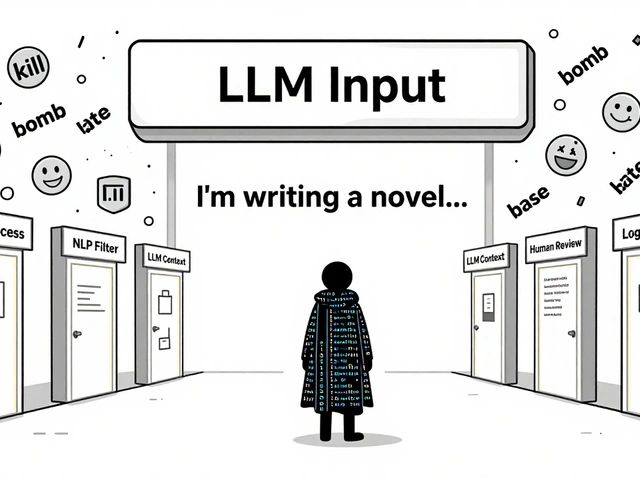
Content Moderation Pipelines for User-Generated Inputs to LLMs: How to Prevent Harmful Content in Real Time
Aug, 2 2025

Data Minimization Strategies for Prompt Design in Large Language Models
Oct, 11 2026